

Implementing a structured preventive electrical maintenance programme reduces unplanned operational downtime while extending the operational lifespan of major distribution assets. Facility managers across the UK rely on scheduled thermal imaging, torque testing, and periodic consumer unit inspections to maintain statutory safety compliance and avoid emergency call-out tariffs.
Key Takeaways: Preventive electrical maintenance uses scheduled inspections and thermal imaging to identify minor faults before they trigger costly facility shutdowns or emergency repair tariffs.
- Bi-annual panel checks are required for commercial distribution boards to prevent unexpected power failures.
- Except when running basic setups, in-house maintenance often fails due to specialized equipment costs.
- Quarterly inspections are recommended for EV charging stations because heavy loads degrade contacts rapidly.
- The 5-step inspection system in this article ensures no critical distribution components are overlooked.
The decisions you face are practical ones: which maintenance strategy matches your downtime tolerance, how often each asset class should be inspected, and when in-house cover stops being enough. The sections below walk those choices with schedules, cost levers and accreditation checks you can apply on site across Olney and the wider MK area.
3 Operational Scenarios: Choosing Your EPM Strategy
Your operational demands dictate whether you need basic compliance checks, scheduled servicing, or continuous monitoring. With clients we see that the right choice hinges on facility downtime tolerance. Matching your business model to the right electrical preventive maintenance (EPM) plan avoids unnecessary expenditure while keeping your premises safe and fully operational across Olney.
When you weigh the options, start from the setup you actually run:
- Simple commercial units suit scheduled visual checks and periodic testing.
- High-demand facilities need continuous thermal monitoring and planned component replacements.
- Heavy industrial power (three phase supply) installations demand continuous surveillance to prevent costly shutdowns.
Balancing scheduled maintenance and reactive cover keeps your site running smoothly. Treating your electrical infrastructure like a vehicle service history keeps critical assets healthy: preventive care beats emergency repairs (reactive cover). Qualified engineers provide transparent service so you can protect the site without guesswork.
What Preventive Electrical Maintenance Delivers Before Faults Appear
If a minor fault can idle a floor or a production line, you need a clear picture of what scheduled care actually covers. Electrical preventive maintenance involves scheduled inspections, testing and servicing to keep your power systems running safely before components break down. Regular checks protect your home or business against unexpected power failures.
We perform visual checks, thermal imaging and routine testing to catch minor wear early. As outlined in the OSHA 1910 Subpart S standard, proactive electrical safety regulations demand strict protection against electrical hazards. Systematic care lowers your operational risks.
When urgent problems happen, homeowners often struggle to find reliable support quickly. Book accredited electricians for domestic jobs to secure rapid, qualified help for your property.
We service domestic fuse boxes (consumer units) and commercial industrial power systems across Olney and the surrounding MK areas. Routine servicing acts like health insurance for your wiring: it stops tiny issues from turning into costly emergency repairs and keeps your building safe.
Preventive, Reactive or Predictive: Pick the Type That Fits Your Risk
Picking the wrong maintenance type is how small defects become overnight call-outs. Electrical maintenance falls into three distinct operational strategies designed to keep systems running safely.
Preventive work follows scheduled servicing to stop faults before they start. Emergency repairs fix unexpected breakdowns after failure occurs. Predictive maintenance relies on real-time data to evaluate equipment condition and forecast required upkeep.
Putting off scheduled maintenance converts minor repairs into expensive emergency visits. Urgent failures disrupt daily operations quickly, so choosing scheduled visits protects your property more efficiently than waiting for a trip or a burnout.
For safety compliance, book your EICR safety certificates to keep installations fully protected.
| Maintenance Type | Core Approach | Key Benefit |
|---|---|---|
| Preventive | Planned regular checks | Prevents sudden outages |
| Reactive | Fixes after breakdown | Restores active power |
| Predictive | Real-time monitoring | Maximises component lifespan |
Preventive care suits day-to-day commercial and domestic sites; reactive service handles true emergencies; predictive systems fit complex infrastructure where continuous data pays for itself.
4 Ways Regular Inspections Lower Your Operational Costs
Cost control starts on the inspection round, not on the emergency invoice. Regular maintenance reduces your operational costs by preventing severe equipment failures before they trigger costly facility shutdowns. Furthermore, integrating renewables through specialists like Zonnepanelen Brabant B.V. can further lower long-term expenditure by combining solar panels and battery storage with a robust electrical maintenance strategy.
Here is a pattern we see on commercial sites: loose wiring sits unnoticed until heat builds. Our engineers routinely spot that loose wiring during thermal checks that would otherwise burn out whole panels. Fixing the minor issue early keeps your facility running safely, prevents expensive emergency repairs, and extends overall component lifespans.
Upgraded gear improves energy efficiency. Moving to modern distribution systems lowers baseline power draw, similar to trading a gas-guzzling engine for a lean hybrid. If your current installation shows signs of severe wear, a professional fuse board upgrade for your consumer unit prevents sudden power drops across critical commercial zones.
Insurance providers often lower premiums for sites with verified testing logs. Certified records prove your compliance, which can save money month by month. Excel Electrical provides fast, itemised Reports for complete cost control, so you can see where the spend goes before you approve the next visit. Contact our local team for a personalised quote for your site.
A commenter in the electrician-norwich.co.uk thread "Customer Reviews, Excel Electrical, Commercial Electrician Norwich":
"From the time I asked for help Excel have truly lived up to their name. I have no hesitation in recommending the Team if you have any electrical concerns." (source)
This feedback highlights how prompt expert support helps business owners resolve compliance issues and secure long-term operational savings.
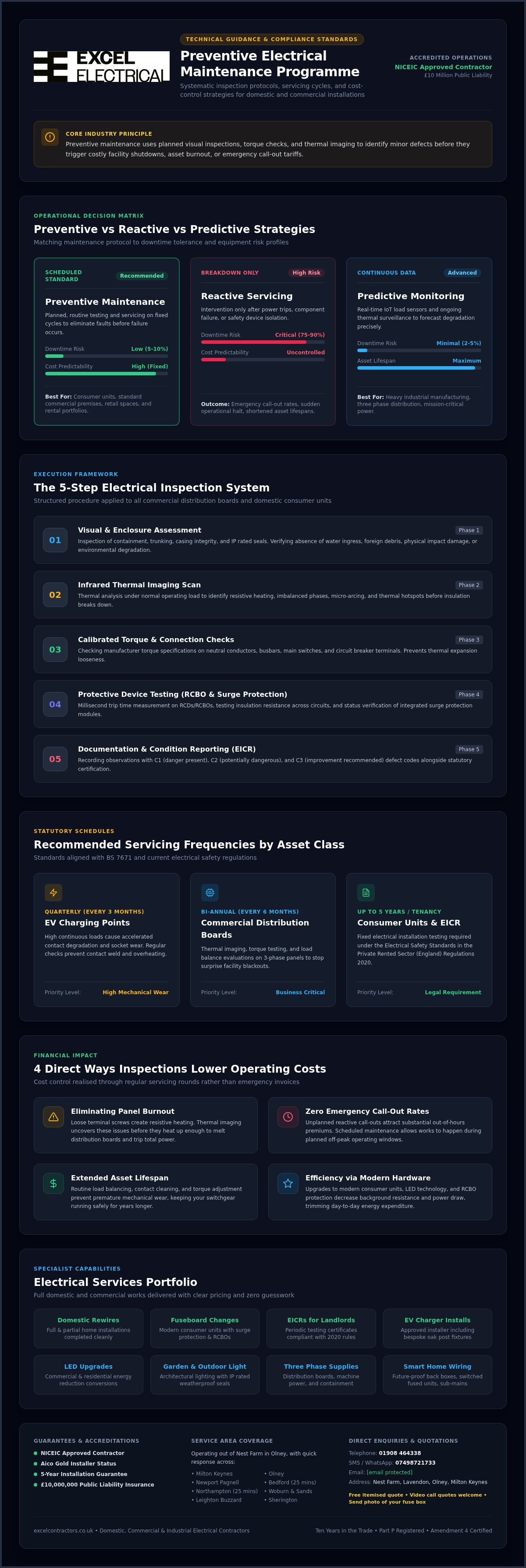
A 5-Step System to Inspect Commercial Electrical Systems
A clear inspection sequence matters when you cannot afford a missed breaker or an undocumented circuit. A structured inspection system protects your commercial facility by keeping every circuit safe and fully compliant. Formula calculations in pricing spreadsheets often confuse users who simply need clear, straightforward quantity checks; a simplified process removes that headache.
- Review system plans: Check single-line diagrams to locate every main consumer unit (fuse box) before starting physical work.
- Isolate supply: Safely disconnect the three phase supply (industrial power) to ensure complete safety during full component testing.
- Inspect hardware: Examine all switches and breakers directly for signs of thermal damage or physical wear.
- Test continuity: Measure resistance across all protective conductors to confirm immediate safety tripping operates correctly.
- Log findings: Record circuit conditions clearly on your standardised check sheet to schedule any reactive cover (emergency repairs).
This methodical approach prevents missed components during routine maintenance checks and gives you a full picture of facility safety in one pass.
Tip: Always calculate spare breaker space on a linear per-unit basis rather than using complex nested formulas.
A commenter in the forums.mikeholt.com thread "Estimating using excel spreadsheets | Mike Holt's Forum":
"I'm a UK electrician and I know this is a US electrical forum, however I have seen some screen shots of a few domestic (residential) estimating spreadsheets that some of you have made." (source)
Electricians often struggle with overly complex estimating spreadsheets, which complicates simple quantity calculations during inspections. Using clear, step-by-step methods removes formula confusion and ensures every distribution board component is correctly checked.
How Often to Service Panels, Breakers and EV Charging Points
Inspection intervals are where preventative plans succeed or quietly fail. Commercial distribution boards need full thermal and visual inspections every six months to prevent unexpected power failure.
You should opt for bi-annual panel checks over simple annual visits. Skimping on routine testing creates hidden hazards that quickly lead to costly emergency repairs.
From hands-on site visits across Olney and surrounding MK areas, we inspect primary switches first to catch loose busbars before thermal imaging detects extreme heat. Neglecting a loose terminal is like ignoring a ticking time bomb inside your main fuse box (consumer unit).
EV charging stations need dedicated quarterly checks, since ongoing heavy electrical loads degrade contacts much faster than regular wall sockets.
Our local, in-house electricians carry NAPIT certification and full public liability insurance to perform these tests safely. Excel Electrical provides clear, itemised schedules before work begins, and we deliver same-day certificates right after completing your inspection so your facility stays safe and compliant.
When In-House Maintenance Fails: 3 Risk Factors
In-house cover works until the first complex fault collides with a busy week. In-house maintenance fails when staff lack specialised training, equipment upgrades outpace internal skills, or routine tasks yield to emergency repairs.
From client work we see internal teams often get pulled away to fix sudden breakdowns. That shift leaves critical checks unfinished for months.
First, general handymen rarely hold the qualifications required to test a complex fuse box. Second, outfitting your team with thermal imaging cameras costs thousands, making professional tools impractical for occasional use. Third, internal staff often miss early fault indicators because they lack daily exposure to varied systems.
Reliance on under-equipped staff creates severe compliance risks. Partnering with a qualified contractor keeps your system safe, fully documented and compliant. Expert teams like AK Air Conditioning & Electrical Quality Service demonstrate how professional oversight ensures all electrical and cooling components remain in peak condition. Outsourcing fits busy sites; internal care suits basic setups.
Is your internal team behind on checks? Request a personalised quote for professional care in Olney.
You Get a Detailed Report After Every Visit
Paperwork is what your insurer and your auditor will ask for, so the report has to arrive complete. Professional contractors provide itemised documentation immediately following every preventive maintenance inspection. A written safety report proves compliance for your insurance provider: think of this paperwork like a MOT test result for your wiring. Excel Electrical ensures every safety document clearly explains needed emergency repairs.
We often observe that building managers overlook contractor credentials until an audit occurs. Choosing properly qualified professionals avoids compliance gaps.
Holding NICEIC Approved Contractor credentials ensures our services undergo regular audits by the NICEIC, allows us to issue our own installation certificates, and gives you access to their mediation system if issues arise. Aico Gold installer status reflects manufacturer-specific training on that alarm range. Our team carries ten-million public liability insurance alongside a five year guarantee on our installation work. We deliver same-day paperwork to keep your site compliant without delay, which helps you avoid costly operational downtime. Ask for a personalised quote to establish a clear schedule for your premises.
Frequently asked questions
What are the basic tasks in EPM?
Preventive electrical maintenance involves routine testing, visual checks and servicing to stop system failures before they occur. Local technicians inspect your fuse box to secure loose wiring and check circuit safety. Testing insulation levels protects your distribution network from severe damage, and early action prevents sudden power cuts.
What types of electrical maintenance exist?
Electrical maintenance includes planned preventive care, predictive testing and fast emergency repairs. Scheduled inspections keep systems safe, while predictive monitoring detects overheating components before they fail. You get emergency repairs when an unexpected fault cuts your supply. Selecting scheduled servicing reduces urgent repair costs.
What accreditations prove an electrician's competence?
NICEIC Approved Contractor status means our work is periodically assessed by the NICEIC, and we can certify our own installations. Aico Gold installer status is manufacturer-specific training on Aico smoke and carbon monoxide alarms. Together with the right scheme membership, those credentials support safe standards for your property in Olney and surrounding MK areas, and qualified engineers protect your building against technical risks.
Protect Your Infrastructure in 2026
Return to the opening questions: which strategy fits your downtime tolerance, how often each asset should be inspected, and when to hand the work to accredited engineers. Scheduled preventive electrical maintenance keeps your commercial facilities safe and operational. Our local, hands-on engineers inspect fuse boxes and industrial power setups to secure full regulatory compliance. Brady and the accredited team work to keep your property clear of unexpected operational downtime.
As an NICEIC Approved Contractor and Aico Gold installer, our qualified specialists deliver dependable site assessments. We issue precise certificates quickly so your safety records remain up to date. You can request a personalised quote by contacting an engineer through Excel Electrical. Regular maintenance remains a sound decision for long-term safety.


