

Your stylish new rainfall shower could be a legal liability if the electrical work behind the tiles doesn't meet the latest safety standards. Most homeowners find the maze of bathroom electrical safety regulations UK daunting; it's perfectly normal to feel overwhelmed by technical jargon like Zone 1 or IPX4. You want a beautiful space, but you also need the peace of mind that comes with knowing your family is protected from the unique risks of mixing water and electricity.
This guide will help you master the complexities of bathroom electrical zones, IP ratings, and Part P compliance to ensure your renovation is both safe and fully legal. We'll break down the 2026 requirements of the BS 7671:2018+A4:2026 regulations, explain which fixtures are permitted in specific areas, and clarify what certification you must receive from your contractor to protect your home's insurance and future resale value. Understanding these rules ensures your project is completed to the highest professional standard without any costly surprises.
Key Takeaways
- Learn how to navigate the latest bathroom electrical safety regulations UK to ensure your home renovation meets the strict 2026 standards set by BS 7671.
- Master the specific IP ratings required for Zones 0, 1, and 2 to ensure every fixture is correctly protected against water ingress.
- Understand the critical role of RCD protection and supplementary bonding in preventing electric shocks in high-risk wet environments.
- Clarify the legal restrictions on installing 230V sockets and why shaver-only points are the primary exception for bathroom convenience.
- Recognise the importance of NICEIC certification and Part P compliance in protecting your property's insurance and future resale value.
Understanding the Importance of Bathroom Electrical Safety Regulations in the UK
Bathrooms are unique environments where the risk of electric shock is significantly increased. Water reduces the body’s natural resistance, making even minor electrical faults potentially fatal. Because of these high-moisture conditions, the bathroom electrical safety regulations UK homeowners must follow are remarkably strict. These rules aren't designed to be bureaucratic hurdles; they're essential life-saving measures that ensure every light fitting, shower, and heater operates safely in a damp atmosphere.
The primary technical standard for these installations is BS 7671:2018+A4:2026, often referred to as the 18th Edition. Published on 15 April 2026, this latest amendment consolidates safety requirements for modern technologies. Whilst BS 7671 provides the technical roadmap, Part P of the Building Regulations provides the legal teeth. It mandates that all electrical work in a dwelling must be safe. Failure to comply can lead to local authority enforcement action, but more commonly, it creates significant hurdles when you try to sell your property or claim on your buildings insurance.
The Legal Framework: BS 7671 and Part P
UK law classifies bathrooms as "special locations" because of the heightened risk. This classification means that standard electrical practices used in a bedroom or lounge aren't sufficient. An 18th Edition qualification is the minimum standard you should expect from your installer. Using a qualified professional ensures that the work adheres to the UK wiring regulations, providing a verifiable paper trail of safety. Without this, you risk a non-compliant installation that could lead to electrical fires or persistent circuit tripping in humid conditions.
Why DIY Bathroom Electrics are a High-Risk Strategy
Attempting DIY electrical work in a bathroom is a dangerous gamble. Condensation and steam can penetrate poorly sealed fixtures, leading to short circuits that a standard homeowner's toolkit isn't equipped to prevent. Most electrical work in a bathroom is legally "notifiable" under Part P. This means you must either pay for a local authority building control inspection or hire a registered contractor to self-certify the work. Professional installers carry out rigorous testing, including insulation resistance and earth continuity checks, to ensure every circuit is safe before the power is turned on. At Excel Electrical, we prioritise these safety protocols to give our clients total peace of mind.
Deciphering Bathroom Zones and IP Ratings for Electrical Fixtures
The bathroom electrical safety regulations UK homeowners must adhere to are built upon a precise zoning system. This framework classifies different areas of the bathroom based on their proximity to water sources. By understanding these zones, you can ensure that every light fitting, extractor fan, or heater is fit for purpose and legally compliant. When planning these layouts, you can discover WDC Services for insights into professional bathroom design that balances aesthetics with safety standards. These zones dictate exactly where specific electrical items can be installed to prevent dangerous contact between water and live components.
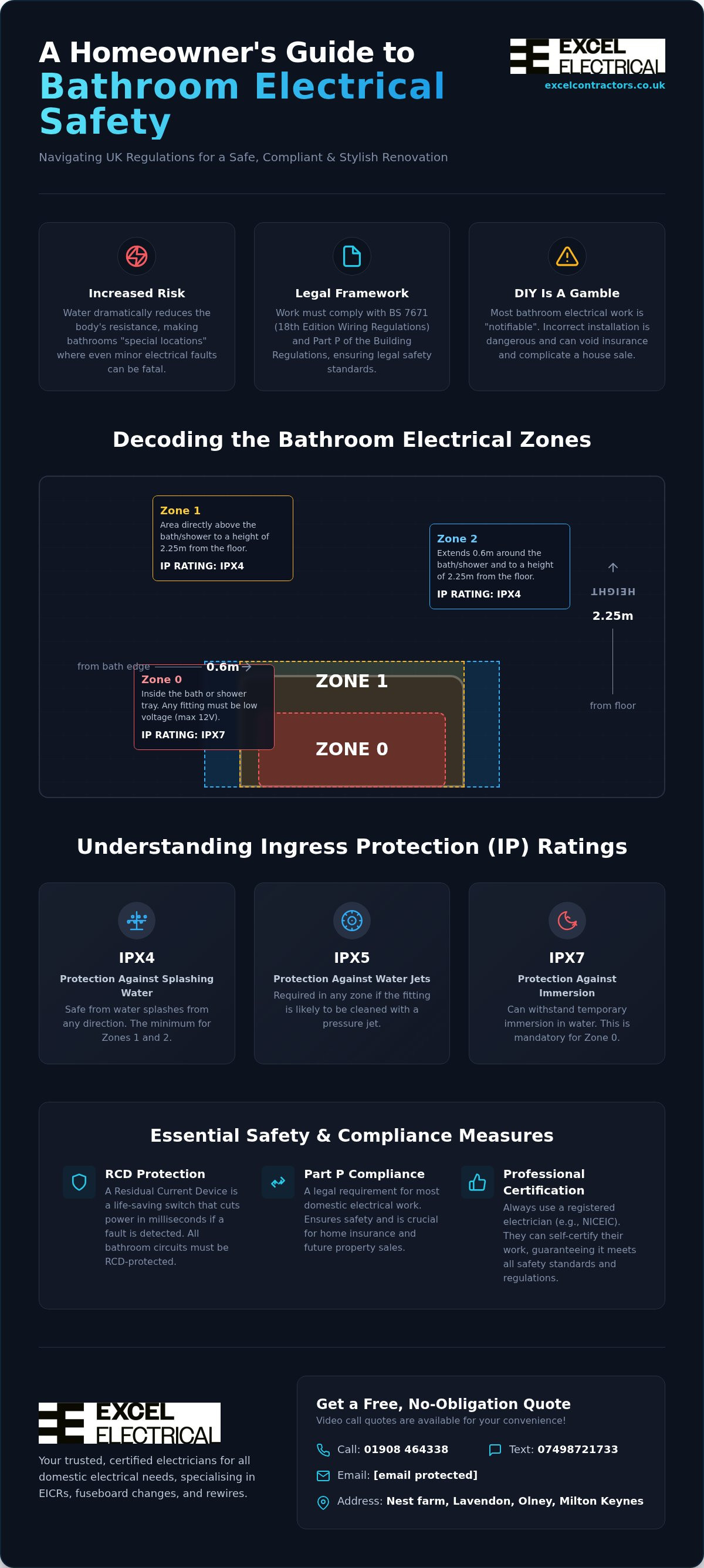
Zone 0 is the most restricted area, defined as the interior of the bath tub or shower tray itself. Any equipment here must be low voltage, typically a maximum of 12V, and specifically designed for immersion. Zone 1 is the area directly above the bath or shower, reaching a height of 2.25m from the finished floor level. Zone 2 encompasses the space extending 0.6m horizontally from the perimeter of the bath or shower and up to 2.25m in height. Every fixture within these boundaries must meet a specific Ingress Protection (IP) rating.
Zone-by-Zone IP Rating Requirements
To determine if a fixture is safe for a specific zone, we look at its IP rating. This code consists of two digits; the first relates to protection against solid objects and the second to moisture. In a bathroom environment, the second digit is the most critical factor for safety.
- Zone 0: Requires a minimum of IPX7. This ensures the device is protected against temporary immersion in water, which is vital for items like internal bath lights.
- Zone 1: Requires a minimum of IPX4, which protects against splashes from any direction. If the fixture is likely to be cleaned with water jets, such as in a commercial setting, IPX5 is necessary. It is also a legal requirement to have RCD protection in bathrooms for all circuits serving these areas.
- Zone 2: Requires a minimum of IPX4. This zone often includes the area immediately surrounding a washbasin, ensuring that steam and occasional splashes do not compromise the electrical integrity.
The "Outside Zones" and General Bathroom Safety
The area beyond Zone 2 is often referred to as the "Outside Zones." Whilst the regulations are less prescriptive here, any electrical equipment must still be suitable for the humid environment. High levels of condensation in typical British bathrooms mean that standard fittings intended for dry rooms may corrode or fail prematurely. When measuring zones in smaller or awkwardly shaped rooms, always measure from the water source's edge. If a space is too confined to maintain these distances, the entire room may effectively be treated as Zone 2. Planning a compliant layout requires technical precision, which is why a professional bathroom electrical upgrade is the safest route for any renovation project.
Regulations for Specific Bathroom Electrical Installations and Appliances
While general zoning defines where equipment can be placed, specific rules dictate how appliances must be installed. The bathroom electrical safety regulations UK homeowners must follow are particularly strict regarding power outlets. Standard 13A sockets are permitted only if they're installed at least 3 metres horizontally from the boundary of Zone 1. Because many British bathrooms are compact, this rule effectively prohibits standard plug sockets in most domestic settings. For a deeper look at these specific fixture rules, the UK Bathroom Electrical Safety Guidance provides detailed advice on shaver sockets and lighting.
Shaver-only sockets are the primary exception to the socket rule. These must comply with BS EN 61558-2-5 and are safe for installation in Zone 2. They incorporate an internal isolation transformer that limits the current, significantly reducing the risk of a fatal shock. Lighting fixtures, such as recessed downlights or illuminated LED mirrors, also require careful selection. An LED mirror positioned over a washbasin usually sits within Zone 2, meaning it must carry a minimum rating of IPX4 to protect against steam and splashes.
Electric showers are amongst the most power-intensive appliances in any home. They require a dedicated circuit directly from the consumer unit, protected by a 30mA Residual Current Device (RCD). The cable sizing is critical; a high-kilowatt shower may require 10mm² cabling to prevent overheating. Correct installation ensures the pull-cord switch or wall-mounted isolator is positioned outside the restricted zones or is specifically rated for the environment.
Heating and Ventilation Standards
Electric underfloor heating is a popular choice for modern renovations, but it must be installed with a continuous metallic earth grid or screen. This grid must be connected to the protective conductor of the electrical circuit. Similarly, electric towel rails must be hard-wired into a fused connection unit located outside the bathroom zones. Extractor fans are essential for moisture control and often require a three-pole isolator switch. This switch is typically located above the bathroom door or in a nearby cupboard to allow for safe maintenance without isolating the entire lighting circuit.
Smart Technology and Luxury Fixtures
The trend for luxury bathrooms has introduced integrated Bluetooth speakers and smart toilets into many homes. These fixtures often require low-voltage power supplies or specific IP-rated connections that must be hidden behind tiles or within ceiling voids. Installing these items safely requires the precision of a qualified 18th Edition electrician who understands how to maintain the integrity of the bathroom's safety zones. At Excel Electrical, we specialise in integrating these luxury fixtures whilst ensuring every connection remains fully compliant with current safety standards.
Ensuring Compliance: Part P, RCD Protection, and Supplementary Bonding
Achieving a safe bathroom installation requires more than just choosing the right fixtures. It involves a systematic approach to circuit protection and legal documentation. The bathroom electrical safety regulations UK homeowners must follow place a heavy emphasis on two technical safeguards: Residual Current Devices (RCDs) and supplementary bonding. These systems work in tandem to prevent the metalwork in your bathroom from becoming live in the event of a fault, providing a vital safety net in a high-risk environment.
Supplementary bonding involves connecting the earth conductors of all electrical circuits in the bathroom to the metal pipes of the heating and water systems. This process ensures that all accessible metal surfaces remain at the same electrical potential. If a fault occurs, this equalisation significantly reduces the risk of a lethal shock. Whilst many modern homes with plastic plumbing have simplified requirements, a qualified electrician must still verify the continuity of these connections during any renovation phase.
The RCD: Your Bathroom’s Lifesaver
An RCD is a sensitive safety device that switches off electricity automatically if it detects a fault. It constantly monitors the electric current flowing through the circuits it protects. If it detects electricity flowing down an unintended path, such as through a person who has touched a live part, the device will switch the circuit off in less than 40 milliseconds. Under the latest BS 7671:2018+A4:2026 regulations, every circuit serving a bathroom must have 30mA RCD protection. We recommend testing your RCD every six months by pressing the 'test' button to ensure the internal mechanism remains responsive and reliable.
The Certification Process for Homeowners
Compliance is not just about physical safety; it is about legal accountability. When electrical work in a bathroom is finished, you must receive a Domestic Electrical Installation Certificate (DEIC) or, for smaller alterations, a Minor Electrical Installation Works Certificate (MEIWC). This document is your proof that the work was tested and meets national standards. The process follows three clear steps:
- Step 1: Hire an NICEIC Approved Contractor to ensure the installer is competent, insured, and regularly assessed.
- Step 2: Receive your safety certificate immediately after the final testing is complete.
- Step 3: Ensure the contractor notifies Milton Keynes Council or your local building control body. Registered contractors can self-certify their work, saving you the time and expense of a separate council inspection.
If you are planning a renovation, contact us for a professional bathroom electrical upgrade to ensure your project is fully certified, safe, and legally compliant.
Why Professional Certification is Essential for Bathroom Electrical Upgrades
Ensuring your renovation adheres to the bathroom electrical safety regulations UK homeowners must follow is a significant responsibility. Certification is the only way to prove that your installation is safe, legal, and compliant with the BS 7671:2018+A4:2026 standards. Hiring an NICEIC Approved Contractor provides a guarantee that your electrician is regularly assessed for technical competence and safety. This professional oversight protects you from the risks of poor workmanship, which can lead to electrical fires or insurance claim rejections. For added security, using a TrustMark registered contractor offers an extra layer of consumer protection, ensuring high standards of customer service and technical integrity.
Before you begin a major bathroom renovation, we recommend commissioning an Electrical Installation Condition Report (EICR). This report acts as a health check for your home's existing wiring. It identifies any hidden faults or outdated components, such as an old fuseboard that lacks necessary RCD protection, before you invest in expensive tiling and fixtures. Starting with an EICR ensures that your new bathroom is built on a safe foundation, preventing the need for disruptive remedial work once the project is finished. At Excel Electrical, we prioritise this methodical approach to ensure every domestic electrical service we provide is thorough and transparent.
Choosing a Reliable Electrical Contractor in Milton Keynes
Selecting a contractor with local expertise is vital for a smooth project. A local professional understands the specific notification requirements for Milton Keynes Council and the surrounding Home Counties. It's essential to verify that your chosen electrician is 18th Edition qualified, specifically holding the latest 2026 A4 amendment certification. You can easily verify a contractor's credentials by checking the official NICEIC or TrustMark registers. This simple step ensures you're hiring a legitimate expert rather than an uncertified individual. Our team, based at Nest farm, Lavendon, Olney, Milton Keynes, maintains these high standards through continuous training and strict adherence to national safety protocols.
Streamlining Your Project with Excel Electrical
We understand that planning a bathroom upgrade can be time-consuming. To make the process more efficient, we offer free video call quotes. This allows us to assess your project and provide an accurate estimation without an initial site visit, saving you time. Whether you require a full rewire, a consumer unit upgrade, or the installation of smart bathroom technology, our commitment is to deliver tidy, professional, and fully compliant workmanship. We handle the entire notification process, providing you with the necessary safety certificates to keep your home records up to date.
Contact us today to discuss your project. You can call 01908 464338 or text 07498721733 for enquiries. You can also reach our team via email at [email protected] or visit us at Nest farm, Lavendon, Olney, Milton Keynes. Let us help you ensure your renovation meets all current bathroom electrical safety regulations UK standards with total peace of mind.
Securing Your Home with Compliant Bathroom Electrics
Mastering the bathroom electrical safety regulations UK homeowners must navigate ensures your renovation is both a sanctuary and a legal asset. By correctly identifying zones, selecting appropriate IP-rated fixtures, and ensuring 30mA RCD protection on all circuits, you protect your property from the unique risks of wet environments. These technical standards aren't merely suggestions; they're critical requirements that safeguard your insurance and future home sale.
As an NICEIC Approved Contractor and TrustMark registered specialist, Excel Electrical ensures your project meets the rigorous 18th Edition compliance standards. We pride ourselves on providing clear communication and methodical workmanship for every domestic project in Milton Keynes and Olney. Don't leave your safety to chance or uncertified installers who may overlook the nuances of the 2026 amendments.
Book your free bathroom electrical safety consultation with Excel Electrical today to discuss your upgrade. You can also call 01908 464338 or text 07498721733 for enquiries or to arrange a free video call quote. We look forward to helping you create a safe, beautiful, and fully compliant bathroom for your home.
Frequently Asked Questions
Can I install my own bathroom lighting in the UK?
You shouldn't attempt DIY electrical work in a bathroom because it is classified as a "special location" under the bathroom electrical safety regulations UK. Most bathroom electrical work is notifiable to Building Control under Part P. This means you must either hire a registered electrician to self-certify the work or pay for a local authority inspection. For your safety and legal protection, professional installation is the only reliable option.
What IP rating do I need for a light above a shower?
A light fitting installed directly above a bath or shower tray (Zone 1) must have a minimum rating of IPX4. This ensures the fixture is protected against water splashes from any direction. If the shower area is likely to be cleaned with high-pressure water jets, you should opt for an IPX5 rating. Our team at Excel Electrical can verify the correct specifications during a site visit.
Do I need a Part P certificate for a bathroom extractor fan?
Yes, you must have a Part P certificate for the installation of a new bathroom extractor fan. Because bathrooms are high-risk areas, the work must be notified to your local building control body. A registered contractor will handle this notification for you and provide a Domestic Electrical Installation Certificate. This document is vital for maintaining your home insurance and simplifies any future property sales in Milton Keynes.
Are plug sockets allowed in UK bathrooms?
Standard 13A plug sockets are only permitted if they are positioned at least 3 metres horizontally from the boundary of Zone 1. Due to the compact size of most British bathrooms, this makes standard sockets rare. However, shaver-only sockets are a specific exception under the bathroom electrical safety regulations UK. These can be safely installed in Zone 2, provided they meet the BS EN 61558-2-5 safety standard.
What is the difference between Zone 1 and Zone 2 in a bathroom?
Zone 1 refers to the area directly above the bath or shower to a height of 2.25m from the floor. Zone 2 is the area stretching 0.6m outside the perimeter of the bath or shower, also up to a height of 2.25m. Both zones require electrical equipment with specific IP ratings to prevent moisture ingress. Understanding these boundaries is essential for the safe placement of heaters, fans, and lighting.
Why does my bathroom mirror need to be IP rated?
If your mirror includes integrated LED lighting or a demister pad, it is an electrical appliance that must resist moisture. Mirrors are typically installed above washbasins, which often falls within Zone 2. To comply with safety standards, these mirrors must have a minimum rating of IPX4. This protection prevents steam and occasional splashes from causing a short circuit or a dangerous electrical fault within the mirror's components.
How much does it cost to get a bathroom electrical safety certificate?
The cost of certification depends on the scope of the work and whether you require a full EICR or a Minor Works Certificate. We don't provide fixed prices without an assessment, as every home's wiring is unique. To get an accurate estimation for your project, we suggest calling 01908 464338 or texting 07498721733. We offer free video call quotes to streamline the process for our clients.
Does an electric towel rail need its own circuit?
An electric towel rail doesn't always require a dedicated circuit, but it must be hard-wired into a fused connection unit located outside the bathroom zones. It must also have 30mA RCD protection at the consumer unit. Whether it can share an existing circuit depends on the total electrical load and the condition of your current wiring. Our Olney-based electricians can assess your fuseboard to ensure the installation is safe.


