

TL;DR: Commercial properties in Northampton must obtain a business electrical safety certificate every five years, or every three years for industrial sites, to ensure legal compliance.
- Inspection duration typically spans 2 to 8 hours depending on the total circuit count.
- Except when known faults exist, as these should be repaired before testing to avoid failure.
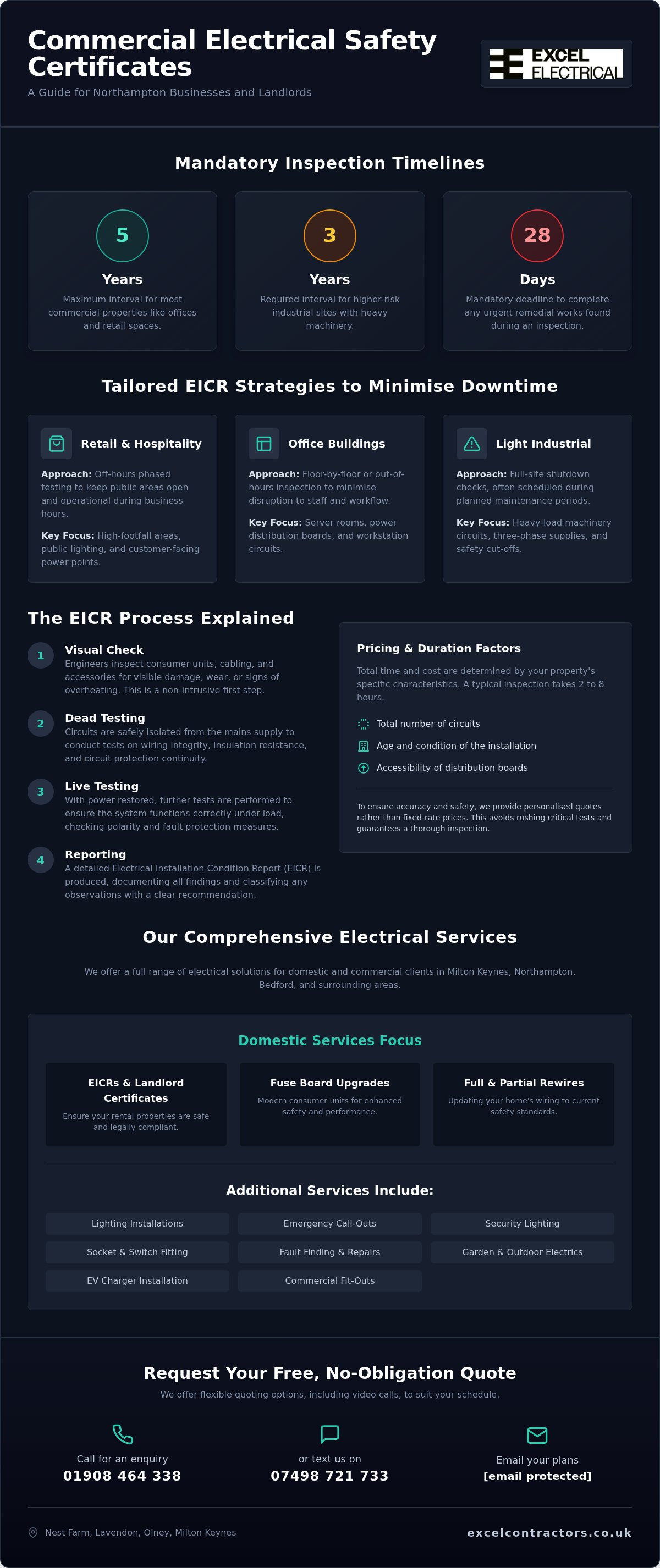
- Best-for busy retail venues to use off-hours phased testing to prevent operational downtime.
- The 28-day deadline for remedial works is mandatory to maintain a valid compliance status. Commercial properties and tenancies in Northampton require a valid business electrical safety certificate (EICR) to ensure legal compliance (Statutory Inspection) and workplace safety. Electrical safety testing (Electrical Installation Condition Report) protects your premises, staff, and visitors from potential electrical hazards. The overall cost varies based on the size of your property and the total number of circuits requiring inspection. Before you book, weigh three decisions: which testing path fits your site, whether faults need fixing first, and how pricing and duration scale with your circuits.
Matched EICR paths cut downtime on your Northampton site
Different commercial sites need tailored testing strategies based on their unique operational demands. High-turnover retail spaces need faster inspection cycles than quiet office blocks. Choosing a path matched to your site prevents costly operational downtime during testing.
Typical situations and a concrete next step:
- Busy retail or hospitality floor: use off-hours phased testing so public areas stay open.
- Multi-floor offices: run a floor-by-floor inspection with focus on server rooms and power distribution.
- Compact light-industrial unit: schedule a full-site shutdown check on machinery circuits and heavy loads.
Your property type directly determines the scope of a business electrical safety certificate (EICR). You can inspect your setup in full or use a phased plan. Managing safety compliance means matching your risk level to the right strategy.
| Property Type | Recommended Testing Approach | Key Focus Area |
|---|---|---|
| Retail & Hospitality | Off-hours phased testing | High-footfall public areas |
| Office Buildings | Floor-by-floor inspection | Server rooms and power distribution |
| Light Industrial | Full-site shutdown checks | Machinery circuits and heavy loads |
Phased inspections suit busy venues; total site testing suits smaller premises. Exploring options for EICRs and safety certificates keeps your site legal. An electrical safety testing works as a structured condition check for the wiring in your facility, and regular checks protect your staff.
Five-year EICR rules keep Northampton landlords compliant
Northampton landlords must secure a business electrical safety certificate (EICR) at least every five years to remain compliant.
Local regulations demand rigorous safety compliance for every tenant turnover. Neglecting these mandatory checks exposes your investments to severe penalties. For historic properties, compliance needs extra attention. The Northampton Museum 2025 report shows local heritage structures require careful management during modern upgrades. Keeping up with statutory checks prevents costly legal disputes.
Hire qualified Commercial Electricians to handle electrical safety testing on a set routine. Trained technicians identify hidden wiring dangers and issue legal landlord electrical (Domestic Electrical Installation Condition Report) documents right after testing.
Necessary electrical work (Remedial Works) must occur within 28 days of an inspection. Missing this timeline voids coverage. Completing repairs promptly secures your valid testing certificate (Certification of Compliance). Excel Electrical delivers fast turnaround times so your properties stay lawful and protected.
Tip: Keep your digital EICR copies accessible for safety audits and insurance validations.
EICR pricing and test times scale with your circuits
A business electrical safety certificate (EICR) generally requires two to eight hours of site testing depending on property size.
From field testing experience, assessing complex commercial distribution boards takes significantly more time than inspecting simple retail units. Larger industrial sites with multiple sub-mains demand longer site visits so every circuit can be tested safely.
Scheduling site assessments for off-peak hours avoids expensive operational downtime when engineers disconnect main distribution circuits.
Prioritizing complete circuit transparency over cheap fixed-rate quotes matters because rushing dead testing compromises workplace safety. Cutting physical inspection hours often leads to missed defects and dangerous hidden overloads.
Total expenditure varies based on circuit counts, building age, and accessibility. According to current market rates, local commercial testing costs fall into a standard market price band with a typical median rate across regional providers. You can integrate electrical safety testing alongside planned Commercial fit outs to keep overall labour expenses manageable. Complex installations needing extensive electrical work shift overall costs upward. Ask for a personalised quote to get precise figures for your venue.
What an EICR checks without shutting your site down
An inspection covers every fixed component, from the main intake down to individual final circuits, without creating massive operational disruption. Engineers keep downtime brief by isolating circuits systematically rather than shutting down your whole facility at once. This structured approach supports business continuity while holding to strict standards.
- Visual check: Engineers inspect consumer units, cabling, and accessories for visible damage or wear.
- Dead testing: Power is briefly paused to check insulation resistance and earthing integrity.
- Live testing: Technicians verify that protective devices trip correctly under fault conditions.
- Distribution review: Systems like Three phase and distribution setups are assessed for balanced loads and thermal safety.
- Final reporting: Findings are logged to issue your business electrical safety certificate (EICR).
One undetected weak point in fixed wiring can put the wider network at risk. Rigorous electrical safety testing pinpoints these risks early and supports safety compliance for your premises.
When delaying a full EICR saves you a failed report
Requesting a full business electrical safety certificate (EICR) immediately is the wrong move if your system has known, unaddressed faults.
Business owners often order formal assessments too early. That leads to automated failures and costly re-inspections. Ordering a full assessment while obvious defects remain is wasted spend: you already know the report will fail.
Address obvious hazards before formal electrical safety testing begins. Fixing loose sockets or damaged cables first saves both time and money.
If major alterations or fresh wiring are currently underway, wait. New installations require a different safety compliance document entirely.
When you have known defects, choose direct electrical work first to fix visible issues. Choose a full testing certificate inspection only when your setup is stable and visually sound.
Fast remedial works restore your commercial safety certificate
Prompt electrical work ensures your commercial property stays compliant after a business electrical safety certificate (EICR) inspection reveals faults.
Start with Code C1 and C2 defects immediately to maintain safety compliance across your facility. Fixing these issues prevents dangerous hazards and keeps your operational insurance valid. Major power grid standardization dates back to industrial pioneers like the General Electric Company 1892 history page on Wikipedia.
Minor observations noted in an electrical safety testing frequently turn into expensive system failures when left unaddressed. Delaying minor fixes inflates future repairs, so schedule them while the report is still fresh.
Licensed professionals for fast repairs protect staff and limit expensive downtime. Excel Electrical delivers complete testing certificate documentation once all repairs meet national wiring guidelines. Request a personalised quote for a tailored action plan.
Book accredited Northampton electricians who document every test
When choosing contractors across Northamptonshire, hire registered engineers who deliver official documentation directly to your inbox.
Finding the right person is harder when two similar listings appear in a quick search. Clear differences show up between general installers and certified inspectors. Verified professionals complete thorough checks without disrupting daily business operations, and they know local commercial properties in detail.
Excel Electrical provides fully accredited testing tailored to your site's specific layout. An approved local firm brings inspection depth that a general handyman cannot match.
Always check credentials before booking your business electrical safety certificate (EICR). Qualified teams explain findings clearly and provide transparent reports. Confirm your chosen contractor holds proper insurance and industry accreditations for commercial safety compliance.
Excel Electrical assists local managers with electrical safety testing services end to end. Reach the team to arrange a site visit.
Frequently asked questions
What is an EICR?
An EICR is an official document evaluating the safety of your property's fixed wiring. Qualified engineers examine circuits for faults to support statutory inspection (safety compliance). A business electrical safety certificate (EICR) helps protect commercial spaces from potential fire hazards.
What is inspected during an EICR?
Engineers inspect your main consumer unit, switches, sockets, and hidden cabling. They check for wear, damaged components, and overloaded circuits during electrical safety testing. These checks keep your building safe for staff and visitors.
How often must a landlord obtain an EICR?
Landlords must secure a certificate every five years or at the start of a new tenancy. This requirement falls under regulations for landlord electrical (Domestic Electrical Installation Condition Report) responsibilities and helps keep tenants safe.
How often should an EICR be conducted?
Commercial properties require testing every five years, while industrial sites need inspection every three years. High-risk premises require annual checks. Following testing certificate timelines keeps your business compliant; tailored assessment schedules can match your specific operational needs.
Final thoughts for your business
Securing a valid business electrical safety certificate (EICR) in 2026 keeps your commercial site protected, provided you pick the right testing path, fix known faults before the formal report, and budget for circuit count and access. Excel Electrical provides professional electrical safety testing across Northampton, Olney, and Milton Keynes. The qualified team handles fuseboard upgrades and full electrical work so your premises stay compliant.
Proper testing protects your team and property. Contact us for a free quote or consultation. You can visit Nest Farm, Lavendon, Olney, Milton Keynes. Reach the office on 01908 464338, text 07498721733, or email [email protected].


