

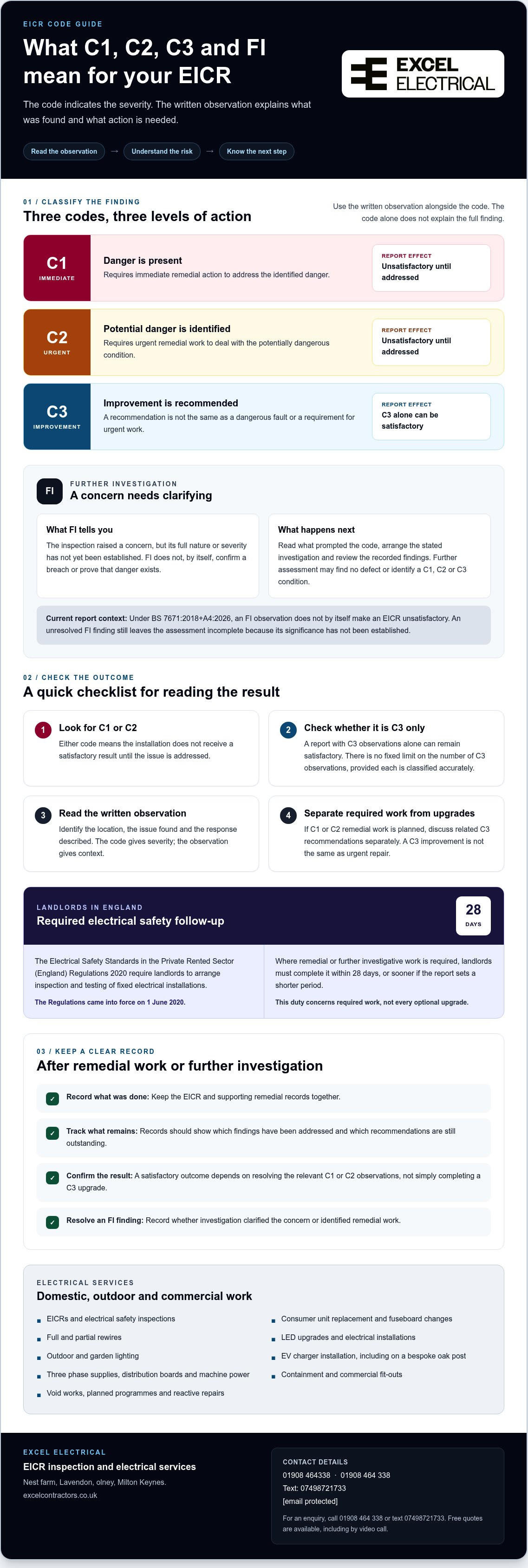
The difference between C1, C2 and C3 EICR codes is the level of risk and the action needed. C1 means danger is present and requires immediate remedial action; C2 identifies a potentially dangerous fault that needs urgent attention. A C3 records a recommended improvement and, on its own, does not make the report unsatisfactory.
A C3 can still be worth understanding, especially if it relates to older wiring or equipment. But a recommendation to improve an installation is not the same as a failed EICR, and the code should reflect the actual safety concern rather than a preference for newer equipment.
This guide explains what each EICR code means, which findings make a report unsatisfactory, and how the written observation and inspection scope affect the result. The code indicates the severity; the observation explains what the inspector found and what action is needed.
Key Takeaways
- Understand how C1, C2 and C3 findings differ in severity and the action they call for.
- Learn which observations make an EICR unsatisfactory and why a C3 alone does not.
- See how further investigation findings affect the report and what follow-up may be needed.
- Read the written observation alongside its code to understand the fault and the recommended response.
- Find out how inspection scope shapes the report and what to consider when planning remedial work.
What makes an EICR unsatisfactory?
An EICR is unsatisfactory when it records a fault requiring urgent or immediate action. A C1 finding identifies danger that needs immediate remedial action. A C2 finding identifies a potentially dangerous condition requiring urgent remedial work. Either code means the electrical installation does not receive a satisfactory result until the issue is addressed.
A C3 observation has a different status. It recommends an improvement, but does not identify an immediate or potential danger by itself. A report containing C3 observations alone can still be satisfactory. There is no fixed limit on the number of C3 observations, provided the inspector has classified each finding accurately.
For landlords in England, the Electrical Safety Standards in the Private Rented Sector (England) Regulations 2020 apply. According to the UK Government, these Regulations come into force on 1st June 2020. The rules require landlords to arrange inspection and testing of fixed electrical installations. Where remedial or further investigative work is required, landlords must complete it within 28 days, or sooner if the report sets a shorter period.
That legal duty concerns required work, not every optional upgrade. A C3 recommendation may identify an improvement to protection or equipment. The customer can decide whether to arrange it, taking account of the report’s explanation and the installation’s intended use. A C3 alone does not make an EICR unsatisfactory.
- C1 or C2: Arrange the necessary remedial work to address the identified danger or potential danger.
- C3 only: Review the recommendation and decide whether to make the improvement; the report can remain satisfactory.
- Unclear observation: Use the written description to understand what part of the installation needs attention.
If remedial work is already planned for a C1 or C2 fault, the customer can also consider related C3 recommendations. For example, if work involves a consumer unit, discuss any listed protection upgrade at the same time. The electrician can explain whether it is separate from the urgent repair. Agreeing the scope beforehand helps distinguish essential remedial work from optional improvements.
After required work, the report or supporting records should show what the electrician has done and which findings remain. A satisfactory outcome depends on resolving the relevant C1 or C2 observations, not simply completing a C3 upgrade. If further investigation identifies a dangerous fault, the resulting classification determines the action needed. Keep the EICR and remedial records together, so you can track completed work and outstanding recommendations.
What are EICR codes used for?
EICR codes classify electrical safety observations consistently. They help distinguish an identified danger from a recommendation or an issue that needs further investigation. Read the code alongside its written observation to understand what the inspector found, where it is, and what response is required.
FI means “Further Investigation”. An electrician uses this classification when inspection findings raise a concern but do not establish its full nature or severity. FI does not, by itself, confirm a breach or prove that danger exists. It indicates that more assessment is needed before the electrical condition can be properly classified.
For example, an inspection might uncover a wiring arrangement that cannot be assessed fully during the initial examination. The observation should explain what prompted the FI code and which part of the installation needs investigation. The next assessment may establish that no defect exists, or it may identify a condition that calls for a C1, C2 or C3 classification.
Under BS 7671:2018+A4:2026, an FI observation does not by itself make an EICR unsatisfactory. The code is not a substitute for a conclusion: the further investigation must clarify the issue so the report can give an accurate outcome. An unresolved FI finding leaves the assessment technically incomplete, because its significance has not yet been established.
Older EICR formats treated an FI observation as requiring further investigation without delay, and it affected the overall result. The reporting format matters when interpreting older paperwork. For a current report, check the observation, stated action and standard used rather than assuming every FI means immediate danger or has the same effect on the result.
Follow-up should resolve the uncertainty described in the report. The electrician investigating the issue can examine the relevant circuit or equipment, carry out suitable tests, and record the findings. The record should state whether the concern is resolved or needs remedial action. A satisfactory EICR depends on assessing the installation clearly, not simply removing an FI label.
- Read the observation: Identify the location and concern that led to the FI classification.
- Arrange further investigation: Have the stated issue assessed so its safety significance becomes clear.
- Review the outcome: Use the recorded findings to understand any required remedial work and the report result.
In domestic EICRs, most observations can generally be classified without FI when the inspector has enough information. If a report leaves you unsure what needs investigating, an EICR inspection and testing can help clarify the electrical findings and appropriate follow-up.
What Does a C3 Code Mean, and Does It Fail an EICR?
A C3 code means the electrician recommends an improvement, but has not identified danger in the installation’s present condition. A C3 observation alone does not make an EICR unsatisfactory. It signals that an upgrade may improve safety or bring equipment closer to current expectations, rather than requiring urgent remedial action.
The meaning and priority of each code depend on the risk described in the observation. BS 7671, the UK Wiring Regulations, provides the basis for classifying EICR findings. The code summarises severity; the accompanying explanation identifies the location, defect and action needed. A code without that detail gives you less information about the practical issue.
- C1, Danger present: The installation presents immediate danger, so urgent action is required. For example, accessible live parts can create a serious risk of electric shock or injury.
- C2, Potentially dangerous: The condition could become dangerous and requires urgent remedial work. The report should describe the fault and why it presents a risk.
- C3, Improvement recommended: The finding does not indicate danger in its present state. The electrician recommends an improvement, but a C3 alone does not fail the report.
- FI, Further Investigation: The inspector needs more information to determine the condition or appropriate classification. The investigation should establish whether remedial action is needed.
Older wiring colours offer one possible C3 example. Red and black conductors indicate wiring dating from before 2006, but their age alone does not prove that an installation is dangerous. The inspector assesses the wiring’s condition and safety. A recommendation to improve or update it may be recorded as C3 where no higher-risk defect is identified.
Do not treat every old component or difference from current practice as an automatic failure. The assessment concerns the installation’s safety, not simply whether it matches the newest edition of the regulations. Equally, a C2 should not be reduced to C3 merely to obtain a satisfactory outcome. The classification must reflect the evidence and risk recorded during inspection.
FI needs careful interpretation. Under BS 7671:2018+A4:2026, an FI observation does not by itself make an EICR unsatisfactory. It identifies a need to investigate the concern and establish the correct classification. Older reporting formats treated FI as requiring investigation without delay and affecting the result, so check the standard and reporting format stated on the document.
For you, the practical distinction is the action attached to each observation: address immediate danger, arrange urgent work for potentially dangerous faults, and weigh C3 improvements against the written recommendation. If FI appears, follow up the specific investigation so the installation’s condition and report outcome are clear.
Understanding the written observation and inspection scope
An EICR records observations about the parts of an electrical installation included in the inspection. Read each entry alongside its location, description and recommended action. The word “circuit” alone tells you little; a useful observation identifies the circuit or equipment and explains what inspection or testing revealed.
A classification should reflect the safety significance of the evidence. IET inspection and testing guidance says observations must be recorded and coded according to that significance. Inspectors may reach different conclusions if conditions or evidence differ. The written explanation helps you understand the reason for the code, rather than relying on its letter alone.
The inspection schedule contains 62 items to check before testing begins. These checks support a structured assessment, but an EICR does not record every possible issue in a building. Its scope covers the electrical installation included in the inspection. If access is restricted or an area cannot be assessed, the report should make that limitation clear.
Inspection cycles vary across the UK nations. In Wales, five-yearly electrical inspections have applied since 1 December 2022 under the Renting Homes (Wales) Act. In Scotland, five-yearly electrical checks have been required under the repairing standard since December 2015. Northern Ireland requires EICRs every five years for new tenancies from April 2026, and for existing tenancies from 1 December 2026.
Use the certificate and supporting records together. Check that the report identifies the inspected areas, clearly lists observations, and records relevant test results or access limitations. If remedial work follows, keep its completion records with the EICR. Together, these records show which findings were addressed and which recommendations remain outstanding.
The recommended interval before the next inspection reflects the property’s use and the installation’s condition. An EICR normally recommends another inspection after ten years for an owner-occupied home, and five years for a rented home or at change of occupancy. Poor condition can prompt an earlier reinspection, such as after six months or a year. Treat the recommendation as specific to the findings, not as a substitute for reading them.
Landlords managing several properties should link each certificate to the correct address and tenancy records. Note the recommended inspection date, any access limitations, and the evidence supporting completed work. This makes it easier to compare reports over time and spot changes, such as a newly recorded defect or a circuit that could not be tested during the latest visit.
What is the difference between C1, C2 and C3 electrical safety codes
The difference between C1, C2 and C3 EICR codes comes down to risk and the action needed. EICR classification codes follow BS 7671, the UK Wiring Regulations. They distinguish immediate danger from a potentially dangerous defect and a recommended improvement. The observation explains the evidence behind each code.
- C1, danger present: The electrician has identified an immediate risk. The installation needs immediate remedial action, such as preventing access to exposed live parts.
- C2, potentially dangerous: The finding could create danger and needs urgent remedial action. Missing RCD protection on a circuit buried less than 50mm below a wall surface can be a C2 example.
- C3, improvement recommended: The finding does not indicate danger in its present state. It identifies an improvement to consider, rather than urgent work needed to make the report satisfactory.
EICR classifications do not simply measure how old an installation looks. An older installation may meet the requirements that applied when it was installed. Its age, or a difference from newer regulations, does not alone prove a dangerous fault. The inspector assesses the installation’s condition and risk, then records the evidence and appropriate code.
A consumer unit made from plastic is not automatically a C2 finding solely because current domestic units are generally non-combustible. Its condition, location and surrounding installation inform the assessment. A combustible enclosure may be relevant to a C2 observation, but the material alone does not determine the result. The written observation should explain the specific concern.
For a C1, prioritise immediate remedial action because the report identifies danger now. For a C2, arrange urgent remedial work because the defect could become dangerous. A C3 gives you an improvement to consider, with no mandatory action arising from that code alone. If the electrician cannot establish the issue’s severity, an FI observation calls for further investigation; it is not itself a C1, C2 or C3 classification.
Read the description to understand why a code applies. A clear entry identifies the affected circuit, equipment or location, describes the condition observed, and states the recommended action. “Upgrade required” on its own may not explain whether the finding concerns safety or an improvement. Ask the inspector to explain the specific observation before deciding what work to arrange.
Knowing the difference between C1, C2 and C3 EICR codes helps you understand the report outcome and urgency of follow-up. A C2 must not be downgraded to C3 to make an EICR appear satisfactory. If you need the installation assessed or the findings explained, arrange an EICR inspection.
Excel Electrical: Domestic Electrical Services
Excel Electrical provides EICRs and electrical maintenance for homes, along with commercial electrical services for businesses. If an EICR identifies work that needs attention, the team can assess the findings and carry out relevant electrical work.
Excel Electrical is a NICEIC Approved Contractor and TrustMark registered business. The team can assess reported findings and explain the next steps, helping you distinguish observations that need remedial work from recommendations for improvement.
To discuss an EICR or electrical maintenance, call 01908 464338 or text 07498721733. You can request a free quote, including by video call. Excel Electrical is at Nest farm, Lavendon, olney, Milton Keynes. Email [email protected] or visit excelcontractors.co.uk to get in touch.
Turn your EICR into a clear next step
Keep your report with the property’s electrical records and note any follow-up work. For each observation, record its location, the action taken and the paperwork received. This gives you a clear reference when planning future maintenance or arranging another inspection.
Understanding the difference between C1, C2 and C3 EICR codes can help you discuss a report in precise terms. If an observation or recommended action remains unclear, write down the wording and identify the point you need explained. A focused conversation can help you decide what to do next without losing track of the report’s findings.
Excel Electrical supports property owners with electrical work following an inspection. If you’re ready to discuss your report or arrange help with your property, contact Excel Electrical for advice. Take the next step with the information in your report to hand, and move forward with a clearer plan for the property.
Frequently Asked Questions
What should you do after receiving an EICR?
Read the report’s overall result, then match each observation to its location and recommended action. Keep the EICR with the property’s electrical records, and note which findings need work, further assessment or monitoring. If you manage a rented property, organise the necessary follow-up and retain evidence of completed work. Ask the inspector to explain any wording you cannot connect to a specific circuit or item of equipment.
Can you ignore a C3 because the EICR is satisfactory?
A satisfactory result means the C3 finding does not, by itself, require work to achieve a satisfactory EICR. It doesn’t mean the recommendation has no value. Consider whether the suggested improvement suits the property’s use, planned alterations or maintenance priorities. For example, if you are already planning electrical work, discuss whether the recommendation fits that project. Keep a note of your decision alongside the report.
How Many C3's are Acceptable When Carrying out an EICR?
There is no fixed maximum number of C3 observations. A report can contain several C3 recommendations and remain satisfactory, provided it has no finding that makes the result unsatisfactory. The number alone does not determine the outcome. Review each observation separately, since one recommendation may concern an upgrade whilst another identifies a different improvement. The inspector’s written reasons help you decide which recommendations to plan first.
How Should Businesses Manage C1, C2 and C3 Findings Across a Portfolio?
Businesses can manage findings with a property-by-property register linked to each EICR. Record each observation, affected area, required action, responsible person and completion evidence. Separate urgent safety work from improvement recommendations, then track outstanding items during maintenance reviews. For example, a facilities manager overseeing several premises can use the register to identify sites needing immediate coordination and those with planned upgrades awaiting approval.
What do EICR codes C1, C2 and C3 mean?
C1 records danger requiring immediate action; C2 identifies a potentially dangerous condition needing urgent remedial work; C3 recommends an improvement. The code gives you a concise priority, whilst the observation should explain the specific finding. For instance, a C3 recommendation may concern an upgrade that would improve the installation without recording a dangerous condition. Read the report’s overall result as well as each individual code.
What electrical faults qualify for a C1 code on an EICR?
A C1 applies when the electrician finds danger that requires immediate remedial action. The report should identify the affected part of the installation and explain the danger, rather than relying on the code alone. The precise classification depends on the observed condition and its safety significance. If a report records C1, treat the stated action as urgent and arrange for the dangerous condition to be addressed promptly.
What electrical faults qualify for a C2 code on an EICR?
A C2 applies to a potentially dangerous defect that requires urgent remedial work. The written observation should show what was found and why it could create danger. For example, the assessment considers the defect’s condition and how the circuit is used, not just its age. Use the location and explanation in the report to identify the work required, then keep records showing what has been completed.
What electrical observations qualify for a C3 code on an EICR?
A C3 records an improvement the electrician recommends considering, where the observation does not indicate danger in the installation’s present condition. It may relate to an upgrade or replacement that would improve the installation. The observation should explain what could be improved and why. Assess the recommendation against the property’s use and future work plans, rather than treating every C3 as an urgent fault or automatic failure.


