

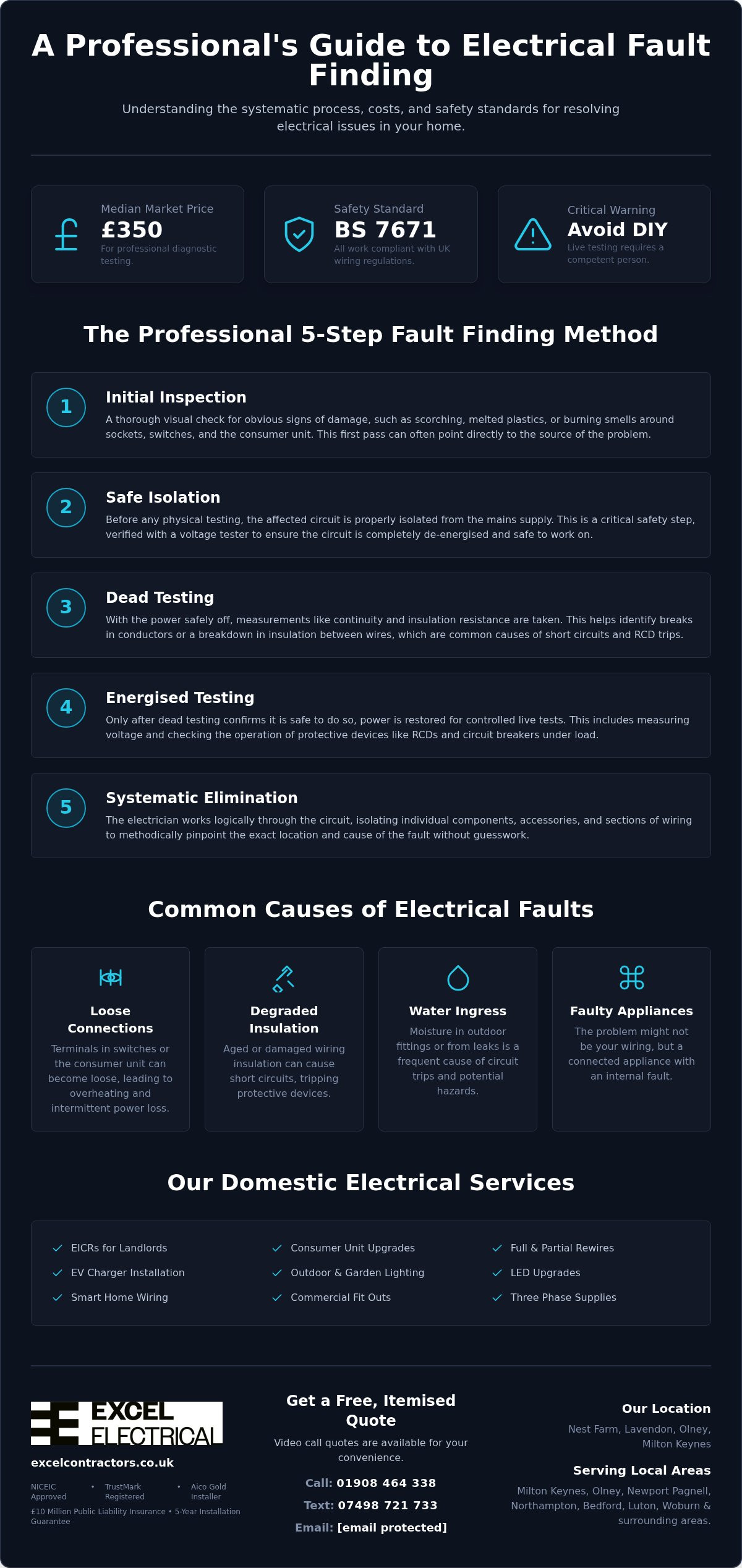
Professional diagnostic services for electrical fault finding carry a median market price indicator of £350 across top providers in the UK. Systematic testing techniques, moving from safe dead testing to live measurements, keep the work inside BS 7671 safety standards, and experienced electricians locate the underlying issue quickly so the installation stays safe to use.
Key Takeaways: Professional electrical fault finding follows a strict sequence of visual inspection, safe isolation, dead testing, and live measurements to identify issues while ensuring BS 7671 compliance.
- Budget a median market price of £350 for professional diagnostic testing and certification.
- Avoid DIY live testing unless you are a competent person with calibrated instruments.
- Use multi-function testers for efficiency as they combine insulation, loop, and RCD testing.
- Thermal imaging identifies loose connections and hidden heat before they cause total supply loss.
Match your fault diagnosis approach to your role and legal risk
Select a diagnostic strategy that matches your technical responsibility and legal obligations. Three situations come up often:
- Early-career tradespeople tracing a single dead socket: work circuit by circuit from the fuse box (consumer unit) to the outlet, using a written dead-test sequence before any live check.
- Facility managers facing a total loss of supply (isolation point failure): triage the isolation point first so you can restore critical loads, then schedule full testing once the site is stable.
- Landlords and homeowners with repeated trips or a suspected earth fault on the circuit protective conductor: bring in a qualified electrician for documented testing so tenant safety and compliance records stay intact.
Your role dictates the pace and the paperwork. Commercial managers need rapid risk triage to limit operational downtime; property owners need clear certificates after the repair. Selecting the method that fits prevents unnecessary disruption and keeps the evidence trail clean.
If the fault looks complex, book our call-out fault finding in Olney. You get same-day certificates, step-by-step explanations, and clear itemised details in writing before work starts.
A step-by-step electrical fault finding method that protects the installation
Diagnosing electrical issues needs a strict sequence so you stay safe and the home’s infrastructure is not damaged by guesswork.
- Initial inspection: check for visual signs of damage or thermal stress.
- Safe isolation: isolate the circuit before touching any internal wires.
- Dead testing: measure continuity and insulation resistance while power is completely off.
- Energised testing: restore power only to check live voltages under control.
- Systematic elimination: isolate individual components until you locate the exact issue.
An abnormal current flow can damage equipment or start a fire if you skip steps, so the order matters. Professional home electricians complete dead testing before restoring any power to the consumer unit (fuse box).
Plenty of faults look identical and are not. An RCD that trips at night is usually a different problem to one that trips when the shower runs: we test rather than swap parts hopefully, which is why faults other people have already tried often clear on a structured pass.
Transparent pricing follows the same plain logic. A commenter in the electriciansforums.net thread "Excel formula Page 2 | Electricians Forums" put it this way:
"Because you are making it difficult for a non experienced excel user.....just put the quantity of each unit, no need for a formula.....if a box of screws are £10 then they are 10p each...simples" (source)
That preference for direct unit totals over over-engineered spreadsheets matches how itemised fault-finding quotes should read: quantity, rate, and total, with no obligation until you accept the written figure.
Price instruments against the diagnosis you actually need
Selecting diagnostic instruments means balancing tool capability against your operational budget. High-grade testing tools support safe work during EICR inspections. Choosing multi-function testers over separate single-purpose units also saves kit space in the van. More on this: EICRs and safety certificates.
Buying basic individual metres often costs more once you add later upgrades. Multi-function units combine insulation resistance, loop impedance, and RCD testing in one device. Thermal cameras pick up subtle heating before a protective-conductor fault takes the circuit down completely.
| Equipment Type | Key Diagnostic Role |
|---|---|
| Multi-function tester | Verifies circuit safety |
| Insulation resistance meter | Measures breakdown |
| Thermal camera | Identifies hot spots |
The tool set you need depends on the inspection routine you run. For those managing heavy equipment or agricultural machinery, Mechnician provides advanced diagnostic tools to support professional maintenance. Regardless of the sector, ask for a personalised, itemised quote for the testing package and service rates that match your site.
Tip: Allocate funds for annual calibration alongside the initial purchase price of diagnostic instruments.
Trace the usual causes before you face a full loss of supply
A sudden loss of supply usually comes from tripped protective devices, degraded cable insulation, or loose terminal screws inside the board.
In daily fault finding we see overheating from loose connections burn away conductor insulation. That damage drives repeated trips on a residual current breaker with overcurrent protection (RCBO). Aged wiring breakdown or water ingress in external fittings then accelerates the cut-offs.
When the board itself has failed, a full consumer unit upgrade restores safe power and reduces hidden fire risk and persistent tripping in an Olney home. More on this: Fuse board replacement.
Writing in the electrician-norwich.co.uk thread "Customer Reviews, Excel Electrical, Commercial Electrician Norwich", one commenter observed:
"They are always reliable, knowledgeable, clean and tidy and polite. I can always trust them to do a great job!" (source)
Fast access to a dependable local electrician cuts the stress when an outage disables essential circuits. Request same-day attendance and an itemised plan before any strip-down begins.
Where DIY live testing crosses legal and insurance lines
Attempting non-qualified live testing creates severe safety hazards and can leave a related insurance claim open to rejection if that work caused the loss. UK rules expect competent-person certification for hazardous electrical work. If you touch live terminals without the right competence, injury or fire damage may fall outside cover.
Uncertified repairs on a fuse box also sit outside Electricity at Work expectations. Shortcuts put your household at real physical risk.
You get fully insured fault finding across Olney and the surrounding MK areas, with valid compliance certificates issued after each repair. Call for direct 24/7 assistance when the board will not reset safely.
Isolate multi-circuit faults without shutting the whole site
You isolate complex multi-circuit failures by testing three-phase commercial distribution boards down to individual sub-circuits. When a protective-conductor fault trips a main switch, a total shutdown disrupts the whole site. The practical fix is to isolate sub-circuits one by one under controlled conditions so loads return in stages. Advanced diagnostics need precise instruments to avoid false readings. Research highlighted by the CORDIS 2014 report shows that precision monitoring tools cut diagnostic downtime during major fault-finding operations.
Distribute single-phase loads evenly across all three phases before you swap components. Unbalanced boards often mimic genuine faults by pushing neutral current up. Peel the board back sub-circuit by sub-circuit so you do not replace healthy parts. Calibrated multi-testers cost more to buy and keep in cal, yet they give readings you can act on. Across Olney and nearby areas you receive same-day certificates and fully itemised quotes before work starts, so the business stays protected while the fault is narrowed down.
Catch hidden heat before thermal faults cut your supply
Thermal imaging detects hidden heat signatures before an unexpected loss of supply shuts the site.
Infrared scans show dangerous temperature rises across the system. On client sites, thermography has caught loose busbar joints and overheating switchgear weeks before a breakdown: the hotspot marks high resistance that a visual check misses. You receive a colour-coded report without stopping daily operations. Calibrated cameras are used on routine maintenance visits in Olney and the surrounding MK areas.
Fixing a single loose connection costs a fraction of an emergency full-system replacement. Book a thermal scan when you want those early warnings on record.
Experienced contractors, such as Inlightec Electrical Solutions, utilise these thermal imaging techniques to provide clients with detailed reports on system health and potential risks.
Verify accreditations before you authorise repairs
Hiring a qualified electrician keeps the property aligned with UK National safety standards (BS 7671). Testing live circuits without proper credentials carries legal and physical risk.
Unqualified fault finding often sits behind rejected building insurance claims, because uncertified work fails local safety rules. Check credentials before anyone opens the board.
NICEIC Approved Contractor status means the work is periodically assessed by the NICEIC, the firm can certify its own installations, and you have recourse through their platform if something is wrong. TrustMark registration adds a further vetted layer. Excel Electrical is an Aico Gold installer under the manufacturer’s domestic fire-alarm training scheme, carries ten million public liability insurance, and provides a five year guarantee on installation work. Local cover runs across Olney and surrounding areas: verify the badges, then proceed.
Frequently asked questions
How do I safely start an electrical fault finding job in the UK?
Isolate the mains supply at the fuse box before you touch exposed components. Turning off the main switch keeps you safe while you look for damaged fittings or loose connections. Only continue into live stages once a competent person has confirmed the circuit state.
What tools are essential for UK electrical fault finding?
A calibrated voltage indicator, a proving unit, and an insulation resistance tester form the core kit for local diagnostics. You also need basic hand tools to open faceplates safely. Aico Gold installer status reflects a commitment to recognised professional equipment on each test.
Which step-by-step methodology should I follow?
Start with a visual inspection, move to dead testing, and finish with live operational checks. That sequence locates damaged circuits without adding hazards. Strict testing steps on every project protect the property and shorten the path to the real fault.
How do I perform dead tests before live measurements?
Disconnect the power completely and prove the circuit dead with a proving unit and voltage tester. Then measure continuity and insulation resistance on the isolated cables to reveal hidden faults. Working dead first prevents shocks and protects sensitive equipment from surprise energisation.
What are the most common causes of loss of supply?
A tripped circuit breaker or a protective-conductor fault usually sits behind an unexpected loss of supply. Overloaded sockets and degraded cable insulation also trigger sudden cuts in domestic properties. A structured inspection identifies the faulty branch and restores power on a certified basis.
Book a professional circuit assessment when the fault will not clear
Accredited engineers undertake diagnostic testing to maintain safety standards and meet UK building regulations in 2026.
Clearing a persistent protective-conductor fault protects the home from fire risk and repeat trips. As an NICEIC Approved Contractor and Aico Gold installer, Brady and the Excel Electrical team handle complex diagnostics across Olney and surrounding areas so hazards do not linger.
If you suspect hidden wiring issues, request a detailed quote for multi-circuit inspections or site assessments. You receive free, itemised figures in writing, same-day options where available, and clear paperwork with no obligation until you decide to proceed. More on this: Electricians in Milton Keynes.


