

What if emergency lighting passes a quick check but its batteries fail before an evacuation is complete? Meeting emergency lighting testing requirements means checking more than whether a fitting switches on. You need a routine that checks operation, confirms how long the lights stay on and records what happens when a fault is found.
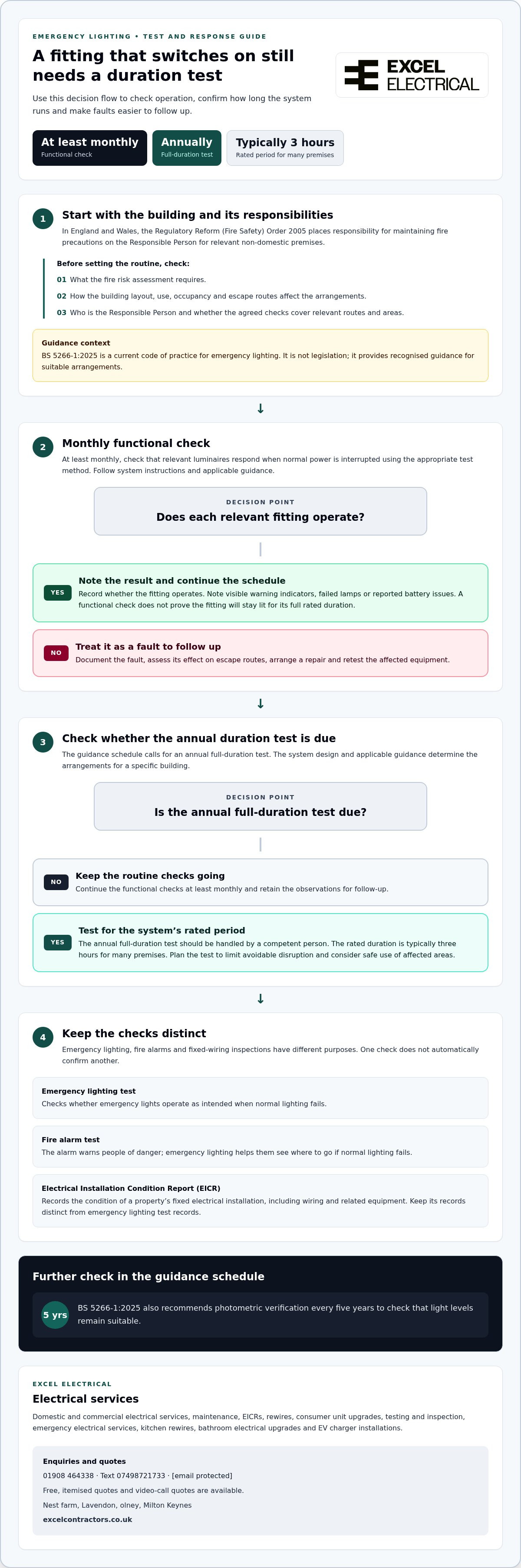
In England and Wales, the Regulatory Reform (Fire Safety) Order 2005 places responsibility for maintaining fire precautions on the Responsible Person. BS 5266-1:2025 provides current recognised guidance. Monthly functional tests check that the lights operate, while an annual full-duration test checks that they last for the system’s rated period, typically three hours.
This guide explains who should oversee testing, what routine checks and formal tests generally involve, what to record and how to respond to faults. It also shows how to make follow-up actions clear, so problems do not get lost between a test and a repair.
Excel Electrical provides domestic and commercial electrical services, maintenance, EICRs, rewires, consumer unit upgrades, testing and inspection, emergency electrical services, kitchen rewires, bathroom electrical upgrades and EV charger installations. For enquiries, call 01908 464338, also written as 01908 464 338, or text 07498721733. Free, itemised and video-call quotes are available. Email [email protected] or visit Nest farm, Lavendon, olney, Milton Keynes.
Key Takeaways
- Understand how emergency lighting testing requirements fit within UK fire safety responsibilities and how your fire risk assessment informs the system.
- Learn how routine functional checks differ from a full-duration test, and why the system design and applicable guidance matter when setting the schedule.
- Keep a clear record of tests, faults and follow-up actions, including whether repairs have been retested.
- If a test finds a fault, document it, assess the effect on escape routes, arrange a repair and retest the affected equipment.
- Find out how to plan testing and electrical support for premises in Milton Keynes and nearby areas.
Emergency lighting testing requirements: what the rules are designed to achieve
Emergency lighting testing checks that designated lights operate when normal lighting fails, helping people see escape routes and leave a building safely. It tests the lighting system’s response to a loss of normal power, rather than simply checking the fittings’ appearance. The Emergency light Wikipedia overview gives a general introduction to emergency lighting and its different applications.
In England and Wales, the Regulatory Reform (Fire Safety) Order 2005 sets out fire safety duties for relevant non-domestic premises. The Responsible Person, which may be an employer, building owner or person with control of the premises, must ensure that appropriate fire precautions are maintained. BS 5266-1:2025 provides a current code of practice for emergency lighting. A British Standard isn’t legislation, but it offers recognised guidance for putting suitable arrangements in place.
The premises’ fire risk assessment helps determine where emergency lighting is needed and what it must support. Building layout, use, occupancy and escape routes all affect the assessment. Emergency lighting testing requirements should therefore be considered in the context of the building and its fire safety arrangements, rather than treated as identical for every property.
Which premises and people should consider emergency lighting checks?
Landlords, business occupiers, facilities managers and others responsible for premises should understand what the fire risk assessment requires. The Responsible Person may be an individual or organisation with control of the premises; the role depends on the circumstances. A landlord’s responsibilities can differ according to the building and their control of shared or occupied areas. Identify who holds responsibility and make sure the agreed arrangements cover the relevant escape routes and areas.
A building with several floors, corridors or changes of direction may need different lighting arrangements from a small, open-plan workplace. The assessment should consider how people would find their way out if normal lighting stopped working. Pay particular attention to routes, exits and changes in level that could be difficult to see in an outage.
How emergency lighting relates to fire and electrical safety
Emergency lighting checks don’t replace fire alarm testing. A fire alarm warns people of danger; emergency lighting helps them see where to go if normal lighting fails. Both form part of a wider fire safety approach, but they perform different functions and need their own suitable maintenance arrangements.
They’re also different from an Electrical Installation Condition Report (EICR). An EICR records the condition of a property’s fixed electrical installation, including wiring and related equipment. Emergency lighting tests focus on whether the emergency lights operate as intended. One process doesn’t automatically confirm the other, so keep the relevant inspection and test records distinct.
Working illumination can help people identify escape routes and exits during a power failure. It supports evacuation, but it doesn’t replace clear routes, suitable fire precautions or a fire risk assessment. For a wider view of fixed-wiring safety, see this electrical testing guidance.
How often should emergency lighting be tested, and what does each check involve?
A useful schedule moves from brief operational checks to a test that confirms how long the system can keep running. The precise arrangements depend on the system design and applicable guidance. BS 5266-1:2025 is the current code of practice; the British Standards Institution’s BS 5266 British Standard overview explains the standard’s scope.
Schedule summary: BS 5266-1:2025 guidance calls for a functional check at least monthly and a full-duration test annually. The annual test covers the system’s rated duration, typically three hours for many premises. The design and applicable guidance determine the correct arrangements for a specific system. The standard also recommends photometric verification every five years to check that light levels remain suitable.
Routine function checks and recorded observations
A brief functional check confirms that relevant luminaires respond when normal power is interrupted through the appropriate test method. Follow the system instructions and applicable guidance for the timing and method. Check each relevant fitting and note whether it operates, along with any visible warning indicators, failed lamps or reported battery issues. A quick operational check does not prove that a fitting will stay lit for its full rated duration.
Duration testing and system-specific considerations
A duration test checks continued operation for the period specified for that system. Plan it in line with the design basis and relevant standard, rather than assuming one duration applies to every building. The annual full-duration test should be handled by a competent person. Arrange the test to limit avoidable disruption, and consider how occupants can use affected areas safely while testing takes place. Guidance on ongoing checks and planned upkeep is available in this electrical maintenance guide.
What to record after an emergency lighting test
A logbook helps the Responsible Person see what was checked, what failed and whether follow-up work was completed. A simple, consistent record is useful: include enough detail for another person to identify the result and locate the affected fitting.
- Date, test type and areas or fittings checked.
- Name of the person who completed the check and the result for each relevant fitting.
- Any fault, including its location and the affected equipment.
- Remedial work, completion date and the result of any retest.
Keeping records useful for future inspections
Keep records accessible to the Responsible Person and maintenance staff. Use consistent labels for locations and fittings so recurring faults are easier to identify. Records support oversight and show how issues were managed, but they don’t replace physical checks. If you need support with electrical testing and maintenance, see electrical services and support.
What to do if an emergency lighting test finds a fault
A failed fitting needs prompt attention, but it doesn’t automatically prove the whole emergency lighting system has failed. Equally, one working fitting doesn’t confirm that the rest of the system is safe. Record what the test revealed, then assess the effect on the affected escape route and the wider premises. The Responsible Person should decide what interim precautions are appropriate for the specific building and occupancy.
Use a clear sequence so the fault moves from the test record to a documented outcome:
- Document the result. Record the date, test type, fitting or location and what happened, such as a luminaire failing to illuminate or a warning indicator showing a fault.
- Assess the risk. Consider whether the affected fitting serves an escape route, exit or other area identified in the fire risk assessment. Review occupancy and any alternative routes.
- Arrange remedial work. Have the fault investigated and repaired by someone with the appropriate electrical competence. Follow applicable requirements, system instructions and relevant guidance.
- Retest and update the record. Confirm the repair has restored the required operation, record the retest result and keep any unresolved issue visible for follow-up.
Prioritising faults without delaying safety action
Be specific about where the fault occurred. “Landing fitting outside flat 4” is more useful than “light not working”, particularly where several fittings look alike. The Responsible Person should assess how the fault affects people using the route and consider interim safety measures in light of the premises’ risk assessment. The correct response depends on the building and circumstances, so don’t assume every fault calls for the same occupancy or closure decision.
If a test shows several fittings have failed, or a shared indicator points to a broader problem, arrange a wider system assessment. Record and address a single failed fitting even if other emergency lights appear to work.
Repair, retest and close the record
Ask a competent electrical professional to identify the cause and carry out the appropriate remedial work. A lamp, battery, connection or control issue may need investigation; don’t assume the visible symptom identifies the underlying fault. Work and any necessary verification should follow applicable electrical requirements, relevant emergency lighting guidance and the system design.
After repair, retest the affected equipment using the appropriate method. Record what was repaired, who completed the work, the completion date and the retest outcome. If the fitting still fails, keep the issue open, escalate it through the premises’ safety process and continue to review the risk and interim measures. Close the record only when the outcome has been checked and documented.
Excel Electrical provides electrical testing and maintenance support. Contact Excel Electrical to discuss the work required.
Plan emergency lighting testing and electrical support in Milton Keynes
Clear test records and planned follow-up help you manage emergency lighting as part of your wider electrical safety arrangements. Excel Electrical provides electrical installation, maintenance, testing and inspection for homes and business premises in Milton Keynes, Olney and nearby towns. If a test identifies a fault, we can discuss the electrical work needed to investigate and address it.
Our services include domestic electrical work, electrical maintenance, commercial electrical services, Electrical Installation Condition Reports (EICRs), rewires, consumer unit upgrades, testing and inspection, emergency electrical work, kitchen rewires, bathroom electrical upgrades and EV charger installations. Our installation work carries a five-year guarantee, and we hold £10 million public liability insurance. Excel Electrical is NICEIC Approved and TrustMark registered.
What local property owners can expect from an enquiry
When you get in touch, share the type of premises, the test result and the affected area or fitting. Include any immediate measures already in place and whether you need testing, inspection or remedial electrical work. This gives us a clear starting point for discussing the scope of your enquiry and preparing a quote.
We serve Milton Keynes, Olney, Newport Pagnell, Northampton, Bedford, Luton, Leighton Buzzard, Sherington, Stoke Holding Ton, Woburn and Woburn Sands. You can call 01908 464 338 or text 07498721733. Email [email protected], or visit us at Nest farm, Lavendon, olney, Milton Keynes.
Discuss a project and request a free quote
For a testing or repair project, explain what the test showed and what you need done next. We offer free, itemised quotes and video-call quotes, giving you a practical way to discuss the work and understand its scope before proceeding. The quote can reflect your premises and the electrical work required, whether you need help with an emergency lighting fault or broader electrical work.
To discuss your requirements, contact Excel Electrical. A clear account of the fault, its location and any retest information helps keep the next steps focused.
If you’re ready to discuss inspection, testing or remedial work in Milton Keynes or the surrounding area, request a free electrical quote.
Put your next emergency lighting check on the plan
Use your next maintenance review to turn emergency lighting testing requirements into a clear, workable plan. Set out who oversees the arrangements, where current test records are kept and how faults move from report to repair and retest. This gives you a practical way to keep safety tasks visible between inspections.
If your arrangements need attention, note the work you want assessed and the information you already have, such as fitting locations, previous test results or outstanding faults. Excel Electrical Installations Ltd provides electrical testing, inspection and maintenance for domestic and commercial properties. A free, itemised quote or video-call quote can help you understand the proposed work before you decide how to proceed.
Request a free, itemised quote or video-call quote, or call 01908 464 338 or text 07498721733. You can also email [email protected].
Frequently Asked Questions
Is emergency lighting testing a legal requirement in England?
Fire safety law in England requires the Responsible Person to maintain appropriate fire precautions, which can include emergency lighting where the premises’ fire risk assessment identifies a need. The Regulatory Reform (Fire Safety) Order 2005 applies to relevant non-domestic premises. Arrangements depend on the building, its use and assessed risks, so don’t assume every property needs the same system or testing plan.
How often should emergency lights be tested in the UK?
Current BS 5266-1:2025 guidance sets out monthly functional checks and an annual test for the system’s rated duration. The applicable duration depends on the system design, so check its specification and instructions rather than assuming one test period fits all premises. Keep the planned schedule with the building’s maintenance information, especially if responsibility for the premises or its systems changes.
Can emergency lighting be tested while a building is occupied?
Testing can be planned around building use, but first consider whether it could affect occupants’ ability to use a route safely. Tell relevant staff or building users which areas may be affected, arrange suitable access and coordinate the work with other activities. Don’t bypass safety measures or assume occupancy is safe in every case. The Responsible Person should assess the specific premises and plan accordingly.
What happens if emergency lighting fails a test?
Record the affected fitting and result, then have the Responsible Person assess the impact on the relevant route and occupancy. Arrange appropriate remedial work and keep the issue open until the repair has been checked. A single failed fitting doesn’t by itself prove a system-wide failure, but it still needs attention. Decisions about interim precautions depend on the location, building and risk assessment.
Who is responsible for emergency lighting test records?
The Responsible Person oversees fire safety arrangements for relevant premises and should make sure test results and follow-up are managed. They may assign checks or recordkeeping to staff with suitable competence, but delegation should leave clear ownership of outstanding faults. Agree who logs a failed fitting, who arranges the repair and who records the retest, so an unresolved issue isn’t lost between teams.
Does an emergency lighting test replace an EICR?
No. Keep the EICR and emergency lighting test records as separate entries in your maintenance files, even if both activities take place during the same visit. For example, note the EICR’s report reference and any recommended follow-up separately from the lighting test results. This makes it easier to assign actions, track completion and retrieve the right record during a review, without treating one inspection as evidence that the other task is complete.
What should an emergency lighting logbook include?
Include enough information for someone else to understand what happened and what remains to be done. Record the date and type of test, areas or fittings checked, results, faults found, remedial action and retest outcomes. Add the checker’s name and completion dates, and use consistent room or fitting references. These details help maintenance staff spot repeated problems and track whether corrective work has been completed.


