

Choosing the wrong light fixture for your shower isn't just a design mistake; it's a serious breach of UK safety regulations that could put your home at risk. Many homeowners feel overwhelmed when looking for bathroom lighting zones explained, fearing that strict safety rules will limit their aesthetic vision. It's a valid concern; the combination of water and electricity requires a methodical approach to ensure every fitting is fit for purpose. At Excel Electrical, we believe high standards of safety provide the foundation for great design.
You deserve a bathroom that feels like a sanctuary without the underlying anxiety of non-compliance. In this professional guide, we'll master the complexities of the 18th Edition wiring regulations together, giving you the clarity needed to select fixtures that are both stunning and safe. We'll provide a clear breakdown of Zone 0, 1, and 2 requirements, whilst explaining exactly what those IP ratings mean for your renovation. By the end, you'll have the peace of mind that your home meets every national standard.
For expert assistance in Milton Keynes, contact Excel Electrical at Nest farm, Lavendon, Olney, or call 01908 464338. You can also email [email protected] or text 07498721733 for enquiries. We offer free video call quotes to streamline your project and ensure your domestic electrical services are handled with professional precision.
Key Takeaways
- Understand how the 18th Edition Wiring Regulations (BS 7671) define safety distances from water sources to prevent electrical hazards.
- Get the bathroom lighting zones explained with a detailed breakdown of the technical requirements and mandatory IP ratings for Zones 0, 1, and 2.
- Learn how to decode IP ratings to distinguish between IP44 and IP65 protection for various areas of your bathroom.
- Discover how to balance strict compliance with contemporary design by safely integrating task, ambient, and accent lighting.
- Recognise why hiring an NICEIC Approved Contractor is essential for securing the necessary certification for your bathroom electrical upgrade.
Understanding Bathroom Lighting Zones: Safety and UK Regulations
Bathrooms are unique environments where water and electricity exist in close proximity. To manage this inherent risk, the UK electrical industry uses a system of geographic areas known as bathroom zones. Having these bathroom lighting zones explained is the first step for any homeowner planning a renovation in Milton Keynes or Olney. These zones are defined by their distance from water sources like baths, showers, and basins. The core framework for these safety measures is the 18th Edition Wiring Regulations (BS 7671), which sets the national standard for all electrical installations in the UK.
Electrical bodies, such as the NICEIC, classify bathrooms as "special locations." This isn't just industry jargon; it's a recognition that the presence of moisture significantly increases the risk of electric shock. In these areas, standard light fittings are insufficient. Every fixture must have a specific IP Code (Ingress Protection) rating. This rating indicates how well the fitting resists the entry of water and dust. It ensures the internal components remain dry and functional even in high-humidity environments. Selecting the correct rating is essential for long-term safety and equipment durability.
Why Do We Need Bathroom Zones?
The human body's electrical resistance drops dramatically when the skin is wet. In a bathroom, even a small electrical fault can have fatal consequences. Zones are designed to prevent accidental contact with live parts and to stop equipment failure caused by moisture ingress. Without these boundaries, steam and condensation would quickly corrode non-rated electrical components. This leads to flickering lights, short circuits, and potentially dangerous fires. Proper zoning ensures that your lighting choices match the environmental demands of the space, protecting both the residents and the electrical infrastructure.
The Legal Requirement for Professional Installation
In England and Wales, most electrical work in a bathroom is "notifiable" under Part P of the Building Regulations. This means the work must be reported to the local authority building control. Attempting DIY electrical work in these high-risk areas is dangerous. It can also invalidate your home insurance and complicate future property sales. Professional installation by an NICEIC Approved Contractor, such as Excel Electrical, provides you with a compliance certificate. This document proves that the installation meets the rigorous standards of the 18th Edition.
Whether you require a full bathroom upgrade, an EICR, or a fuseboard change, our team at Nest farm, Lavendon, prioritises your safety. We offer free video call quotes to help you understand the costs involved in getting your bathroom lighting zones explained and correctly installed. For enquiries in Milton Keynes and the surrounding areas, call us on 01908 464338 or text 07498721733. You can also reach us at [email protected] to discuss your project requirements.
Zone 0, 1, and 2: A Detailed Breakdown of Requirements
To ensure your renovation is compliant, you need the specific bathroom lighting zones explained with technical precision. These zones are not merely suggestions; they are strict boundaries defined by the proximity to water and the resulting risk of electrical conductivity. Each zone carries its own set of requirements for voltage and ingress protection to mitigate the chance of electric shock in wet conditions.
Zone 0 and 1: The High-Risk Areas
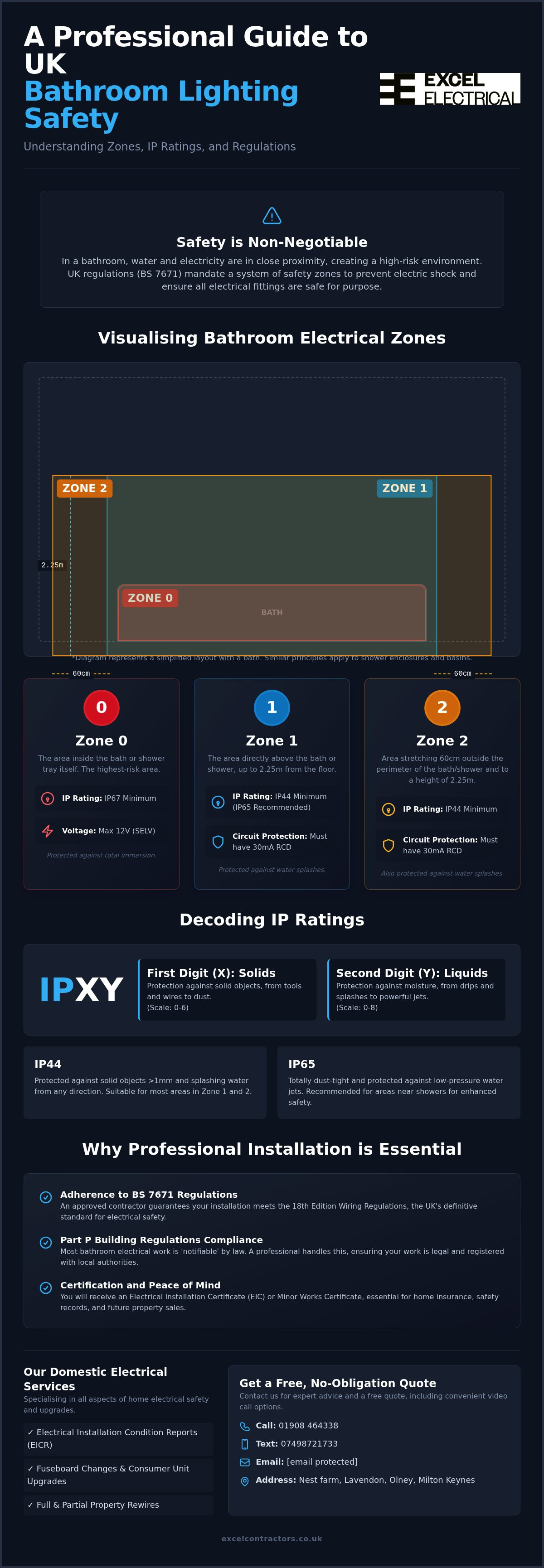
Zone 0 is the most critical area, representing the interior of the bath or shower tray. Any fitting installed here must be Safety Extra Low Voltage (SELV) with a maximum of 12V and carry an IP67 rating. This ensures the unit is protected against total immersion. Moving upwards, Zone 1 covers the area directly above the bath or shower to a height of 2.25m from the finished floor level. While the minimum requirement here is IP44, we often recommend IP65 to our clients in Milton Keynes for added protection against water jets from shower heads. As outlined in the UK government's Approved Document P, all 230V circuits serving these areas must be protected by a 30mA Residual Current Device (RCD) to ensure rapid disconnection in the event of a fault.
Zone 2 and the 'Outside Zones'
Zone 2 extends 0.6m beyond the edge of the bath or shower and reaches the same 2.25m height. It also encompasses the area surrounding the washbasin, typically measured as a 0.6m radius from the tap. Fittings in this zone require a minimum of IP44. This boundary is vital because it accounts for the typical "reach" of a person who is wet, preventing accidental contact with unsuitable electrical equipment. Understanding these measurements is a core part of having bathroom lighting zones explained for a safe installation.
Beyond these designated spaces lie the "Outside Zones". Whilst no specific IP rating is legally mandated by the 18th Edition for these areas, we advise using moisture-resistant fittings, such as those rated IP20 or higher. This is particularly important in smaller bathrooms where steam and condensation can still affect electrical components over time. If you are unsure about the layout of your space, our domestic electrical services include expert advice on zone compliance and fixture selection. We can help you navigate these technical requirements to ensure your project is both beautiful and safe.
For professional guidance on your bathroom upgrade, call Excel Electrical at 01908 464338 or text 07498721733. You can also visit us at Nest farm, Lavendon, Olney, or email [email protected]. We provide free quotes and video call estimates to help you plan your project with confidence.
IP Ratings Explained: Choosing the Right Fixtures for Your Space
Selecting the correct light fitting requires more than just an eye for style; it demands a technical understanding of Ingress Protection (IP) ratings. An IP rating consists of two digits that define how well a fixture is sealed against external elements. These ratings are a core component of the IET Wiring Regulations, ensuring that electrical equipment is suitable for the environment in which it is installed. Having bathroom lighting zones explained helps you identify where a light can go, but the IP rating tells you if the specific product is actually up to the task.
The First Digit: Protection Against Solids
The first digit in an IP code ranges from 0 to 6. This number indicates the level of protection against the ingress of solid foreign objects, such as dust or fingers. In a domestic bathroom, a rating of 4 is common, meaning the fixture is protected against solid objects larger than 1mm. Whilst this digit is often less discussed than the second, it remains vital for the longevity of your installation. A high rating here prevents dust build-up within the fitting, which can lead to overheating or premature component failure. Most specialised bathroom lights will carry a '4' or '6' as their first digit to ensure mechanical durability.
The Second Digit: Protection Against Liquids
The second digit is the most critical for bathroom safety, measuring protection against moisture on a scale from 0 to 8. For most bathroom zones, IPX4 is the baseline standard. This rating ensures the fixture is protected against water splashes from any direction. However, modern high-pressure power showers often require a higher level of protection. In these instances, we recommend opting for IPX5, which protects against water jets. If you are installing lights inside a shower cubicle (Zone 1), an IP65 rating is often the safest choice to ensure the seal can withstand direct contact with water spray during cleaning or use.
It's a common misconception that any product labelled "bathroom rated" is safe for use anywhere in the room. This marketing term is often too vague. A fixture might be IP44, which is perfect for a Zone 2 ceiling, but entirely unsuitable for Zone 0 where total immersion protection (IP67) is mandatory. The integrity of these ratings relies heavily on high-quality seals and gaskets. If these components are damaged during installation or degrade over time, the safety rating is compromised. Our team at Excel Electrical ensures every fitting is installed with precision to maintain these vital barriers.
If you're unsure which rating your project requires, we can provide expert guidance through a bathroom electrical upgrade consultation. For a free quote or to book a video call estimate, contact our Milton Keynes office at 01908 464338 or text 07498721733. You can also reach us at [email protected] or visit us at Nest farm, Lavendon, Olney, Milton Keynes. We specialise in ensuring your bathroom lighting zones explained are matched with the perfect, compliant fixtures.
Practical Design: Balancing Style with Electrical Compliance
Achieving a luxury aesthetic in a wet room or ensuite requires a strategic approach to layering light. You don't have to settle for a single, clinical ceiling light just to remain compliant. Once you've had the bathroom lighting zones explained, you can use these safety boundaries as a creative framework. By integrating task, ambient, and accent lighting, you can create a sophisticated space that functions perfectly for both morning routines and evening relaxation. The key is ensuring each layer of light respects the physical boundaries and voltage limits set by the 18th Edition regulations.
Layering Light Safely
Effective task lighting around vanity mirrors usually falls within Zone 2. This is the ideal location for IP44-rated wall lights or sconces. When positioning ceiling spotlights, you must be mindful of the Zone 1 vertical boundary of 2.25m. Any downlight placed directly above a shower must carry the appropriate IP rating, typically IP65 for modern power showers. Dimmable options are an excellent way to transition the atmosphere, provided the dimming system and drivers are installed in a compliant location outside the zones. This allows you to soften the environment without compromising the integrity of the seals.
Innovative Solutions for Small Bathrooms
In many Milton Keynes homes, compact bathrooms or cloakrooms are the norm. In these smaller spaces, almost the entire room may fall within Zone 1 or Zone 2. This leaves no room for standard, non-rated fixtures. Integrated LED mirrors and cabinets are highly effective here; they provide high-quality illumination and are factory-sealed to specific safety standards. If you're planning a complex layout in a tight space, it's worth discussing bespoke electrical solutions with a qualified expert to ensure every fixture is both functional and legal.
Low-level floor lighting is a growing trend for those seeking a spa-like retreat. Using IP67-rated LED strips along the base of a bath or within floor recesses adds depth and provides safe navigation for night-time use. When choosing finishes such as matt black, chrome, or brushed brass, ensure the product is specifically manufactured to withstand high humidity. Poorly chosen finishes will quickly pit and corrode in the steam-heavy environment of a bathroom, leading to a degraded appearance and potential mechanical failure of the fitting.
Ready to transform your space? Book a bathroom electrical upgrade with Excel Electrical to ensure your design is both stunning and safe. Call our team on 01908 464338 or text 07498721733 for a free quote. You can also reach us at [email protected] or visit us at Nest farm, Lavendon, Olney, Milton Keynes, to discuss your renovation plans.
Professional Installation and Certification in Milton Keynes
Having the bathroom lighting zones explained provides the necessary knowledge to plan your project, but the physical execution requires professional oversight. In the UK, electrical safety in wet areas isn't just about choosing a stylish fixture; it's about the technical integrity of the entire circuit. When you commission a professional bathroom electrical upgrade, you're investing in the expertise required to verify that RCD protection is functioning correctly and that every seal is airtight. This methodical approach ensures your renovation is both beautiful and strictly compliant with national safety standards.
Why NICEIC and TrustMark Matter
The role of an NICEIC Approved Contractor is vital for any bathroom project. NICEIC accreditation means our work is regularly assessed to ensure it meets the highest industry standards. This provides you with the peace of mind that your home is in safe hands. TrustMark registration adds another layer of security, confirming that we've been vetted for our technical competence and customer service. You should always verify your electrician's credentials before work begins to avoid the risks associated with uncertified tradespeople. A legitimate contractor will always be happy to provide proof of their qualifications and insurance.
During a professional bathroom electrical upgrade, we do more than just swap fittings. We assess the existing wiring to ensure it can handle the load of modern LED systems. For older bathrooms in Milton Keynes, we often recommend an EICR (Electrical Installation Condition Report) before starting any work. This report identifies any hidden defects or degraded wiring that could compromise your new installation. Once the project is complete, we provide the necessary certification to prove compliance with Part P and the 18th Edition regulations. This documentation is essential if you ever decide to sell your property.
Ready to Upgrade Your Bathroom?
Excel Electrical serves homeowners across Milton Keynes, Olney, Newport Pagnell, and the wider Bedfordshire area. We understand that planning a renovation can be complex. To streamline the process, we offer free video call quotes. This allows us to assess your space remotely and provide a rapid estimation without the need for an initial site visit. Whether you need a full rewire, a fuseboard change, or a partial update, our team is ready to help. Our focus remains on domestic electrical needs, ensuring every home we visit is safe and efficient.
Visit us at Nest farm, Lavendon, Olney, Milton Keynes to discuss your project in person. You can reach our office at 01908 464338 or email [email protected]. For quick enquiries, call 01908 464 338 or text 07498721733. Request your free quote for bathroom electrical upgrades today and ensure your home remains safe, stylish, and fully compliant with the bathroom lighting zones explained in this guide.
Secure a Safe and Stylish Bathroom Renovation
Mastering the 18th Edition regulations ensures your renovation is built on a foundation of safety. By having the bathroom lighting zones explained, you can now confidently select fixtures that meet the rigorous IP rating requirements for Zones 0, 1, and 2. Design and safety must work in tandem to protect your home. Don't leave your electrical integrity to chance; compliance is essential for your peace of mind and home insurance. As an NICEIC Approved Contractor and TrustMark Registered business, Excel Electrical provides the technical expertise required for a certified result.
We specialise in domestic electrical services across Milton Keynes and Olney, from EICRs to full bathroom upgrades. Our team at Nest farm, Lavendon, prioritises your safety through methodical workmanship and transparent communication. To begin your project with professional precision, book your free bathroom lighting consultation with Excel Electrical today. We offer free video call quotes to streamline the estimation process. For any enquiries, call 01908 464338 or text 07498721733. You can also email [email protected]. We look forward to helping you create a safe, stunning sanctuary in your home.
Frequently Asked Questions
What IP rating do I need for a light inside a shower cubicle?
IP65 is the recommended standard for Zone 1, which includes the area inside a shower cubicle up to a height of 2.25m. When looking at bathroom lighting zones explained, you'll find that whilst the legal minimum is IP44, higher ratings provide better protection against water jets. If the light is installed within the bath or shower tray itself (Zone 0), it must be IP67 and low voltage (12V).
Can I put a standard light switch inside my bathroom?
No, standard wall-mounted light switches are prohibited within the designated bathroom zones. You must use a ceiling-mounted pull-cord switch or a switch located outside the bathroom door. These rules prevent wet hands from coming into direct contact with live electrical components. Some specialised low-voltage electronic touch switches are permitted if they meet specific safety standards, but a pull-cord remains the most common compliant solution for UK homes.
Is it safe to have a pendant light in a bathroom?
Pendant lights are only safe if they are installed in the "Outside Zones" where they won't be splashed or reached by someone in the bath. The bottom of the fitting must be at least 2.25m above the floor level to stay out of Zone 1. You must also ensure the fitting is suitable for high-humidity environments to prevent the metal parts from corroding or the electrical connections from failing over time.
Do I need an EICR before renovating my bathroom?
An Electrical Installation Condition Report (EICR) is strongly recommended before any major bathroom renovation, especially in older properties. This report identifies whether your existing wiring and fuseboard meet current safety standards. It's better to find out that your circuits require upgrading before you've spent money on expensive tiling and new fixtures. Our specialists at Excel Contractors can provide this report to ensure your project starts on a safe and compliant foundation.
What is the difference between IP44 and IP65 for bathroom use?
IP44 protects against water splashes from any direction, making it suitable for Zone 2. In contrast, IP65 offers a higher level of protection against low-pressure water jets, which is why it's preferred for Zone 1 areas directly above a shower. When you have bathroom lighting zones explained by a professional, you'll see that choosing IP65 provides an extra layer of durability against the steam and direct spray found in modern bathrooms.
Can I install my own bathroom lighting if I follow the zones?
No, most electrical work in a bathroom is "notifiable" under Part P of the Building Regulations. This means the work must be carried out by a registered competent person who can certify the installation. DIY electrical work in high-risk wet areas is dangerous and can invalidate your home insurance. It also makes selling your property difficult later because you won't have the required compliance certificates for the local authority.
How far away from the bath does a light need to be to be 'outside' the zones?
A light fitting is considered to be in the "Outside Zones" if it is more than 0.6m away from the edge of the bath or shower. Any area beyond this horizontal 0.6m radius, or higher than 2.25m from the floor, falls outside the specific safety zones. Even in these areas, we advise using moisture-resistant fittings to ensure the longevity of your lighting in a damp and steam-heavy environment.
What are the rules for electrical sockets in a UK bathroom?
Standard 13A sockets are only permitted in UK bathrooms if they are installed at least 3 metres away from the edge of Zone 1. This rule effectively restricts sockets to very large bathrooms. Shaver sockets are the exception; these can be installed in Zone 2 if they meet BS EN 61558-2-5 safety standards. This ensures they are isolated and safe for use near water sources while you're grooming.


