
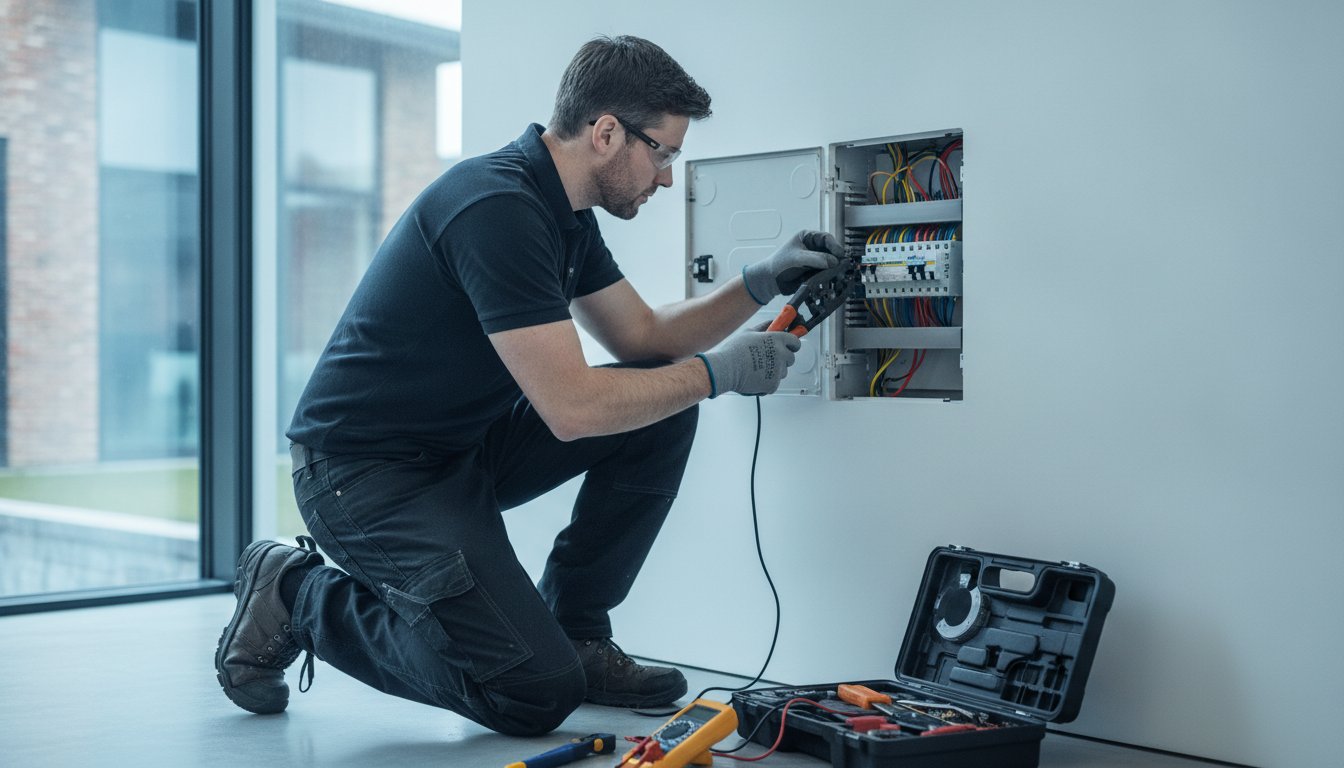
Did you know that electrical hazards are responsible for 53.4% of all accidental home fires in England? With over 20,000 electricity-linked fires occurring every year in the UK, the professional you trust with your wiring isn't just a tradesperson. They're a vital safeguard for your property and its occupants.
It's understandable to feel anxious when selecting an electrician, especially with the confusing array of accreditations and the fear of poor workmanship that fails to meet legal standards. You need the peace of mind that comes from knowing your project is in competent, audited hands. Hiring an NICEIC approved contractor is the most reliable way to ensure your domestic or commercial project remains compliant, safe, and fully insured.
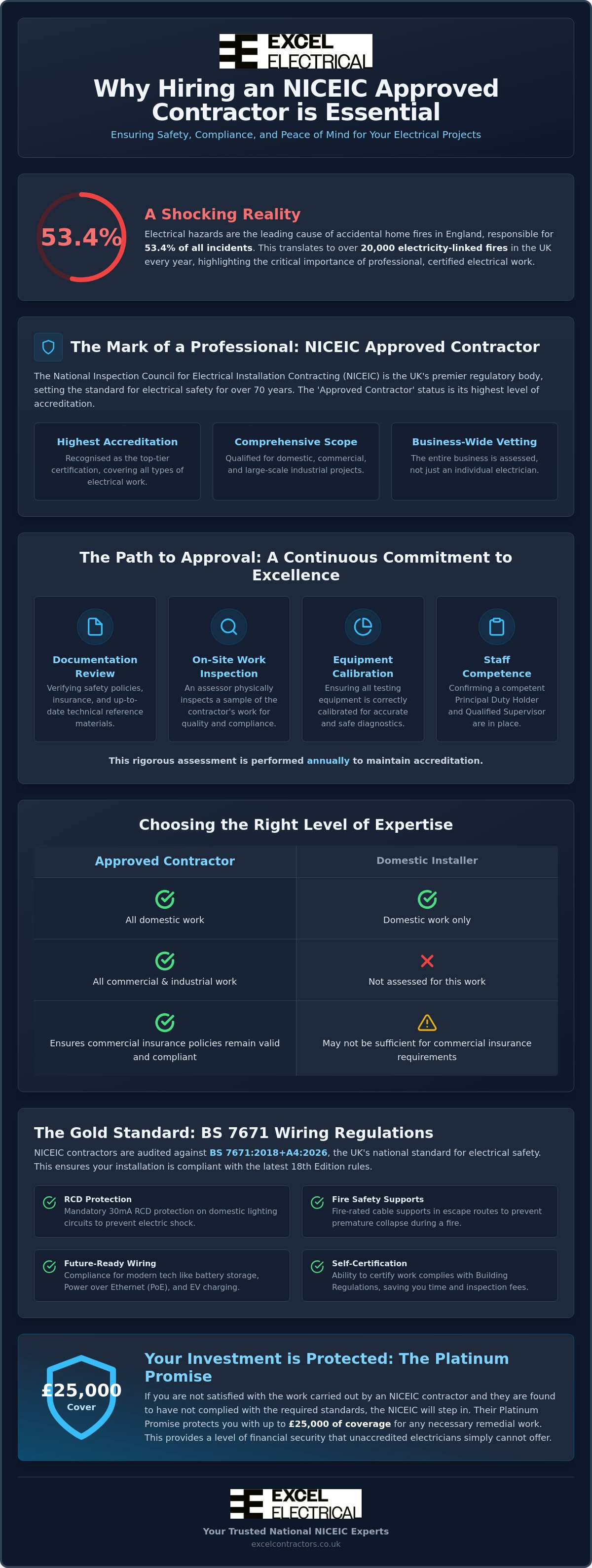
In this guide, you'll discover how these professionals adhere to the latest BS 7671:2018+A4:2026 standards, which include the latest Amendment 4 requirements. We'll also examine the rigorous technical audits they undergo and the specific legal protections, such as the £25,000 Platinum Promise, that safeguard your investment and ensure your work meets the highest industry benchmarks.
Key Takeaways
- Learn why the "Approved Contractor" status represents the highest tier of accreditation, ensuring a business is audited for all types of electrical work.
- Discover how hiring an NICEIC approved contractor guarantees that your project meets the latest BS 7671:2018+A4:2026 safety standards.
- Understand the distinction between Domestic Installers and Approved Contractors to ensure your commercial insurance policies remain valid and compliant.
- Explore the financial protections provided by the NICEIC Platinum Promise, which offers up to £25,000 in coverage for remedial work if required.
- Identify how rigorous annual technical assessments provide a level of accountability that unaccredited electricians cannot match.
What is an NICEIC Approved Contractor?
The National Inspection Council for Electrical Installation Contracting (NICEIC) is the UK’s leading voluntary regulatory body for the electrical industry. It has operated for over 70 years to uphold safety and technical excellence. Whilst many electricians hold individual qualifications, becoming an NICEIC approved contractor is a distinct achievement that applies to the entire business entity. It's widely regarded as the highest tier of accreditation within the scheme because it covers all types of electrical work, from residential repairs to large-scale industrial projects.
This status isn't a permanent award. Businesses must undergo rigorous annual technical assessments to remain on the register. During these audits, an NICEIC assessor visits the firm to inspect physical work, review safety documentation, and verify that the business owns the correct calibrated equipment. This systematic oversight ensures every project aligns with the national safety standard, BS 7671. It serves as the industry benchmark, providing a level of accountability that uncertified operators cannot match.
The Core Purpose of the NICEIC Scheme
The primary objective of the NICEIC is to protect the general public from the dangers of unsafe electrical installations. By maintaining a voluntary register of competent businesses, the scheme creates a standardised framework for electrical excellence across the UK. It ensures that contractors don't just understand the regulations but actively apply them to every consumer unit and circuit they install. This commitment helps mitigate the risk of fire and injury. This is vital when you consider that electrical distribution faults were the largest cause of workplace fires in 2024/25, accounting for 18% of all incidents.
Who Can Become an Approved Contractor?
Accreditation is a business-wide commitment rather than a personal certificate. A firm must appoint a Principal Duty Holder to manage legal responsibilities and a Qualified Supervisor to oversee technical accuracy on all sites. These individuals ensure that every member of the team performs work to the required standard. The firm must also maintain up-to-date technical reference documents and use testing equipment that is regularly calibrated. This infrastructure ensures that whether the project involves domestic electrical services or complex commercial electrical services, the technical output remains precise and fully compliant with the latest 18th Edition regulations.
The Standards Behind the Badge: BS 7671 and the 18th Edition
The badge of an NICEIC approved contractor is backed by the most stringent technical regulations in the UK. At the heart of this system is BS 7671, also known as the IET Wiring Regulations. This document isn't just a set of guidelines; it's the national standard for all electrical installations. As of April 15, 2026, the industry moved to Amendment 4 of the 18th Edition (BS 7671:2018+A4:2026). Contractors who fail to keep pace with these rapid changes risk leaving properties unsafe and legally non-compliant.
Hiring a certified professional gives you access to the privilege of self-certification. This means the contractor is trusted by the government to certify that their own work complies with Building Regulations. It's a high level of trust that must be earned through years of proven competence. Without this, you'd often need to pay local authority building control to inspect the work, adding significant cost and delay to your project.
Understanding the 18th Edition Requirements
The latest 18th Edition updates have fundamentally changed how modern properties are wired. Amendment 4 now mandates 30mA RCD protection on all domestic lighting circuits and introduces strict requirements for stationary battery storage and Power over Ethernet (PoE). These regulations also demand fire-rated cable supports in all escape routes to prevent premature collapse during a fire. An NICEIC approved contractor stays ahead of these technical shifts, ensuring your infrastructure is ready for modern demands like EV charging and renewable energy integration. You can find more detail on these standards on the NICEIC official website.
The Annual Assessment Process
Maintaining this accreditation requires more than just a one-off exam. Every year, an inspector performs a deep dive into the business. They examine office records to ensure insurance is valid and then move to a live site for a technical audit. The inspector checks everything from the tightness of terminations to the accuracy of test results. If any non-conformances are found, the firm must rectify them within a strict timeframe or face removal from the register. This relentless focus on quality control means that when you choose professional electrical maintenance, you aren't just buying a service; you're investing in a verified safety system.
Approved Contractor vs. Domestic Installer: Which Do You Need?
Confusion often arises when property owners encounter different NICEIC logos. Whilst both Domestic Installers and Approved Contractors are registered with the National Inspection Council for Electrical Installation Contracting, the scope of their authority differs significantly. A Domestic Installer is assessed solely for work in residential settings under Part P of the Building Regulations. Conversely, an NICEIC approved contractor is the highest tier of accreditation, authorised to work across domestic, commercial, and industrial sectors.
The distinction is particularly critical for business owners. Most commercial insurance providers mandate that any electrical work is performed by an Approved Contractor. Using a Domestic Installer for a warehouse or office fit-out could invalidate your policy, leaving you liable in the event of a fault. The assessment for "Approved" status is far more exhaustive; it requires the firm to demonstrate competence in complex environments that a domestic-only specialist may not be equipped to handle.
Commercial and Industrial Specialisations
Commercial premises demand a higher tier of technical oversight due to the complexity of their infrastructure. An NICEIC approved contractor possesses the expertise to design and install three-phase power systems, which are standard in industrial settings but rare in homes. This includes the management of heavy-duty switchgear and industrial power distribution networks. These professionals are also qualified to install and maintain emergency lighting and fire alarm systems that meet strict workplace safety laws. For any business, this level of certification is essential to ensure that commercial electrical services remain compliant with both the Electricity at Work Regulations 1989 and the latest 18th Edition standards.
Domestic Versatility
Hiring an Approved Contractor for your home brings industrial-grade precision to residential wiring. Whilst a Domestic Installer can handle basic house rewires, luxury domestic renovations often require the "Full Scope" accreditation that only an Approved Contractor provides. This is especially true for high-end properties featuring smart home integration, stationary battery storage, or complex lighting designs. Because these firms are already vetted for the most demanding environments, they offer a superior level of technical assurance. They also streamline the legal process by handling all building control notifications directly, ensuring you receive your safety certificates promptly without the need for additional third-party inspections.
For homeowners and developers who wish to explore High-end electrical and smart home installation projects, working with a specialist firm ensures that complex systems are integrated with both safety and aesthetic precision.
When achieving this balance of aesthetics and functionality, many homeowners also collaborate with design experts; you can learn more about InteriorVibe to see how ergonomic spaces are planned to complement high-end infrastructure.
Client Protections: The Platinum Promise and Compliance
Selecting an NICEIC approved contractor provides more than just technical safety; it offers a robust framework of financial and legal protection. The NICEIC stands behind its registered members through a scheme known as the Platinum Promise. This acts as a guarantee that all work will meet the required national standards. If an installation is found to be non-compliant, the NICEIC oversees the necessary remedial work. This level of corporate accountability is a major reason why professional property managers and homeowners prioritise accredited firms.
The Financial Safety Net
The Platinum Promise provides coverage up to a limit of £25,000 for any single installation. This protection remains valid for six years from the date of completion, giving you long term security for your investment. It triggers if the original contractor has ceased trading and is unable to rectify a fault themselves. This differentiates registered professionals from "handyman" services or unaccredited tradespeople. In those cases, if the individual disappears or closes their business, you're often left to pay for expensive repairs out of your own pocket. It's a vital safety net for any significant project.
Documentation and Certification
Documentation is the final piece of the compliance puzzle. Upon completion of any significant project, you'll receive an Electrical Installation Certificate (EIC). This is a legal record that the work was designed, constructed, and tested in accordance with BS 7671. These certificates are vital during property sales. Solicitors will often pause a transaction if valid electrical paperwork is missing. For existing installations, an Electrical Installation Condition Report (EICR) provides a formal assessment of safety. You can easily verify a firm’s credentials by entering their details into the official NICEIC register. This transparency ensures you aren't relying on a contractor's word alone. It's a mandatory requirement for every NICEIC approved contractor to maintain these records.
Valid certification is also a prerequisite for most insurance policies. Insurers expect that electrical systems are maintained by competent persons. If a fault leads to a fire and the work was performed by an uncertified individual, your claim could be rejected. Using a registered firm ensures your safety certificates are legally recognised. If you want to secure your property's compliance and insurance validity, speak to our team about domestic electrical services.
Partnering with Excel Electrical: Your National NICEIC Experts
Excel Electrical operates with over a decade of experience across the domestic, commercial, and maintenance sectors. We manage the intricate details of electrical compliance so you can focus on the broader objectives of your project. Our dual accreditation with TrustMark and the NICEIC demonstrates a commitment to government-endorsed standards and technical precision. As an NICEIC approved contractor, we ensure every installation we perform meets the rigorous criteria of the 18th Edition, specifically the latest BS 7671:2018+A4:2026 regulations.
We believe that safety should never be a secondary thought. It must be built into the design of every circuit and the termination of every cable. By choosing a partner with national reach and verified credentials, you eliminate the risks associated with unaccredited labour. We provide the documentation, the expertise, and the accountability required to protect your property and your people.
Comprehensive Professional Services
Our team delivers a broad range of specialised services tailored to high-stakes environments. We provide high-end domestic electrical services, including bespoke lighting designs and modern infrastructure for luxury renovations. For our business clients, we design and install complex commercial electrical services, ranging from three-phase power systems to large-scale industrial distribution networks. We also offer structured electrical maintenance programmes. These include scheduled preventive checks, expert fault-finding, and comprehensive safety audits for property managers. This systematic approach ensures long-term system reliability and identifies potential hazards before they cause operational downtime.
Why We Value Our NICEIC Status
Our philosophy is built on transparency, accountability, and technical accuracy. We don't view our accreditation as a simple marketing tool; it's a rigorous framework that governs our daily behaviour and workmanship. Every electrician in our firm is 18th Edition qualified and undergoes continuous training to stay current with the latest legislative updates and safety protocols. This methodical approach provides our national clients with the ultimate peace of mind. They know their property is compliant, their insurance remains valid, and their electrical systems are handled by experts who take pride in industry excellence.
Don't leave the safety of your property to chance. Enquire about your next electrical project with Excel Electrical to ensure your work is handled by a verified NICEIC approved contractor committed to the highest standards of the trade.
Secure Your Property with Verified Electrical Excellence
Choosing the right professional for your electrical project is a decision that impacts the long-term safety and legal compliance of your property. By opting for an NICEIC approved contractor, you ensure that every circuit and installation meets the rigorous BS 7671:2018+A4:2026 standards. This accreditation provides essential protections, such as the Platinum Promise and the ability to self-certify work for building control, which unverified tradespeople simply cannot offer.
Excel Electrical has been a trusted partner in the industry since 2015. Our team consists of 18th Edition qualified electricians who prioritise technical precision and transparent communication. As a TrustMark registered firm, we maintain the highest levels of accountability for our domestic and commercial clients nationwide. We handle the complexities of certification and safety audits so you can focus on your property's development with absolute confidence.
Protect your investment and ensure your insurance remains valid with a team that values industry excellence. Request a free, professional quote from our NICEIC Approved team today. We look forward to supporting your next project with the steady hand of an expert partner.
Frequently Asked Questions
What is the difference between an NICEIC Approved Contractor and a Domestic Installer?
An Approved Contractor is authorised to work across all sectors, including domestic, commercial, and industrial installations. In contrast, a Domestic Installer is limited to residential work under Part P of the Building Regulations. This means an NICEIC approved contractor can perform complex three-phase industrial projects and formal inspections that a domestic-only specialist is not authorised to undertake.
Is it a legal requirement to use an NICEIC registered electrician?
No, there is no specific law stating you must use the NICEIC. However, you are legally required to ensure all electrical work complies with Building Regulations. Using a registered professional is the most efficient way to achieve this. It allows the contractor to self-certify the work, saving you the time and expense of arranging separate local authority inspections.
How can I verify if an electrical contractor is actually NICEIC approved?
You can verify a firm's status by using the "Find a Contractor" search tool on the official NICEIC website. Simply enter the company name or their registration number to confirm their current standing. It's a vital step to ensure the business is still active on the register and has passed their most recent technical assessment.
Does an NICEIC Approved Contractor provide a guarantee on their work?
Yes, every NICEIC approved contractor provides a guarantee through the Platinum Promise scheme. This ensures that if the work fails to meet national safety standards, the NICEIC will oversee the necessary remedial actions. This protection offers clients a level of security that unaccredited handymen cannot provide, ensuring the installation remains safe and compliant.
What is the Platinum Promise and how does it benefit me?
The Platinum Promise is a financial safeguard that covers remedial work up to the value of £25,000 per installation. It protects you for six years from the date the work was completed. If your original contractor ceases trading and the installation is found to be non-compliant, the NICEIC will pay for another registered firm to correct the faults at no extra cost to you.
Why do commercial insurance companies insist on NICEIC Approved Contractors?
Insurers require this accreditation because it guarantees the contractor has been audited for high-risk commercial environments. These firms must demonstrate competence in complex systems, such as three-phase power and emergency lighting. By insisting on an Approved Contractor, insurance providers mitigate the risk of fire and electrical failure, ensuring the property is maintained to the highest safety standards.
How often are NICEIC contractors assessed for their technical competence?
Registered businesses undergo a technical assessment every year. During this audit, an inspector reviews office documentation, insurance validity, and performs a physical inspection of a live site. This regular oversight ensures that the firm continues to operate in accordance with the latest BS 7671 regulations and maintains the correct calibrated testing equipment.
Will an NICEIC contractor notify Building Control on my behalf?
Yes, registered contractors handle all necessary Building Control notifications for notifiable work. They submit the details through the NICEIC's online system, which then informs the local authority. Once the process is complete, you will receive a Building Regulations Compliance Certificate through the post. This documentation is essential for your records and is often required during property sales.


