
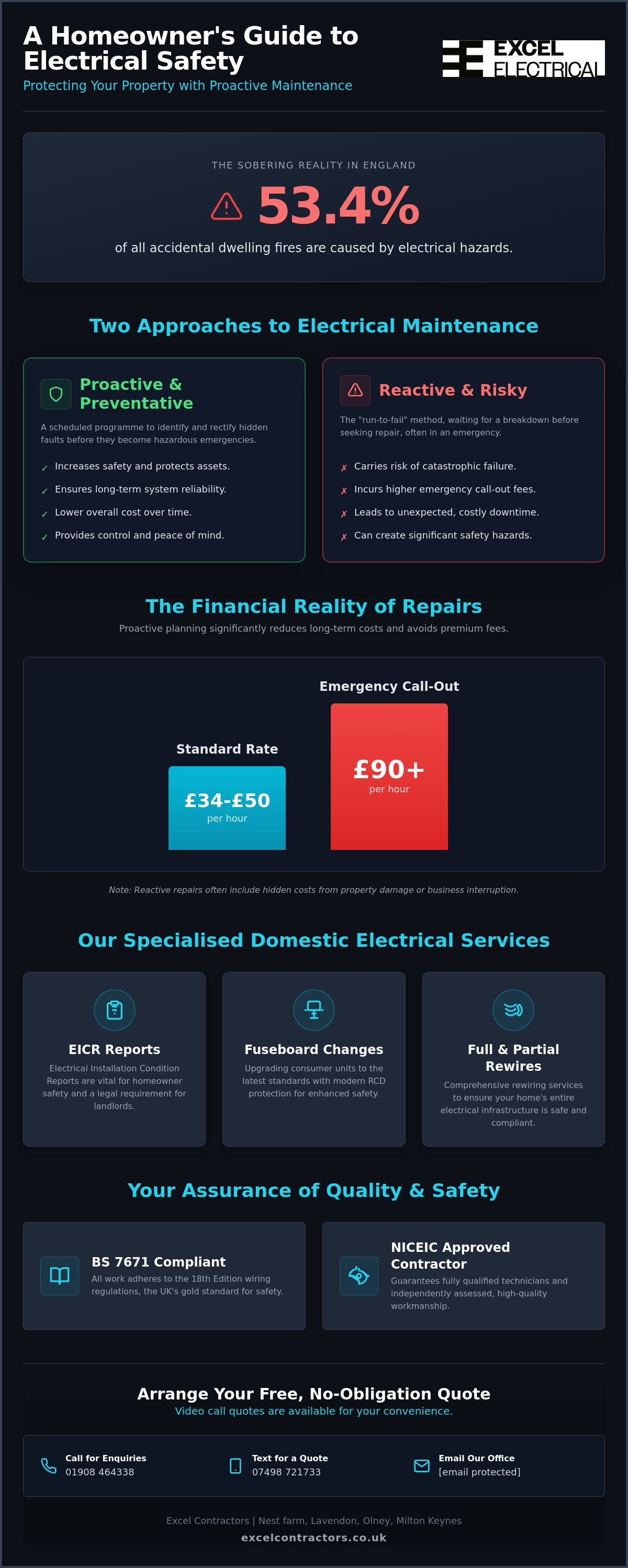
Did you know that electrical hazards cause 53.4% of all accidental dwelling fires in England? It's a sobering statistic that explains why many homeowners feel a persistent fear of system failures or confusion regarding the latest UK wiring regulations. You likely recognise that staying ahead of potential faults is safer than reacting to an emergency, yet the concern over the cost of planned electrical maintenance services often leads to unnecessary delay.
This guide explains how professional maintenance acts as a vital risk-management strategy rather than an optional expense. You'll learn how to ensure your home meets the BS 7671:2018+A4:2026 standards, protecting both your family and your property assets for the long term. We provide a clear overview of maintenance schedules, the legal requirements for EICRs, and practical ways to reduce operational costs. Excel Electrical provides these essential domestic services from our base at Nest farm, Lavendon, Olney, Milton Keynes. For enquiries, you can call 01908 464338, text 07498721733, or email [email protected]. We offer free quotes and video call quotes to streamline the estimation process.
Key Takeaways
- Learn how systematic electrical maintenance services protect your property by identifying hidden faults before they become hazardous emergencies.
- Understand the critical difference between costly reactive repairs and a proactive, preventative maintenance programme designed for long-term reliability.
- Navigate the complexities of UK safety standards, including the legal necessity of Electrical Installation Condition Reports (EICR) for landlords and homeowners.
- Recognise the essential technical components of a thorough inspection, from visual checks of sockets to verifying the integrity of your consumer unit.
- Discover the benchmarks for selecting a reliable electrical partner, specifically looking for NICEIC accreditation and current 18th Edition qualifications.
What are Professional Electrical Maintenance Services?
At the heart of all UK electrical work is the BS 7671:2018+A4:2026 standard, often referred to as the 18th Edition. This is the gold standard for installations, and any reputable service must adhere to these regulations to ensure legal compliance. Choosing an NICEIC Approved Contractor, such as Excel Electrical, guarantees that the technicians performing the work are fully qualified and that their workmanship is subject to regular independent assessment. This level of oversight is essential for maintaining the integrity of your property's electrical infrastructure.
The Core Objectives of Electrical Upkeep
The primary goal of any maintenance schedule is the safety of the occupants and the protection of the building fabric. Faulty wiring is a leading cause of domestic fires, so regular checks are a non-negotiable safety requirement. Beyond safety, a well-executed strategy for Preventive Maintenance helps in maximising the energy efficiency of existing components. When systems run optimally, they consume less power and put less strain on the infrastructure. This naturally leads to extending the lifespan of expensive electrical equipment, reducing the need for premature replacements or full rewires.
Domestic vs Commercial Maintenance Scopes
In a domestic setting, the focus of our electrical maintenance services remains heavily on the consumer unit, RCD protection, and the safety of home wiring. We prioritise services such as EICR assessments, fuseboard changes, and partial or full rewires to keep households compliant with current safety legislation. Commercial requirements are often more complex, involving emergency lighting systems, three-phase power, and heavy-duty switchgear that must handle significantly higher loads. Whilst residential maintenance prioritises occupant safety and domestic compliance, industrial maintenance focuses on the high-demand stability of heavy-duty power systems and complex distribution networks.
If you require expert assistance with your property, Excel Electrical is located at Nest farm, Lavendon, Olney, Milton Keynes. For enquiries or to arrange a video call quote, please call 01908 464338 or text 07498721733. You can also reach our team via email at [email protected] to discuss your specific requirements or to request a free quote.
Preventative vs Reactive Maintenance: A Strategic Comparison
Reactive maintenance is often described as the "run-to-fail" method. It involves waiting for a socket to stop working, a light to flicker, or a circuit breaker to trip before calling a technician. This approach carries inherent risks. Electrical systems don't always fail gracefully; they can fail catastrophically and without warning. In contrast, preventative maintenance is a scheduled, proactive programme designed to catch degradation early. By investing in regular electrical maintenance services, you shift from being reactive to being in control of your property's safety and infrastructure.
The financial implications of these two styles are stark. Reactive repairs frequently incur higher emergency call-out fees. Current industry data suggests that standard hourly rates for electricians typically range from £34 to £50, whereas emergency call-outs can average £90 per hour. Beyond the technician's invoice, there is the significant cost of downtime. For commercial clients, a sudden power failure can halt production or force a retail space to close. This disruption to business continuity often costs far more than the repair itself, making the reactive model a poor financial choice in the long term.
The Hidden Costs of Electrical Failure
Downtime is only one part of the problem. Electrical distribution faults account for approximately 18% of fires in non-residential buildings. If a fire is caused by neglected infrastructure, insurance providers may scrutinise your adherence to The Electricity at Work Regulations 1989. Faults also have a compounding nature. A loose connection in a consumer unit generates heat, which then damages adjacent wiring. What could've been a simple tightening job during a routine check can quickly escalate into a full board replacement or a partial rewire.
Benefits of a Scheduled Programme
A proactive programme allows for predictable budgeting. You can plan for necessary upgrades, such as consumer unit upgrades or full rewires, rather than being forced into them by a midnight emergency. This provides genuine peace of mind, knowing your installation remains in continuous compliance with safety regulations. Reliability is also enhanced during peak demand periods. When your system is under the most stress, you can trust that it's been tested and verified to handle the load safely.
Excel Electrical is based at Nest farm, Lavendon, Olney, Milton Keynes. You can contact our team at 01908 464338 or via email at [email protected]. To simplify the process, we offer free quotes and video call quotes for all domestic electrical needs. Please call 01908 464 338 or text 07498721733 to discuss how we can help you organise a reliable maintenance schedule.
The Essential Components of a Maintenance Programme
A comprehensive maintenance strategy isn't just a list of chores; it's an integrated system of checks designed to ensure long-term reliability. Effective electrical maintenance services combine sensory observation with advanced diagnostic technology to ensure every part of the installation remains compliant. By following the IET Wiring Regulations, contractors can identify specific points of failure before they manifest as fires or power cuts. This systematic approach is what separates professional upkeep from simple troubleshooting.
Functional testing of safety devices is a non-negotiable part of this process. Residual Current Devices (RCDs) are designed to save lives by tripping during a ground fault, but they can seize if they aren't operated regularly. Similarly, for commercial properties, emergency lighting must be triggered and timed to ensure it meets the legal duration requirements. These tests verify that when a system is under stress, the safety mechanisms will perform exactly as intended.
Visual Inspections and Physical Checks
Visual checks are the first line of defence in any maintenance schedule. Technicians look for discolouration on sockets and switches, which often indicates heat build-up from loose connections or overloaded circuits. We ensure all enclosures and distribution boards are securely fixed and that the correct safety signage is in place. Clear labelling is equally important; it allows for the rapid isolation of circuits during an emergency or future repair work, reducing both risk and labour time.
Technical Testing and Data Analysis
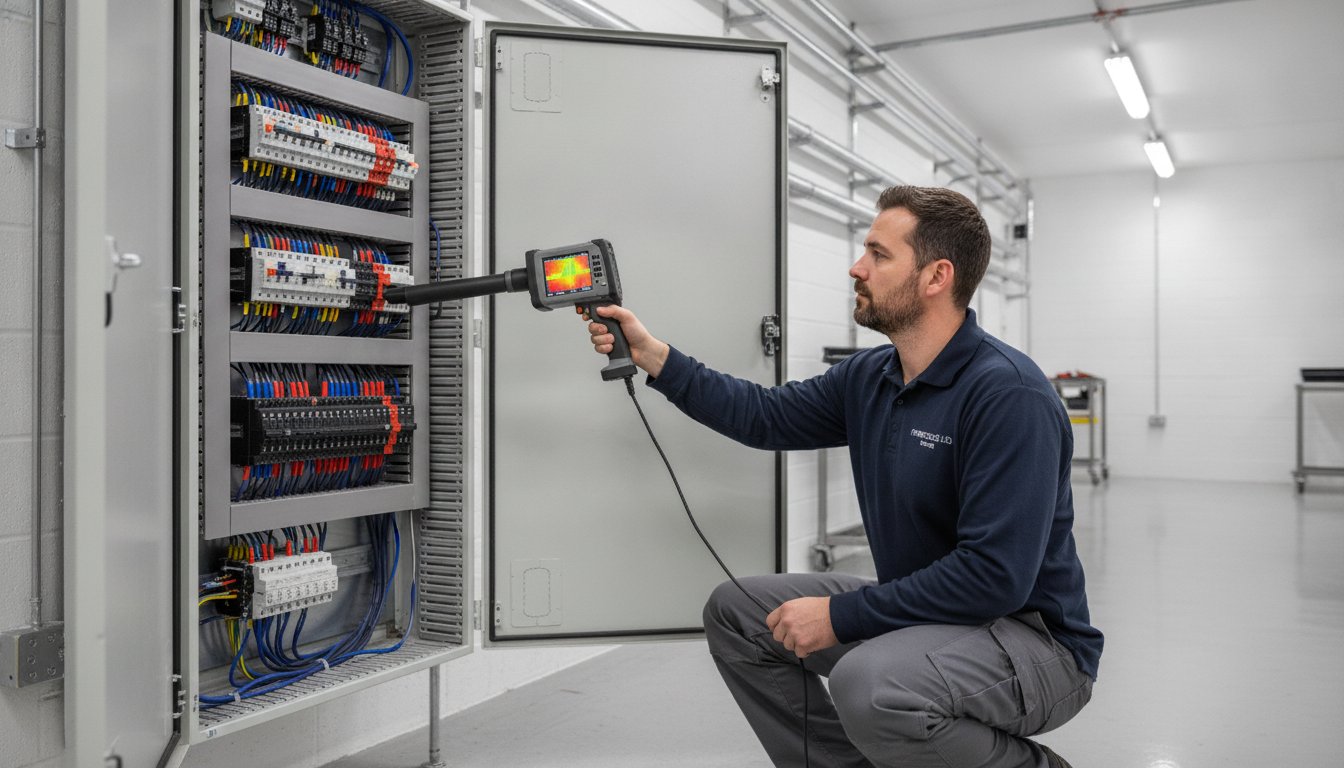
Whilst visual checks find obvious flaws, technical testing reveals what's hidden behind walls and within conduits. An Electrical Installation Condition Report (EICR) involves insulation resistance testing to check if cable sheathing has degraded over time. We also perform earth loop impedance testing to guarantee that safety devices will disconnect the power within the required timeframes if a fault occurs. Thermal imaging is a vital tool for modern electrical maintenance because it allows us to see heat signatures that are invisible to the eye, identifying overloaded circuits or high-resistance joints without disrupting your power supply.
If you're looking for a reliable partner to manage your property's safety, Excel Contractors is here to help. Our team operates from Nest farm, Lavendon, Olney, Milton Keynes, and we specialise in everything from EICRs to full rewires. For enquiries or to arrange a video call quote, please call 01908 464338 or text 07498721733. You can also reach us at [email protected] to discuss your domestic or commercial needs and receive a free quote.
Navigating UK Compliance: EICR, 18th Edition, and Legal Duties
Compliance in the electrical industry is a matter of legal accountability and risk management. For property owners and managers, professional electrical maintenance services provide the documented evidence required to prove that an installation is safe for continued use. The current benchmark for these standards is BS 7671:2018+A4:2026. This amended version of the 18th Edition was published on April 15, 2026, and it becomes the only recognised standard from October 15, 2026. Adhering to these latest regulations ensures that your property remains protected against evolving technical risks, such as those associated with stationary battery storage and Power over Ethernet installations.
The primary document used to demonstrate compliance is the Electrical Installation Condition Report (EICR). This report is not merely a checklist; it is a formal declaration of the system's integrity. To ensure the highest levels of consumer protection, you should always look for contractors who carry the TrustMark quality mark and NICEIC Approved Contractor status. These credentials signify that the work is performed by qualified technicians who are regularly assessed for their competence and adherence to national safety standards.
Understanding the EICR Process
During an inspection, faults are categorised using specific codes that dictate the required response. A C1 code indicates that danger is present and there is an immediate risk of injury; remedial action must be taken at once. A C2 code denotes a potentially dangerous condition that requires urgent attention. C3 is used for improvements that are recommended but not mandatory, whilst an FI code suggests that further investigation is required. Having a valid EICR is a vital safeguard against insurance claims. If a fault leads to an incident, your insurer will likely require proof that you have maintained the system according to the recommended testing frequency, which is typically every five years for residential rentals or sooner depending on the building's use and risk profile.
Employer and Landlord Obligations
Landlords in the private rented sector (PRS) in England face strict legal duties. They must ensure that a valid EICR is in place for every tenancy, with renewals required at least every five years. Failure to comply can result in financial penalties of up to £40,000. For employers, the Health and Safety at Work Act and the Electricity at Work Regulations 1989 mandate that all electrical systems in a workplace are maintained in a safe condition. This is a continuous obligation that requires a systematic approach to testing and inspection to protect employees and visitors from harm.
To ensure your property meets these stringent requirements, you can book your EICR and compliance check with our expert team. Excel Contractors is located at Nest farm, Lavendon, Olney, Milton Keynes. For professional advice or to request a free quote, call 01908 464338 or text 07498721733. We also offer video call quotes to streamline the estimation process. You can reach us directly via email at [email protected] to discuss your domestic or commercial maintenance needs.
Selecting a Qualified Electrical Partner for Long-Term Safety
Choosing the right partner for your property's electrical maintenance services is a decision that impacts the long-term safety, valuation, and legal standing of your assets. It isn't simply about finding a technician to repair a fault; it's about establishing a relationship with an expert who understands the specific requirements of your installation. A qualified partner provides transparency through detailed reporting and clear communication, ensuring you're never left in the dark about the condition of your wiring or consumer unit.
Every on-site technician must hold current 18th Edition qualifications to ensure they're working to the latest BS 7671 standards. This technical knowledge is essential for identifying subtle risks that an unqualified person might overlook. When you evaluate a contractor, look for a proven track record in domestic services, particularly in complex tasks such as full rewires or fuseboard changes. This expertise guarantees that any remedial work is performed with precision and adheres to the highest safety benchmarks.
The Value of NICEIC Approval
NICEIC Approved Contractor status is the ultimate benchmark for quality in the UK electrical industry. This accreditation isn't a one-time achievement; it involves rigorous annual assessments that verify the technical competence and safety of the contractor's work. One significant benefit for clients is the Platinum Promise, which provides an additional layer of security by guaranteeing that any work non-compliant with safety standards will be rectified. NICEIC contractors also have direct access to the latest industry updates and technical support, ensuring their methods remain at the forefront of the trade.
Establishing a Maintenance Partnership
There are clear advantages to using a single contractor for both installation and ongoing maintenance. A partner who is familiar with the history of your property can identify patterns of wear more effectively than a new technician. For property managers, tailored maintenance contracts reduce the administrative burden by automating the scheduling of EICRs and routine inspections. This proactive approach ensures you never miss a compliance deadline, protecting you from the legal risks discussed in previous sections.
Excel Contractors integrates safety and reliability into every contract we manage. Our team is based at Nest farm, Lavendon, Olney, Milton Keynes, and we're committed to providing the highest standards of domestic and commercial care. We encourage you to Contact Excel Electrical for a professional maintenance consultation to discuss your requirements. For enquiries, call 01908 464 338 or text 07498721733. We offer free quotes and the option for video call quotes to make the estimation process as streamlined as possible. You can also reach our office via email at [email protected].
Securing Your Property's Electrical Future
Professional electrical maintenance services are a fundamental investment in the safety and longevity of your building. By moving away from a reactive mindset and embracing a structured programme of inspections and EICRs, you ensure that your installation remains compliant with the latest 18th Edition Regulations. This proactive approach mitigates the risk of fire and system failure whilst providing a clear documented history that is essential for insurance and legal standing.
As an NICEIC Approved Contractor and TrustMark Registered business, Excel Contractors provides the technical expertise and accountability required for high-stakes electrical work. We're based at Nest farm, Lavendon, Olney, Milton Keynes, and we prioritise transparency in every domestic project we undertake. You can Request a free quote for your electrical maintenance from Excel Electrical by calling 01908 464 338 or texting 07498721733. We also offer video call quotes to make the estimation process as efficient as possible. Feel free to email [email protected] to discuss how we can help you maintain a safe and efficient home. We look forward to helping you achieve total peace of mind.
Frequently Asked Questions
How often should electrical maintenance be carried out in a commercial building?
The frequency of maintenance depends on the building's specific use and risk profile. Whilst a standard office or retail space typically requires a full EICR every five years, industrial environments with high-load machinery often need more frequent inspections. Routine visual checks should be integrated into your annual safety reviews to catch minor wear and tear before it escalates.
What is the difference between an EICR and routine electrical maintenance?
An EICR is a formal, periodic in-depth inspection that verifies the integrity of the entire installation every few years. Routine maintenance involves smaller, ongoing tasks such as checking for loose connections, testing RCDs, and replacing damaged fittings. Both are essential parts of comprehensive electrical maintenance services to ensure continuous safety and reliability.
Is electrical maintenance a legal requirement for UK businesses?
Yes, UK businesses must comply with the Electricity at Work Regulations 1989. This legislation mandates that all electrical systems are maintained in a safe condition to prevent danger to employees or visitors. Failure to prove a systematic maintenance regime can lead to heavy financial penalties and may invalidate your property insurance policies.
What are the signs that my domestic electrical system needs urgent maintenance?
You should look for discoloured socket faces, persistent burning smells, or lights that flicker despite changing the bulbs. Frequent tripping of the consumer unit or circuit breakers is also a clear sign that your domestic system requires an urgent professional assessment. If your fuseboard is over 15 years old, it's likely it no longer meets current safety standards.
Can any electrician perform commercial electrical maintenance services?
Technically yes, but you should always choose an NICEIC Approved Contractor for commercial tasks. Commercial systems often involve three-phase power and complex distribution networks that require specific technical competence. Excel Contractors provides this high-level expertise from our base at Nest farm, Lavendon, Olney, Milton Keynes, ensuring all work meets the latest regulations.
Will electrical maintenance work cause significant disruption to my business?
Some testing requires temporary power isolation, but we work to minimise the impact on your operations. We can schedule the most disruptive phases of our electrical maintenance services during periods of low activity or outside of peak hours. Clear communication before we start ensures you can plan your workflow accordingly without unexpected downtime.
How long does a typical electrical maintenance inspection take?
The duration depends entirely on the size and complexity of the installation. A standard domestic EICR for a three-bedroom home typically takes between two and four hours to complete. Large commercial premises or industrial sites can require several days of systematic testing to cover every circuit, emergency light, and distribution board.
What happens if my property fails an electrical safety inspection?
If your property fails, you'll receive a report highlighting specific C1 or C2 faults that require remedial action. You must address these "Unsatisfactory" findings to ensure the safety of the occupants and to remain legally compliant. We offer free quotes and video call quotes to help you resolve these issues; please call 01908 464 338 or text 07498721733 for enquiries.


