

TL;DR:
- Most 7kW home chargers require a 6mm² or 10mm² cable to prevent dangerous overheating.
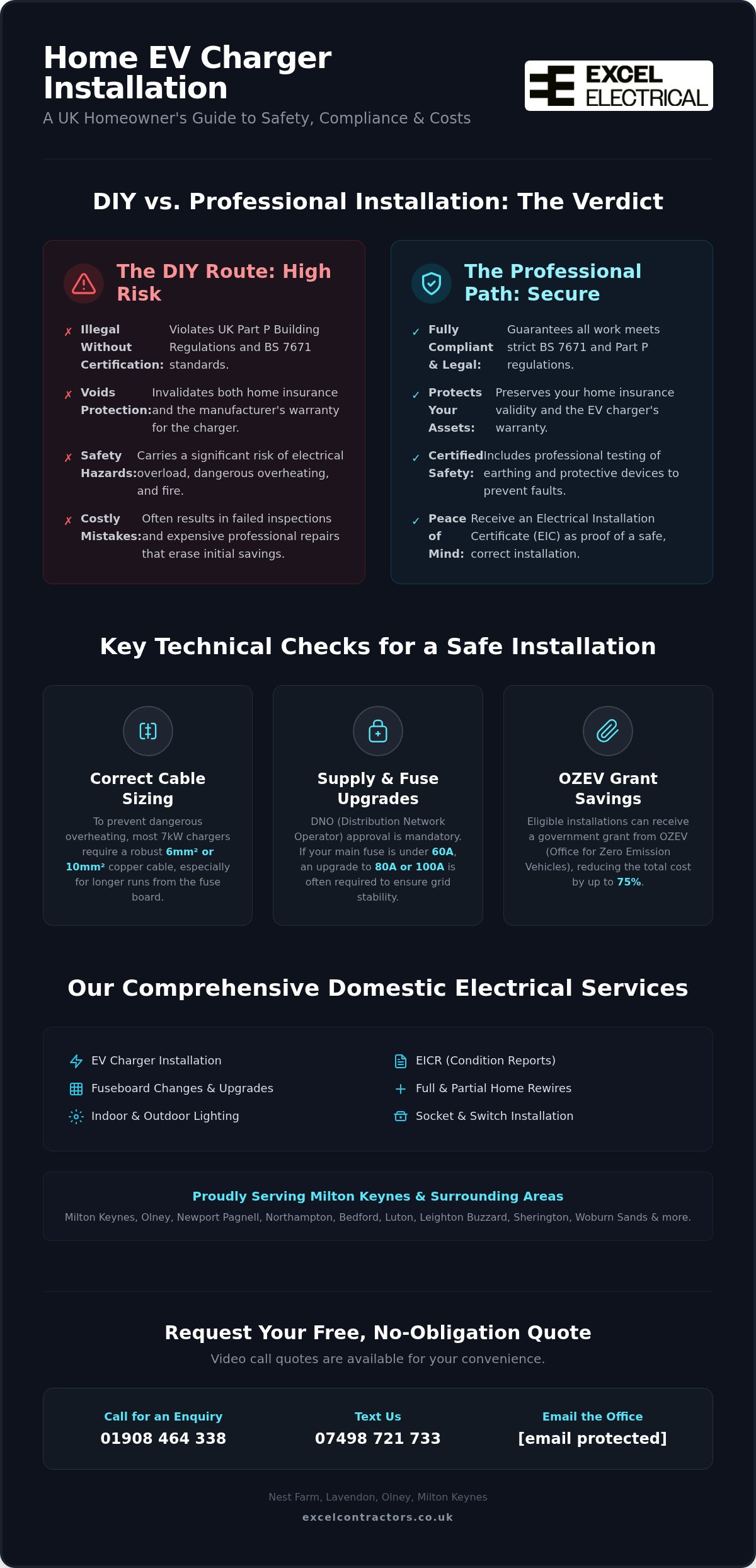
- DIY installation is illegal unless you hold certified electrical credentials and provide BS 7671 certification.
- Professional installation is the only verdict for homeowners to preserve warranties and insurance validity.
- The article confirms OZEV grants can reduce eligible installation costs by up to 75%. Legally, you can physically mount a home charger yourself, but connecting it to the UK mains supply requires a qualified electrician, strict BS 7671 compliance and Part P certification. Professional installation costs vary depending on your home setup, so certified work is the safest path to protect your warranty and home insurance. Ask for a tailored estimate to see the exact expenses for your home.
DIY EV charger fitting fails legal checks without a qualified electrician
No, you cannot legalise a DIY home EV charger setup without a qualified professional.
Typical situations we meet on site:
- You only want the wallbox on the garage wall: you may mount the enclosure, then stop and hand the circuit, earthing and certification to a registered electrician.
- Your consumer unit is already full or the main fuse is under 60 amps: book a survey first so fuse upgrades and DNO notices are planned before any hardware is bought.
- You care about warranty and insurance: choose professional EV charge point installation so the unit, protective devices and paperwork meet the required standards.
With clients we see that the DIY route usually leads to failed inspections and dangerous electrical overloads. Mains power needs strict regulatory compliance to prevent fire hazards. Installing high-voltage equipment without certified training carries the same kind of risk as servicing your own gas boiler.
Certified fitting protects your home and keeps the manufacturer warranty valid.
Part P and BS 7671 rules block uncertified home charger wiring
Fitting your own charger setup without a qualified electrician violates UK law under Part P Building Regulations.
Attempting DIY electrical work without certification creates real safety hazards. In our professional view, self-installation is a dangerous gamble that voids home protection. Mains power demands tested protective devices to prevent electrical fires. Registered Electricians in Milton Keynes | Homes and Business hold the proper testing equipment to verify earthing and PEN fault protection safely.
Your main supply might need a fuse boost. Contacting the grid provider for a fuse upgrade and DNO approval ensures the local network can handle the extra current without failing. Correct cable sizing also prevents severe overheating.
A dedicated home charger circuit, installed and certified properly, keeps the property secure and allows a 7kW unit to run safely for years.
Tip: Always request an Electrical Installation Certificate (EIC) to ensure your home insurance remains fully valid.
Correct cable size stops overheating on long home runs
Calculating the correct cable size depends directly on the distance to your main fuse board. Most home EV charger units demand a 6mm² or 10mm² copper cable to run safely.
Extended cable paths passing through dense masonry add major resistance; heat buildup and voltage drop then force a larger wire thickness. Your supply must handle the constant load when a 7kW charger draws continuous power for hours.
Check your main fuse capacity early. You may need a DNO-approved fuse upgrade if your main fuse handles under 60 amps. Understanding What Happens During a Solar and Battery Install helps clarify how extra electrical demands impact your system. Always check consumer unit space first so protective devices can be added without a later overhaul.
DNO approval and fuse upgrades keep your supply stable
Securing Distribution Network Operator (DNO) consent is a mandatory step before any home charger hardware is connected.
In our workshop, we frequently inspect main fuse ratings to ensure the property can handle a new EV charger. Insufficient electrical capacity causes power cuts across the household grid.
Your installer handles the Energy Networks Association (ENA) application on your behalf. They evaluate whether your 7kW charger needs a simple "fit and inform" notification or prior approval. A standard 60-amp main fuse often requires an upgrade to 80 or 100 amps before connection. You can check Can My House Have an EV Charger? to see how technical specifications affect grid demands.
If too many high-power devices draw through a fuse that is too small, the whole system grinds to a halt. Getting approval locks in regulatory compliance for your home network.
Professional EV charger installation costs less than fixing DIY faults
Professional fitting costs more upfront than doing it yourself, yet DIY faults often bring high repair fees. Hiring an expert avoids catastrophic failure. DIY only fits those who already hold certified electrical credentials; everyone else is better served by a professional.
Our experience with customers shows that bypassing qualified installers regularly results in failed compliance checks. Fixing faulty wiring later eats up any initial savings. Choosing professional fitting keeps the property protected.
| Route | Upfront Financial Risk | Professional Guarantee Included |
|---|---|---|
| Self-Installation | High | No |
| Professional Specialist | Low | Yes |
Setting up a home charger yourself breaches stringent electrical codes. A 7kW unit needs proper cable sizing to run safely, DNO approval for any fuse upgrade needs specific sign-offs, and safety devices must be verified on site. Get a custom price breakdown to view actual hardware and labour costs.
5 Steps that keep a home charger safe and compliant
Installing an EV charger safely requires systematic technical planning and strict regulatory compliance. Following a clear process protects your household electrical system. Checking supply capacity before buying equipment prevents unexpected power trips later.
- Assess your power supply: Confirm whether the existing fuse and board can take the load, or whether you must secure DNO approval and a fuse upgrade with your network provider first.
- Select the right equipment: Pick a home charger that matches your vehicle specifications and daily driving range.
- Check the cable size: Ensure the cable can safely handle the full electrical demand of the wallbox over the planned run length.
- Fit all safety devices: Install dedicated circuit breakers and earthing protection that meet regulatory requirements.
- Verify that the charger will work: Test that the 7kW charger operates correctly under maximum continuous load.
Qualified professionals handle these technical requirements as part of a certified install. Ask for a personalised quote for exact figures on your home setup.
For readers seeking similar expertise in the Middle East, Copak Technical Services LLC provides professional EV charging solutions for residential and commercial customers throughout the United Arab Emirates.
OZEV grants can cut eligible home charger costs by up to 75%
Government financial support can significantly lower the cost of a home EV charger for flat owners and tenants. Grants cover up to 75% of the total cost, capped at £350 per installation. Eligibility requires off-street parking and an approved installer.
From client work we see that many renters miss out on funding simply because they delay seeking permission: the situation is a tenant who wants a wallbox, solution is early landlord approval plus an approved installer, result is access to the grant rather than paying the full amount. According to the GOV.UK EV chargepoint grant guidance 2025, installers must submit claims on your behalf through the online portal. Landlords can also access funding for multi-unit properties.
Excel Electrical handles the required paperwork so the certified setup proceeds without extra admin stress.
Match charger hardware to your supply, vehicle and solar
Selecting the right hardware means matching your vehicle's connector type to your domestic power supply before you buy.
From client work we see that drivers often overlook solar integration. Choosing a unit with intelligent solar matching lets you charge using free household energy. According to the Wikipedia Charging Station 2026 entry, public and domestic supply points rely on specific standard connectors to supply power safely.
Self-installation remains unsafe and outside the legal path. A home charger with dynamic load balancing helps prevent blown main fuses. Verify cable size and protective device specs before purchase so the finished circuit matches the load.
Uncertified DIY charger work risks fire, rewiring and void cover
Tackling a home EV charger project without professional training and formal certification creates severe safety risks. Attempting the job yourself often leads to costly mistakes. In daily field work, botched self-installs regularly need complete rewiring after incorrect cable size calculations cause dangerous overheating in the walls.
A 7kW charger draws continuous high current for hours. Skipping a DNO fuse upgrade before connecting new hardware risks total power loss. Missing protective devices exposes the home to fire hazards. Professional fitting keeps the system within BS 7671 and Part P requirements and preserves peace of mind.
Frequently asked questions
How much will a home EV charger installation cost?
Total expenses depend on cable distance and consumer unit upgrades. Request a personalised quote to get precise figures for your property.
Can I install the charger myself or need a specialist?
You must hire a certified professional rather than attempting the install yourself. High-voltage work requires strict safety devices and certification to keep the house safe and legal.
Do I need to upgrade my fuse for a 7kW charger?
Your electrical supply might require a main fuse assessment before a 7kW unit is connected. The installer will contact your local network operator if a DNO-approved fuse upgrade is needed.
What cable size do I need for a home EV charger?
Determining the correct cable size depends on the overall distance from your main fuse box. Certified installers calculate these exact requirements during the initial site assessment.
Who can install?
Only a qualified specialist can complete this complex electrical work safely. Contact Excel Electrical to arrange your installation.
Can I install my own EV charger UK?
You must hire a qualified electrician to fit a home EV charger legally in 2026. DIY routes risk safety issues and break UK law.
Your 7kW charger needs proper cable sizing and protective devices to run safely. The right DNO approval and fuse upgrade prevent power trips across the property.
Excel Electrical handles regulatory compliance for your home: site survey, notices and certified connection. Reach out to excelcontractors.co.uk for a tailored quote on your property.


