

Would your business premises pass an unannounced health and safety inspection tomorrow? For many Milton Keynes business owners, the thought of an electrical safety audit for businesses brings more anxiety than assurance, especially with the strict BS 7671 Amendment 4 regulations now in full effect as of October 2026. You shouldn't have to worry about whether your testing frequency is correct or if a minor fault could lead to a costly unsatisfactory report that halts your operations and invalidates your insurance.
We understand that managing a commercial property is demanding enough without the added stress of technical compliance and the fear of business disruption. This guide ensures your premises remain fully compliant and safe by providing a professional checklist for your next audit. You'll gain a clear understanding of the new individual qualification requirements for inspectors, the updated EICR classification codes, and a list of actionable steps to reduce fire risks. Excel Electrical, based at Nest farm, Lavendon, Olney, Milton Keynes, provides this expertise to help you secure lower premiums and total peace of mind. For enquiries, you can reach our office at 01908 464338 or via email at [email protected].
Key Takeaways
- Understand the essential legal requirements of an electrical safety audit for businesses to ensure full compliance with the latest BS 7671 Amendment 4 standards.
- Learn how professional audits combine visual inspections of distribution boards with technical circuit testing to identify hidden hazards like faulty earthing or overloaded systems.
- Discover the critical pre-audit preparation steps, including locating previous EICR documentation, to ensure a smooth inspection with minimal disruption to your daily operations.
- Identify the correct testing frequency for your specific sector, ranging from the standard five-year commercial cycle to annual requirements for high-risk environments.
- Recognise why using an NICEIC Approved and TrustMark registered contractor is vital for maintaining your commercial insurance validity and ensuring technical precision.
What is an Electrical Safety Audit for Businesses?
An electrical safety audit for businesses is a systematic and detailed evaluation of an organisation’s entire electrical infrastructure. It encompasses a rigorous review of physical installations, operational procedures, and safety documentation. Unlike a simple visual check, the core objective of this process is to identify latent hazards that could lead to fire, injury, or catastrophic operational failure. These hazards often include overloaded circuits, degraded insulation, faulty wiring, or a critical lack of effective earthing that could prevent safety devices from tripping during a fault.
UK insurers increasingly view these audits as a prerequisite for maintaining valid business cover. In the event of a fire or electrical accident, the first document an assessor will likely request is a current safety report. Without a comprehensive electrical safety audit for businesses, a firm may find its claims for damage or workplace accidents rejected, leaving the company liable for significant costs. This makes the audit a strategic risk management tool that protects both the workforce and the company's financial stability. To further support your business's financial health, you can discover Green Compare for expert advice on utility procurement and commercial finance.
The Legal Framework: BS 7671 and the 18th Edition
BS 7671, the IET Wiring Regulations, represents the "Gold Standard" for UK electrical safety. The 18th Edition update significantly impacts modern business premises, particularly concerning surge protection and the management of heat-related risks. It accounts for modern technologies such as electric vehicle charging points and sophisticated server infrastructure, ensuring that the safety measures in place are sufficient for contemporary power demands. This technical framework is legally enforced through the Health and Safety at Work Act 1974, which mandates that all electrical systems are constructed and maintained to prevent danger.
Audit vs. Inspection: Clearing the Confusion
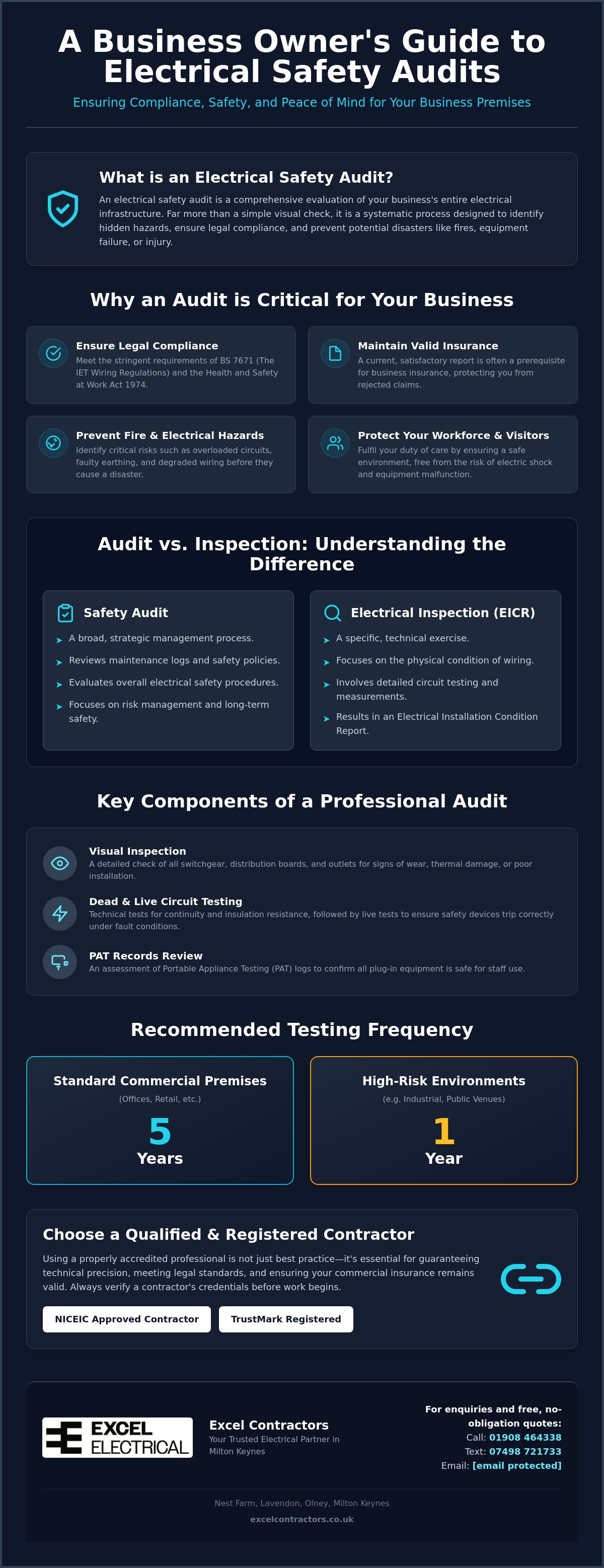
Many people use the terms "audit" and "inspection" interchangeably, but they serve different purposes. An inspection is a technical exercise, typically resulting in an Electrical Installation Condition Report (EICR), which focuses on the physical condition of the wiring. A safety audit is a broader management process. It incorporates electrical safety testing procedures but also reviews maintenance logs, safety policies, and the frequency of past repairs.
Under UK law, business owners have a non-delegable duty of care to ensure that all electrical equipment and installations are maintained in a safe condition to prevent danger to employees and visitors. Engaging an NICEIC Approved contractor like Excel Contractors ensures that both the technical testing and the procedural review are handled with professional precision. For expert guidance on your compliance status, contact us at Nest farm, Lavendon, Olney, Milton Keynes, call 01908 464338, or email [email protected].
Key Components of a Professional Electrical Safety Audit
A professional electrical safety audit for businesses involves more than a cursory glance at your fusebox. It requires a methodical approach to identifying risks that are often invisible to the untrained eye. Whilst UK regulations are specific, global benchmarks like OSHA electrical safety standards highlight the universal importance of protecting workers from electrical shock and arc flash hazards. A thorough audit ensures every part of your system, from the main intake to the final socket, is fit for purpose.
The process typically includes the following technical evaluations:
- Visual Inspection: A detailed check of all electrical points, switchgear, and distribution boards for signs of thermal damage, wear, or poor installation.
- Dead and Live Testing: Technicians perform continuity and insulation resistance tests on de-energised circuits, followed by live testing to ensure safety devices trip under fault conditions.
- PAT Records Review: An assessment of your Portable Appliance Testing (PAT) logs to ensure all plug-in equipment is safe for staff use.
- Ancillary Systems Check: Verification of the electrical integrity of emergency lighting and fire alarm systems, ensuring they will function correctly during a power failure.
EICR: The Core of the Commercial Audit
The Electrical Installation Condition Report (EICR) serves as the technical backbone of your audit. It reveals the state of hidden wiring that has degraded over time due to environmental factors or excessive load. Faults are categorised using standardised codes: C1 indicates immediate danger, C2 signifies potential danger, and C3 suggests improvements are recommended. Regularly scheduled professional electrical testing and EICR services allow businesses to catch these issues before they escalate into costly repairs or safety incidents.
Fixed Wire Testing and RCD Protection
Fixed wire testing is particularly vital for businesses in Milton Keynes and Bedford operating out of older industrial units or converted offices. These premises often lack modern Residual Current Device (RCD) protection. RCDs are life-saving components designed to disconnect the power instantly if a fault is detected, preventing workplace electrocution. During an electrical safety audit for businesses, we verify that these devices meet the response times mandated by the 18th Edition. Keeping your 'Log Book' up to date with these results is essential for satisfying health and safety inspectors during a site visit.
If you're unsure when your last full system check was performed, it's worth considering a professional inspection to secure your premises. For a free quote or to arrange a video call consultation, contact Excel Contractors at Nest farm, Lavendon, Olney, Milton Keynes, or call 01908 464338.
The Ultimate Business Electrical Safety Checklist
Preparation is the foundation of a successful electrical safety audit for businesses. A chaotic site visit often results in prolonged on-site time and potentially incomplete data. Managers should start by locating the most recent EICR and any existing distribution board charts. These documents provide a technical roadmap for the visiting electrician, allowing them to verify that previous remedial works were completed and to understand the building's circuit architecture without unnecessary delay.
Staff notification is equally critical. Comprehensive circuit testing inevitably requires temporary power outages. It's best to plan these interruptions during low-activity periods to minimise disruption to your operations. A well-notified workforce is a safer and more cooperative one, ensuring that sensitive electronic equipment is shut down correctly before testing commences.
Daily and Weekly Internal Checks for Managers
You don't need to be a qualified electrician to spot the early warning signs of electrical failure. Managers should conduct weekly visual checks for scorched sockets, frayed cables, or flickering lights. These are often symptoms of circuit overloading or loose connections. Ensure that ventilation around electrical equipment and server racks is never blocked by storage or debris. Critically, you must prohibit the 'daisy-chaining' of extension leads in the office, as this practice is a leading cause of commercial electrical fires.
What to Look for on the Day of the Audit
Always confirm the contractor's NICEIC credentials before work begins. This ensures they have the technical competence required for an electrical safety audit for businesses. On the day, ensure a clear perimeter is established around open distribution boards to protect staff and visitors. Discuss any specific high-risk areas of your business, such as commercial kitchens or heavy-duty workshops, with the engineer. This allows them to focus their attention on the areas subject to the most environmental wear and tear.
If you're looking for a reliable partner in Milton Keynes or the surrounding areas, Excel Contractors provides expert assessments to keep your premises safe. Contact us at Nest farm, Lavendon, Olney, Milton Keynes, call 01908 464338, or text 07498721733 for enquiries. We also offer video call quotes to help streamline your estimation process.
Frequency and Compliance: How Often Does Your Business Need an Audit?
Determining the frequency of an electrical safety audit for businesses depends largely on the nature of your operations and the environment in which you work. For standard commercial premises, such as retail units and offices, the industry standard is to conduct a full Electrical Installation Condition Report (EICR) every five years. This cycle ensures that gradual wear and tear on the installation is identified before it becomes a hazard. However, this is a maximum timeframe. If your business undergoes a major office rewire or renovation, you must commission a new audit immediately to verify the safety of the modified system.
High-risk environments require a much more rigorous schedule. Industrial sites, laundrettes, and petrol stations are subject to annual audits due to the increased stress placed on electrical components by heavy machinery, moisture, or combustible materials. Ignoring these schedules carries severe legal risks. Under the Electricity at Work Regulations 1989, duty holders can face unlimited fines for non-compliance. Perhaps more critically for your daily operations, failing to maintain a valid safety certificate can void your commercial insurance, leaving the business entirely exposed in the event of an electrical fire.
Understanding the 'Unsatisfactory' Result
If your audit identifies a Code 1 (C1) or Code 2 (C2) fault, the report will be classified as 'unsatisfactory'. A C1 fault indicates immediate danger, whilst a C2 signifies a potentially dangerous condition. Under the latest BS 7671 Amendment 4 standards, you have a 28-day window to complete the necessary remedial works to bring the installation back into a compliant state. Excel Contractors provides transparent, fixed quotes for these essential repairs, including fuseboard changes and circuit upgrades, ensuring you can restore safety without hidden costs.
Record Keeping and the Safety Certificate
You should keep all electrical safety records on file for at least six years, or until a newer report replaces the old one. Maintaining these records is a primary requirement for health and safety inspections and insurance renewals. The industry is moving rapidly toward digital certification, which offers significant benefits for multi-site property managers who need to track compliance across various locations. Excel Contractors provides full digital documentation for all audits, giving you instant access to your compliance history whenever you need it.
Don't leave your compliance to chance. Call 01908 464 338 or text 07498721733 to book your electrical safety audit and ensure your business remains fully protected under the 2026 regulations.
Choosing a Reliable Electrical Contractor in Milton Keynes
Selecting the right partner for an electrical safety audit for businesses is a decision that directly impacts your legal standing and site safety. It isn't merely about ticking a compliance box. It's about ensuring your premises are handled by professionals who understand the nuances of commercial infrastructure in Milton Keynes, Olney, and the wider Bedfordshire area. Hiring a local contractor ensures a faster response and a deeper understanding of the specific electrical challenges found in the region’s diverse business parks and industrial estates.
Excel Contractors prioritises technical accuracy and transparent communication. We believe that a professional service should put the client at ease, providing clear results and actionable advice without unnecessary jargon. By choosing a contractor with a proven track record in both domestic and high-end commercial maintenance, you ensure that every aspect of your audit is performed to the highest industry standards. Our approach focuses on long-term reliability, positioning us as a stable hand in a high-stakes industry.
Why NICEIC Approval is Non-Negotiable
NICEIC approval serves as the industry's primary safeguard for technical competence. Contractors with this accreditation must undergo a rigorous annual assessment process. During these checks, an independent assessor reviews their work, equipment, and documentation to ensure they meet the latest 18th Edition standards. This process guarantees that any electrical safety audit for businesses is conducted with precision and authority, meeting the requirements of both local authorities and insurers.
It's also essential to verify that your contractor holds the correct Professional Indemnity insurance. This specific cover is vital for commercial audits, as it protects your business against any professional errors in the reporting process. Choosing an NICEIC Approved contractor like Excel Contractors provides the peace of mind that your liability is managed and your safety certificates are legally robust. We also hold TrustMark registration, which provides an extra layer of consumer protection and confirms our commitment to high standards and fair trading.
Streamlining Your Audit with Excel Contractors
We understand that business managers are often time-constrained. To make the process as efficient as possible, we offer the option for video call quotes. This allows us to assess your distribution boards and site layout remotely, providing a rapid estimation without the need for an initial site visit. Whether you require a consumer unit upgrade, full testing and inspection, or ongoing electrical maintenance, our team is equipped to handle the project with minimal disruption to your staff and operations.
Our office is located at Nest farm, Lavendon, Olney, Milton Keynes. We're proud to serve as a local partner for businesses across the region, from small retail units to large-scale industrial facilities. Contact us today at 01908 464338 or request your free electrical safety audit quote online. You can also text us at 07498721733 for enquiries or reach our team via email at [email protected]. Let us help you maintain a safe, compliant, and efficient workplace.
Securing Your Business Continuity and Compliance
Adhering to the latest BS 7671 Amendment 4 standards is a fundamental requirement for any responsible organisation. An electrical safety audit for businesses serves as more than a regulatory hurdle; it's a vital safeguard against operational downtime and insurance liabilities. By following the 2026 compliance checklist, you ensure that your premises remain safe for employees and visitors alike while protecting your bottom line from the risks of electrical failure.
Excel Contractors brings technical precision to every inspection. As an NICEIC Approved Contractor and TrustMark Registered Professional, our 18th Edition Qualified Electricians provide the expertise needed to navigate complex commercial regulations. Whether you need a full EICR, a fuseboard change, or a video call quote to streamline your planning, we are here to support your Milton Keynes or Bedfordshire business. Our team prioritises transparency and clear communication to put you at ease during the process.
Book Your Free Business Electrical Safety Consultation today or call us on 01908 464338 to discuss your requirements. You can also reach our office at Nest farm, Lavendon, Olney, Milton Keynes, or email [email protected]. We look forward to helping you achieve total peace of mind through professional electrical excellence.
Frequently Asked Questions
Is an electrical safety audit a legal requirement for UK businesses?
Yes, an electrical safety audit for businesses is a legal requirement under the Electricity at Work Regulations 1989. This legislation mandates that all electrical systems in a workplace are maintained in a safe condition to prevent danger to employees and visitors. Whilst the law doesn't specify a fixed timeframe, regular audits are the only way to demonstrate compliance to health and safety inspectors and your insurance provider.
How much does a commercial electrical safety audit cost in Milton Keynes?
The cost of an audit varies based on the size of your premises and the number of electrical circuits involved. Factors such as the age of the building and the complexity of the installation also influence the final price. We recommend a video call quote or a site visit to provide an accurate estimate tailored to your facility. Contact Excel Contractors on 01908 464338 or email [email protected] for a free, transparent quote.
How long does a full electrical audit take for a standard office?
A standard office audit typically takes between four and eight hours to complete. This duration depends on the number of distribution boards and the accessibility of electrical points throughout the building. Larger commercial sites or industrial units with complex machinery will require more time. We work methodically to minimise disruption and can often plan testing around your quietest operational periods to keep your business running smoothly.
What is the difference between an EICR and a safety audit?
An EICR is the technical report focusing on the fixed wiring and physical safety of the installation itself. A comprehensive electrical safety audit for businesses is broader, encompassing the EICR alongside a review of maintenance logs, PAT testing records, and safety policies. While the EICR provides the technical data, the audit ensures your entire management system for electrical safety meets national standards and insurance requirements.
Will my power be turned off during the electrical safety audit?
Yes, short periods of power disconnection are necessary to perform essential dead testing on your circuits. These tests ensure that insulation is intact and that earthing is effective across the entire system. We understand that server uptime is critical, so we collaborate with your team to schedule these outages. By planning ahead, we ensure that sensitive equipment is safely shut down before any testing begins.
What happens if my business fails its electrical safety audit?
If an audit identifies C1 or C2 faults, you'll receive an unsatisfactory report. A C1 code requires immediate action as it indicates that danger is present. Under current regulations, you have 28 days to complete remedial works to remain compliant. Once the faults are corrected, we issue a satisfactory certificate to confirm your premises are safe, ensuring your insurance remains valid and your staff are protected.
Do I need to test every single electrical appliance (PAT testing) every year?
Annual testing isn't a blanket legal requirement for every appliance. The frequency of PAT testing depends on the type of equipment and the environment where it's used. For example, a kettle in a high-use kitchen needs more frequent checks than a desktop computer in a low-risk office. We help you establish a risk-based testing schedule that ensures safety without creating unnecessary expense or administrative burdens for your business.
How often should emergency lighting be tested as part of an audit?
Emergency lighting requires regular attention beyond the main audit cycle. You should conduct a brief monthly flick test to ensure all bulbs are functional. Once a year, a full discharge test is required to confirm the batteries can power the lights for their full rated duration, typically three hours. We verify these logs during your audit at Nest farm, Lavendon, Olney, Milton Keynes, to ensure your systems meet safety standards.


