

Your home insurance policy could be rendered worthless by a single, non-compliant electrical modification that fails to meet the latest BS 7671:2018+A4:2026 standards. It is a common concern for many homeowners; the fear that outdated wiring or uncertified work might compromise both safety and legal standing. You likely recognise that a professional lighting circuit installation is about more than just illumination. It is a critical infrastructure project that must adhere to strict Part P building regulations to ensure your property remains protected and fully compliant.
This guide provides the clarity you need to achieve a safe, compliant, and future-proofed system. We will explore essential safety standards, modern wiring methods, and the 18th Edition requirements that define professional workmanship, including how these factors influence EICR outcomes and fuseboard upgrades. You will gain a clear overview of the process, from navigating old wiring compatibility to understanding the latest surge protection mandates. For expert assistance or a free video call quote, contact Excel Electrical at our Lavendon office on 01908 464338 or email [email protected]. Our team, based at Nest farm, Lavendon, Olney, Milton Keynes, is dedicated to ensuring your home meets every modern safety benchmark.
Key Takeaways
- Learn why Part P of the Building Regulations is a mandatory requirement for any new lighting circuit installation to ensure your home remains safe and legally compliant.
- Understand the technical differences between "loop-in" and radial wiring methods to determine the most efficient infrastructure for your property.
- Identify critical safety risks in older properties, such as the absence of circuit earthing, and how modern consumer units provide essential fault protection.
- Discover how to design layered lighting zones for open-plan living and luxury kitchens to balance functional tasks with architectural atmosphere.
- See how Excel Contractors applies 18th Edition standards and NICEIC expertise to deliver future-proofed electrical systems across Milton Keynes.
Understanding Lighting Circuit Installation: Safety and Regulations
A dedicated lighting circuit is the fundamental infrastructure that delivers power from your consumer unit to every light fitting in your home. Unlike socket circuits, lighting circuits typically use lower-rated cabling and protective devices, usually 1.0mm or 1.5mm twin and earth cable protected by a 6A or 10A circuit breaker. This separation is vital for safety and functionality. If a fault occurs in a kitchen appliance, your lights remain operational, preventing you from being plunged into darkness. Modern installations must adhere to Electrical Wiring Principles to ensure the system handles the load of contemporary LED technology and smart controls safely.
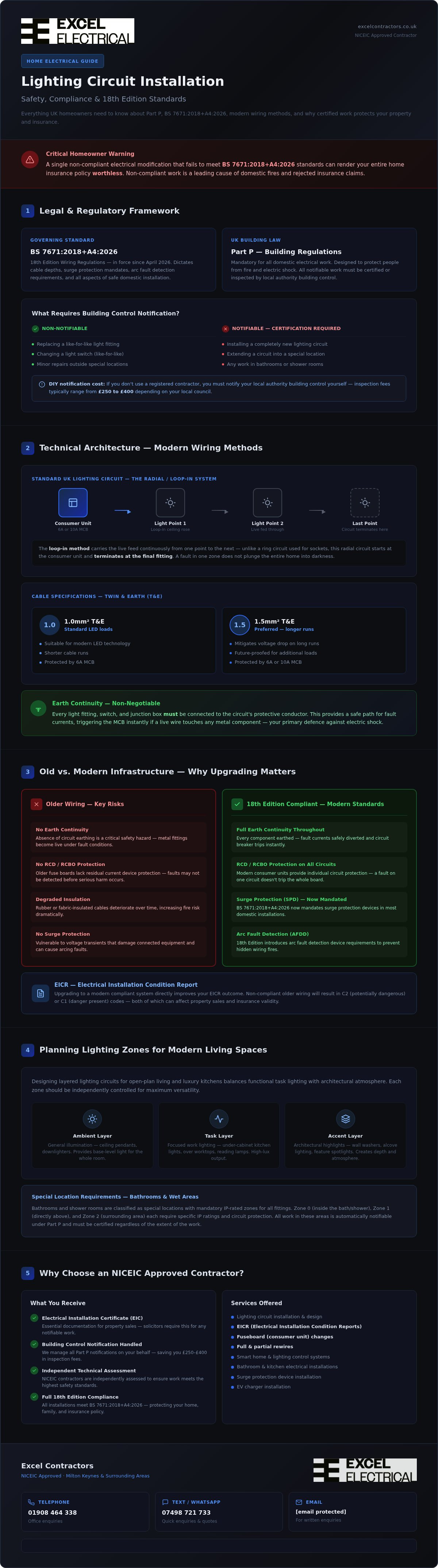
Compliance is not optional. The legal framework governing domestic work is Part P of the Building Regulations. This requires all electrical work in homes to be safe and designed to protect people from fire or electric shocks. Since April 2026, the industry has operated under the 18th Edition BS 7671:2018+A4:2026 standards. These regulations dictate everything from cable depths to the requirement for surge protection and arc fault detection. Failing to follow these rules creates significant risks. Non-compliant work is a leading cause of domestic fires and frequently leads to home insurance claims being rejected. If your wiring does not meet current standards, you are essentially self-insuring against any future electrical faults.
Is Lighting Circuit Installation Notifiable Work?
Not every electrical task requires building control notification, but a new lighting circuit installation certainly does. Whilst changing a light switch or replacing a like-for-like fitting is generally non-notifiable, installing a completely new circuit or extending one into a "special location" is different. Bathrooms and shower rooms are classified as special locations due to the increased risk of electric shock. Any work in these zones must be certified. If you don't use a registered contractor, you must notify local authority building control yourself. This often involves inspection fees between £250 and £400 depending on your local council.
The Role of the NICEIC Approved Contractor
Hiring an NICEIC Approved Contractor like Excel Contractors provides immediate peace of mind. We are independently assessed to ensure our work meets the highest technical and safety standards. Upon completion, we provide an Electrical Installation Certificate (EIC) and handle the building control notification on your behalf. This documentation is essential when selling your property, as solicitors will require proof of compliance for any major electrical changes. You can learn more about Why Hiring an NICEIC Approved Contractor is Vital for your next project. For a free quote or a video call estimation, call us on 01908 464338 or text 07498721733. You can also visit us at Nest farm, Lavendon, Olney, Milton Keynes, or email [email protected].
The Technical Architecture: Modern UK Wiring Methods
Modern domestic lighting is almost exclusively wired as a radial circuit. Unlike ring final circuits used for sockets, a radial circuit starts at the consumer unit and terminates at the last light fitting. In the UK, we rely on the "loop-in" system. This method allows the live feed to be carried from one point to the next, creating a continuous chain. Adhering to UK electrical wiring regulations ensures that this chain is robust and safe. Every lighting circuit installation must be designed to handle the specific electrical load of the property whilst maintaining long term stability.
For a standard lighting circuit installation, we typically use 1.0mm² or 1.5mm² Twin and Earth (T&E) cable. Whilst 1.0mm² is often sufficient for modern LED loads, 1.5mm² is frequently chosen for longer cable runs to mitigate voltage drop. Earth continuity is non-negotiable. Every light fitting, switch, and junction box must be connected to the circuit's protective conductor. This provides a path for fault currents, triggering the circuit breaker if a live wire touches a metal component. This safety mechanism is the primary defence against electric shocks in the home.
Loop-in at the Ceiling Rose vs. Loop-in at the Switch
Traditional UK homes often use the ceiling rose as the junction point for the loop-in system. This involves three or four cables meeting at the light fitting, which can be cumbersome and difficult to maintain. Modern installations increasingly favour looping at the switch. This method brings the permanent live and neutral wires directly into the switch back box. It is the superior choice for future-proofing. Many smart dimmers and automated switches require a neutral wire to function. By ensuring a neutral is present at every switch position, you avoid costly rewiring when you decide to upgrade to smart home technology.
Circuit Protection and Load Calculations
Every circuit requires precise protection. A standard 6A or 10A Type B circuit breaker is the norm. In the past, we calculated loads based on 60W or 100W tungsten bulbs. Today, the efficiency of LED lighting allows for significantly more fittings on a single circuit. However, we must still account for "inrush current", the brief surge of power when LEDs are first switched on. Under 18th Edition standards, almost all domestic lighting circuits require RCD (Residual Current Device) protection. This device monitors the balance of current and cuts power in milliseconds if a leak is detected. If you are uncertain about your current protection levels, calling us on 01908 464338 for a professional electrical assessment will help verify your system's integrity.
For further enquiries or to book a free video call quote, contact Excel Contractors at Nest farm, Lavendon, Olney, Milton Keynes. You can reach the office on 01908 464338, text 07498721733, or email [email protected].
Old vs. Modern Lighting Infrastructure: Why Upgrading Matters
Properties built before the mid-1960s often harbour a hidden danger within their walls. Until 1966, UK electrical regulations did not mandate a circuit protective conductor (CPC), or earth wire, for lighting. If your home still relies on this original wiring, any metal light fitting or switch plate poses a genuine risk of electric shock. A modern lighting circuit installation rectifies this by providing a continuous earth path, ensuring that any fault safely trips the protective device. Upgrading is not just about aesthetics; it is a fundamental safety requirement for any property pre-dating the 1970s.
The first step in modernising your home is an Electrical Installation Condition Report (EICR). This systematic inspection identifies degraded insulation, loose connections, and the presence of obsolete materials. During these assessments, we strictly follow the technical requirements for lighting installations to determine if a simple circuit upgrade or a more comprehensive partial rewire is necessary. Often, the condition of the lighting circuit serves as a reliable indicator for the health of the entire domestic system.
Signs Your Lighting Circuit Needs a Professional Upgrade
You don't always need an expert to spot the warning signs of failing infrastructure. If you notice lights flickering when other appliances turn on, or hear persistent buzzing from your switch plates, the system is likely struggling. A faint smell of burning or discolouration around light fittings suggests arcing, a serious fire hazard. Most critically, if your home still contains lead-sheathed or Vulcanised Indian Rubber (VIR) cabling, the insulation has almost certainly perished. These materials are well beyond their intended lifespan and require immediate replacement through a professional lighting circuit installation.
Consumer Unit Compatibility
A safe lighting system is only as effective as the consumer unit protecting it. Old-fashioned fuse boxes with re-wireable fuses cannot provide the millisecond response times of modern circuit breakers. When we install new lighting zones, we ensure your consumer unit is equipped with RCDs and, where appropriate, Arc Fault Detection Devices (AFDDs) to mitigate fire risks. You can read more about Upgrading Your Consumer Unit to see how it acts as the brain of your home's safety system. For a free quote on upgrading your infrastructure, call Excel Contractors on 01908 464338 or visit us at Nest farm, Lavendon, Olney, Milton Keynes. You can also text 07498721733 or email [email protected] for a video call estimation.
Planning Your Lighting Circuit for Open-Plan and Luxury Spaces
Modern architectural designs, particularly open-plan living areas and integrated kitchen-diners, require a sophisticated approach to electrical planning. A standard lighting circuit installation must now accommodate multiple layers of light to create a functional yet atmospheric environment. We move beyond the traditional "one room, one light" mentality by segmenting the space into distinct zones. This ensures that a large room can be brightly lit for cleaning or focused work, whilst remaining warm and inviting for evening relaxation.
In luxury kitchen environments, we implement three specific layers: task, mood, and accent lighting. Task lighting is positioned over work surfaces and hobs to ensure safety during food preparation. Mood lighting, such as pendants over an island or dimmable wall lights, defines the social areas. Accent lighting, including recessed LED strips in cabinetry or floor-level plinth lights, highlights the room's architectural features. Precision in the lighting circuit installation phase allows these layers to operate independently, giving you total control over the room's character.
Safety considerations extend to bathroom electrical zones. We strictly adhere to Ingress Protection (IP) ratings to ensure fittings are safe for their specific environment. For example, lights installed directly above a shower (Zone 1) require a higher IP rating than those further away from water sources. Our team ensures that every fitting selected is compliant with the 18th Edition standards, protecting your household from moisture-related electrical faults.
Zoning and Mood Lighting Control
Effective zoning relies on multi-gang switches and high-end dimming modules. By grouping fittings onto separate "legs" of the circuit, you can control different areas of a large room from a single point. We also prioritise future-proofing by installing high-quality LED drivers and ensuring neutral wires are present at every switch. This allows for the seamless integration of automated control systems or bespoke dimming solutions for artwork and architectural features later on.
External and Garden Lighting Circuits
Extending your lighting into the garden requires specialised materials to withstand the British weather. We utilise Steel Wire Armoured (SWA) cable for all underground runs to provide mechanical protection against accidental damage from gardening tools. All external circuits are protected by dedicated RCDs to ensure any fault is isolated immediately. You can find detailed information on External Electrical Wiring for Garden Lighting in our dedicated guide. To discuss a professional lighting circuit installation for your home or garden, call Excel Contractors on 01908 464338 or book an electrical design consultation today.
For more information or to request a free video call quote, contact Excel Contractors at Nest farm, Lavendon, Olney, Milton Keynes. You can reach the office on 01908 464338, text 07498721733, or email [email protected].
Choosing Excel Electrical for Your Lighting Installation
Selecting a contractor for your lighting circuit installation is a decision rooted in trust and safety. At Excel Contractors, we don't just pull cables; we engineer systems that comply with the rigorous BS 7671:2018+A4:2026 standards. Our NICEIC Approved status means every project undergoes meticulous planning and execution. We understand that having tradespeople in your home can be intrusive. Our team operates with a clear system designed to minimise disruption, ensuring your living spaces remain clean whilst we work on your electrical infrastructure.
The final testing phase is the most critical part of our process. We perform comprehensive inspections to verify earth continuity and insulation resistance before any circuit is energised. These tests ensure the protective devices in your consumer unit will function correctly during a fault. Upon completion, you receive an Electrical Installation Certificate. This document is your proof of compliance and is essential for home insurance and future property sales. A professional electrical installation ensures that your home remains a safe environment for your family.
Free Quotes and Video Call Estimations
We recognise that Milton Keynes residents lead busy lives. To streamline the estimation process, we offer video call quotes. This allows us to assess your current consumer unit and the scope of the lighting circuit installation without an initial site visit. To prepare for the call, simply ensure you have access to your fusebox and the areas where new lighting is required. You can call 01908 464 338 or text 07498721733 to book your free consultation today. Our estimates are transparent, detailed, and provide the clarity you need to move forward with confidence.
Our Local Expertise and Credentials
Based at Nest farm, Lavendon, Olney, Milton Keynes, we are perfectly positioned to serve Newport Pagnell, Bedford, and the surrounding counties. Our reputation as a TrustMark registered contractor reflects our commitment to high-quality workmanship and customer protection. We are also proud to be a registered supplier for Abbey Mill Homes, a testament to our ability to deliver luxury electrical solutions in high-end properties. Whether you require a kitchen rewire or a full domestic system upgrade, our 18th Edition qualified electricians provide the technical accuracy your home deserves. Visit us in Lavendon or email [email protected] to discuss your project requirements.
For all domestic electrical needs, contact Excel Contractors at Nest farm, Lavendon, Olney, Milton Keynes. You can reach the office on 01908 464338, text 07498721733, or email [email protected] for expert advice and reliable service.
Securing Your Home with Professional Lighting Standards
A successful lighting circuit installation is the foundation of a safe and functional modern home. By prioritising 18th Edition compliance and addressing outdated infrastructure, you protect your property from fire hazards and ensure your insurance remains valid. Whether you are designing a luxury kitchen or upgrading an old fuse box, the technical precision of your wiring dictates the long-term reliability of your system.
Excel Contractors provides the expertise required to navigate these complex regulations whilst delivering a finish that enhances your living space. As an NICEIC Approved Contractor and TrustMark Registered business, we offer the peace of mind that comes with professional certification. We invite you to Request a Free Professional Lighting Quote from Excel Electrical to begin your project with a clear, expert assessment. Our free video call quotes are available to streamline the process for local residents in Milton Keynes and the surrounding counties.
Call our office at Nest farm, Lavendon on 01908 464338, text 07498721733, or email [email protected] today. We look forward to helping you achieve a safe, compliant, and beautifully lit home.
Frequently Asked Questions
How long does it take to install a new lighting circuit in a three-bedroom house?
A standard lighting circuit installation in a three-bedroom house typically takes between one and two days to complete. The duration depends on the ease of access to floor voids and whether cables are being chased into solid walls or run through existing cavities. If your property requires extensive lifting of floorboards or carpets, the timeframe may extend slightly to ensure a tidy and professional reinstatement.
Do I need a new consumer unit to add more lights to my home?
You don't always require a new consumer unit, provided your existing board has a spare "way" and sufficient RCD protection. However, many older fuse boxes lack the modern safety components mandated by the 18th Edition regulations. If your current unit is obsolete or full, we may recommend a consumer unit upgrade to ensure your new lighting zones are safe and fully compliant with national standards.
Can I install my own lighting circuit if I follow a UK wiring guide?
Whilst you can physically install the wiring yourself, a new circuit is "notifiable work" under Part P of the Building Regulations. This means you must pay your local authority building control to inspect and certify the work, which often costs between £250 and £400. Hiring an NICEIC contractor avoids these fees and ensures your home insurance remains valid through professional certification and testing.
What is the difference between a lighting circuit and a ring main?
The primary difference lies in the wiring topology and the electrical load. A lighting circuit is usually a radial system where power travels in a single line from the consumer unit to each fitting. A ring main is a continuous loop designed for higher-power sockets. Lighting circuits are also protected by much lower-rated breakers, typically 6A or 10A, compared to the 32A used for socket circuits.
Why do my lights flicker when I turn on a high-power appliance?
Flickering lights often indicate a voltage drop or a loose connection within your consumer unit or the circuit itself. When a high-power appliance like an electric shower starts, it draws significant current, which can cause a momentary dip in power to other circuits. This is more common in properties with older wiring or where the incoming mains supply requires maintenance from the grid operator.
Is it mandatory to have an EICR before installing new lighting?
An EICR is not legally mandatory before every minor change, but it is highly recommended for older properties. We must verify that the existing infrastructure can safely support additional loads before we begin any work. Conducting a preliminary check ensures that your new lighting doesn't trigger faults in hidden, degraded wiring elsewhere in the home, providing you with essential peace of mind.
What is the average cost of a lighting circuit installation in Milton Keynes?
The cost for a lighting circuit installation in Milton Keynes depends on the property's layout and the specific fittings you choose. Because every home is different, we provide transparent, tailored estimates following a site visit or a video call. You can call our office at Nest farm, Lavendon on 01908 464338 or text 07498721733 to arrange your free consultation and receive an accurate quote.
Can I use existing old wiring for new LED downlights?
You can only use existing wiring for LED downlights if it includes a functional earth wire and the insulation resistance is within safe limits. LEDs are highly efficient but sensitive to electrical noise and poor connections. If your wiring dates from before 1966, it likely lacks an earth, making a full circuit replacement necessary. For expert advice, contact Excel Contractors at [email protected] or visit us at Nest farm, Lavendon, Olney, Milton Keynes.


