

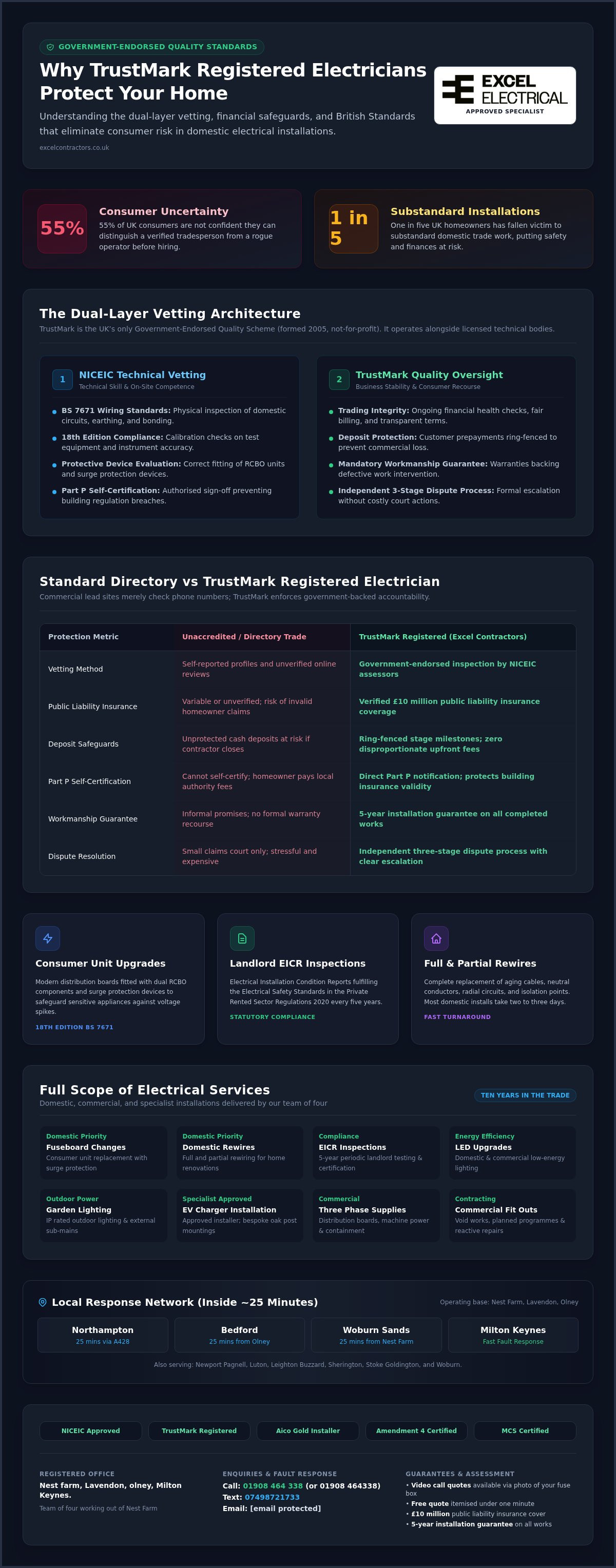
According to recent industry findings, 55% of UK consumers are not confident they can distinguish a verified tradesperson from a rogue operator, whilst one in five homeowners has fallen victim to substandard work. When you invite someone into your home to alter circuits or replace a consumer unit, you shouldn't have to gamble with your family's safety. Choosing a TrustMark registered electrician removes that uncertainty by giving you government-endorsed validation backed by strict British Standards.
You might already feel overwhelmed by confusing trade badges, Part P notifications, and the fear of poor wiring that invalidates your building insurance. In this guide, you'll discover how hiring a TrustMark registered electrician protects your home, finances, and domestic electrical safety. We outline the strict vetting process behind government-endorsed quality schemes, explain how deposit protection safeguards your project funds, and show you how to verify an insured domestic specialist with complete confidence.
Key Takeaways
- Understand how hiring a TrustMark registered electrician guarantees that your installer is vetted through accredited bodies like NICEIC for technical skill and fair trading.
- Learn how deposit protection rules and an independent three-stage dispute process safeguard your project funds against unfinished or substandard domestic work.
- Discover why verified competent person schemes matter for Building Regulations Part P self-certification and keeping your home insurance fully valid.
- Follow clear steps to check trade credentials and licence numbers on the official register before booking consumer unit upgrades or domestic rewires.
- Find out what level of installer protection to expect, including the value of £10 million public liability cover and a five-year workmanship guarantee.
What is a TrustMark registered electrician?
TrustMark represents the only Government-Endorsed Quality Scheme covering domestic repairs, maintenance, and home improvements across the United Kingdom. Formed in 2005 as a not-for-profit organisation, it bridges the gap between technical regulations and consumer rights. While commercial platforms offer basic review systems, answering what is a TrustMark in the UK construction trade reveals an enforceable standard backed by formal scrutiny. A TrustMark registered electrician is a vetted specialist assessed against BS 7671 standards, proving both technical proficiency and operational stability under government-backed scrutiny.
Electrical safety requires far more than surface-level checks. Hiring an accredited specialist ensures your project meets verified criteria across three core areas:
- Verified technical skill: Work conforms directly to BS 7671 wiring standards, preventing fire hazards and voltage faults.
- Trading integrity: Contractors maintain transparent contracts, clear payment terms, and proper financial records.
- Consumer recourse: Homeowners access clear complaints procedures and formal dispute resolution mechanisms.
The Government-Endorsed Quality Scheme framework
You cannot join TrustMark by paying an annual membership fee or listing a profile. Businesses must be certified through licensed Scheme Providers, primarily technical industry bodies like NICEIC. While standard trade directories simply confirm a contact number or collect unverified online reviews, the TrustMark framework enforces ongoing independent oversight. NICEIC assesses the technical trade qualifications directly; TrustMark reviews the business health, customer protections, and operational integrity behind the scenes. This dual-layer structure ensures that registered contractors remain accountable long after a certificate is issued.
Technical assessment and 18th Edition compliance
Domestic installations demand rigorous adherence to current 18th Edition wiring regulations. A TrustMark registered electrician undergoes regular on-site assessments to confirm their installations, calibration equipment, and safety practices align with current British Standards. Evaluators inspect live domestic work to verify critical safety measures, including the correct installation of an RCBO (residual current circuit breaker with overcurrent protection) and appropriate surge protection devices.
This scrutiny applies to domestic houses, flats, and private rental accommodations. For landlords navigating the Electrical Safety Standards in the Private Rented Sector (England) Regulations 2020, selecting an accredited contractor guarantees that every Electrical Installation Condition Report (EICR) or consumer unit replacement satisfies statutory building safety requirements.
Key protections homeowners receive from TrustMark registration
Hiring a tradesperson to rewire a kitchen or replace a distribution board involves significant trust. When you choose a TrustMark registered electrician, that trust is reinforced by formal consumer safeguards. Unregulated operators often rely on verbal estimates and informal agreements. In contrast, accredited contractors operate under legally enforceable standards covering pricing transparency, dispute handling, and workmanship guarantees. Homeowners seeking reliable domestic upgrades can explore the official key protections from TrustMark, which guarantee that your funds and property remain safeguarded throughout the project.
Working alongside an NICEIC approved contractor who holds TrustMark status ensures complete structural protections across several areas:
- Transparent contracts: Itemised written quotes define the exact scope of works before any tools touch your walls.
- Mandatory insurance: Businesses must carry verified public liability cover to safeguard against structural or accidental property damage.
- Deposit protection: Prepayments are ring-fenced to prevent financial loss if an installer experiences commercial insolvency.
- Guaranteed workmanship: Installations include mandatory warranty periods covering remedial interventions for defective work.
Financial safeguards and deposit security
TrustMark trading codes strictly regulate financial transactions between contractors and clients. Electricians cannot demand disproportionate upfront cash deposits before commencing domestic installations. Instead, payment schedules must follow transparent milestones linked directly to delivered materials or verified stages of practical completion. Because registered firms undergo regular financial health checks, the risk of a contractor abandoning unfinished work mid-project is dramatically reduced.
Alternative Dispute Resolution (ADR) and warranties
If an installation fails to meet expectations, you are not forced into expensive court litigation. TrustMark provides a free three-stage dispute resolution process. Homeowners raise the concern with the contractor directly at Stage 1, escalate the matter to the Scheme Provider (such as NICEIC) at Stage 2, and access the independent Dispute Resolution Ombudsman (DRO) at Stage 3 if the issue remains unresolved after 12 weeks. Crucially, a TrustMark registered electrician must provide written workmanship warranties, ensuring defective circuits or faulty switchgear are rectified at no extra cost.
Rigorous customer charter standards
Technical compliance represents only half of the accreditation criteria. The TrustMark Customer Charter enforces clear operational standards, requiring contractors to arrive punctually, maintain tidy workspaces, and communicate variations promptly. Vulnerable homeowners are protected against aggressive sales tactics and opaque pricing. If you are planning domestic improvements, choosing verified domestic electrical services gives you total peace of mind through structured accountability and clear, written terms.
TrustMark registered vs unaccredited electricians: comparison
Hiring an unverified worker often looks like a cost saving on paper, but uncertified domestic electrical work carries legal and financial liabilities. While an unaccredited contractor offers an informal quote, a TrustMark registered electrician provides legally certified workmanship backed by national trading standards. Knowing how these two paths diverge helps you avoid substandard modifications and expensive remedial bills.
| Protection Feature | TrustMark Registered Electrician | Unaccredited Electrician |
|---|---|---|
| Technical Vetting | Annual on-site audits and verified BS 7671 qualifications | Unchecked skills with no mandatory technical oversight |
| Part P Self-Certification | Direct notification to local authority building control | No authority to self-certify notifiable domestic work |
| Consumer Recourse | Access to the independent Dispute Resolution Ombudsman | Limited to civil court proceedings at your own expense |
| Insurance & Guarantees | Mandatory public liability cover and workmanship warranties | Variable or absent cover; zero insurance-backed warranty |
Part P certification and building control compliance
Major domestic electrical tasks, including consumer unit replacements, new circuit installations, and bathroom additions, are legally notifiable under Building Regulations Part P. An accredited installer completes the project, issues an Electrical Installation Certificate, and notifies building control directly. When you hire an unregistered installer, you must pay your local authority an upfront building notice fee to send an independent inspector to evaluate the installation. Leading industry bodies recommend that you verify your electrician prior to commissioning work to ensure they hold self-certification privileges.
Insurance validation and property transaction risks
Insurers expect fixed domestic wiring to satisfy national safety codes. If uncertified electrical work triggers a house fire or property damage, loss adjusters can reject insurance claims on the grounds of negligence. Uncertified work also derails property sales. Conveyancing solicitors routinely demand Part P compliance certificates for altered circuits; missing documentation stalls transactions and invites price reductions. If your home has undergone undocumented alterations, booking an Electrical Installation Condition Report provides a full safety assessment of the existing circuits.
How to verify your electrician and plan domestic work
Studies show that 35% of UK adults fail to perform verification checks before hiring a tradesperson. Taking five minutes to confirm credentials prevents project delays, non-compliant wiring, and unneeded expenses. Follow this five-step sequence before commissioning domestic works:
- Step 1: Search the business name or licence number directly on the official TrustMark register.
- Step 2: Confirm active registration with an approved competent person scheme, such as NICEIC.
- Step 3: Gather initial project requirements, floor layouts, or equipment locations.
- Step 4: Request an itemised quotation with explicit milestones and parts breakdowns.
- Step 5: Check physical identification, public liability insurance, and written warranty terms.
Checking credentials and on-site identification
Never rely solely on a website badge. Search the contractor's trading name or unique licence number on the online TrustMark database to confirm their status remains valid. When the electrician arrives at your property, inspect their Scheme Provider photo identification card. Check their policy documents to confirm they hold substantial cover, such as ten million pounds of public liability insurance. This level of protection ensures substantial cover should accidental structural damage occur during chasing or board replacements.
Preparing for quotations and remote assessments
Modern visual assessments simplify the pricing process. Snapping a clear photo of your fuse box allows an engineer to inspect your existing consumer unit, main switch rating, and earthing arrangements before visiting. You can also book a video call quote to examine cable containment runs, consumer unit clearance, and meter locations. Ensure your written quote itemises hardware specifically, including modern surge protection devices and individual RCBO switchgear rather than generic allowances.
Priority domestic projects requiring certified expertise
High-load residential upgrades carry no margin for technical error. Complete house rewires, fuse box changes, and dedicated supplies for induction hobs demand precise design. When adding high-draw infrastructure or garden power, installers must calculate cable derating factors and run a dedicated radial circuit from the main distribution board. Reviewing a practical home electrical maintenance checklist helps you identify circuit vulnerabilities before arranging work. If your installation requires urgent attention, you can book an itemised quote with our team to plan your project safely.
Professional electrical contracting across Milton Keynes and Olney
Excel Electrical operates directly from Nest Farm, Lavendon, Olney, Milton Keynes. As an established NICEIC Approved Contractor and TrustMark registered electrician, our team of four brings ten years in the trade to every domestic and commercial property we enter. We hold ten million pounds of public liability insurance cover, ensuring dependable financial protection across all installations. To underline our commitment to standards, every domestic project we complete is backed by our five-year installation guarantee.
Homeowners seeking a verified TrustMark registered electrician can book services directly through Excel Electrical for domestic safety and compliance.
Full range of domestic and commercial electrical services
We deliver an extensive selection of domestic electrical services, maintenance, and commercial installations. Our daily work centres on critical domestic safety interventions:
- Consumer unit upgrades: Replacing outdated fuse boxes with metal-clad consumer units fitted with Type A RCBO devices and surge protection.
- Rewiring projects: Full rewires, kitchen rewires, and bathroom electrical upgrades designed around your living spaces.
- Inspection and testing: Thorough landlord EICR inspections to satisfy the Electrical Safety Standards in the Private Rented Sector (England) Regulations 2020.
- Modern infrastructure: Dedicated EV charger installations, outdoor and garden lighting, distribution board upgrades, commercial fit outs, and emergency electrical services.
Local service coverage and rapid response
Our workshop base at Nest Farm positions us within 25 minutes of Milton Keynes, Olney, Newport Pagnell, and Sherington. We operate rapid response services to Northampton, which is 25 minutes away on the A428, alongside regular callouts to Bedford and Woburn Sands within that same 25-minute window. Our local mobile vans also cover Luton, Leighton Buzzard, Stoke Goldington, and Woburn. Most domestic installations are completed within two to three days, keeping disruption to an absolute minimum.
Straightforward quotation and contact options
Planning electrical alterations should never involve guesswork. We provide free quotes that are itemised down to individual circuits and hardware components. Homeowners can arrange a video call quote to walk through job scopes remotely or simply send a clear photo of your fuse box for rapid assessment. Call our office on 01908 464338, text our engineers on 07498721733, or email [email protected] to discuss your upcoming project with our qualified team.
Secure your home with verified electrical standards
Choosing a TrustMark registered electrician ensures your domestic wiring meets strict BS 7671 standards whilst shielding your finances through deposit protection and independent ombudsman access. From compliant consumer unit upgrades to full domestic rewires, certified self-certification keeps your property legally protected under Building Regulations Part P without building control fees or insurance complications.
Our team brings ten years in the trade to every home we enter. As an NICEIC Approved Contractor and TrustMark registered installer, we back our domestic workmanship with ten million pounds of public liability insurance cover alongside a five-year installation guarantee. Holding Aico Gold installer status and Amendment 4 compliance, we take pride in delivering installations that put your safety first. Contact Excel Electrical for a free quote on 01908 464338, text 07498721733, or arrange a convenient video call quote to start your domestic electrical project with complete confidence.
Frequently Asked Questions
What is the difference between an NICEIC Approved Contractor and a TrustMark registered electrician?
NICEIC validates trade-specific technical skill, whereas TrustMark provides an overarching framework for consumer rights and trading standards. NICEIC assesses practical wiring capability against BS 7671 safety regulations through regular site inspections. In contrast, TrustMark evaluates financial stability, fair trading practices, and customer care. A TrustMark registered electrician achieves accreditation through an approved Scheme Provider like NICEIC, uniting technical excellence with formal consumer protection under one verified standard.
Can any qualified electrician register with TrustMark?
No, electricians cannot simply pay a fee to join TrustMark directly. An installer must first hold full accreditation through an approved Scheme Provider such as NICEIC. Beyond holding technical electrical qualifications, the business must pass vetting regarding trading history, financial standing, insurance levels, and complaints handling. Only tradespeople who consistently satisfy both trade-specific benchmarks and the TrustMark Customer Charter receive official government-endorsed registration.
Is TrustMark registration legally required for domestic electrical work in the UK?
TrustMark registration is not a statutory legal requirement for domestic work, but Part P compliance with Building Regulations is mandatory. Unaccredited electricians can legally trade, yet homeowners must pay local authority building control to inspect notifiable jobs. TrustMark status is voluntary, demonstrating that a business operates above minimum safety baselines. It is also mandatory for installers participating in government-funded energy efficiency or home retrofit programmes.
How does TrustMark registration protect my payments and deposits?
TrustMark trading standards prevent contractors from demanding unreasonable upfront cash sums. Electricians must provide transparent, itemised quotes and structure payments around agreed project milestones linked to completed labour or delivered equipment. Registered businesses are audited for financial stability, meaning your advance funds are safeguarded. If an installer ceases trading before completing an installation, deposit protection mechanisms ensure you do not suffer total financial loss.
What happens if a dispute arises with an accredited electrical contractor?
Homeowners have access to a clear, three-stage dispute resolution process. You first raise the issue directly with the contractor to seek an internal solution. If the problem persists, you escalate the dispute to the Scheme Provider, such as NICEIC, for independent mediation. If the matter remains unresolved after 12 weeks, you can access the independent Dispute Resolution Ombudsman free of charge without entering court litigation.
Can a TrustMark electrician self-certify Part P Building Regulations work?
Yes, a TrustMark registered electrician accredited through a body like NICEIC can self-certify domestic work under Part P of the Building Regulations. This applies to major domestic projects such as full house rewires, new circuit installations, and consumer unit upgrades. The contractor tests the system, issues a Building Regulations Compliance Certificate, and notifies your local council directly, saving you independent local authority inspection fees.
How do I check if an electrician holds genuine TrustMark accreditation?
You can verify credentials by visiting the official TrustMark website and searching the business name or licence number. Avoid relying purely on marketing graphics or vehicle decals. When the engineer arrives at your home, ask to inspect their Scheme Provider photo identification card. You can also contact our team at Nest Farm in Olney on 01908 464338 to verify our credentials before scheduling domestic work.
Does TrustMark cover installations like consumer unit upgrades and EV charge points?
Yes, TrustMark covers the full spectrum of domestic electrical work, including consumer unit upgrades, EV charge point installations, full rewires, and landlord testing. Because these high-load installations involve significant technical safety requirements, using a verified installer guarantees that all protective devices, surge protection equipment, and radial circuits comply fully with BS 7671 standards, manufacturer specifications, and national building safety rules.


