

What if the tradesperson updating your consumer unit has just invalidated your home building insurance? Most homeowners assume that anyone carrying an electrical tester can sign off domestic wiring, but hiring someone who isn't an 18th edition qualified electrician puts your household at serious risk. Substandard installations create hidden fire hazards, fail local authority building control checks, and leave you legally unprotected. You deserve absolute certainty that the wiring behind your walls is safe, and making sense of British Standards shouldn't feel like a guessing game.
Discover what 18th Edition BS 7671 qualifications mean for your domestic safety, legal compliance, and property installations. You will learn the exact regulations governing modern UK homes, find out how to verify an installer's NICEIC credentials, and see how certified work protects your investment while fully satisfying local building control.
Key Takeaways
- Understand how BS 7671 governs national safety standards and what the latest amendments require for modern UK homes.
- Discover the mandatory safety hardware inside a modern metal consumer unit, including surge protection and individual RCBO devices.
- Learn why hiring an 18th edition qualified electrician is legally required under Part P to avoid invalidating your building insurance.
- Follow a practical checklist to verify trade credentials on official databases such as the NICEIC Competent Person register.
- Find out how working with qualified professionals guarantees building control approval and long-term domestic electrical safety.
What Does an 18th Edition Qualified Electrician Actually Mean?
While many trade websites treat the 18th Edition as merely a classroom certificate or an exam code like City & Guilds 2382, it represents something far more critical for you as a property owner. An 18th edition qualified electrician has proven their working knowledge of the national benchmark that protects domestic buildings from fire, shocks, and catastrophic circuit failures. They know how to calculate cable capacities, assess earthing arrangements, and ensure every circuit safely disconnects during a fault.
Understanding the BS 7671 Wiring Regulations
In the UK, domestic electrical work is governed by the national publication formally established as the BS 7671 electrical wiring standards. Published jointly by the Institution of Engineering and Technology (IET) and the British Standards Institution (BSI), these rules dictate how every single cable, socket, and distribution board must perform.
Modern households draw significantly more power than properties did decades ago. Between heat pumps, induction hobs, and multiple digital devices running simultaneously, an uncertified tradesperson can easily overload older circuits. Faulty wiring and undersized protective devices remain leading causes of residential fires across the country. Hiring someone who holds active 18th Edition credentials guarantees that your installer understands exact volt-drop tolerances, proper containment, and secure terminations at every point.
The Role of Recent Amendments
The regulations are not static. They are updated through regular amendments to address emerging domestic technologies and modern energy demands. Working with an 18th edition qualified electrician ensures your home benefits from the latest safety mandates, which include:
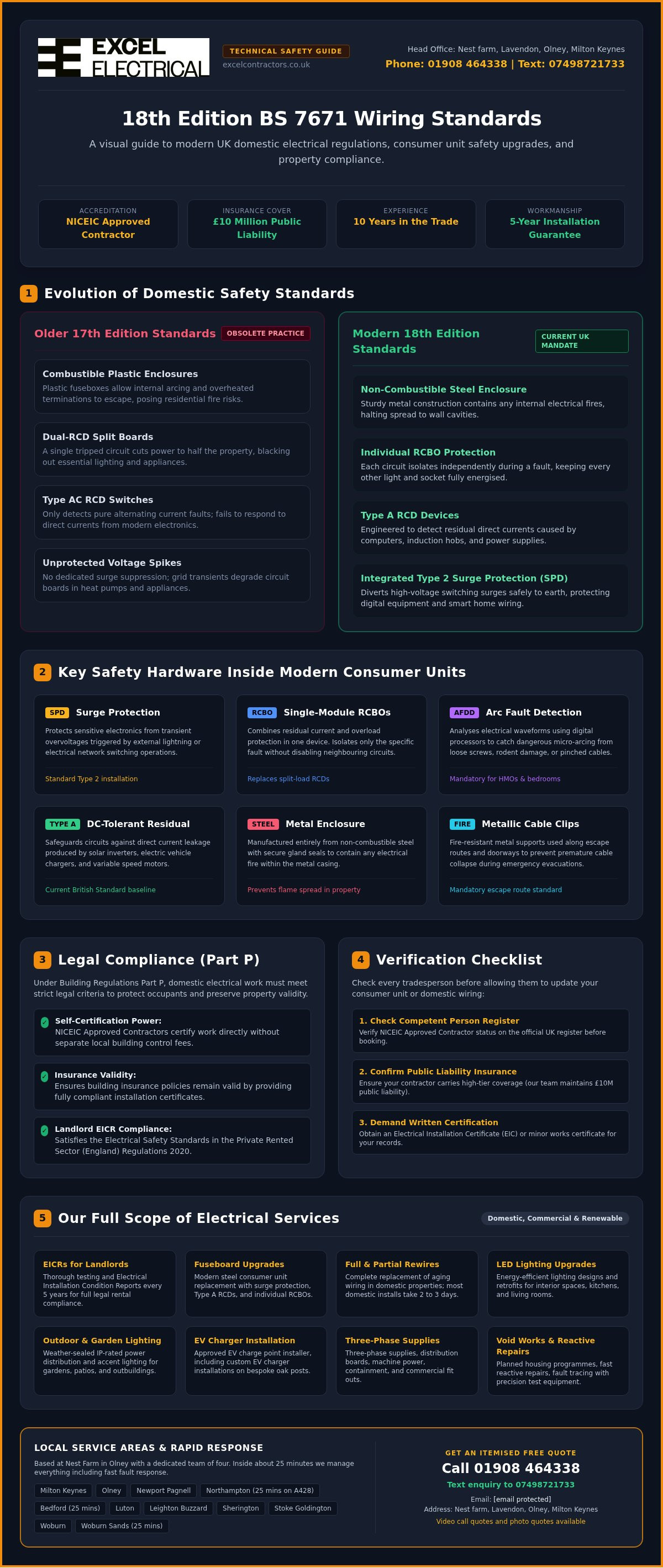
- Residual Current Breakers with Overcurrent Protection (RCBO): Replacing outdated dual-RCD split boards with individual RCBO protection to stop an isolated fault from blacking out half your property.
- Type A RCD Protection: Protecting circuits against residual direct currents produced by modern electronic goods and appliance power supplies, replacing obsolete Type AC switches.
- Renewables and Clean Power Integration: Applying updated standards for dedicated radial circuits serving solar energy systems, domestic battery storage, and electric vehicle charge points.
These updates safeguard your household against modern electrical risks, making sure newly installed equipment runs efficiently and safely for years to come.
Crucial Upgrades Mandated by Modern 18th Edition Standards
Modern electrical standards do far more than replace old wires. The updates set out by the IET 18th Edition Wiring Regulations mandate specific protective devices designed to stop domestic fires before they ignite and prevent expensive hardware destruction. An 18th edition qualified electrician uses these technical requirements to make sure your home's infrastructure can handle modern domestic power loads without risk.
Mandatory Surge Protection and Modern Consumer Units
Older 17th Edition consumer units relied on dual-RCD split arrangements housed in combustible plastic enclosures. Modern regulations require all new domestic consumer unit boards to be manufactured from non-combustible steel. This prevents internal arcing from escaping into the property.
In addition, modern boards integrate dedicated Type 2 surge protection devices. These units divert transient overvoltages caused by switching surges or grid fluctuations safely away to earth. They protect expensive equipment like heat pumps, computers, and smart appliances from silent internal component degradation. Pairing this with single-module RCBOs ensures an overload on a garden radial circuit won't plunge your entire ground floor into darkness.
Arc Fault Detection Devices (AFDDs) Explained
Standard miniature circuit breakers detect overloads, while RCDs detect earth leakage. Neither responds to dangerous micro-arcing caused by pinched cords, loose terminals, or rodent-damaged cabling behind plasterboard. AFDDs constantly analyse electrical waveforms using digital processors. If they detect the erratic signature of a sparking arc, they trip the circuit instantly. Modern regulations mandate AFDDs in higher-risk residential settings such as houses in multiple occupation (HMOs) and strongly recommend them for domestic circuits supplying bedrooms to stop smouldering fires during the night.
Cable Support and Fire Safety Improvements
Fire safety extends along the entire cable run. Under modern standards, all cabling installed along escape routes, doorways, and corridors must be secured using fire-resistant metal clips rather than plastic trunking or standard PVC cable clips. This requirement prevents cables from dropping down during a fire, removing a lethal entanglement hazard for escaping occupants and responding emergency fire crews.
If you have an older distribution board with rewirable fuses or brittle plastic casing, book a consumer unit upgrade with a certified installer to bring your property up to current British safety standards.
Why Hiring an 18th Edition Electrician Is Essential for Property Owners
Electrical safety is not just a technical consideration; it is a legal safeguard for your property. When you hire an 18th edition qualified electrician, you protect your home against structural fire risks while maintaining full legal compliance with English housing laws and local authorities. Uncertified electrical work creates serious liabilities that can cost thousands of pounds and disrupt future property sales.
Compliance with Part P Building Regulations
In England and Wales, domestic electrical work must comply with strict statutory standards under Building Regulations Approved Document P. High-risk alterations, including consumer unit replacements, full house rewires, and any new circuits in kitchens or bathroom zones, are legally notifiable to Local Authority Building Control (LABC).
If you hire an unregistered tradesperson, you must pay your local council building control team hundreds of pounds to inspect and approve the work independently. In contrast, checking our NICEIC approved contractor guide reveals how registered competent persons self-certify their own work. They notify the council directly and issue you an official Building Regulations Compliance Certificate, which solicitors require when selling a home.
Landlord Legal Responsibilities and EICRs
Private landlords face strict statutory requirements under the Electrical Safety Standards in the Private Rented Sector (England) Regulations 2020. These rules require landlords to have domestic installations inspected and tested at least every five years.
A qualified tradesperson completes an Electrical Installation Condition Report (EICR) to verify system integrity. If the report identifies C1 (Danger Present) or C2 (Potentially Dangerous) defects, landlords must hire an 18th edition qualified electrician to complete remedial works within 28 days. Failing to produce a compliant EICR can result in local council civil penalties reaching up to £30,000 per breach.
Protecting Your Home Insurance Policy
Loss adjusters scrutinise domestic electrical paperwork following house fires. Most UK building insurance policies include clauses requiring fixed wiring to be maintained in a safe condition by competent professionals. If an uncertified DIY installation or an unregistered handyman caused an electrical blaze, your insurer can refuse your payout entirely. Hiring certified, insured contractors holding valid public liability coverage ensures your insurance cover remains intact and your family stays safe.
How to Verify Electrician Qualifications and Credentials
Protecting your property starts before tools touch a wall. Anyone can print a professional logo or claim trade experience, but confirming an 18th edition qualified electrician holds legitimate credentials requires four systematic checks:
- Confirm Competent Person status: Verify that the contractor is registered to self-certify domestic work under Part P.
- Examine proof of qualification: Ask to see their Electrotechnical Certification Scheme (ECS) gold card or BS 7671 course certificate.
- Check public register listings: Look up the trading name on official regulatory databases.
- Validate insurance coverage: Ensure the business holds active public liability insurance to cover structural risks.
Following our practical home electrical maintenance checklist helps you identify early system faults so you can vet contractors methodically rather than rushing during an emergency.
Checking Competent Person Scheme Registers
There is a substantial difference between holding a classroom certificate and being authorised to sign off domestic installations. An individual might pass a theoretical exam, yet lack the technical competence or auditing required to self-certify under building control.
Always search the national NICEIC Find a Contractor register or the Registered Competent Person Electrical roll. Look for the NICEIC Approved Contractor designation, which involves regular technical assessments of on-site work and calibration testing equipment. Government-endorsed TrustMark status adds an extra layer of consumer vetting, ensuring the business meets strict trading benchmarks and transparent customer dispute standards.
Requesting Certification and Insurance Documentation
Reputable tradespeople never hesitate to produce proof of competence. Ask your contractor to show their ECS card on arrival; qualified electricians hold a gold card indicating formal apprenticeship completion alongside current 18th Edition assessments.
Check the company's insurance schedule. Modest policies may fail to cover major structural fire damage. At Excel Electrical, we maintain ten million pounds of public liability insurance through NICEIC Insurance Services, giving you complete reassurance while works take place. When planning your next domestic installation, contact our certified team for a free itemised quote to guarantee verified, safe workmanship.
Professional Domestic Electrical Services from Excel Electrical
Finding a trusted 18th edition qualified electrician shouldn't involve dealing with distant training academies or unvetted contractors. Excel Electrical Installations Ltd delivers certified expertise directly to your doorstep. Backed by over ten years in the trade, our team of four combines technical precision with clear communication, ensuring every domestic installation meets current British Standards and satisfies local building control.
Specialist Domestic Installations and Safety Inspections
We handle every stage of your home's electrical work, taking between two to three days to complete most domestic installations and partial rewires. Our full scope of domestic services includes:
- Consumer unit upgrades: Replacing outdated fuse boxes with metal-clad, RCBO-protected units featuring integral surge protection.
- Full and partial rewires: Upgrading aging vulcanised rubber or degraded PVC wiring throughout older properties.
- EICR testing and inspections: Providing landlords and homebuyers with certified safety reports and completing required remedial repairs.
- Kitchen rewires and bathroom electrical upgrades: Installing dedicated radial circuits, IP rated fittings, and supplementary bonding.
- EV charger installations: Fitting high-output domestic charging points with certified earthing arrangements.
- Electrical maintenance and emergency electrical services: Swift fault finding and circuit isolation when urgent issues arise.
As an NICEIC Approved Contractor, TrustMark registered firm, and Aico Gold installer, we back all our installation work with a comprehensive 5-year guarantee.
Local Coverage Across Buckinghamshire and Bedfordshire
Operating from Nest farm, Lavendon, Olney, Milton Keynes, we provide responsive coverage across the entire surrounding region. Our location allows our team to reach jobs quickly, offering fast fault response times inside about 25 minutes.
We regularly serve homeowners and landlords across Milton Keynes, Olney, Newport Pagnell, Bedford (25 minutes away), Northampton (25 minutes via the A428), Luton, Leighton Buzzard, Sherington, Stoke Goldington, Woburn, and Woburn Sands.
Request Your Free Itemised Electrical Quote
Getting your project priced is straightforward. You can snap a clear photo of your fuse box and send it over, or book a convenient video call quote so we can assess your consumer unit, earthing arrangements, and circuit layout remotely. Every quote we provide is completely free, transparent, and fully itemised with zero obligation.
To discuss your project or schedule an installation with a verified 18th edition qualified electrician, call our office on 01908 464338 or text our mobile on 07498721733. You can also reach our team by email at [email protected] or visit excelcontractors.co.uk today.
Secure Your Property with Certified Electrical Standards
Prioritising domestic safety is the most reliable way to protect your property, your family, and your financial investment. Upgrading your consumer unit and maintaining fixed wiring under modern BS 7671 standards prevents electrical fires, eliminates transient voltage damage, and maintains full compliance with Part P Building Regulations. Choosing an 18th edition qualified electrician removes every doubt, keeping your building insurance valid and your local authority paperwork in order.
You shouldn't have to compromise on quality or peace of mind. As an NICEIC Approved Contractor and TrustMark registered team, Excel Electrical brings proven technical discipline to every project. We protect your household with ten million pounds of public liability insurance cover and back every completed job with our five-year installation guarantee. Book your free quote with an NICEIC Approved 18th Edition electrician today and take the confident first step towards an electrically sound, fully certified home.
Frequently Asked Questions
What is an 18th edition qualified electrician?
An 18th edition qualified electrician is a trade professional who has passed formal assessments demonstrating full competence in BS 7671 UK wiring regulations. This qualification confirms they understand current standards for circuit protection, earthing, cable sizing, and domestic safety systems. Working with a certified professional guarantees that electrical installations comply with modern national benchmarks and perform safely under high domestic electrical loads.
Is it a legal requirement for an electrician to be 18th Edition certified?
While holding an 18th Edition certificate is not an independent statute, complying with BS 7671 is the recognised route to satisfy British statutory legislation, including Part P of the Building Regulations and Electricity at Work Regulations. Membership of authorised competent person schemes like NICEIC strictly requires 18th Edition certification, making it mandatory for legally self-certifying domestic installations.
Can an electrician work without the 18th Edition qualification in the UK?
An uncertified tradesperson can technically complete minor, non-notifiable tasks or work under direct supervision on a construction site. However, they cannot self-certify notifiable works under Part P Building Regulations, issue valid Electrical Installation Certificates, or sign off landlord safety inspections. For consumer unit upgrades, new circuits, and rewires, hiring someone without current 18th Edition credentials breaches local building control compliance rules.
What is the difference between 17th Edition and 18th Edition regulations?
The 18th Edition introduced major safety mandates absent in older 17th Edition standards. Key differences include requiring non-combustible metal enclosures for consumer units, mandating Type 2 surge protection devices to shield electronics, and prohibiting plastic cable fixings across escape routes. It also integrates standards for Arc Fault Detection Devices (AFDDs), bidirectional protective devices, and dedicated supplies for domestic battery systems and electric vehicle chargers.
How do I check if my electrician holds valid 18th Edition credentials?
You can verify an installer's status by asking to see their Electrotechnical Certification Scheme (ECS) gold card, which details their current qualifications on the reverse. Additionally, search their business name or registration number on the official NICEIC Find a Contractor portal or the Registered Competent Person Electrical website. Legitimate contractors will gladly present physical certificates and proof of public liability insurance before commencing work.
Does home insurance cover electrical damage if work was done by an uncertified tradesperson?
Home insurers often reject claims for fire or electrical damage if you cannot prove fixed wiring was installed by a competent person. Standard UK policies include reasonable care clauses requiring installations to meet current safety standards. If an uncertified contractor or DIY job causes a fire, loss adjusters can treat the policy as breached, leaving you personally liable for structural repairs and property losses.
What domestic services does an 18th Edition electrician carry out?
An 18th edition qualified electrician manages a full range of domestic requirements. Certified contractors handle consumer unit upgrades, full or partial rewires, kitchen rewires, bathroom electrical upgrades, and EV charger installations. They also perform electrical maintenance, emergency fault isolation, and formal testing and inspection, such as issuing landlords with an Electrical Installation Condition Report to verify domestic installation safety across Milton Keynes and surrounding towns.


