

What if a single misplaced light fitting or an uncertified socket could invalidate your home insurance and compromise your family’s safety? It’s a genuine concern for homeowners who want a luxury finish but feel overwhelmed by the technicalities of bathroom electrical regulations UK. You likely understand that water and electricity are a dangerous combination. However, the specific requirements for IP ratings and zones can feel unnecessarily complex.
We’re here to provide the clarity you need to ensure your renovation is both stylish and fully compliant with the latest 18th Edition standards. This guide masters the intricacies of UK bathroom zones and mandatory RCD protection, giving you the peace of mind that your home remains a safe sanctuary. At Excel Electrical, based at Nest farm, Lavendon, Olney, Milton Keynes, we prioritise technical accuracy and clear communication. For expert advice or to arrange a free video call quote, you can reach our office on 01908 464338, text 07498721733, or email [email protected] to discuss your domestic electrical requirements.
Key Takeaways
- Identify the precise boundaries of Zones 0, 1, and 2 to ensure all light fittings and appliances meet the required IP ratings for moisture protection.
- Understand why 30mA RCD protection is a mandatory safety requirement for all bathroom circuits to prevent fatal electric shocks in wet environments.
- Navigate the latest bathroom electrical regulations UK to ensure your luxury renovation is Part P compliant and professionally certified.
- Learn the strict installation standards for electric showers and shaver units, including the necessity of dedicated circuits and isolation transformers.
- Recognise the importance of using NICEIC Approved and TrustMark registered contractors to guarantee that all work meets the 18th Edition safety standards.
Understanding Bathroom Electrical Regulations in the UK
Bathrooms are legally classified as "Special Locations" within Section 701 of BS 7671. This classification exists because the standard risk profile of a home changes the moment moisture is introduced. When your skin is wet, its natural electrical resistance drops significantly, making even a minor fault potentially fatal. Adherence to UK electrical wiring standards is therefore not a suggestion but a safety requirement. The 18th Edition Wiring Regulations (BS 7671:2018+A4:2026) serve as the definitive benchmark for these installations, ensuring that every light fitting and power source is engineered to withstand high-humidity environments.
To manage these risks, the bathroom electrical regulations UK employ a strict zoning system. By dividing the room into specific areas based on their proximity to water, we can determine the exact level of protection required for each component. This approach allows for the integration of luxury features, such as bespoke lighting or electric showers, without compromising the underlying safety of the installation. It provides a methodical framework that balances high-end design with technical discipline, ensuring that aesthetics never override household protection.
The Legal Framework: BS 7671 and Part P
Part P of the Building Regulations governs electrical safety in dwellings across England and Wales. Under these rules, almost all electrical work in a bathroom is "notifiable." This means the work must be reported to Local Authority Building Control to ensure it meets national standards. When you partner with Excel Electrical, we handle the technical complexities and provide an Electrical Installation Certificate upon completion. This document acts as your legal guarantee that the work is compliant and safe. You can find more about our domestic electrical services on our website, where we outline our commitment to high-standard workmanship.
The Consequences of Non-Compliant Bathroom Electrics
Choosing an uncertified installer can lead to severe safety failures or long-term financial complications. Beyond the immediate risk of electric shock, uncertified work is a major red flag during property surveys. If you decide to sell your home in Olney or Milton Keynes, a missing safety certificate can stall the transaction or force a significant price reduction. Most home insurance providers also require proof that electrical work was performed by a qualified professional to maintain your coverage. Our team, located at Nest farm, Lavendon, Olney, Milton Keynes, ensures every project is fully documented and certified. For enquiries, call 01908 464 338, text 07498721733, or email [email protected].
A Guide to Bathroom Electrical Zones and IP Ratings
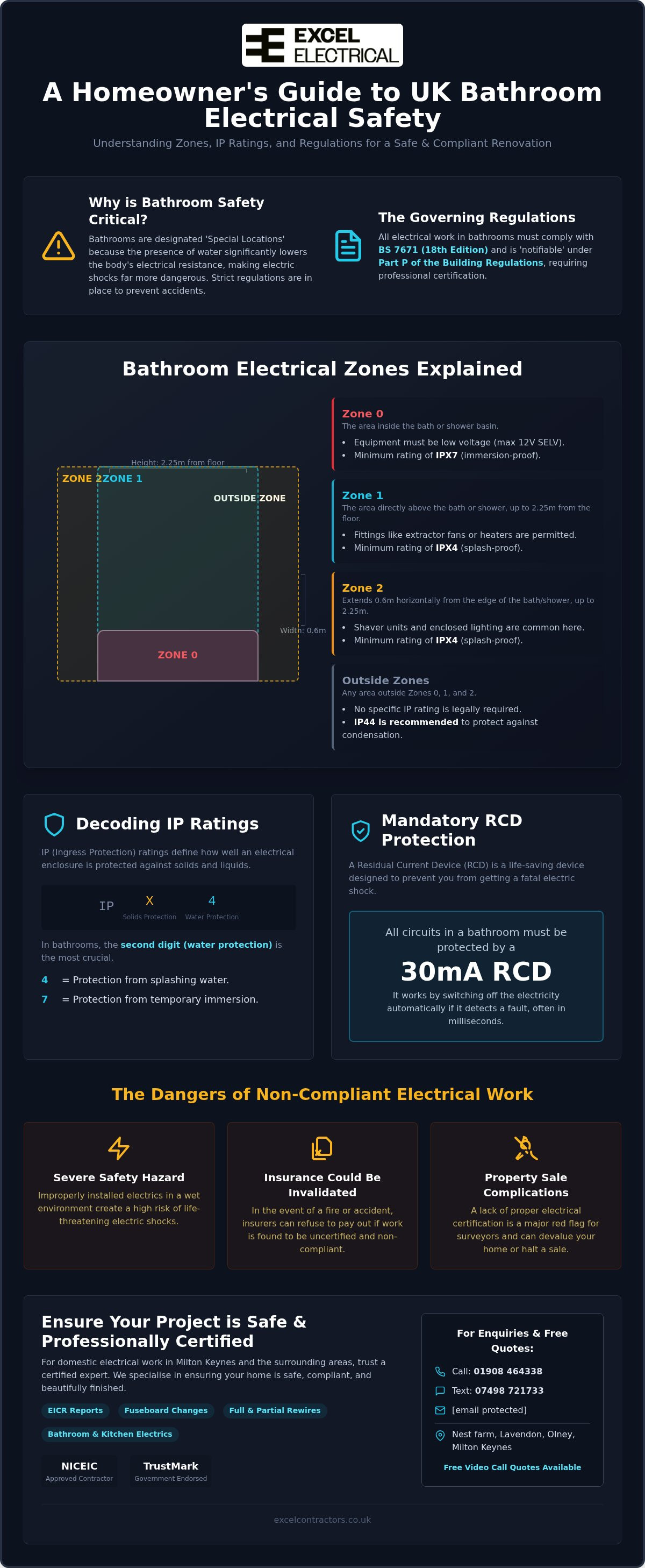
Selecting the correct fittings for your project requires a technical understanding of Ingress Protection (IP) ratings. This two-digit system classifies how effectively an electrical enclosure resists moisture and dust. The first digit represents protection against solid objects, while the second digit indicates liquid resistance. In a high-humidity environment, the second digit is the priority for following bathroom electrical safety advice. Choosing the wrong rating can lead to internal corrosion or short circuits, which undermines the safety of your entire installation.
Zone 0 and Zone 1: High-Risk Areas
Zone 0 is the area inside the bath or shower tray itself. Any electrical equipment here must be low voltage (maximum 12V) and carry a minimum rating of IPX7, meaning it can withstand temporary immersion. Zone 1 covers the area directly above the bath or shower, extending to a height of 2.25 metres from the finished floor level. Fittings in this zone, such as extractor fans or water heaters, must have at least an IPX4 rating to protect against splashes. If your design includes 12V Safety Extra Low Voltage (SELV) equipment, the transformer must be situated outside these zones to comply with bathroom electrical regulations UK.
Zone 2 and Beyond: Balancing Design and Safety
Zone 2 extends 0.6 metres horizontally from the edge of the bath or shower and up to a height of 2.25 metres. Equipment in this area requires a minimum rating of IPX4. Once you move beyond this 0.6m boundary, you enter the "Outside Zones." While specific IP ratings are not legally required here, we recommend using IP44 fittings as a minimum standard to manage steam and condensation. This proactive approach ensures your luxury decor and electrical components remain in peak condition over the long term.
One of the most misinterpreted aspects of bathroom electrical regulations UK is the placement of standard 230V sockets. These must be located at least 3 metres horizontally from the boundary of Zone 1. Because most UK bathrooms don't have the floor space to accommodate this distance, sockets are generally prohibited in domestic settings. If you’re concerned about the layout of your current space, our team at Excel Electrical can conduct a professional inspection to verify your compliance. We are based at Nest farm, Lavendon, Olney, Milton Keynes. For enquiries, call 01908 464 338, text 07498721733, or email [email protected].
Safe Installation of Bathroom Appliances and Fittings
Luxury bathroom design often includes high-load appliances that require rigorous planning to meet bathroom electrical regulations UK. Electric showers are amongst the most power-hungry devices in a home. They must be installed on a dedicated circuit, separate from the lighting or main socket rings. This prevents overloading and ensures that a fault in the shower doesn't plunge the rest of the house into darkness. The cable size must be carefully calculated based on the kilowatt rating of the unit to prevent overheating within the walls.
Shaver units are another specific case. These are the only socket types permitted in Zone 2, provided they incorporate an internal isolation transformer. This transformer limits the current, making it safe to use even in damp conditions. When planning for electric towel rails or underfloor heating, placement is critical. These items must be permanently wired into a fused spur located outside the high-risk zones. Underfloor heating systems must also include a protective earth mat or screen to ensure safety in the event of a cable fault.
Lighting Circuits and Extractor Fans
Achieving a sleek, modern aesthetic usually involves IP-rated downlights. For Zone 1, these must be at least IPX4, though many high-end projects opt for IP65 to ensure maximum longevity against steam. Standard wall switches are prohibited inside the bathroom to prevent contact with damp hands. You must use a ceiling-mounted pull-cord or, more commonly in luxury renovations, position the switch outside the room entrance. Extractor fans should be integrated into the lighting circuit with a timer overrun. This ensures the fan continues to clear moisture after the lights are turned off, protecting your decor from mould and dampness.
High-End Features: Smart Showers and Bespoke Tech
Modern renovations frequently include digital shower controllers, heated smart mirrors, and integrated Bluetooth speakers. These bespoke additions must be 18th Edition compliant and correctly zoned. Digital controllers often use low-voltage signals to communicate with a remote pump or mixer valve. We typically house these high-voltage components in a loft space or airing cupboard to keep them away from water. All such installations must adhere to bathroom electrical regulations UK to protect your home's safety and insurance validity.
Integrating these features requires a deep understanding of The Professional Guide to High-End Electrical Installations in 2026. At Excel Electrical, we specialise in these complex domestic setups. Our team at Nest farm, Lavendon, Olney, Milton Keynes, ensures that your bespoke tech is both stylish and safe. For a free quote or a video call consultation, call us on 01908 464 338, text 07498721733, or email [email protected].
Essential Safety Features: RCDs and Supplementary Bonding
RCDs are the most critical safety feature in modern bathroom electrics. These devices monitor the flow of electricity and cut the power in less than 40 milliseconds if they detect a leak. This response speed is vital for preventing fatal shocks in wet environments where body resistance is naturally lower. Under current bathroom electrical regulations UK, every circuit serving a bathroom must be protected by a 30mA RCD. This requirement isn't limited to power showers; it extends to lighting, extractor fans, and shaver points too.
Fault finding and testing are integral parts of any bathroom rewire. We don't just install new cables; we verify their performance under load using calibrated instruments. This methodical approach ensures that your safety devices will actually trip when needed. It provides the peace of mind you expect from a professional installation, ensuring that hidden faults don't compromise your household safety.
Why Your Consumer Unit Matters
Older properties often rely on traditional fuse boxes that lack the sophisticated RCD protection required today. To meet the 2026 standards, many homeowners need a consumer unit upgrade. This provides the necessary infrastructure to support high-draw appliances whilst ensuring individual circuit safety. A professional EICR testing report is the first step in this process. It identifies hidden risks like degraded insulation or poor earthing that a visual inspection might miss, allowing for targeted improvements before your renovation begins.
Supplementary Bonding vs. Modern Wiring
Supplementary equipotential bonding involves connecting all accessible metal parts in a bathroom to an earth wire. This ensures that if a fault occurs, everything stays at the same electrical potential, preventing a shock if you touch two different metal surfaces simultaneously. In older homes with copper or lead plumbing, this remains a mandatory safety measure. However, modern installations using plastic piping have changed these requirements significantly.
If your home uses plastic pipes, supplementary bonding might not be necessary, provided certain earthing conditions are met. A qualified electrician must verify earth continuity throughout the system to confirm this. We use precision instruments to test these connections, ensuring your home remains compliant with bathroom electrical regulations UK. If you're planning a renovation in Olney or Milton Keynes, our team at Nest farm, Lavendon, Olney, Milton Keynes can help. For a free video call quote, call 01908 464 338, text 07498721733, or email [email protected] to discuss your project.
Why Choose Excel Electrical for Your Bathroom Project in Milton Keynes
Ensuring your project complies with the latest bathroom electrical regulations UK requires more than just basic electrical knowledge. It demands a contractor with a proven track record in high-end domestic installations. Excel Electrical Installations Ltd provides this expertise as an NICEIC Approved and TrustMark registered business. These accreditations aren't just badges; they represent our unwavering commitment to the 18th Edition Wiring Regulations and consumer safety. We focus on delivering domestic excellence, whether you require a full rewire, a consumer unit upgrade, or a mandatory EICR to verify your existing circuits.
Local Expertise in Olney and Milton Keynes
Our team's local expertise is a significant advantage for homeowners in Milton Keynes and the surrounding regions. Based at Nest farm, Lavendon, Olney, Milton Keynes, we have a deep understanding of the diverse property types across Newport Pagnell, Northampton, and Olney. We've managed complex electrical upgrades in everything from traditional stone cottages to modern, tech-heavy developments. This experience allows us to anticipate potential challenges with older wiring systems or integration issues with new smart home technology, ensuring your project stays on schedule and within budget. We don't just complete a job; we aim to build a long-term partnership based on transparency and professional excellence.
Start Your Renovation with a Video Consultation
We believe that professional service starts with clear communication and accessibility. To make the initial stages of your project as simple as possible, we offer free quotes and a convenient video call consultation option. This allows us to assess your bathroom layout and electrical needs remotely, providing a fast and accurate estimate to help you plan your renovation. This methodical process ensures that every detail, from IP-rated lighting to RCD protection, is accounted for before work begins. This saves you time and ensures that the technical requirements of the bathroom electrical regulations UK are integrated into your design from day one.
Recognising Why Hiring an NICEIC Approved Contractor is Vital is essential for any homeowner who values safety and legal compliance. Our goal is to provide you with total peace of mind, backed by official certification upon completion of every project. For all enquiries or to book your video consultation, call 01908 464 338, text 07498721733, or email [email protected]. You can also view our full range of domestic services at excelcontractors.co.uk to see how we can support your next luxury bathroom upgrade.
Securing Your Home’s Future with Compliant Bathroom Design
Achieving a luxury bathroom finish requires a methodical approach to safety. By mastering the specific zones and ensuring your fittings carry the correct IP ratings, you protect both your family and your property's market value. Adhering to the latest bathroom electrical regulations UK isn't just about legal compliance; it's about building a home that operates with technical precision and safety at its core. These standards ensure that moisture and electricity never meet, allowing you to enjoy your high-end features with total peace of mind.
As NICEIC Approved and TrustMark registered contractors, our 18th Edition qualified electricians specialise in domestic rewires, EICRs, and consumer unit upgrades. We provide the professional certification required to keep your insurance valid and your renovation seamless. Whether you're in Milton Keynes, Olney, or the surrounding areas, we're here to help you navigate these technical complexities with confidence and authority.
For a free quote or to arrange a convenient video call consultation, call Excel Electrical on 01908 464338 or text 07498721733 today. You can also reach us at our office at Nest farm, Lavendon, Olney, Milton Keynes, or email [email protected]. We look forward to making your renovation vision a safe and stylish reality.
Frequently Asked Questions
Can I install my own bathroom lighting in the UK?
You shouldn't attempt to install bathroom lighting yourself because bathrooms are defined as "Special Locations" under the 18th Edition Wiring Regulations. Most electrical work in these areas is notifiable to Local Authority Building Control under Part P. For safety and legal compliance, you must use a registered electrician who can issue an Electrical Installation Certificate. This documentation is essential for home insurance and future property sales in Milton Keynes.
What is the 3-metre rule for sockets in a bathroom?
The 3-metre rule dictates that standard 230V plug sockets must be installed at least 3 metres horizontally from the boundary of Zone 1. Since most UK bathrooms are relatively small, this regulation effectively prohibits sockets in the majority of domestic washrooms. The only common exception is for shaver-supply units, which have internal isolation transformers and can be safely installed within Zone 2 of the room.
Is an RCD mandatory for all bathroom electrical circuits?
Yes, a 30mA Residual Current Device (RCD) is mandatory for all circuits serving a bathroom under current bathroom electrical regulations UK. This safety device is designed to disconnect the power in under 40 milliseconds if a fault is detected. This prevents fatal electric shocks in wet environments. If your existing consumer unit lacks RCD protection, it will likely require an upgrade to meet modern 18th Edition safety standards.
Do I need a Part P certificate for a bathroom extractor fan?
Yes, you need a Part P certificate for the installation of a bathroom extractor fan because it involves electrical work in a high-risk "Special Location." Any new circuit or alteration to an existing circuit in a bathroom must be certified by a qualified professional. This ensures the installation is safe and has been reported to the local building control office, protecting your property's legal standing and safety.
What IP rating is required for a shower light in Zone 1?
A shower light installed in Zone 1 requires a minimum Ingress Protection rating of IPX4 to protect against water splashes. However, many high-end domestic installations utilise IP65-rated fittings. These provide a higher level of protection against low-pressure water jets and steam, ensuring greater longevity for your lighting. Always verify the manufacturer's instructions to ensure the specific fitting is approved for use directly above a shower or bath.
Can I have a standard light switch inside my bathroom?
No, you cannot have a standard wall-mounted light switch inside a bathroom. Regulations require that switches are either operated by a ceiling-mounted pull-cord or located entirely outside the room. This rule prevents the risk of electric shock from touching a switch with wet hands. In luxury renovations, placing the switch outside the entrance is the preferred method for a cleaner, modern aesthetic that remains fully compliant.
How much does it cost to rewire a bathroom in Milton Keynes?
The cost of rewiring a bathroom varies significantly based on the complexity of your project and the specific high-end features you choose to install. Factors such as the age of your property and the condition of your existing consumer unit will influence the final estimate. For an accurate price tailored to your home, call Excel Electrical on 01908 464338 to arrange a free video call consultation or a site visit.
What is the difference between Zone 1 and Zone 2 in a bathroom?
Zone 1 refers to the area directly above the bath or shower up to a height of 2.25 metres from the floor. In contrast, Zone 2 extends 0.6 metres horizontally from the edge of the bath or shower tray, also reaching a height of 2.25 metres. These zones dictate the specific IP ratings required for electrical equipment to ensure safety. Following bathroom electrical regulations UK helps you choose the correct fittings for each area.


