

Did you know that electrical distribution faults were the leading cause of approximately 18% of all non-residential workplace fires in the UK during 2024/25? For any business owner in Milton Keynes or the surrounding counties, the fear of a sudden electrical failure causing a total shutdown is a significant concern. You likely agree that your electrical setup should be the silent engine of your productivity, yet it often becomes a source of confusion, particularly with the recent arrival of BS 7671 Amendment 4:2026. Managing commercial power distribution systems requires a strategic approach to ensure your infrastructure remains safe, efficient, and fully compliant with the latest national standards.
This guide explains how to design, maintain, and optimise your system to ensure full 18th Edition compliance and long-term operational reliability. We'll examine the necessity of regular EICR inspections, the benefits of scalable infrastructure, and how to mitigate the risk of equipment damage. Excel Electrical, located at Nest farm, Lavendon, Olney, Milton Keynes, provides the technical expertise needed to secure your premises. For a free quote or to arrange a video call consultation, call 01908 464338, text 07498721733, or email [email protected] to discuss your specific requirements today.
Key Takeaways
- Understand the vital role of switchgear and distribution boards in protecting your business infrastructure from electrical overloads and faults.
- Learn to distinguish between radial and ring circuits to ensure your wiring configuration matches your specific operational requirements.
- Discover how to maintain commercial power distribution systems in full compliance with the latest 18th Edition regulations and mandatory EICR standards.
- Identify strategies for designing a scalable electrical network that supports business growth whilst reducing the risk of equipment damage.
- Recognise the value of NICEIC Approved expertise in delivering a reliable, efficient, and safe electrical environment for your commercial premises.
What are Commercial Power Distribution Systems?
A commercial power distribution system is the internal network of cables, switchgear, and transformers that manages and directs electricity within a business premises. It acts as the vital link between the high-voltage utility supply and the specific equipment used in your daily operations. Understanding commercial power distribution systems is essential for any business owner looking to maintain safety and operational continuity whilst managing energy costs; for professional support in this area, The Energy Desk provides specialist energy procurement and management services for UK companies.
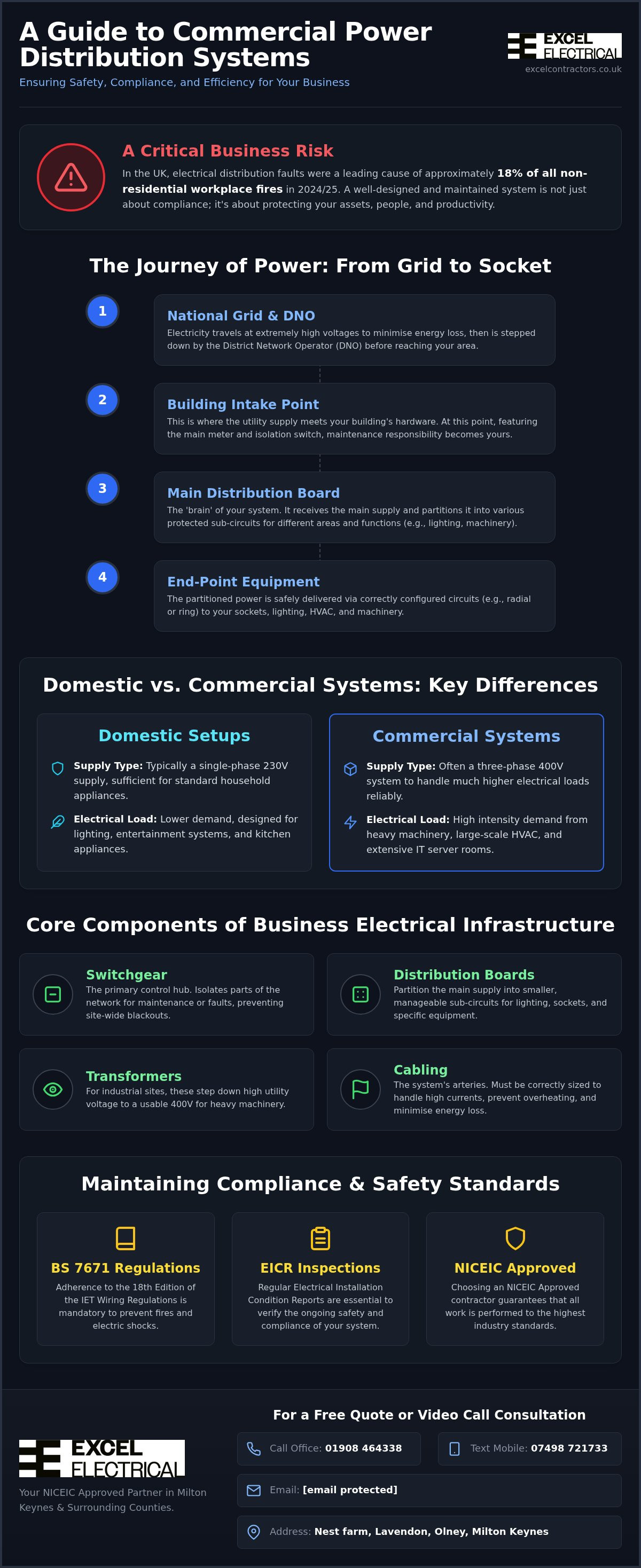
The system is divided into primary and secondary distribution. Primary distribution refers to the utility-side network managed by the District Network Operator (DNO). Secondary distribution is the infrastructure within your building's boundary. Once the power passes the intake point, where the utility supply meets your building's hardware, it becomes your responsibility to maintain. This point usually houses the main meter and the primary isolation switch for the entire site.
Commercial systems differ significantly from domestic setups due to the intensity of the demand. While a house typically runs on a single-phase 230V supply, businesses often require a three-phase 400V system. This setup allows for much higher electrical loads. It supports the efficient operation of heavy machinery, large-scale HVAC systems, and extensive server rooms that would otherwise overwhelm a standard residential connection.
The Journey from Grid to Socket
Electricity travels from the National Grid at extremely high voltages to reduce energy loss. Before it reaches your premises, it's stepped down through a series of substations and transformers to a usable level. The main distribution board serves as the brain of the system, receiving the stepped-down voltage and partitioning it into various sub-circuits. In the UK commercial market, a service drop describes the physical cable connection that bridges the gap between the local utility network and your building's intake equipment.
Key Objectives of an Efficient System
A well-designed system prioritises three core pillars: safety, reliability, and efficiency. Safety is the most critical factor. By adhering to the 18th Edition of the IET Wiring Regulations, you prevent electrical fires and shocks through correct circuit protection and earthing. Reliability ensures that critical business operations continue without interruption. Proper load balancing and high-quality switchgear minimise the risk of nuisance tripping or system-wide failures. Efficiency focuses on reducing energy waste. Modern transformer technology and optimised cable runs help lower your carbon footprint and reduce overheads.
If you're concerned about the health of your infrastructure, Excel Electrical provides expert commercial electrical services across Milton Keynes and Bedfordshire. You can reach our team at Nest farm, Lavendon, Olney, Milton Keynes, by calling 01908 464338 or emailing [email protected]. For a direct enquiry, call 01908 464 338 or text 07498721733 to discuss a free quote or a video call consultation.
The Core Components of Business Electrical Infrastructure
While the previous section outlined the high-level journey of power, the physical integrity of commercial power distribution systems depends on the specific hardware installed within your building. These components must be robust enough to handle continuous, high-capacity loads that would overwhelm a standard residential setup. Each part of the infrastructure serves a distinct purpose in ensuring that electricity is safely managed and directed to the correct equipment.
Switchgear acts as the primary control and protection hub for the entire site. It incorporates electrical disconnect switches and circuit breakers designed to isolate specific areas of the network during maintenance or fault conditions. High-quality switchgear is essential for preventing a localised issue from cascading into a total site blackout. Following this, distribution boards (DBs) partition the main supply into sub-circuits for lighting, small power, and HVAC. In larger facilities, we often install several sub-distribution boards fed from a main panel to keep cable runs manageable and ensure that a fault in one department doesn't affect the entire building.
For industrial sites with extreme energy requirements, on-site transformers may be necessary to step down utility voltage to a usable 400V. To move high currents across large warehouse floors, we frequently utilize busbar trunking systems instead of heavy, inflexible cabling. This modular approach provides a space-saving solution that is much easier to modify as your business grows. It's a disciplined method that prioritises long-term flexibility over a quick, temporary fix.
Understanding Three-Phase Power
Most commercial properties require three-phase electrical installations for business premises to support heavy machinery and large-scale server infrastructure. By using three live conductors, the system provides a more stable and powerful supply. It's vital to balance these loads across all three phases. If one phase is overloaded whilst others remain underutilised, it creates system stress that leads to premature component failure or nuisance tripping. Professional load balancing is a core requirement for any efficient commercial setup.
Cabling and Containment Systems
In a professional environment, cables require physical protection to ensure longevity. We typically use Steel Wire Armoured (SWA) cables for main feeds due to their durability. For indoor office spaces, Low Smoke Zero Halogen (LSZH) cabling is the standard to reduce toxic fumes in the event of a fire. These cables are housed in containment systems such as galvanised trunking, trays, or conduits. Proper containment doesn't just look professional; it protects the wiring from mechanical damage and assists with heat dissipation. Correct cable sizing is also essential to prevent overheating and voltage drop over long distances.
If you're planning an upgrade or need to verify the condition of your current setup, our team at Excel Electrical can provide a detailed assessment of your commercial electrical services. We're based at Nest farm, Lavendon, Olney, Milton Keynes, and you can contact us on 01908 464338 or via email at [email protected] for expert advice. Call 01908 464 338 or text 07498721733 to discuss a free quote or a video call consultation today.
Radial vs Ring Circuits: Choosing the Right Configuration whilst Planning
Choosing the right circuit configuration is a fundamental decision during the planning phase of commercial power distribution systems. Your choice directly impacts the system's resilience and its ability to handle specific electrical loads. Radial circuits are typically the preferred choice for high-load machinery or dedicated equipment. In a radial setup, a single cable runs from the distribution board to the appliance. This isolation ensures a fault on one machine won't shut down other parts of your facility. While they require more cabling, the safety benefits for industrial plant are undeniable.
Ring final circuits remain a staple in UK office environments. These circuits loop back to the distribution board, providing two paths for the current to flow. This design is highly efficient for serving multiple low-power socket outlets across a single floor. For critical infrastructure, such as data centres, we often implement interconnected systems. These provide redundant power paths. If one supply line fails, another takes over instantly. This level of reliability is essential for businesses where downtime causes significant financial loss.
Designing for Scalability
A forward-thinking design must account for future expansion. Leaving at least 20% 'spare ways' in your distribution board is a vital practice for future growth. It allows for new circuits to be added without the cost of a full board replacement. Integrating smart meters into your commercial power distribution systems also provides the data needed to monitor circuit-level energy consumption. This transparency helps identify waste and informs decisions on where to expand. For more complex requirements, we offer Bespoke Electrical Solutions tailored to your specific site layout.
Modern Upgrades: EV Charging and Solar
Modern infrastructure must now accommodate the shift towards green energy. EV chargers significantly impact the total demand of a system, often requiring dedicated sub-mains to handle the load. We use load shedding devices to protect your main fuse by temporarily reducing power to non-essential circuits when demand peaks. Solar PV inverters integrate with a main distribution board by connecting to a dedicated circuit breaker that allows generated electricity to feed directly into your building's internal network. This integration reduces your reliance on the grid and lowers long-term operational costs.
Excel Electrical is based at Nest farm, Lavendon, Olney, Milton Keynes. For expert guidance on your commercial infrastructure, call 01908 464338 or email [email protected]. You can also call 01908 464 338 or text 07498721733 for enquiries, free quotes, or to arrange a video call consultation with our team.
Maintaining Compliance: EICR and Safety Standards for Distribution
The EICR Process for Businesses
An Electrical Installation Condition Report (EICR) is the formal method for assessing the safety of your electrical infrastructure. The process begins with a thorough visual inspection of all distribution boards, switchgear, and visible cabling to identify signs of wear or thermal damage. Our engineers then perform dead and live testing to verify that circuit protection operates correctly and that the earthing system is robust. Findings are categorised using industry-standard codes. A C1 code indicates immediate danger requiring urgent action, whilst a C2 code signifies a potentially dangerous defect. Achieving a "Satisfactory" result is essential for maintaining your building's compliance status.
Preventative Maintenance Strategies
Beyond mandatory inspections, proactive maintenance is the best way to avoid costly operational downtime. We utilise thermal imaging technology to detect hot spots within switchgear and distribution boards before they lead to component failure. This non-invasive method identifies loose connections or overloaded circuits that aren't visible to the naked eye. We also conduct scheduled torque checks on busbar connections to ensure they haven't loosened due to thermal expansion or vibration. Adopting these professional electrical maintenance services extends the lifespan of your equipment and prevents the risk of arcing or electrical fires.
Excel Electrical provides a comprehensive range of services including domestic electrical services, electrical maintenance, and commercial electrical services. We specialise in EICRs, rewires, consumer unit upgrades, and EV charger installations. Our team also handles kitchen rewires, bathroom electrical upgrades, and emergency electrical services across Milton Keynes and Bedfordshire. Based at Nest farm, Lavendon, Olney, Milton Keynes, we're your local 18th Edition qualified experts. Call 01908 464338 or text 07498721733 for enquiries, free quotes, or video call quotes. You can also email [email protected] to discuss how we can secure your commercial power distribution systems today.
Partnering with Excel Electrical for Your Commercial Infrastructure
Excel Electrical has established a reputation for unwavering reliability across Milton Keynes, Bedford, and Northampton. We understand that commercial power distribution systems are the silent engine of your business operations. Our approach focuses on technical precision and transparency, ensuring your infrastructure remains 18th Edition compliant whilst supporting your long-term growth. Whether you require a full system redesign or a methodical maintenance audit, our team provides the steady hand needed to manage high-stakes electrical projects with confidence.
While we provide extensive support for business infrastructure, our core expertise is rooted in domestic electrical services. We believe that every property, whether a large-scale warehouse or a local residence, deserves the highest standard of safety. Our primary focus is on essential domestic needs, with a specific emphasis on EICR (Electrical Installation Condition Reports), full or partial rewires, and professional consumer unit upgrades (fuseboard changes). We offer a comprehensive list of services to meet every requirement:
- Domestic Electrical Services (Our primary focus)
- EICR (Electrical Installation Condition Reports)
- Rewire (Full and partial)
- Consumer Unit Upgrade (Fuseboard changes)
- Kitchen Rewire and Bathroom Electrical Upgrades
- Ev Charger Installations
- Testing and Inspection
- Electrical Maintenance
- Commercial Electrical Services
- Emergency Electrical Services
Why Choose an NICEIC Approved Contractor?
Selecting a contractor with the right credentials is the most effective way to mitigate risk. Understanding why hiring an NICEIC Approved Contractor is vital comes down to accountability and safety. This accreditation confirms that our work is regularly assessed to meet rigorous national safety standards. It also provides you with the peace of mind that comes from professional indemnity insurance and a formal guarantee of workmanship. Our 18th Edition qualified experts are equipped to handle the most complex commercial power distribution systems, from initial design to final certification.
Get Started with Your Professional Quote
If you're looking for a reliable partner to manage your electrical needs, contact our office today. We're based at Nest farm, Lavendon, Olney, Milton Keynes, and we serve the wider regional area with a commitment to high standards and industry compliance. We offer free quotes and the option for video call quotes to streamline the estimation process for busy managers and homeowners alike. You can reach us through several channels to discuss your requirements:
- Call our office on 01908 464338 for a detailed discussion.
- Text our mobile on 07498721733 for rapid enquiries or quick questions.
- Email [email protected] to arrange a formal tender or a maintenance audit.
We pride ourselves on clear communication and a disciplined approach to every project. Contact Excel Electrical today to secure your infrastructure and ensure your premises are safe, efficient, and fully compliant with the latest UK regulations.
Securing Your Business Infrastructure for the Future
A strategic approach to your electrical network is the most effective way to protect your business from operational failure and legal non-compliance. By understanding the core components of commercial power distribution systems and maintaining them through regular EICR testing, you build a foundation for long-term growth. Whether you're managing a warehouse in Bedford or an office in Milton Keynes, your infrastructure must be both scalable and safe to meet modern energy demands.
Excel Electrical provides the technical expertise needed to manage these complex systems. As an NICEIC Approved Contractor and TrustMark Registered business, we employ 18th Edition Qualified electricians who prioritise precision and safety. We're based at Nest farm, Lavendon, Olney, Milton Keynes, and we're ready to assist with your next project. You can book your free commercial electrical quote today or arrange a video call consultation to discuss your requirements. Call our team on 01908 464338, text 07498721733, or email [email protected]. Investing in professional electrical services today ensures a reliable and efficient environment for your team tomorrow.
Frequently Asked Questions
How often should a commercial power distribution system be inspected?
Commercial installations should typically be inspected every five years through an Electrical Installation Condition Report (EICR). For industrial environments with higher usage or harsh conditions, this interval often reduces to three years. Regular testing ensures that your commercial power distribution systems remain safe for continued use and compliant with the latest BS 7671 standards. It's a vital step in protecting your staff and property.
What is the difference between single-phase and three-phase distribution for businesses?
Single-phase distribution uses one live conductor at 230V and is suitable for small offices with standard equipment. Three-phase distribution uses three live conductors at 400V, providing the stable power required for heavy machinery, large HVAC units, and high-density server rooms. Most modern commercial premises require a three-phase setup to handle the increased load demand effectively without putting the system under unnecessary stress.
Is an EICR a legal requirement for my commercial premises in the UK?
Yes, an EICR is a legal necessity to comply with the Electricity at Work Regulations 1989. This legislation requires employers and building owners to maintain electrical systems in a safe condition at all times. Failure to produce a valid report can invalidate your insurance and lead to significant fines if an accident occurs on your premises. It's your primary evidence of due diligence.
Can a domestic electrician install commercial power distribution systems?
While a domestic electrician may have the basic qualifications, commercial power distribution systems require specific expertise in three-phase power and high-current containment. It's essential to use an NICEIC Approved Contractor who is familiar with industrial standards. This ensures the work is certified correctly and meets the rigorous safety requirements of a business environment. Professional accreditation provides the peace of mind that domestic-only training cannot offer.
What are the signs that my business needs a distribution board upgrade?
Common signs include frequent circuit breaker tripping, flickering lights, or visible signs of overheating such as scorched plastic around terminals. If your board still uses old-fashioned rewirable fuses or lacks the space for new circuits, it's likely time for an upgrade. A modern distribution board provides better protection through RCDs and surge protection devices, which are essential for protecting sensitive electronic business equipment.
How much does a commercial electrical safety audit cost?
The cost of a commercial electrical safety audit depends on the size of your premises and the number of circuits being tested. Factors such as the age of the installation and ease of access to distribution boards also influence the final price. Contact Excel Contractors for a free quote or a video call consultation to get an accurate estimate for your specific site without any guesswork.
What happens if my business fails an electrical inspection (EICR)?
If your inspection identifies C1 (Immediate Danger) or C2 (Potentially Dangerous) faults, your installation will be deemed "unsatisfactory". You're then legally required to carry out remedial work to fix these issues. Most businesses have 28 days to complete these repairs and obtain a satisfactory report to remain compliant with UK safety laws. Ignoring these faults can lead to prosecution or the disconnection of your supply.
Can I add EV charging points to my existing commercial distribution system?
Yes, you can usually add EV charging points, but your existing system's spare capacity must be assessed first. We evaluate the main fuse rating and current load to ensure the additional demand won't cause overloads. In some cases, we install load management devices that prioritise power to your building whilst safely charging vehicles. This ensures you stay green without risking your primary power supply.


