
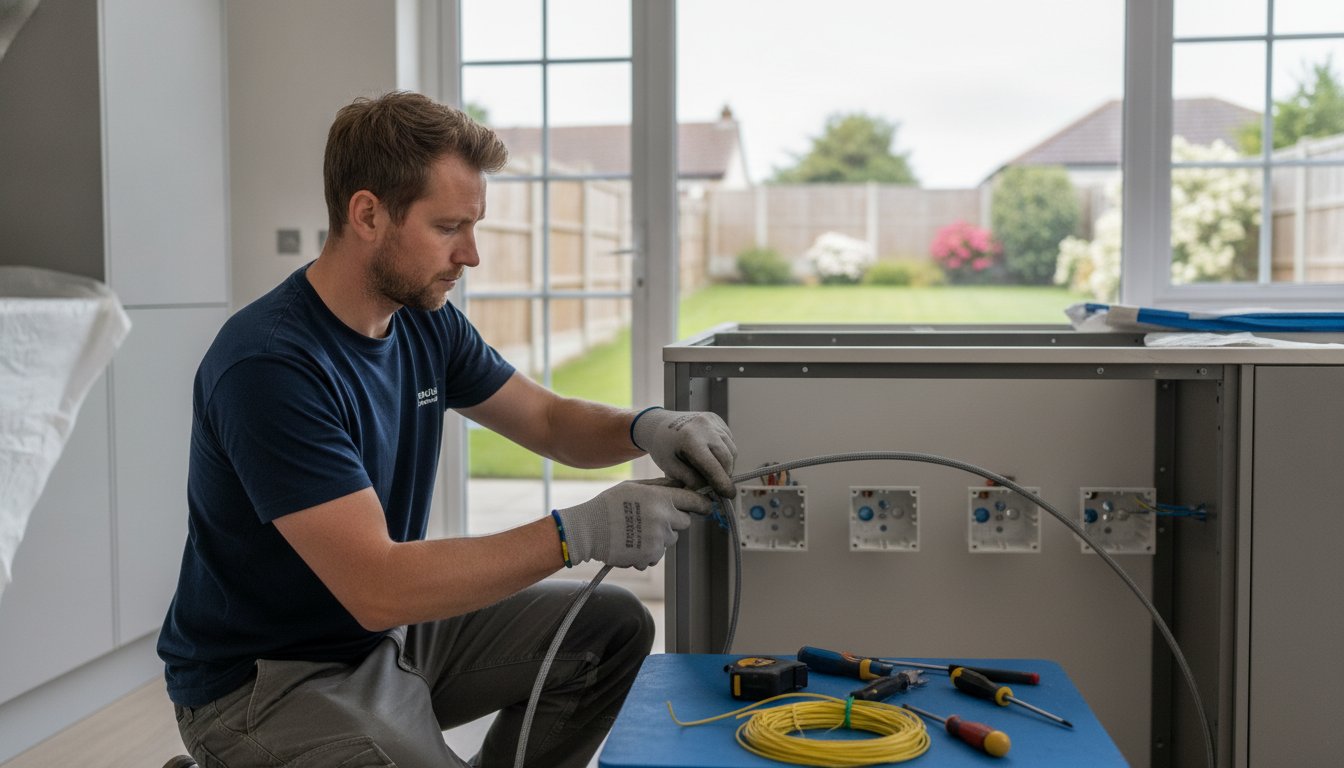
Is the risk of cutting into your bespoke flooring worth a guess at where the power cables should go? Many homeowners find themselves overwhelmed by conflicting online advice, often mistakenly following American NEC standards instead of the mandatory UK BS 7671:2018+A4:2026 regulations. Understanding the specific electrical requirements for kitchen island installations is critical to avoid costly mistakes and safety hazards. It's a high-stakes scenario where an error doesn't just mean a failed building control inspection; it could compromise the long-term safety of your home. We understand the anxiety that comes with planning a centrepiece that requires structural changes and navigating complex safety codes.
This guide provides a clear roadmap to ensure your project meets Part P building regulations and remains fully functional for years to come. You'll learn exactly how to master technical standards to keep your renovation compliant and safe. We'll explore the critical standards for socket placement near sinks, the necessity of 30mA RCD protection, and how to correctly organise dedicated circuits for modern, high-draw appliances. By the end of this article, you'll have the professional knowledge needed to plan a safe, compliant, and sophisticated kitchen installation.
Key Takeaways
- Master the current BS 7671:2018+A4:2026 standards to ensure your installation meets the latest UK safety regulations before the October 2026 transition deadline.
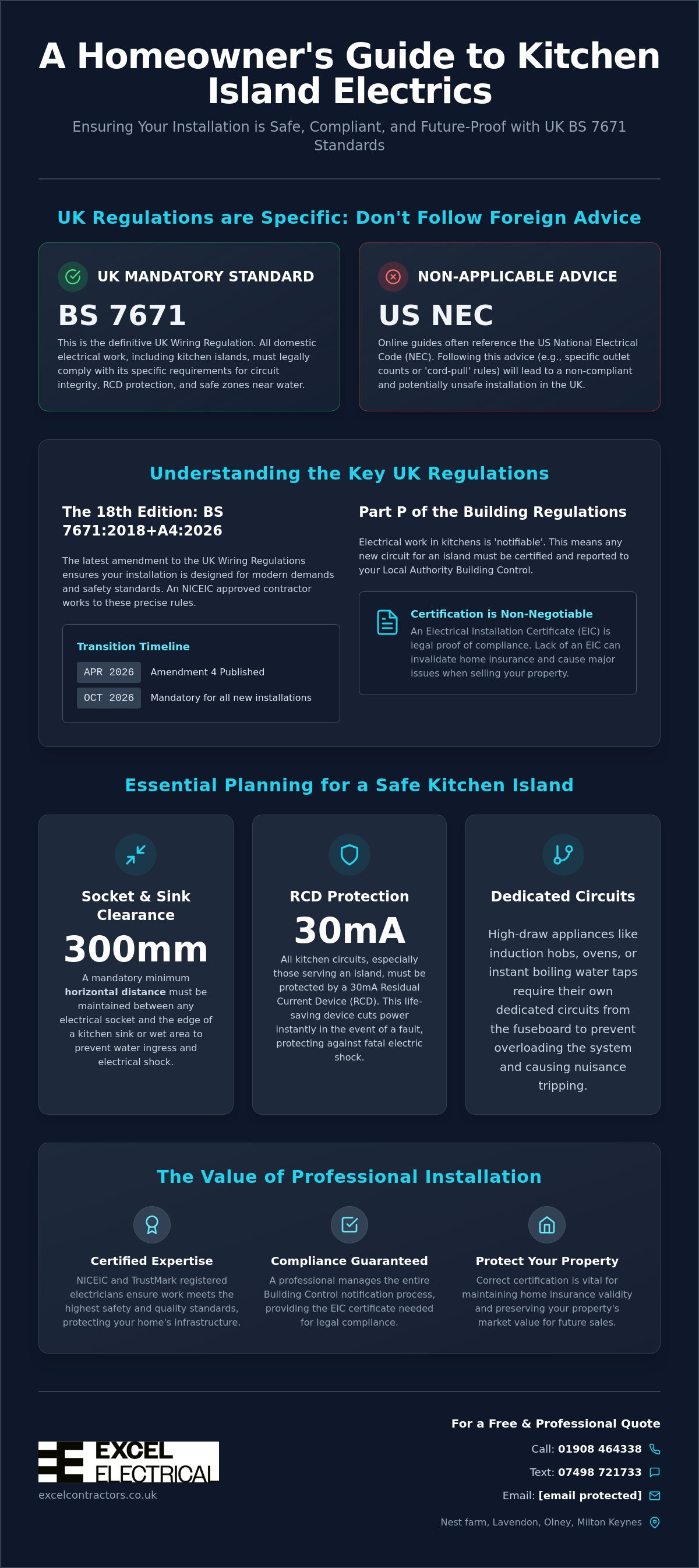
- Determine the specific electrical requirements for kitchen island power loads whilst maintaining the mandatory 300mm horizontal clearance between sockets and sinks.
- Learn the technical logistics of floor chasing and cable management to prevent structural damage to expensive flooring during your domestic kitchen rewire.
- Understand why NICEIC certification and professional testing are vital for maintaining home insurance and ensuring the safety of your property's electrical infrastructure.
- Contact Excel Electrical at [email protected] or call 01908 464338 for a free video quote to plan your project at Nest farm, Lavendon, Olney, Milton Keynes.
Understanding British Standards for Kitchen Island Electrics
In the UK, the electrical requirements for kitchen island installations are governed by strict safety protocols that differ significantly from international standards. You might encounter online advice regarding "cord-pull" safety or specific outlet counts that apply to the US National Electrical Code (NEC). These do not apply here. British installations must adhere to the BS 7671 Wiring Regulations, which focus on circuit integrity, RCD protection, and specific moisture zones. Following the wrong guidance can lead to failed inspections or, worse, dangerous living conditions. Professional planning ensures your kitchen remains a safe environment for your family whilst maintaining the integrity of your home's electrical system.
The 18th Edition and Your Kitchen
As of 2026, all new domestic electrical work must comply with BS 7671:2018+A4:2026. This latest amendment, published on April 15, 2026, introduces specific updates for stationary secondary batteries and functional earthing. Whilst a kitchen island isn't always a "special location" in the same technical sense as a bathroom, its proximity to water sources and high-load appliances requires expert planning. The transition period for these new regulations ends on October 15, 2026, after which all designs must follow the Amendment 4 standards. Using an NICEIC approved contractor ensures that your island's new circuits are designed to handle modern demands. This level of precision is a hallmark of high end electrical installations that prioritise long-term safety over quick fixes. A professional approach protects your property's infrastructure and ensures that every socket and appliance functions reliably under heavy use.
Part P Building Regulations Explained
Electrical work in kitchens is classified as "notifiable" under Part P of the Building Regulations. This means any new circuit created for a kitchen island must be reported to Local Authority Building Control. In areas like Milton Keynes, Bedford, and Northampton, homeowners often face significant hurdles during property sales if they lack the correct certification. An Electrical Installation Certificate (EIC) is not just a piece of paper; it's legal proof that your home meets national safety standards. Without it, you risk invalidating your home insurance or being forced to pay for costly remedial work later. Professional installers who are TrustMark registered manage this notification process on your behalf. This provides peace of mind and protects your property's market value. It's a systematic approach that ensures your renovation is a stable and dependable asset for years to come.
Planning Socket Placement and Appliance Requirements
A kitchen island serves as a multifunctional hub, often housing a combination of high-draw appliances and sensitive electronics. When calculating the electrical requirements for kitchen island projects, you must consider the cumulative load of induction hobs, wine coolers, and modern boiling water taps. Unlike wall-mounted units, an island has no direct connection to the building's perimeter wiring, making the initial load assessment vital. Accurate planning prevents the frustration of tripped breakers when you're using multiple appliances simultaneously. Compliance with Approved Document P requires that all electrical work in dwellings prioritises safety and accessibility, particularly in high-moisture environments like kitchens. If you are unsure about the current capacity of your fuseboard, a professional domestic electrical assessment can identify if upgrades are necessary before the island is installed.
Choosing the Right Socket Types
Selecting the correct hardware is about balancing aesthetics with rigorous safety standards. Pop-up towers are a popular choice for their ability to disappear into the worktop, but they must possess an appropriate IP (Ingress Protection) rating to resist liquid splashes. Flush-mounted designer sockets offer a more permanent, minimalist look and are often installed on the side panels of the island. For modern households, integrating USB-C charging points is a practical addition for those who use the island as a workspace. Regardless of the style, every socket must be positioned to avoid cable trailing across walkways, which is a significant trip hazard in a busy kitchen environment.
High-Load Appliance Considerations
Induction hobs are the most demanding components of a kitchen island, often requiring a dedicated 32A or 40A circuit. This cannot simply be spurred off an existing ring main; it requires its own run from the consumer unit. You must also plan for accessible isolation switches. These safety devices should be located within two metres of the appliance but can be discreetly housed within a nearby cupboard to maintain a clean visual line. When planning for multiple appliances, electricians use a calculation called "diversity." This recognises that not every appliance will be drawing maximum power at the exact same second, allowing for a more efficient and cost-effective wiring design. This methodical approach ensures that your island remains a safe, high-performance centrepiece for your home.
Managing Wiring Logistics: Floor Chasing and Infrastructure
The physical challenge of bringing power to the centre of a room is often the most complex part of a kitchen renovation. This stage, known as the "first fix," must occur before any flooring or cabinetry is installed. Failure to plan the electrical requirements for kitchen island infrastructure at this point can lead to the expensive and disruptive task of lifting finished floors later. Whether your home has solid concrete floors or traditional timber joists, the method of installation must prioritise both electrical safety and structural integrity. Coordination between your electrician and kitchen fitter is essential to ensure that power feeds emerge exactly where the island's plinths will be situated.
Wiring Through Concrete and Screed
Chasing cables through concrete or screed requires a methodical approach to ensure long-term reliability. We use specialised equipment to cut precise channels, ensuring the cables are buried at a depth that protects them from surface impacts. It's a strict requirement to use conduit, either rigid or flexible, when burying cables in screed. This protects the cable insulation from the chemical reactions of the drying floor and allows for easier maintenance in the future. If your kitchen features underfloor heating, we carefully coordinate the cable routes to avoid thermal interference or damage to the heating pipes. This level of precision ensures that your kitchen's foundation remains stable and your electrical system remains secure.
Timber Floor Installations
For homes with timber floors, we adhere to established "safe zones" when drilling or notching joists. To maintain the floor's strength, holes should be drilled through the neutral axis of the joist, typically between 0.25 and 0.4 times the span from the support. We avoid notching the top or bottom of joists whenever possible, as this significantly reduces their load-bearing capacity. Additionally, we implement fire-stopping measures where cables pass through floor voids or between different levels of the property. This prevents the passage of fire and smoke, fulfilling essential building safety requirements whilst preserving the structural preservation of your home.
Managing these logistics correctly requires professional expertise and high-quality materials. We provide detailed wiring diagrams to ensure your specific island layout is powered efficiently. To discuss your project or to arrange a free video call quote, you can call 01908 464 338 or text 07498721733. Our team at Nest farm, Lavendon, Olney, Milton Keynes, specialises in these technical domestic installations, ensuring your renovation is both beautiful and compliant with all national standards.
Essential Safety Features: RCDs, Zones, and Compliance
Safety is the foundational element of any kitchen renovation. When considering the electrical requirements for kitchen island installations, you must account for the unique risks posed by the proximity of water and high-powered appliances. Every circuit serving a kitchen island must have 30mA RCD (Residual Current Device) protection to prevent electric shocks. This is a mandatory requirement under BS 7671. Additionally, professional installers ensure that earthing and bonding are correctly implemented to protect users from faults in the wider electrical system. If your home's infrastructure is dated, you might need to consider a consumer unit upgrade to accommodate these modern safety devices and the increased load of an island.
The 300mm Sink Rule
UK safety standards specify clear zones to manage the interaction between water and electricity. The most critical guideline for islands is the 300mm rule. This requires all socket outlets to be placed at least 300mm horizontally from the edge of a sink or drainer. This distance reduces the risk of water splashes entering the electrical points during food preparation or cleaning. Whilst low-voltage lighting or integrated appliances might have different tolerances depending on their IP rating, standard 13A sockets must strictly adhere to this spacing. Proper placement is a key part of maintaining a compliant and safe kitchen environment that meets national building standards.
RCD and RCBO Protection
Modern installations often utilise RCBOs (Residual Current Breaker with Overcurrent) instead of traditional RCDs. RCBOs combine the functions of a circuit breaker and an RCD for each individual circuit. This design is superior because it prevents nuisance tripping across the entire house if a single fault occurs on the island. Every newly installed safety device must undergo rigorous testing to ensure it trips within the required millisecond timeframe. If your existing fuseboard lacks individual circuit protection, a professional upgrade is often the only way to meet current 18th Edition standards. This ensures that a minor fault in a toaster doesn't plunge your entire home into darkness.
Ensuring your project meets these stringent safety criteria provides long-term peace of mind and protects your family. To ensure your home is fully compliant, you can book our domestic electrical services for a comprehensive safety inspection. Our team at Nest farm, Lavendon, Olney, Milton Keynes, provides the certification necessary for insurance and future property sales. You can call 01908 464 338 or text 07498721733 to discuss your specific requirements.
Professional Installation and Certification with Excel Electrical
Professional kitchen rewires involve far more than simply running cables to a central point. They require a methodical approach to design and a deep understanding of the electrical requirements for kitchen island installations to ensure long-term reliability. At Excel Electrical, we prioritise a systematic planning process to ensure every socket, induction hob, and integrated appliance is powered correctly within your kitchen's infrastructure. This meticulous preparation minimises household disruption and ensures that the final installation is both functional and fully compliant with the latest BS 7671 standards. Our approach provides the stability and technical accuracy required for high-stakes domestic renovations.
The NICEIC Advantage
Our status as an NICEIC Approved Contractor means our workmanship and safety standards undergo regular independent assessments. This certification is a vital asset for your home insurance and provides essential documentation for any future property sale. Hiring an NICEIC approved contractor ensures you are protected by the Platinum Promise, which guarantees that the work meets the required technical standards. For luxury projects where precision is paramount, this level of formal accreditation is non-negotiable. It offers peace of mind by positioning our business as a stable and dependable choice for complex electrical tasks, including fuseboard changes and full domestic rewires.
Your Local Milton Keynes Experts
Based at Nest farm, Lavendon, Olney, Milton Keynes, we are ideally positioned to serve homeowners across Newport Pagnell, Bedford, and the wider Buckinghamshire area. Our extensive experience working with luxury home developers like Abbey Mill Homes has refined our ability to deliver sophisticated domestic electrical services. We understand that a kitchen renovation is a significant investment. To assist with your planning, we offer free quotes and the option for video call quotes to streamline the estimation process. This allows us to provide expert advice on the electrical requirements for kitchen island projects from the earliest stages of your design.
To discuss your project or to book a comprehensive EICR (Electrical Installation Condition Report), please contact our office. You can reach us via email at [email protected] or visit our premises in Olney. For all enquiries, call 01908 464 338 or text 07498721733 to arrange a consultation. Our team is committed to providing the professional expertise and clear communication needed to make your kitchen renovation a safe, compliant, and successful centrepiece of your home.
Securing Your Kitchen Renovation for the Future
Integrating power into a central island requires more than just aesthetic consideration; it demands a disciplined approach to current UK safety standards. From ensuring 30mA RCD protection to maintaining the mandatory 300mm horizontal clearance from water sources, every detail contributes to a compliant and functional space. Proper infrastructure planning during the first-fix stage prevents structural issues and ensures your electrical requirements for kitchen island projects are met with precision. This methodical approach protects your property value and ensures the long-term safety of your household.
As NICEIC Approved and TrustMark Registered contractors, we have provided expert domestic electrical services across Milton Keynes and the Home Counties since 2015. Our 18th Edition qualified electricians manage every aspect of the process, from initial design to final certification. We invite you to Request a Free Video Quote for Your Kitchen Installation to streamline your planning process. For enquiries, call 01908 464 338 or text 07498721733. You can also reach our team at [email protected] or visit us at Nest farm, Lavendon, Olney, Milton Keynes. We look forward to helping you create a safe and sophisticated centrepiece for your home.
Frequently Asked Questions
Do I legally need a socket on my kitchen island in the UK?
No, there is no legal requirement under BS 7671 to install a socket on a kitchen island in the UK. Whilst some international codes mandate them, UK standards leave this decision to the homeowner. We highly recommend including at least one power point to avoid the significant safety hazard of trailing cables from wall sockets to the centre of the room.
How far must a socket be from a kitchen sink?
Sockets must be positioned at least 300mm horizontally from the edge of a kitchen sink or drainer. This distance is a critical safety guideline designed to prevent water splashes from entering the electrical points. Our team ensures all electrical requirements for kitchen island layouts adhere to these specific zoning rules to maintain a safe environment for your family.
Can I run an induction hob on a kitchen island?
You can certainly run an induction hob on an island, provided it has a dedicated circuit. Most modern induction hobs require a 32A or 40A feed, which must be run directly from your consumer unit rather than spurred from a ring main. It is also essential to install an accessible isolation switch within two metres of the appliance for emergency use.
How do electricians get power to a kitchen island with a concrete floor?
Electricians get power to an island by chasing a channel into the concrete screed. We then install a protective conduit to house the cables before your final flooring is laid. This process must be carefully planned during the "first fix" stage of your renovation to ensure the power feeds emerge exactly where the island cabinetry will be situated.
What is the best type of socket for a kitchen island?
The best type of socket depends on your specific design priorities and how you intend to use the space. Pop-up towers offer a clean, hidden look but must have an appropriate IP rating for splash resistance. Side-panel flush-mounted sockets are often more durable for frequent use and can include integrated USB-C ports for charging laptops or tablets.
Do I need a new consumer unit for a kitchen island installation?
You don't always need a new consumer unit, but your existing one must have sufficient capacity and RCD protection for the new circuits. If your current board is outdated or lacks individual RCBOs, an upgrade is often necessary to meet 18th Edition safety standards. We can assess your current system during a free video call quote to determine if an upgrade is required.
Is a kitchen island electrical installation a 'notifiable' work?
Yes, installing a new circuit for a kitchen island is considered notifiable work under Part P of the Building Regulations. This means the work must be certified by a registered competent person to meet the electrical requirements for kitchen island safety. We provide the necessary NICEIC certification to ensure your installation is legal and your home insurance remains valid.
How much does it cost to wire a kitchen island in Milton Keynes?
The cost of wiring a kitchen island in Milton Keynes varies based on the complexity of the floor chasing and the number of dedicated circuits required. Because every project is unique, we suggest contacting us for an accurate estimate. You can call 01908 464338 or text 07498721733 to arrange a free quote or a video call consultation with our team based in Olney.


