
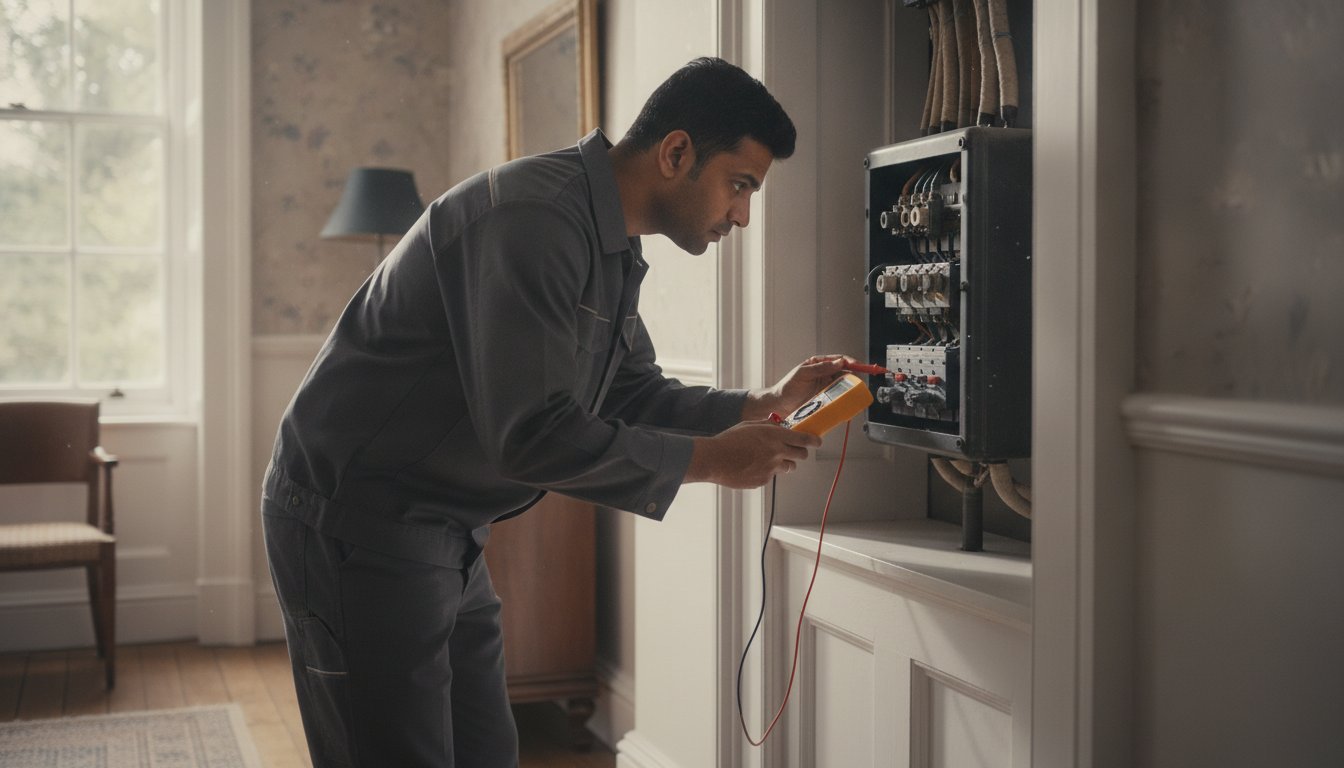
Did you know that 46% of homes in England were built between 1930 and 1982, with many others dating back even further? This means a significant portion of our housing stock relies on infrastructure that predates modern safety innovations. If you live in a period property, conducting thorough electrical safety checks for older homes isn't just a matter of maintenance; it's a vital step in protecting your family from the hidden risks of aging cables and obsolete components.
It's natural to feel concerned about the potential cost of a full rewire or to find the latest BS 7671:2018+A4:2026 regulations confusing. You want a home that feels safe and functions reliably without facing unexpected hazards. This article provides a clear, professional path forward. You'll learn how to spot the early warning signs of electrical fatigue and understand how modern standards, such as Arc Fault Detection Devices (AFDDs), apply to your property. We'll provide a definitive 2026 checklist to help you secure your home and achieve lasting peace of mind.
Key Takeaways
- Understand why domestic wiring over 25 years old requires prioritised monitoring to ensure continued safety and reliability in period properties.
- Identify critical warning signs of aging infrastructure, including discoloured sockets, outdated wooden-backed fuseboxes, and unusual olfactory indicators.
- Learn how to conduct routine visual electrical safety checks for older homes to spot perishing cables or overheating components before they fail.
- Discover the vital differences between a monthly non-invasive user check and a comprehensive professional Electrical Installation Condition Report (EICR).
- Gain clarity on how modern consumer unit upgrades and 18th Edition standards protect your home from the pressures of modern electrical demands.
Why Older Homes Require Specialist Electrical Safety Checks
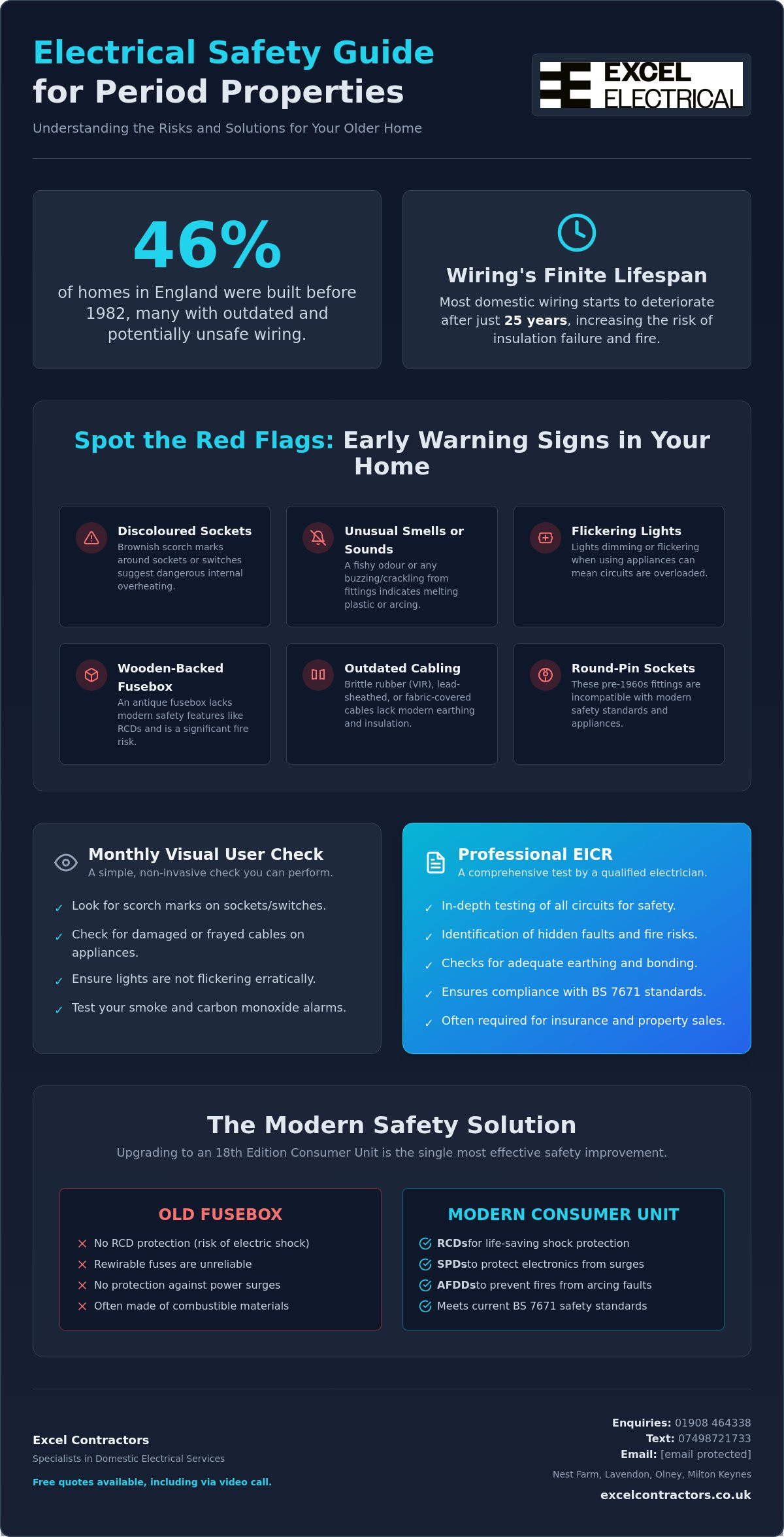
In the context of period properties, electrical safety checks for older homes represent a targeted forensic assessment of aging infrastructure. Unlike a standard inspection in a modern build, these checks focus on identifying obsolete materials and installation methods that were considered acceptable decades ago but now pose significant risks. Many homeowners assume that if the lights turn on, the system is fine. However, electrical components have a finite lifespan. Most domestic wiring starts to deteriorate after 25 years, making prioritised monitoring essential for any property built before the 1990s.
Older systems were designed for a different era of energy consumption. A typical 1950s home was never intended to support the simultaneous load of high-performance induction hobs, power showers, and electric vehicle (EV) chargers. When modern demands are placed on legacy circuits, the result is often thermal stress. This accelerated degradation can lead to insulation failure long before the homeowner notices a problem. Systematic electrical safety checks for older homes ensure that your property’s "hidden" infrastructure can actually handle your 2026 lifestyle.
The Evolution of Wiring Materials
Wiring technology has changed drastically over the last century. Many properties still contain remnants of Vulcanised Indian Rubber (VIR) cabling. Over time, this rubber becomes brittle and flakes away from the copper core, leaving live conductors exposed within walls or floor voids. You might also encounter lead-sheathed or fabric-covered wiring in basements or attics. These materials often lack a reliable earthing system, which is a critical safety failure. In some very old UK properties, you may even find remnants of Knob-and-tube wiring, an early method that is entirely unsuitable for modern electrical loads. Even early PVC cabling from the 1960s can fail due to "green slime" (plasticiser migration), which can corrode components and cause high-resistance connections.
The Role of the 18th Edition Regulations
The current national standard for electrical installations is BS 7671:2018+A4:2026. Whilst regulations are not retrospective, an older home that was safe in 1974 may be classified as "unsatisfactory" today. There is no such thing as a "grandfathered" safety status when it comes to fire prevention. Modern standards require features like Residual Current Devices (RCDs) and Surge Protection Devices (SPDs) that older fuseboxes simply do not have. Maintaining a valid EICR that reflects current 18th Edition standards is frequently a prerequisite for domestic building insurance providers to honour claims related to fire or electrical damage.
Identifying the Red Flags: Warning Signs in Your Period Property
Homeowners often overlook the subtle signals a property sends before a major electrical failure occurs. In a period home, these signals are early warnings that your infrastructure is struggling. Identifying these red flags is a fundamental part of conducting electrical safety checks for older homes. Visual indicators are often the most obvious. If you spot round-pin plugs or sockets, you're looking at a system that likely hasn't been updated since the 1950s. Similarly, discoloured or brownish marks around socket outlets suggest internal overheating, which requires immediate professional attention.
Your senses of smell and hearing are equally important diagnostic tools. A distinct, fishy odour near switches or the fusebox is a classic sign of melting bakelite or overheating plastic insulation. This chemical reaction occurs when components reach dangerous temperatures. You should also listen for buzzing, hissing, or crackling sounds, known as arcing. This phenomenon is a leading contributor to home electrical wiring system fires. If lights flicker when you turn on a kettle or the vacuum cleaner, your circuits are likely overloaded and unable to maintain a stable voltage.
Evaluating Your Consumer Unit (Fusebox)
The heart of your home's safety is the consumer unit. Many older properties in Milton Keynes and Olney still rely on "rewirable" fuses housed in wooden-backed boxes. These vintage units lack modern life-saving components like Residual Current Devices (RCDs) and Surge Protection Devices (SPDs). Rewirable fuses are particularly dangerous because they allow for the wrong gauge of wire to be installed, which can lead to circuit failure. A modern consumer unit upgrade is the most effective way to bring an older property up to 2026 safety standards.
Socket and Switch Safety
Sockets in older homes often have shallow back-boxes that don't allow for proper heat dissipation. Over time, the internal connections can loosen due to the natural expansion and contraction of the wires. A switch that feels warm to the touch or a plug that is difficult to insert are signs of internal fatigue. Don't ignore these issues. If you notice any of these symptoms, arranging a professional electrical inspection will help you identify the root cause before it escalates into a hazard. Prompt action ensures your period property remains a safe environment for your family.
Visual User Checks vs. Professional EICR Testing
Maintaining a period property requires a dual-layered approach to risk management. The first layer consists of the monthly "User Check". This is a non-invasive walk-through where you inspect every visible electrical point in your home. Whilst these routine observations are vital, they cannot replace formal electrical testing conducted by a qualified professional. A visual inspection might reveal a cracked socket, but it won't detect a breakdown in insulation resistance or a high earth fault loop impedance hidden behind the plasterwork.
Homeowners should use resources like the CPSC Home Electrical Safety Checklist to structure their monthly reviews. These checks are particularly useful whilst waiting for a scheduled professional visit, as they allow you to catch obvious mechanical damage early. However, the human eye has significant limitations. You cannot see the integrity of the copper conductors or the speed at which your RCD will trip during a fault. This is why electrical safety checks for older homes must transition from basic visual monitoring to a comprehensive Electrical Installation Condition Report (EICR) at least every ten years for owner-occupied properties, or more frequently if the installation is particularly aged.
What Happens During a Professional EICR?
A professional inspection involves both dead and live testing. Dead testing is performed whilst the power is isolated to verify cable integrity and ensure there are no short circuits. Live testing follows, where the engineer measures the actual performance of safety devices under load. The results are summarised in a report using industry-standard codes. A "C1" indicates immediate danger, "C2" signifies a potential danger requiring urgent action, and "C3" suggests an improvement is recommended. Understanding these codes is essential for prioritising your maintenance budget and ensuring the property remains compliant with modern safety standards.
When is a Full Rewire Necessary?
If your EICR reveals widespread "C2" defects or the presence of the obsolete cabling types mentioned earlier, a home rewiring project may be the only safe solution. In some cases, a partial rewire is sufficient. This involves updating high-demand areas like kitchens or bathrooms whilst leaving lower-risk lighting circuits intact if they meet current standards. Proactive professional maintenance often prevents the need for emergency reactive repairs, which are invariably more disruptive and costly. Systematic electrical safety checks for older homes help you plan these upgrades before a failure occurs.
If your inspection highlights the need for more extensive work, you can visit Foster Electrical to see how specialists manage full and partial property rewires.
The Older Home Electrical Safety Checklist
A systematic walk-through is the most effective way to manage the risks associated with aging infrastructure. Whilst a professional EICR provides the technical data you need, this 2026 checklist allows you to monitor your property's condition between formal inspections. Use these steps to identify immediate hazards that require professional attention.
- Step 1: Inspect the consumer unit. Look for a wooden backing or a lack of RCD protection. If your fusebox uses rewirable wire fuses rather than modern "flip" switches, it's likely over 30 years old and lacks the sensitivity required for modern electronics.
- Step 2: Examine visible cabling. Check the wiring in your loft, basement, or utility cupboard. Look for signs of cracking, perishing, or a green sticky residue on the cable surface. This residue, known as plasticiser migration, is a sign of chemical breakdown in older PVC insulation.
- Step 3: Audit your sockets and switches. Every outlet should be a modern 3-pin type and must be firmly attached to the wall. Loose sockets can lead to strained internal connections and arcing.
- Step 4: Functional RCD test. Locate the "T" or "Test" button on your consumer unit. When pressed, the power should trip immediately. If it doesn't move or the power stays on, the device is faulty.
- Step 5: Identify "DIY" additions. Look for exposed junction boxes or trailing cables in lofts and garages. Unprofessional wiring often lacks the correct earthing or load-bearing capacity, creating a significant fire risk.
Conducting these electrical safety checks for older homes helps you maintain a clear picture of your property's health. If your home fails any of these steps, you should book a professional electrical inspection to resolve the issue safely before it becomes an emergency.
Testing Your RCDs Correctly
The Residual Current Device (RCD) is a sensitive electromagnetic switch designed to disconnect the circuit if it detects a leakage of current. It's a life-saving component that prevents fatal electric shocks. You should perform the "press to test" routine every quarter. This ensures the internal mechanism hasn't seized up over time. If the RCD fails to trip or refuses to reset after a test, it's a sign of a mechanical fault or a permanent circuit error that requires urgent investigation by an NICEIC approved contractor.
External and Garden Electrics
Older garden installations are often the first area to fail due to exposure to the elements. Check your outdoor lighting and power points for moisture ingress or perished rubber seals. Any external circuit must be RCD protected to ensure safety in damp conditions. If you're planning a new garden lighting installation, ensure all wiring is housed in weatherproof enclosures and buried at the correct depth to prevent accidental damage during gardening. For inspiration on how to integrate such features into a professionally designed outdoor space, you can look at the work of INEX Landscaping. Legacy garden wiring often lacks these modern safeguards, making it a priority during your home safety audit.
Professional Safety Solutions in Milton Keynes and Olney
Owners of period properties in Milton Keynes, Olney, and Newport Pagnell face unique challenges when maintaining legacy systems. These areas feature a diverse mix of housing stock, from Victorian terraces to mid-century builds, each requiring a tailored approach to risk management. Excel Electrical is a specialist NICEIC approved contractor with extensive experience in navigating the complexities of older domestic wiring. We prioritise the safety of your family whilst ensuring our work respects the architectural integrity of your home.
Getting started with electrical safety checks for older homes doesn't have to be a source of stress. We understand that homeowners often worry about the potential disruption of a survey or the cost of remedial works. To help you plan effectively, we offer free quotes and a convenient video call estimation service. This allows us to provide a quick, professional assessment of your consumer unit and visible wiring without an initial site visit, giving you clarity on the next steps for your property.
The Excel Electrical Standard
Our team is fully 18th Edition qualified, ensuring every inspection and installation meets the latest national safety standards. As a TrustMark registered business, we provide an additional layer of consumer protection and peace of mind for our clients. We take pride in our systematic approach and our commitment to tidy, professional workmanship. We treat your domestic space with the utmost respect, ensuring that safety upgrades are integrated seamlessly into your living environment.
Contact Us for Your Safety Check
If you're concerned about the age of your wiring or haven't had an inspection in the last ten years, our team is ready to assist. You can visit us at Nest farm, Lavendon, Olney, Milton Keynes to discuss your requirements in person. For a more immediate response, please use the following contact methods:
- Call us on 01908 464338 to speak with a specialist.
- Text 07498721733 for quick enquiries or to organise your free quote.
- Email [email protected] to book your professional EICR today.
Securing Your Period Property for the Future
Managing the electrical infrastructure of a heritage home requires a proactive and methodical approach. By identifying early warning signs like discoloured sockets or unusual odours, you can address potential hazards before they escalate. Whilst monthly visual monitoring is a valuable habit, it cannot replace the technical depth of a professional EICR. Prioritising electrical safety checks for older homes ensures that your aging wiring can safely support the heavy power demands of 2026 and beyond. For those also looking to ensure their heating and water systems are up to standard, you can learn more about WellPlumbed.
Our team at Excel Electrical is dedicated to providing clarity and peace of mind for homeowners in Milton Keynes and Olney. As NICEIC Approved and TrustMark Registered contractors, our 18th Edition qualified electricians possess the specialised knowledge required for period properties. We offer free video call quotes for Milton Keynes homeowners to help you understand your property's needs with minimal disruption. Book your free older home electrical safety consultation with Excel Electrical today to protect your investment. Taking these systematic steps now ensures your home remains a safe, dependable environment for your family for many years to come.
Frequently Asked Questions
How do I know if my older home needs a rewire?
Your property likely requires a rewire if you identify signs of extreme age, such as green sticky residue on cables or the presence of Vulcanised Indian Rubber (VIR) insulation. If the electrical system is over 25 years old and hasn't been updated, it may not support modern power demands. A professional inspection will confirm if the existing cables are still safe for continued use or if they have reached the end of their functional life.
Is an EICR mandatory for older homes in the UK?
An Electrical Installation Condition Report (EICR) is not a legal requirement for owner-occupiers, but it is highly recommended every ten years to ensure safety. For landlords, these inspections are mandatory every five years by law. Regardless of your status, many building insurance providers now require a valid certificate to honour claims related to fire damage, making it a vital part of electrical safety checks for older homes.
To ensure your property meets all legal standards and to protect your interests in landlord-tenant matters, you can find out more about expert legal guidance for property owners.
What are the dangers of VIR (Vulcanised Indian Rubber) cabling?
VIR cabling is hazardous because the rubber insulation becomes brittle and perishes over time. As the material flakes away, it leaves live copper conductors exposed within your walls or ceiling voids. This creates a severe risk of electric shock and is a leading cause of electrical fires in period properties. If you suspect your home still contains VIR wiring, you should isolate the circuits and contact a professional immediately.
Can I upgrade my fusebox without rewiring the whole house?
You can often perform a consumer unit upgrade without a full rewire, provided the existing circuits are in a safe condition. During the installation, we perform rigorous testing to ensure the old wiring can handle the modern safety devices. If the tests reveal significant faults in the hidden cables, we will discuss targeted remedial works to ensure the new unit functions correctly and provides the intended protection.
How long does a professional electrical safety check take?
A comprehensive electrical safety check for a typical three-bedroom older home usually takes between three and four hours. The duration depends on the number of circuits and the complexity of the installation. We take the time to test every accessible point and circuit to ensure the final report is accurate. Larger heritage properties with multiple outbuildings or complex extensions may require a full day to complete thoroughly.
What is the difference between a fusebox and a consumer unit?
A traditional fusebox uses rewirable wire fuses or cartridges that melt when a fault occurs, which is a slow and outdated method of protection. A modern consumer unit uses sensitive circuit breakers and RCDs that trip in milliseconds. These modern units provide much higher levels of safety by detecting tiny leakages of current that a standard fuse would completely ignore, significantly reducing the risk of fire and shock.
How much does an electrical safety check cost in Milton Keynes?
The cost of an electrical safety check depends on the size of your property and the total number of circuits that require testing. Larger homes with more complex wiring systems take longer to inspect, which is reflected in the final price. We provide transparent, bespoke quotes for homeowners in Milton Keynes and Olney. You can use our video call estimation service to receive an accurate quote based on your specific installation.
Will an electrical check cause damage to my period property walls?
An EICR is a non-invasive procedure that does not involve chasing into walls or causing structural damage. We conduct our tests at the consumer unit and by removing socket and switch plates to inspect the connections. Whilst we may occasionally need to lift a floorboard to check a specific junction point, we prioritise maintaining the architectural integrity of your home. We aim to provide a thorough safety assessment with minimal disruption to your domestic space, ensuring your home remains a beautiful backdrop for life's big moments captured by Steven Etheridge Photography.


