

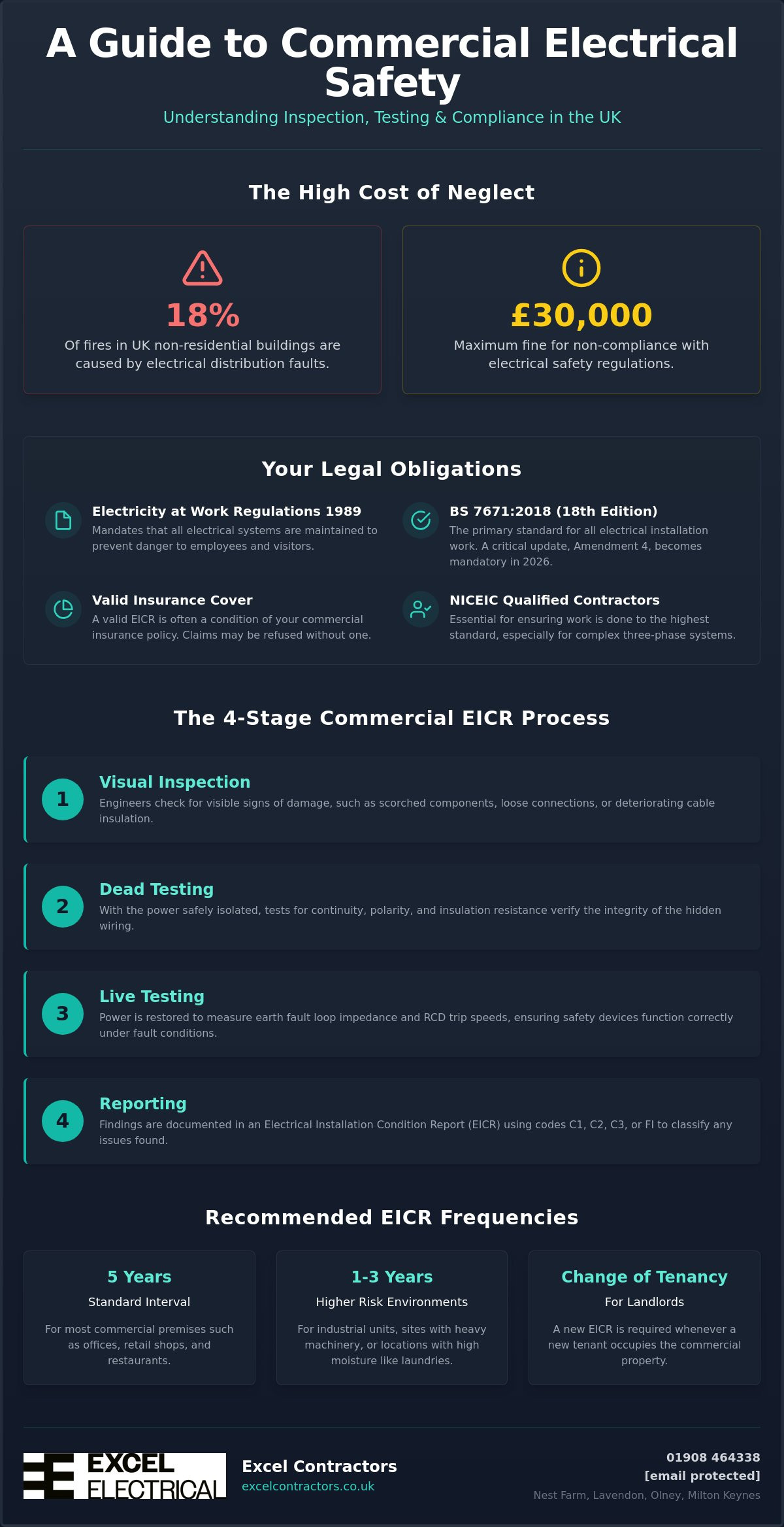
Did you know that electrical distribution faults account for nearly 18% of all fires in UK non-residential buildings? For many business owners, commercial electrical inspection and testing feels like a complex regulatory hurdle that threatens to disrupt daily operations. It’s natural to feel concerned about the potential for hefty non-compliance fines, which can reach up to £30,000, or the confusion surrounding how often your specific sector actually requires a formal check.
You deserve the peace of mind that comes from knowing your workplace is safe and your insurance remains valid. This guide provides the clarity you need to master the latest safety standards, including the mandatory requirements of BS 7671:2018+A4:2026. We’ll explore how to secure a valid EICR efficiently, explain the 18th Edition updates, and help you establish a maintenance schedule that protects your business without causing unnecessary downtime.
Key Takeaways
- Understand your legal obligations under the Electricity at Work Regulations 1989 and stay ahead of the critical 2026 regulatory updates.
- Learn the systematic four-stage process for commercial electrical inspection and testing to ensure a valid EICR whilst minimising business disruption.
- Identify how regular maintenance can uncover hidden fire hazards amongst ageing wiring before they lead to costly equipment failure or safety breaches.
- Discover the essential criteria for selecting a qualified NICEIC contractor in Milton Keynes who understands the complexities of three-phase systems.
- Master the frequency requirements for different commercial sectors to ensure your business remains compliant and fully covered for insurance purposes.
Navigating Commercial Electrical Inspection and Testing Requirements
A commercial electrical inspection and testing programme is a systematic procedure designed to evaluate the safety and integrity of a business’s fixed wiring. Unlike portable appliance testing (PAT), which covers individual items, this process focuses on the infrastructure hidden within walls and ceilings. It ensures that circuits aren't overloaded and that protective devices will function correctly during a fault. This rigorous electrical safety testing is governed by the Electricity at Work Regulations 1989, which mandates that electrical systems must be maintained to prevent danger.
The primary standard for these works is BS 7671, also known as the IET Wiring Regulations. As of 2026, compliance with Amendment 4 is the mandatory benchmark for professional safety. Whilst an Electrical Installation Condition Report (EICR) is the formal document resulting from this testing, it's vital to distinguish it from routine maintenance. Testing is a snapshot of safety at a specific point in time; maintenance is the ongoing care that prevents deterioration between inspections. For expert guidance on these standards, Excel Electrical provides comprehensive compliance support.
The Legal Framework: Why Compliance is Non-Negotiable
Under the Health and Safety at Work Act 1974, company directors and building managers hold a duty of care to employees and visitors. Failing to maintain electrical systems isn't just a safety risk; it's a legal liability. An EICR serves as your primary evidence of due diligence in a court of law or during an HSE investigation. If a fire occurs and no valid report exists, insurance providers often refuse to pay out, citing a breach of policy conditions. Neglect can lead to prosecution, significant fines of up to £30,000, and irreparable reputational damage for your firm.
Frequency of Testing: How Often Does Your Business Need an EICR?
The standard interval for most commercial premises, such as offices, shops, and restaurants, is every five years. However, certain environments demand more frequent intervention. Industrial units with heavy machinery or locations with high moisture levels, like commercial laundries, often require annual inspections due to accelerated wear. For commercial landlords in Milton Keynes, a change of occupancy is a critical trigger. Even if the five-year mark hasn't been reached, a new tenancy necessitates a fresh inspection to ensure the installation remains fit for purpose for the incoming business. This proactive approach ensures a safe working environment and continuous legal compliance.
The 4-Stage Process of a Professional Commercial EICR
A professional Electrical Installation Condition Report (EICR) follows a rigorous sequence to ensure compliance with the Electricity at Work Regulations 1989. It isn't a simple walkthrough; it's a methodical assessment of your building's hidden infrastructure. The process begins with a Visual Inspection, where engineers search for scorched components, loose connections, or damaged cable insulation. Next, Dead Testing is performed whilst the power is safely isolated. This stage includes continuity, polarity, and insulation resistance checks to verify that the wiring remains robust and hasn't degraded over time.
Once the isolated circuits pass, Live Testing commences. The engineer restores power to measure earth fault loop impedance and RCD trip speeds, ensuring safety devices will activate instantly during a fault. The final stage is Reporting. Findings are categorised using specific codes: C1 (danger present), C2 (potentially dangerous), C3 (improvement recommended), or FI (further investigation). Under the 2026 updates to BS 7671, an FI code no longer automatically triggers an "unsatisfactory" result, though it still indicates a need for urgent clarification to ensure long-term safety.
Visual and Physical Testing: What the Electrician Actually Does
During the physical phase, electricians focus on high-load areas like three-phase distribution boards and industrial switchgear. They verify that 18th Edition surge protection devices (SPDs) are correctly installed to protect sensitive commercial electronics from voltage spikes. Every socket-outlet, lighting circuit, and fixed plant machine is sampled to ensure the protective earthing is effective. This level of detail is vital for maintaining a safe working environment and preventing the electrical fires that account for a significant portion of workplace incidents.
Preparing Your Premises for Inspection
Business owners often worry about total site shutdowns, but these are rarely necessary with a managed commercial electrical inspection and testing strategy. We suggest implementing a rolling programme where 20% of the installation is tested annually. This ensures 100% coverage over five years without ever closing your entire facility. Before the engineer arrives, identify critical IT infrastructure or servers that require a managed power-down to prevent data loss. Ensuring clear, unobstructed access to distribution boards and plant rooms will also streamline the process and reduce labour time. If you're unsure how to phase your testing, you can request a free video call quote to plan the logistics with our expert team.
Beyond Compliance: The Strategic Benefits of Regular Testing
Viewing commercial electrical inspection and testing as a mere box-ticking exercise overlooks its value as a vital risk management tool. Proactive testing identifies potential fire hazards amongst ageing wiring long before they lead to catastrophic property loss. Data from 2024/25 shows that electrical distribution faults were responsible for over 2,100 fires in UK non-residential buildings. By catching these faults early, you protect your physical assets and the sensitive data stored on your servers. For a broader perspective on maintaining your systems, read our Essential Guide to Electrical Testing.
Operational efficiency is another significant strategic advantage. Regular inspections often uncover overloaded circuits that generate excess heat, which increases electrical resistance and inflates your energy bills. Identifying these inefficiencies allows you to balance loads and reduce utility costs. There is also a direct link between electrical health and the lifespan of expensive commercial machinery. Stable power delivery prevents internal damage to sensitive control systems and motors, ensuring your capital investments last as long as possible. This methodical approach to maintenance prevents the sudden equipment failures that cripple productivity.
Protecting Business Continuity and Reputation
Business continuity depends on a resilient infrastructure. A single failure in a main distribution board can halt operations for days, leading to lost revenue and frustrated clients. Maintaining a rigorous testing schedule ensures your facility remains operational whilst neighbouring units might face avoidable power faults. Beyond daily operations, your safety record is a key part of your brand reputation. Demonstrating a commitment to safety is often a prerequisite for winning high-value tenders. Many large-scale developers and public sector organisations will only partner with firms that can prove they use an NICEIC-approved contractor for their facility management.
Insurance Validity and Liability Protection
Insurance providers are increasingly stringent regarding electrical safety documentation. Most commercial policies now mandate a "Satisfactory" EICR as a condition of coverage; if a fire occurs and your testing is out of date, the insurer may refuse to pay the claim. This creates a significant financial risk and can even lead to personal liability for company officers. In the context of electrical safety, due diligence is the systematic taking of every reasonable precaution to protect the health and safety of individuals, evidenced by comprehensive and up-to-date electrical records. Maintaining these records is the most effective way to protect your leadership team from legal repercussions following an incident.
How to Select a Qualified Commercial Electrician in Milton Keynes
Selecting the right partner for commercial electrical inspection and testing is a decision that carries significant weight for your business's safety and legal standing. Commercial installations are vastly more complex than domestic ones; they often involve three-phase systems, high-capacity distribution boards, and intricate control gear. It's essential to look beyond a general electrician and find a specialist with a deep understanding of industrial infrastructure in the Milton Keynes and Olney region. A contractor who is familiar with your local area will already understand the specific regional grid requirements and the building types common across Newport Pagnell and the surrounding counties.
Essential Accreditations and Qualifications
NICEIC Approved Contractor status is the gold standard for commercial work. Whilst many electricians are registered as "Domestic Installers", only an Approved Contractor has been assessed for their ability to design, install, and test large-scale commercial systems. This specific accreditation ensures the firm is qualified to produce valid EICRs that satisfy insurers and the Health and Safety Executive. You should also verify that the contractor holds TrustMark registration, which signifies government-endorsed quality standards. Understanding why hiring an NICEIC approved contractor is vital will help you avoid the pitfalls of using unverified labour. Your chosen contractor must also carry robust Professional Indemnity and Public Liability insurance to protect your assets whilst the testing process is underway.
The Value of Local Expertise
Hiring a contractor based in Olney or Milton Keynes offers practical advantages that national firms cannot match. Local experts can provide faster response times for follow-up remedial works, which is critical if a C1 or C2 fault is discovered during an inspection. Proximity also allows for more flexible out-of-hours testing schedules. This means you can arrange for inspections at times that cause the least disruption to your staff and customers in Bedford or Northampton. A firm with a strong local reputation is more likely to value long-term client relationships and provide the transparent, methodical communication required for complex commercial projects. To ensure your premises are fully compliant with the latest 2026 standards, contact Excel Electrical for a professional inspection quote today.
Excel Electrical: Your Partner for Compliance and Safety
Excel Electrical Installations Ltd operates as an NICEIC Approved Contractor with a clear focus on technical accuracy and client safety. Based in Olney, we've built a reputation for delivering methodical commercial electrical inspection and testing across Milton Keynes and the surrounding counties. Our team consists of 18th Edition qualified electricians who prioritise transparent reporting; this ensures you receive a clear, jargon-free understanding of your installation's condition. We take pride in our workmanship, ensuring every project meets national safety regulations whilst providing the peace of mind that comes from a reliable partnership. As a registered supplier for luxury developers like Abbey Mill Homes, we maintain the high standards required for complex, high-stakes electrical infrastructure.
Our approach combines the personal care of a local business with the technical discipline of a high-end service provider. We understand that commercial managers face immense pressure to maintain safety without inflating operational costs. By choosing a TrustMark registered firm, you're guaranteed a service that adheres to government-endorsed quality standards. We don't just provide a report; we offer a long-term safety strategy that helps you manage your assets effectively. Our team is consistently available for communication, ensuring that from the initial quote to the final certificate, you're never left in the dark about your building's compliance status.
Bespoke Testing Solutions for Every Sector
Different commercial environments present unique challenges. A retail unit in Milton Keynes requires a different approach to a light industrial facility in Newport Pagnell. We provide tailored EICR services for offices, shops, and warehouses, applying the same level of care and attention to detail we bring to our domestic electrical services. Our expertise in domestic EICRs, fuseboard changes, and full rewires informs our commercial precision, allowing us to spot subtle faults that others might overlook. To help you prepare for your next visit, you can review our Electrical Safety Audit for Businesses. This checklist provides a practical framework for maintaining compliance throughout the 2026 regulatory cycle.
Get Your Free Commercial Quote Today
We understand that business managers need accurate estimates without unnecessary delays. Excel Electrical offers free quotes and an innovative video call quote option to streamline the estimation process. This allows us to assess your distribution boards and circuit complexity remotely, saving you time and providing a rapid response for your budgeting needs. For all enquiries, please call the office on 01908 464338 or text 07498721733. You can also email us at [email protected] or visit our premises at Nest farm, Lavendon, Olney, Milton Keynes for a consultation. Whether you need a full commercial electrical inspection and testing programme or urgent remedial works to secure your insurance, our team is ready to assist with professional, reliable service.
Secure Your Business Continuity and Compliance
Maintaining a safe workplace is a continuous responsibility that extends far beyond a single inspection. By understanding the 2026 regulatory updates and implementing a systematic approach to commercial electrical inspection and testing, you protect your employees, your assets, and your professional reputation. Whether you're managing a retail unit in Milton Keynes or a light industrial site in Olney, regular testing ensures that hidden faults don't escalate into costly disruptions or safety breaches. It's about more than just avoiding fines; it's about the long-term resilience of your operation.
As an NICEIC Approved Contractor and TrustMark registered firm, our 18th Edition qualified electricians provide the technical expertise you need for total peace of mind. We offer free quotes and the option for video call estimations to streamline your compliance planning. For expert advice, call 01908 464 338 for a free commercial electrical quote or text 07498721733. You can also email [email protected] or visit us at Nest farm, Lavendon, Olney, Milton Keynes. Taking a proactive step today ensures a safer, more stable environment for your entire team.
Frequently Asked Questions
What is the difference between an EICR and PAT testing for businesses?
An EICR evaluates the fixed electrical installation of your building, including the wiring, consumer units, and sockets integrated into the structure. In contrast, PAT testing focuses on individual portable appliances that plug into the system, such as kettles, printers, or power tools. Both are necessary for full safety, but they are separate processes with different testing frequencies.
Can my business remain open whilst commercial electrical testing is carried out?
Yes, most businesses remain operational during commercial electrical inspection and testing. We typically implement a rolling programme where only specific circuits are isolated at one time, minimising the impact on your staff. For critical infrastructure, we can arrange out-of-hours testing or managed power-downs to ensure your daily productivity isn't compromised.
How long does a commercial electrical inspection typically take?
The duration depends entirely on the size of your premises and the number of circuits involved. A small retail unit in Milton Keynes might be completed in a few hours, whilst a large industrial warehouse could take several days. We provide a clear timeframe during our initial estimation process to help you plan your schedule effectively.
What happens if my business fails its electrical inspection?
If your report is "unsatisfactory," it means the engineer has identified C1 or C2 faults that require urgent attention. You'll need to carry out remedial works to address these specific hazards. Once the repairs are completed, we issue a satisfactory certificate to ensure your legal compliance and insurance validity are fully restored.
Is a landlord electrical safety certificate different for commercial properties?
Whilst the principle of safety is the same, commercial certificates cover more complex systems like three-phase power and industrial switchgear. Commercial landlords have a legal duty under the Electricity at Work Regulations 1989 to ensure the installation is safe for tenants. This requires a higher level of qualification and expertise than standard domestic testing.
How much does a commercial EICR cost for a standard office in Milton Keynes?
Costs for an inspection are calculated based on the total number of circuits rather than the square footage of the office. Because every installation is unique, we don't provide flat-rate pricing. We offer free video call quotes for businesses in Milton Keynes to provide an accurate, transparent estimate tailored to your specific infrastructure.
Are 18th Edition regulations mandatory for all UK businesses in 2026?
Yes, all new electrical work and inspections must comply with the latest version of BS 7671. As of 2026, Amendment 4 becomes the mandatory standard on October 15. Ensuring your business meets these updated requirements is essential for maintaining your legal standing and ensuring your insurance coverage remains active and valid.
Can I carry out my own basic electrical checks between professional inspections?
You can and should perform regular visual checks, such as looking for scorched sockets, damaged cables, or flickering lights. These "user checks" help identify obvious hazards amongst your equipment. However, they don't replace formal testing, as they cannot detect hidden issues like poor earthing or insulation degradation within the fixed wiring.


