
You might think the logo on an electrician's van is just a badge of membership, but for a homeowner, that small sticker is often the only thing standing between a legal installation and a voided insurance policy. It's perfectly natural to feel overwhelmed by the alphabet soup of electrical acronyms and technical jargon. You want to ensure your home is safe and compliant with the latest BS 7671:2018+A4:2026 regulations, whilst the debate over NICEIC vs NAPIT electricians often leaves people more confused than when they started.
This guide will clarify exactly what these accreditations mean for your domestic project and why choosing a registered professional is non-negotiable for your safety. We'll explore the practical differences between these two leading Competent Person Schemes, the impact of Part P building regulations, and how to verify that your chosen contractor can legally self-certify their work. By the end, you'll have the confidence to hire a tradesperson who guarantees both technical excellence and administrative compliance.
Key Takeaways
- Understand the legal necessity of Part P Building Regulations and how they ensure your domestic electrical work is safe and insurance-compliant.
- Learn why NICEIC is considered the industry gold standard and why it remains the preferred choice for architects and local authorities.
- Explore the technical strengths of NAPIT and its reputation for excellence within the modern electrical and renewable energy sectors.
- Compare NICEIC vs NAPIT electricians to understand how their rigorous annual assessments and financial protections provide essential peace of mind.
- Discover why additional credentials like TrustMark registration are vital when selecting a reliable professional for EICRs or consumer unit upgrades.
Understanding Competent Person Schemes (CPS) in the UK
A Competent Person Scheme (CPS) is a government-backed initiative designed to ensure that electrical work in your home meets the highest safety standards. These schemes allow registered professionals to self-certify their work, confirming it complies with the Building Regulations. Without these schemes, every significant electrical job would require a costly and time-consuming inspection from Local Authority Building Control. By hiring a registered professional, you bypass this bureaucracy and ensure the job is done right from the outset.
The debate between NICEIC vs NAPIT electricians usually centres on which scheme is "better", but their primary function is to provide a framework for accountability. The National Inspection Council for Electrical Installation Contracting (NICEIC) and NAPIT both demand rigorous annual assessments of their members. This ensures that the person working in your kitchen or bathroom is technically capable and fully insured. It's about peace of mind for the homeowner, knowing that the work is being monitored by a professional body.
The Role of Part P Compliance
Part P is the specific section of the Building Regulations that deals with electrical safety in domestic properties. Not all work is created equal. Replacing a simple light fitting or a socket faceplate is generally non-notifiable. However, more substantial projects like a full rewire, a consumer unit upgrade, or any work in "special locations" like bathrooms must be reported to the local council. A registered contractor handles this notification automatically. They provide you with a Building Regulations Compliance Certificate, which is a vital document for your home records and legal compliance.
Why DIY Electrical Work is a Risk
The temptation to save money by doing it yourself or hiring an uncertified "handyman" is high, but the risks are substantial. Hiring "cowboy" builders who aren't registered with a scheme like NICEIC or NAPIT leaves you legally vulnerable. These individuals often lack the necessary qualifications to understand the latest 18th Edition wiring regulations. If they can't self-certify, the responsibility for notifying the council falls on you, which can cost hundreds of pounds in inspection fees.
Most home insurance providers require that electrical installations are certified by a competent person. If an uncertified installation leads to a fire, your policy may be voided. Beyond safety, there's the issue of property value. When you sell your home, the buyer's solicitor will ask for proof of Part P compliance for any work carried out since 2005. Missing paperwork can stall or even collapse a sale. It's always better to have a professional paper trail from a qualified provider like Excel Electrical.
NICEIC: The Established Gold Standard for Electricians
NICEIC is widely considered the premier accreditation body within the UK electrical industry. It features prominently on the UK government's list of authorized Competent Person Schemes, serving as a hallmark of quality for over 70 years. For many architects, premium developers, and local authorities, NICEIC registration is a mandatory prerequisite for any electrical tender. This preference stems from the organisation's long-standing reputation for maintaining the highest technical standards in the country.
The annual assessment process for an NICEIC contractor is exceptionally thorough. An assessor visits the firm to inspect physical installations on-site, review technical documentation, and ensure all testing equipment is correctly calibrated. This rigorous oversight ensures that contractors stay aligned with the latest safety regulations. All work must now comply with the BS 7671:2018+A4:2026 amendment, which became mandatory on April 15, 2026. This specific update requires 30mA RCD protection on all domestic lighting circuits, a safety feature that an NICEIC professional is trained to implement correctly.
The NICEIC Platinum Promise
When evaluating NICEIC vs NAPIT electricians, the Platinum Promise is a significant factor for many homeowners. This scheme provides a robust financial safeguard. If an NICEIC-registered contractor performs work that is later found to be non-compliant with Building Regulations, and that contractor is no longer in business to fix it, NICEIC will step in. They will arrange for the work to be rectified by another approved firm at no cost to the homeowner. This protection lasts for six years, offering a level of security that unaccredited "cowboy" builders cannot match.
NICEIC Approved Contractor vs Domestic Installer
Homeowners should distinguish between the two primary levels of registration. A "Domestic Installer" is assessed solely for residential work. However, an "Approved Contractor" has met a more demanding set of criteria, allowing them to work across domestic, commercial, and industrial environments. This higher tier of accreditation signifies a broader depth of knowledge and a more robust business infrastructure. Excel Electrical maintains Approved Contractor status, ensuring that our clients receive the most comprehensive expertise available for their projects.
Verifying a firm's credentials via the NICEIC "Find a Contractor" tool is a simple but essential step before any work begins. This ensures your project is handled by a legitimate professional capable of self-certifying the installation. If you require a safety check or a consumer unit upgrade, you can arrange a free quote to ensure your home meets current 2026 standards and remains fully compliant with national safety regulations.
NAPIT: The Modern and Versatile Alternative
NAPIT (National Association of Professional Inspectors and Testers) stands as a major pillar of the electrical industry. It's a fully authorised provider within the UK Government's Competent Person Scheme, meaning its members possess the same legal authority to self-certify their work as those registered with NICEIC. When homeowners evaluate NICEIC vs NAPIT electricians, it's vital to understand that both organisations assess their contractors against the exact same technical standard: BS 7671. This ensures that safety is never compromised, regardless of which logo is displayed on the contractor's vehicle.
NAPIT has earned a reputation for being particularly forward-thinking and technically inclusive. While they cover the full range of domestic electrical services, they're often the preferred body for contractors specialising in renewable energy and microgeneration. As the UK experiences a significant solar boom in 2026, NAPIT's influence in the installation of solar PV and EV chargers has grown. Their assessment process is stringent, involving regular site audits to ensure compliance with the latest BS 7671:2018+A4:2026 wiring amendments. This includes the mandatory requirement for 30mA RCD protection on all domestic lighting circuits, a standard that all registered members must uphold.
NAPIT Work Quality Guarantee
Homeowners often worry about the longevity of their electrical installations. NAPIT addresses this through their Work Quality Guarantee, which provides robust financial protection for up to six years. This scheme covers the cost of rectifying work if it's found to be non-compliant with Building Regulations and the original contractor has ceased trading. Should you ever need to lodge a complaint, the NAPIT framework is designed to be transparent. It prioritises consumer safety by ensuring that faults are corrected without additional financial burden on the property owner.
Broad Scope of Accreditation
One of NAPIT's defining features is its multi-trade approach. Many NAPIT members are accredited across various disciplines, including heating, ventilation, and renewable power systems. This makes them a common choice for eco-home upgrades where electrical work must integrate seamlessly with smart home technology or complex mechanical systems. Before hiring, you should always verify a member's status through the NAPIT official online search portal. This confirms the contractor is currently registered and holds valid insurance. For those seeking reliable domestic electrical services, verifying these credentials is the most effective way to protect your home and ensure your installation is legally compliant.
NICEIC vs NAPIT: A Head-to-Head Comparison for Homeowners
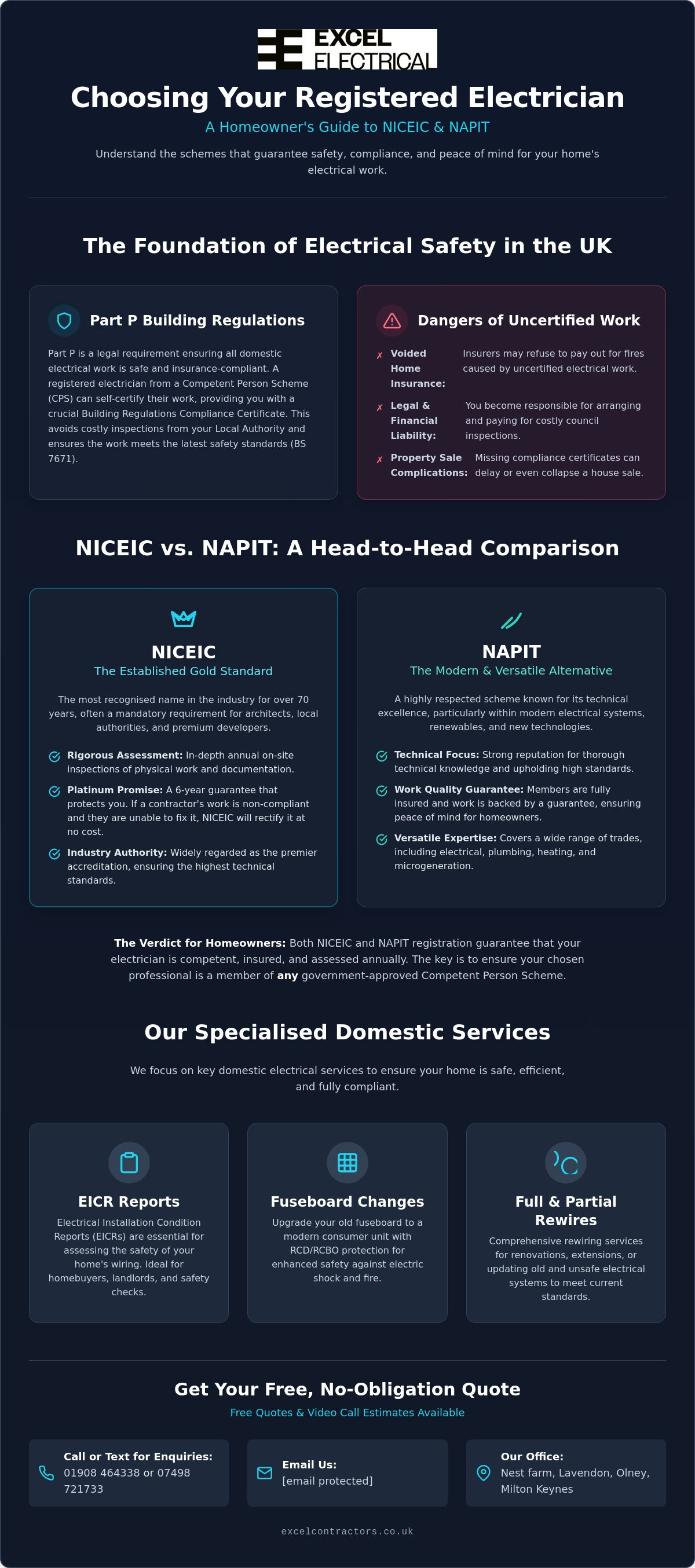
When you sit down to compare NICEIC vs NAPIT electricians, it's easy to get lost in technicalities. However, from a legal perspective, the outcome for a homeowner is identical. Both organisations are authorised Competent Person Scheme providers. This means a member of either scheme has the legal authority to self-certify that their work meets the Building Regulations. Whether you're planning a full rewire or a consumer unit upgrade, both badges guarantee that the contractor is assessed annually to ensure they're working to the latest BS 7671 safety standards.
The primary difference lies in brand recognition and market perception. NICEIC is often the name specifically requested by mortgage surveyors, architects, and local authorities. This long-standing reputation can sometimes make property transactions smoother, as surveyors are historically more familiar with NICEIC documentation. NAPIT, while equally rigorous in its technical assessments, is frequently the choice for modern contractors who specialise in a broader range of trades, such as solar PV or EV charger installations. Both schemes offer a six-year work quality guarantee, such as the NICEIC Platinum Promise or the NAPIT Work Quality Guarantee, ensuring that non-compliant work is corrected even if the original firm stops trading.
Does the Badge Affect the Price?
There is a common myth that hiring NICEIC-registered professionals is always more expensive than choosing those with NAPIT accreditation. This is rarely the case. The annual registration fees for these schemes represent a very small percentage of a professional contractor's overheads. Pricing is typically driven by the complexity of the job, the quality of the materials used, and the level of insurance the firm carries. Choosing a registered professional provides a significant cost-benefit. It's far cheaper to pay for a compliant installation than to rectify "cowboy" work that fails a later EICR or prevents the sale of your home.
Checking Credentials in Milton Keynes and Beyond
If you're a homeowner in Olney, Newport Pagnell, or Bedford, you should never take a contractor's word at face face value. A legitimate professional won't be offended if you ask to see their current registration ID card. This card should feature the scheme logo and a valid expiry date. You can also use the online search tools provided by each organisation to verify that the business is currently active and insured. For residents seeking a trusted partner, you can visit the Excel Electrical homepage to view our verified NICEIC credentials and domestic service history.
Confirming these details before work begins is the only way to ensure your project stays on the right side of the law. If you're unsure about the current safety of your installation, you can request a free video call quote to discuss your needs with a qualified expert from our Olney-based team.
Choosing the Right Professional for Your Home Project
While the debate surrounding NICEIC vs NAPIT electricians provides a clear framework for technical competence, holding a badge is only the first step in selecting the right contractor. Accreditation guarantees that an electrician is assessed against national safety standards, but it doesn't account for their specific experience with your property type or their commitment to customer service. For homeowners, it's essential to look for additional layers of protection, such as TrustMark registration. This government-endorsed quality scheme audits the way a business operates, ensuring they're not only technically sound but also financially stable and fair in their dealings with consumers.
Evaluating a contractor's specific expertise is vital for complex domestic projects. An electrician who spends most of their time on small commercial repairs might not be the most efficient choice for a full domestic rewire or a sensitive fuseboard change in an older property. You should always ask for evidence of their experience in domestic electrical services, particularly for high-stakes tasks like an EICR (Electrical Installation Condition Report). These reports require a methodical mindset and deep diagnostic knowledge to identify potential fire hazards or wiring degradation before they become dangerous.
Local knowledge also plays a significant role in the success of your project. Hiring a contractor based in Olney or Milton Keynes ensures they're familiar with the common housing stock and local authority requirements in the area. This proximity allows for better communication and more responsive service if you require maintenance or emergency assistance. A local, reputable firm like Excel Electrical understands the importance of maintaining a high standard of workmanship to protect their local reputation.
Essential Questions to Ask Your Electrician
- Are you an NICEIC Approved Contractor or a Domestic Installer? Approved Contractors, like Excel Electrical, are assessed to a higher standard that covers commercial and industrial work alongside domestic projects.
- Do you offer video call quotes? Modern firms provide video call estimations to streamline the process, saving you time and providing a faster turnaround for your quote.
- Will you provide a Building Regulations Compliance Certificate? This is a legal requirement for most domestic work. You must ensure your contractor will handle the notification to Local Authority Building Control.
Next Steps for Your Electrical Safety
If you haven't had your home's wiring checked in the last ten years, booking a professional EICR is the most responsible next step. This assessment provides a clear overview of your installation's condition and identifies whether a consumer unit upgrade or partial rewire is necessary to meet 2026 safety standards. Excel Electrical specialises in these domestic safety assessments and fuseboard changes, ensuring your home remains a safe environment for your family.
To discuss your project or arrange a free quote, you can call our office on 01908 464338 or text 07498721733 for enquiries. You can also email us at [email protected] or visit our team at Nest farm, Lavendon, Olney, Milton Keynes. We're committed to providing transparent, professional advice to help you navigate the complexities of electrical accreditations and home safety.
Securing Your Home’s Electrical Future
Understanding the technical landscape of NICEIC vs NAPIT electricians ensures you make an informed decision for your next domestic project. Both organisations provide the essential framework for Part P compliance and consumer financial protection, meaning your home remains safe and your insurance stays valid. The choice ultimately depends on verifying that your contractor is currently registered and possesses the specific expertise required for tasks like EICRs or consumer unit upgrades.
Excel Contractors has been a reliable partner for homeowners since 2015. As an NICEIC Approved Contractor and TrustMark registered business, we maintain the highest standards of safety and professional accountability. If you're based in Olney, Milton Keynes, or the surrounding areas, we're here to help with your electrical maintenance and installation needs. Contact us for a free quote or to arrange a video call consultation to streamline your project estimation.
For all enquiries, please call 01908 464 338 or text 07498721733. You can also email our team at [email protected] or find us at Nest farm, Lavendon, Olney, Milton Keynes. We look forward to ensuring your home’s electrical system is both safe and compliant for years to come.
Frequently Asked Questions
Is NICEIC better than NAPIT for domestic work?
Neither scheme is technically superior for domestic projects. Both NICEIC and NAPIT are authorised Competent Person Schemes that assess contractors against the same national safety standard, BS 7671. Whilst NICEIC is often more recognised by surveyors and architects, a NAPIT registered professional provides the same legal certification for your home. The choice between NICEIC vs NAPIT electricians should focus on the specific contractor's reputation and their experience with domestic installations.
Can a NAPIT electrician sign off NICEIC work?
No, an electrician can only certify work through the specific scheme they are registered with. If you hire a NAPIT member, they will issue a NAPIT certificate. They cannot issue NICEIC paperwork. Certification is a legal declaration that the person signing the document designed, constructed, and tested the work. Most schemes do not allow members to "sign off" work carried out by an unrelated, unregistered third party.
What happens if my electrician isn’t registered with any scheme?
If your electrician isn't registered, the legal responsibility for Building Regulations compliance falls on you. You'll need to notify the local council before work begins and pay their inspection fees, which can be expensive. Unregistered work usually lacks a Building Regulations Compliance Certificate. This can lead to safety hazards, voided home insurance, and significant legal hurdles when you eventually try to sell your property.
How do I check if my electrician is actually NICEIC registered?
You can verify registration by using the "Find a Contractor" search tool on the official NICEIC website. Simply enter the business name or their postcode. Additionally, you should always ask to see their physical ID card when they arrive at your home. This card confirms their identity and shows that their accreditation is current, ensuring they are legally authorised to work on your property.
Do I need a certificate for a simple socket change?
Not usually for a direct replacement of a faceplate. Swapping a damaged socket for a new one in the same location is generally considered non-notifiable work. However, if you are adding a completely new socket or performing work in a "special location" like a bathroom, it often becomes notifiable. It's always best to have a professional check your installation to ensure it meets the latest 18th Edition safety requirements.
Is the NICEIC Platinum Promise free for the homeowner?
Yes, the Platinum Promise is a free safeguard provided to homeowners who use an NICEIC registered contractor. It provides financial protection for up to six years, covering the cost of rectifying work that doesn't meet Building Regulations if the original firm is no longer in business. This is a key reason why many choose NICEIC vs NAPIT electricians, as it offers significant long-term peace of mind.
Can I sell my house if I don’t have an electrical certificate?
Selling a house without certificates is challenging and frequently leads to transaction delays. Buyers' solicitors will check for Part P compliance for any electrical work carried out since 2005. If you lack the paperwork, you might be forced to pay for a retrospective EICR or an indemnity insurance policy. In some cases, a buyer may even demand a price reduction to cover the cost of potential remedial work.
What is the difference between an NICEIC Domestic Installer and an Approved Contractor?
The distinction lies in the scope of their technical assessment. A Domestic Installer is only authorised to work on residential properties. An Approved Contractor, such as Excel Contractors, is assessed to a more rigorous standard that allows them to work in domestic, commercial, and industrial environments. Choosing an Approved Contractor ensures you are working with a firm that possesses a broader depth of technical knowledge and business stability.


