

Did you know that switching to modern commercial LED systems can slash your lighting-related electricity costs by up to 80%? For many UK business owners, rising energy prices and the constant maintenance of flickering, outdated fixtures are more than just a nuisance; they're a direct hit to the bottom line and staff wellbeing. You've likely noticed that poor illumination often leads to persistent headaches and a dip in productivity across the workspace, making professional office lighting upgrades a priority for the coming year.
Investing in these systems is no longer just about visibility. It's about strategic efficiency and strict regulatory adherence. This guide explains how the latest trends can maximise employee output whilst ensuring your business meets 2026 UK compliance standards, including the updated Part L of the Building Regulations. You'll discover how to achieve a modern, energy-efficient office that requires far less maintenance over the long term.
We'll provide a thorough overview of human-centric design, smart IoT controls, and the necessity of 18th Edition safety standards. Based at Nest farm, Lavendon, Olney, Milton Keynes, Excel Electrical provides the technical expertise required for such transitions. You can reach our office at 01908 464338 or [email protected] to discuss future-proofing your workplace for 2026 and beyond.
Key Takeaways
- Understand how the transition from basic utility to wellness-focused design supports your company’s ESG goals and employee wellbeing.
- Discover the science behind Human-Centric Lighting and how specific colour temperatures can regulate circadian rhythms to improve staff concentration.
- Learn how IoT-integrated smart controls and automated daylight harvesting are now essential for meeting the latest UK Building Regulations.
- Identify the financial benefits of professional office lighting upgrades, which can slash energy consumption by up to 80% and offer a rapid return on investment.
- Find out how to achieve full 18th Edition compliance with minimal disruption to your daily operations through professional site surveys and expert installation.
The Evolution of the Workspace: Why Office Lighting Upgrades Matter in 2026
As we move through 2026, the UK office landscape faces a critical infrastructure shift. For decades, lighting was viewed as a basic utility; a fixed cost on the balance sheet that rarely received attention unless a bulb flickered out. That perspective has changed. Modern businesses now recognise that office lighting upgrades are essential for both financial survival and corporate responsibility. High energy prices in the UK have made legacy systems unsustainable, whilst the push for Environmental, Social, and Governance (ESG) compliance has placed building efficiency at the heart of corporate strategy.
The Evolution of Workspace Lighting shows how we've moved from simple gas lamps to sophisticated semiconductor technology. In a commercial setting, this evolution is now driven by the necessity to reduce carbon footprints. Investors and clients alike now demand transparency regarding a firm's environmental impact. Upgrading to advanced LED systems is often the most effective way to meet these targets quickly, providing a visible commitment to sustainability that resonates with stakeholders.
From Fluorescent to Future-Proof LED
The UK has accelerated the phase-out of traditional fluorescent tubes due to their mercury content and poor efficiency. Whilst some businesses attempt a "simple" LED tube swap, these retrofits often fail to address underlying circuit issues or heat dissipation. A truly future-proof system requires a holistic approach. This frequently involves commercial electrical panel upgrades to ensure the distribution board can safely manage the modern drivers and controls associated with high-end LED arrays. Proper installation ensures longevity and prevents the premature failure of expensive components, protecting your investment for years to come.
Lighting as a Tool for Employee Retention
Employee wellbeing has become a competitive advantage in the modern recruitment market. Poor light quality is a primary contributor to "sick building syndrome," leading to eye strain, lethargy, and decreased focus. By reducing glare and eliminating the invisible flicker common in older ballast-driven lights, companies can significantly lower staff absenteeism and improve morale. In the era of hybrid working, the office must become a "destination." High-quality, adaptive lighting creates an environment that people actually want to work in, making the commute feel worthwhile. It's about creating a space that supports focus and collaborative behaviour rather than just providing a place to sit.
Planning these improvements requires technical precision and a commitment to safety. Excel Electrical, based at Nest farm, Lavendon, Olney, Milton Keynes, helps businesses navigate these complex infrastructure changes. To discuss your requirements or to arrange a free quote, please call 01908 464338 or email [email protected].
Human-Centric Lighting (HCL): The Science of Productivity
When planning office lighting upgrades, business owners must look beyond simple brightness. The concept of Human-Centric Lighting (HCL) represents a sophisticated shift in how we illuminate professional environments. It moves away from static, "one-size-fits-all" light levels toward a dynamic system that prioritises the biological needs of the workforce. By accounting for the visual and non-visual effects of light, HCL creates a workspace that actively supports human health rather than merely facilitating a task.
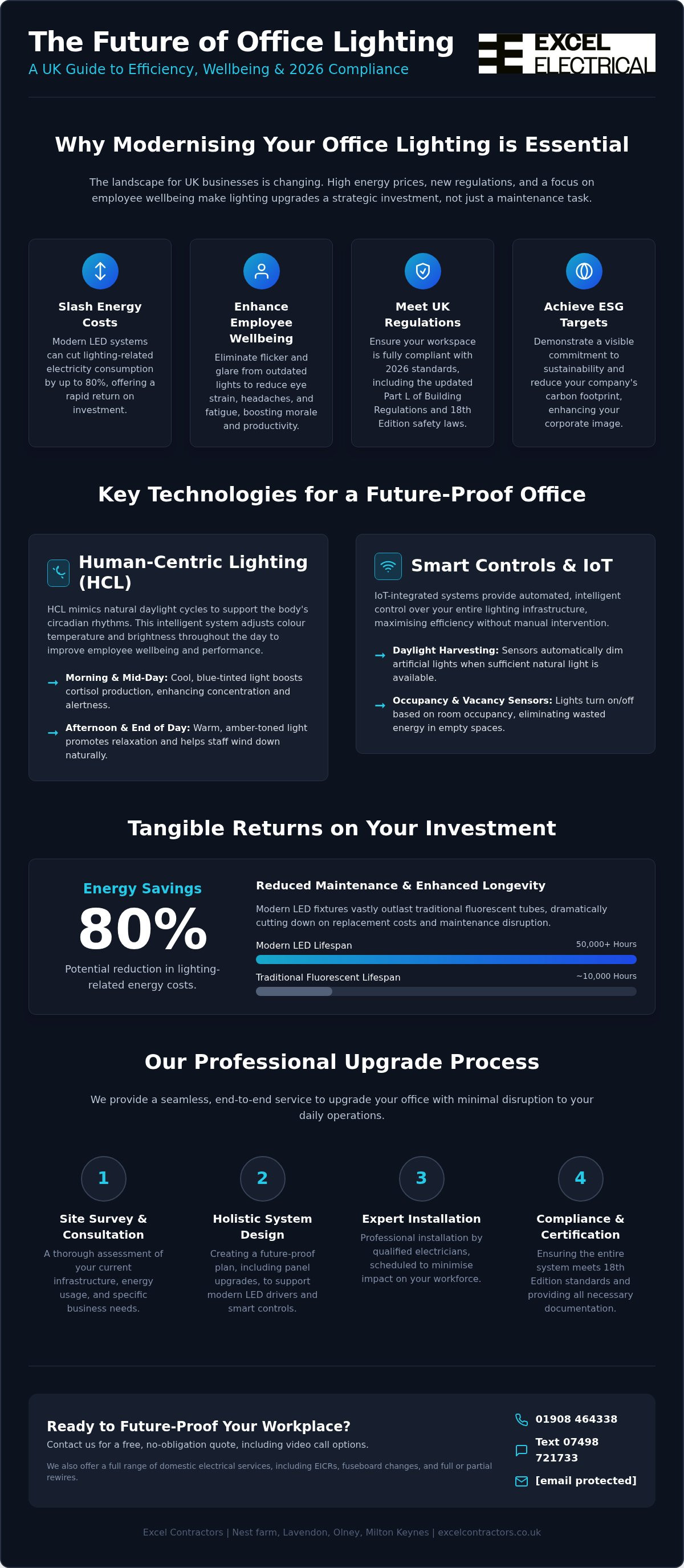
Human-centric lighting is a system that mimics natural daylight cycles to improve alertness. This technology is grounded in the science of circadian rhythms, which are the internal processes that regulate our sleep-wake cycle over a 24-hour period. Research into Human-Centric Lighting demonstrates that specific wavelengths of light can trigger the production of cortisol to keep us awake or melatonin to help us wind down. In a corporate setting, the measurable impact is significant. Correctly implemented HCL has been shown to enhance concentration levels, reduce errors, and improve overall cognitive performance amongst employees.
Tunable White Technology
The technical heart of HCL is tunable white technology. This allows for the adjustment of colour temperature, measured in Kelvin (K), throughout the working day. A typical cycle might begin with cooler, blue-enriched light (around 5000K to 6500K) in the morning to stimulate alertness and suppress lethargy. As the day progresses, the system transitions toward warmer, amber tones (2700K to 3000K). This warmer light is often more suitable for collaborative focus or breakout periods. Installing these systems in large offices requires precise control interfaces and high-quality LED drivers capable of smooth, flicker-free dimming across the entire Kelvin range.
Circadian Rhythm Synchronisation
Synchronising the internal office environment with the natural outdoor light cycle is particularly beneficial for businesses in Milton Keynes that operate across extended hours or multiple shifts. For 24/7 operations, HCL can help mitigate the fatigue often associated with night shifts by providing light that supports the body's natural requirements. However, a successful installation requires bespoke design for different office zones. A high-intensity focus area requires a different lighting profile than a reception desk or a staff canteen. Office lighting upgrades should always account for these varied needs to ensure every square metre of the building is working to support the staff.
Achieving this level of technical sophistication requires a partner who understands both the electrical requirements and the biological goals of the project. Consulting with commercial lighting specialists ensures that your system is not only compliant with 18th Edition standards but also optimised for your specific team. For a professional assessment of your current infrastructure, please contact Excel Electrical at our Lavendon office on 01908 464338.
Smart Controls and IoT: The Brains Behind the Brightness
Modern office lighting upgrades are defined by intelligence. It's no longer enough to install efficient LEDs; those luminaires must be managed by a system that understands the building's environment in real time. The integration of the Internet of Things (IoT) allows every light fixture to act as a data point. This shift transforms lighting from a static overhead cost into a responsive asset that reacts to environmental changes and occupancy patterns.
Two primary technologies drive this technical efficiency: automated dimming and occupancy sensing. Daylight harvesting uses sensors to measure ambient natural light entering through windows, automatically dimming artificial lights to maintain a constant, comfortable lux level. This ensures you aren't wasting energy when natural light is sufficient. Similarly, occupancy sensors ensure you're never paying to light an empty boardroom or corridor. Beyond simple switching, these sensors provide valuable data on office utilisation. Management can track which zones are under-utilised, allowing for better-informed decisions regarding space planning and property costs.
Wireless Control Systems
For businesses operating in historic or listed buildings across the UK, traditional wired installations can be invasive. Wireless control systems using Bluetooth or Zigbee protocols offer a solution that significantly reduces structural impact. By utilising wireless mesh networks, companies can avoid the extensive commercial rewiring often required for older control protocols. This reduces installation time and preserves the architectural integrity of the premises while providing centralised management via tablets or smartphones. It's a precise way to modernise without the disruption of a full-scale construction project.
Integration with Building Management Systems (BMS)
The highest level of efficiency is reached when lighting is fully integrated with a Building Management System. This allows the lighting, heating, and ventilation (HVAC) to work in unison. For example, when an occupancy sensor detects a room is empty, it can signal the BMS to lower the heating simultaneously. These complex hubs often require robust three-phase electrical installations to ensure stable power delivery across the entire smart infrastructure. These systems also enable predictive maintenance. They flag failing drivers or declining luminaire performance before a total outage occurs, allowing for planned repairs rather than emergency call-outs.
Excel Electrical, based at Nest farm, Lavendon, Olney, Milton Keynes, specialises in these technical integrations. We provide free quotes and video call quotes to help you assess your current infrastructure. To discuss your requirements, please call 01908 464338 or text 07498721733 for enquiries.
The Financial Case: ROI, Efficiency, and UK Compliance
For most UK businesses, the decision to invest in office lighting upgrades is driven by a need to control escalating operational costs. Modern LED upgrades can reduce lighting energy consumption by up to 80%, providing a substantial hedge against volatile energy markets. When combined with smart controls, the typical payback period for a commercial installation falls between two and four years. This return on investment is not just found in lower electricity bills; it's also realised through the near-elimination of the maintenance cycle required by legacy fluorescent ballast systems.
Financial incentives currently support this transition. Businesses can utilise the Annual Investment Allowance (AIA) to deduct the full cost of qualifying energy-efficient equipment from their taxable profits. Furthermore, the Business Energy Advice Service (BEAS) grant is available to SMEs until March 2026, providing 50% match-funded grants between £1,000 and £100,000 for energy-saving measures. Delaying these upgrades often incurs hidden costs, such as the premium paid for sourcing obsolete components and the productivity losses associated with inadequate light quality.
Meeting 18th Edition Safety Standards
Compliance with BS 7671, the 18th Edition of the IET Wiring Regulations, is a non-negotiable requirement for commercial premises in the UK. Regular EICR testing is essential to prove that your lighting circuits are safe and to maintain your building's insurance validity. Upgrading your system also provides an opportunity to ensure your emergency lighting meets current UK fire safety regulations. These systems must provide reliable illumination during a power failure to facilitate a safe evacuation, a requirement that legacy systems often fail to meet during rigorous testing.
Future-Proofing for EPC Rating Changes
Lighting performance is a major factor in determining a building's Energy Performance Certificate (EPC) rating. The UK government continues to tighten minimum energy efficiency standards for commercial lets, meaning an inefficient system could soon make a property unmarketable. The updated Part L of the Building Regulations, published in March 2026, now mandates a minimum efficacy of 105 luminaire lumens per circuit watt (lm/W) for general lighting in new non-domestic buildings. Adhering to these standards reduces your carbon footprint, which is a vital metric for modern clients who prioritise Environmental, Social, and Governance (ESG) performance when choosing partners.
To ensure your facility meets these rigorous financial and safety benchmarks, contact our specialists for a commercial electrical assessment. We provide free quotes and video call consultations to help you plan your path to 2026 compliance. Call our office in Olney on 01908 464338 to begin the process.
Planning Your Office Upgrade with Excel Electrical
Executing successful office lighting upgrades involves far more than simply selecting modern fixtures. A professional site survey is the first essential step in any commercial project. This assessment ensures that the proposed design meets the specific illuminance (lux) and glare control (UGR) requirements set out in standards like BS EN 12464-1:2021. Without a detailed technical design, businesses risk installing systems that are either insufficient for the tasks performed or overly bright, leading to unnecessary energy expenditure.
Disruption to daily operations is a primary concern for any business owner. Our team manages the installation process with precision, often utilising phased schedules or out-of-hours working to ensure your staff can remain productive. As an NICEIC Approved and TrustMark registered contractor, we provide the peace of mind that all work adheres to the highest safety standards. We manage the entire process from the initial estimation through to the final commissioning and the issuance of all necessary certification, ensuring your office lighting upgrades are fully compliant.
Bespoke Lighting Design for Milton Keynes Businesses
We provide tailored solutions for offices across Olney, Newport Pagnell, and Bedford. Every workspace has a unique architectural character, and our designs reflect this. We ensure that the aesthetics of the luminaires match your brand identity, whether you require a minimalist industrial look or a high-end luxury fit-out. Specialist lighting for boardrooms or reception areas is integrated seamlessly into the wider electrical infrastructure, ensuring a consistent and professional appearance throughout the building.
Why Choose Excel Electrical Installations Ltd?
Our expertise in 18th Edition regulations and commercial maintenance makes us a reliable partner for complex projects. Whilst we specialise in domestic electrical services like full rewires and EICR testing, our commercial department is equally focused on safety and systematic delivery. We pride ourselves on clear communication and technical accuracy, ensuring your project is completed on time and within the agreed scope. Our persona is that of a steady hand, providing the technical knowledge required to keep your business running safely.
To begin your transition to a modernised workspace, we offer free quotes and the convenience of video call quotes to streamline the estimation process. Contact our team at Nest farm, Lavendon, Olney, Milton Keynes, or call 01908 464338 to get started. You can also text 07498721733 for enquiries or email [email protected]. Our office is dedicated to providing the technical support your business needs for a safe and efficient future.
Secure Your Workspace Efficiency for 2026
The transition toward intelligent, human-centric lighting is no longer a luxury but a technical necessity for UK businesses. By prioritising office lighting upgrades, you can achieve a workspace that supports employee wellness whilst drastically reducing operational overheads. These advanced systems provide the infrastructure required to meet 2026 Part L Building Regulations and ensure your property remains a compliant, high-performing asset. Professional installation ensures that your business benefits from maximum energy savings and a significant reduction in long-term maintenance requirements.
Excel Contractors brings technical precision and accountability to every project. We are NICEIC Approved, 18th Edition qualified, and TrustMark registered professionals. Based at Nest farm, Lavendon, Olney, Milton Keynes, we provide the stability and expertise needed for both complex commercial installations and essential domestic electrical services. We take pride in our methodical approach, ensuring all safety standards are met without compromise.
Taking the first step toward a future-proofed office is straightforward. You can request your free video call quote for office lighting upgrades from Excel Electrical to begin your assessment. For enquiries, call 01908 464338, text 07498721733, or email [email protected]. We look forward to helping you create a safer, more productive environment for your team.
Frequently Asked Questions
How much can my business save by upgrading to LED office lighting?
Businesses can reduce their lighting-related electricity costs by up to 80% by switching to modern commercial LED systems. This significant reduction in energy consumption typically results in a payback period of between two and four years. These financial gains are further enhanced by the near-total removal of the maintenance costs associated with traditional fluorescent ballast replacements and frequent bulb failures.
Will an office lighting upgrade disrupt my staff's working day?
Disruption is kept to an absolute minimum through careful project management and flexible scheduling. We often perform installations during out-of-hours periods or weekend shifts to ensure your staff's working day remains uninterrupted. Our team works systematically through different office zones to maintain a safe and functional environment throughout the duration of the project.
What is the 18th Edition and does my office lighting need to comply?
The 18th Edition, also known as BS 7671, is the current UK standard for electrical installations, and compliance is mandatory for all commercial premises. Your office lighting upgrades must meet these safety regulations to ensure the installation is safe for use and to maintain your building's insurance validity. Our electricians are fully 18th Edition qualified to guarantee that all work meets these rigorous national standards.
Can I integrate smart lighting with my existing office electrical panel?
Yes, smart lighting can be integrated with existing panels, although a technical assessment is required to ensure the current distribution board can handle modern drivers. In some cases, a commercial electrical panel upgrade is necessary to support the advanced control hubs and IoT sensors required for daylight harvesting. We evaluate your existing infrastructure during the initial site survey to determine the best integration path.
Do I need an EICR before upgrading my office lighting?
We highly recommend an EICR (Electrical Installation Condition Report) before commencing any major lighting project. This report identifies any underlying faults in your existing circuits that could compromise the safety or performance of your new LED system. Identifying these issues early prevents unexpected delays and ensures your new investment is built on a safe, compliant foundation.
What is Human-Centric Lighting and is it worth the investment?
Human-Centric Lighting is a system that mimics the natural cycle of daylight to support the body's biological circadian rhythms. It is a worthwhile investment for businesses prioritising employee wellbeing and productivity, as it has been shown to improve concentration levels and reduce lethargy. By adjusting colour temperatures throughout the day, you create a destination office that supports staff performance and long-term retention.
Does Excel Electrical offer free quotes for commercial projects in Milton Keynes?
Yes, Excel Electrical offers both on-site free quotes and the option for video call quotes for office lighting upgrades in Milton Keynes and the surrounding areas. This flexible approach allows us to provide accurate estimations whilst minimising the time commitment required from your management team. You can contact our office at Nest farm, Lavendon, Olney, on 01908 464338 to arrange your assessment.
How often should commercial office lighting be maintained and tested?
Commercial lighting should undergo a formal EICR at least every five years, whilst emergency lighting requires more frequent statutory testing. Emergency systems must be functionally tested monthly and undergo a full duration test annually to comply with UK fire safety regulations. Regular maintenance ensures that your smart controls continue to operate at peak efficiency and that all safety components remain fully operational.


