

Electrical safety is binary: a repair is either compliant with the 18th Edition or it's a latent hazard waiting to manifest. It's understandable why many people feel tempted to tackle common electrical faults in UK homes using a quick online tutorial or some basic tools from the local DIY store. You want to save on costs and resolve the inconvenience of a tripping circuit or a faulty socket as quickly as possible. However, the reality of domestic electrics is far more complex than a simple video guide suggests.
Attempting these repairs yourself often leads to hidden dangers that can invalidate your home insurance and increase the risk of electrical fires. This article will explain why professional electrical repairs are the only way to ensure total 18th Edition compliance and provide genuine peace of mind for your family. We'll debunk the most persistent DIY myths, explore the legal requirements for certified installations, and show you how to identify when a minor flicker is actually a sign of a much larger issue. By the end, you'll understand why hiring a NICEIC Approved contractor is an essential investment in your property's safety and long-term value.
Key Takeaways
- Understand why strict adherence to BS 7671 (18th Edition) regulations is the only way to guarantee that modern domestic electrical systems are truly safe and compliant.
- Learn to recognise the subtle warning signs of common electrical faults in UK homes, such as unusual odours or warm faceplates, before they escalate into dangerous hazards.
- Discover why a functional DIY fix does not equate to a safe one and how uncertified work can lead to the invalidation of your home insurance policy.
- Explore how professional interventions, including EICRs and consumer unit upgrades, provide long-term peace of mind whilst protecting your property's value.
- Find out how to streamline your repair process through modern estimation methods, such as video call quotes, provided by NICEIC Approved contractors.
The Reality of Professional Electrical Repairs in 2026
Professional electrical repairs are defined by a strict adherence to the BS 7671 regulations, commonly known as the 18th Edition. In 2026, the domestic environment is significantly more complex than it was even a decade ago. We now integrate high-demand appliances, electric vehicle (EV) charging points, and sophisticated smart home automation into our daily lives. These additions place a greater strain on older circuits, often leading to common electrical faults in UK homes that require more than just a surface-level fix. A professional repair ensures that the entire circuit can handle these modern loads whilst maintaining safety parameters. It's a move from simple "fixing" to comprehensive system management.
Defining Professional Standards in the Modern Home
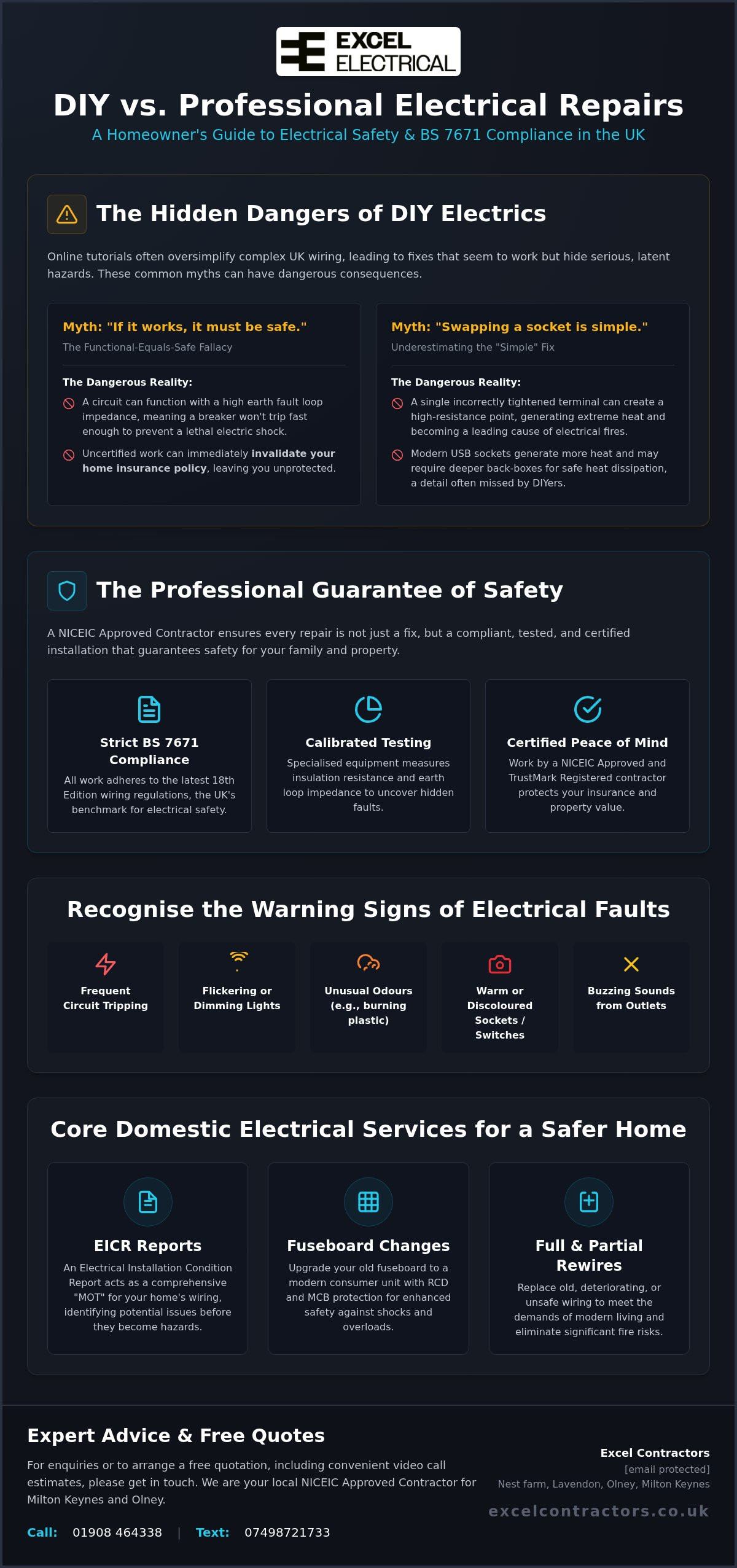
Compliance with the 18th Edition is the absolute minimum benchmark for any domestic repair. It isn't just about making a light bulb shine; it's about verifying that the protective devices will actually trip in the event of a fault. Qualified electricians use calibrated testing equipment to measure earth loop impedance and insulation resistance, tools that a typical DIY enthusiast simply does not possess. This systematic approach is vital when dealing with electrical wiring standards in the United Kingdom, as it identifies degradation amongst older wiring systems before they become fire risks. Regular maintenance by a professional prevents these faults from escalating, ensuring the longevity of your home's infrastructure.
The Danger of the YouTube Electrician Trend
The rise of online tutorials has created a dangerous "YouTube Electrician" trend. These videos often provide generic advice that fails to account for the specific nuances of UK ring final circuits. A common mistake is assuming that "colour-to-colour" wiring guarantees safety. Whilst the light may turn on, a high-resistance joint or a missing earth connection could be hiding behind the faceplate. This is the psychological trap of the functional fix. It masks a deeper systemic fault that only a professional inspection can uncover. Without the correct testing, you have no way of knowing if your "repair" has actually created a latent fire hazard. For homeowners in Milton Keynes and Olney, relying on a NICEIC Approved Contractor like Excel Electrical ensures that every repair is backed by formal accreditation and TrustMark registration. This level of accountability is what separates a temporary patch from a compliant, safe installation that protects your insurance and your family.
Debunking Common Myths About DIY Electrical Work
The accessibility of online tutorials has encouraged many homeowners to attempt their own electrical modifications. This often stems from a desire to reduce costs, but it frequently results in common electrical faults in UK homes that compromise long-term safety. Relying on visual cues alone is a dangerous strategy when dealing with invisible hazards. Professional standards exist because electricity does not provide second chances when a mistake is made.
Myth 1: The Functional Equals Safe Fallacy
One of the most persistent myths is that a repair is safe simply because the fuse box hasn't tripped. This represents a fundamental misunderstanding of how protective devices operate. A circuit might appear perfectly functional whilst possessing a high earth fault loop impedance. This technical failure means the circuit breaker cannot disconnect the power quickly enough during a fault to prevent a lethal shock. DIY connections are also prone to arcing, where electricity jumps across loose terminations. If you are experiencing issues with your distribution board, you might find our guide on Why Does My Fuse Box Keep Tripping? particularly useful.
Myth 2: The Simple Socket Swap
Many homeowners believe that swapping a socket faceplate is a basic task anyone can do. Modern upgrades, such as USB-integrated sockets, require more than just matching wire colours. These units generate more heat and often need deeper back-boxes to allow for adequate airflow and heat dissipation. Failing to tighten a terminal correctly is a leading cause of domestic electrical failures. A single loose terminal can lead to a house fire by creating a high-resistance point that generates extreme heat under load. This risk is often invisible until the smell of burning plastic becomes apparent.
Similarly, the use of electrical tape as a permanent fix for damaged cable insulation is a significant hazard. Tape degrades over time and does not provide the mechanical protection or insulation resistance required by BS 7671. There is also a misconception that LED upgrades are entirely "plug and play." In reality, switching to LED lighting often requires a professional assessment of the existing circuit to ensure compatibility with dimmers and to prevent issues like flickering or driver failure. If you suspect your previous DIY attempts have left your system vulnerable, consulting a qualified electrician is the only way to restore true safety and ensure your home remains compliant with national regulations.
Why Functional Does Not Always Mean Safe
A circuit that successfully delivers power to a kettle or a television is not necessarily a safe circuit. Many common electrical faults in UK homes remain completely invisible to the untrained eye because they do not cause an immediate system failure. The most dangerous of these is the high-resistance joint. This occurs when a connection is loose, dirty, or corroded. Whilst it may still allow electricity to flow, the resistance at that specific point generates intense heat. Over time, this heat melts wire insulation and ignites surrounding timber or dust without ever drawing enough current to trip a standard circuit breaker. Only a professional using specialised testing equipment can detect these thermal anomalies before they become catastrophic.
The Impact on Home Insurance and Property Value
Your home insurance policy likely contains specific clauses requiring all electrical work to be carried out by competent persons in accordance with national standards. If a fire is traced back to a DIY repair or a non-compliant installation, insurers often use these clauses to deny claims. This leaves homeowners facing total financial loss for a mistake that seemed like a cost-saving measure. Beyond the immediate safety risks, uncertified work creates significant hurdles when you decide to move. Buyers and solicitors in Milton Keynes now routinely request valid Electrical Installation Condition Reports (EICR) and certificates for any recent works. Without this paperwork, your property value can be negatively affected, or the sale may collapse entirely. For more detail on maintaining premium standards, see The Professional Guide to High-End Electrical Installations.
Compliance with the Latest 18th Edition Regulations
Professional electricians provide more than just a fix; they provide legal documentation. Every repair should be accompanied by either a Minor Works Certificate or a full Electrical Installation Certificate. These documents serve as your proof that the work complies with the 18th Edition of the IET Wiring Regulations. A key requirement of these modern standards is the presence of Residual Current Device (RCD) protection on almost all domestic circuits. During a routine repair for common electrical faults in UK homes, a qualified professional will identify hidden non-compliances, such as missing RCD protection or inadequate earthing, that a DIYer would overlook. This comprehensive approach is why Why Hiring an NICEIC Approved Contractor is Vital for any domestic project. It ensures that your home does not just work today but remains safe and compliant for years to come.
Identifying When Your Home Needs Professional Intervention
Recognising the early symptoms of common electrical faults in UK homes is the most effective way to prevent a minor inconvenience from becoming a major safety hazard. Many electrical issues start as silent warning signs that are easily overlooked during a busy day. However, a structured approach to monitoring your home's electrical health allows you to act before a system failure occurs. You should begin by conducting a sensory check of your property. Unusual fishy smells, often caused by arcing plastic, or faceplates that feel warm to the touch are immediate indicators of thermal stress within your circuits.
The next step involves monitoring the frequency of circuit interruptions. Whilst an occasional trip might be caused by a faulty appliance, regular nuisance tripping of the Residual Current Device (RCD) suggests a deeper issue with the fixed wiring. You should also take note of flickering lights, especially when high-power appliances like electric showers or ovens are switched on. Finally, verify the age of your installation. If your property still uses a wooden-backed fuse board or old-fashioned fuse wire, it's unlikely to meet current safety standards. Once these signs are identified, the only safe progression is to contact a registered professional for a formal fault-finding session.
Warning Signs You Should Never Ignore
Buzzing or crackling sounds coming from light switches, sockets, or the consumer unit should be treated as an emergency. These sounds often indicate "arcing," where electricity is jumping across a gap in a loose connection, creating temperatures high enough to start a fire. Nuisance tripping is rarely a coincidence; it's usually a sign of cumulative earth leakage or insulation degradation. For those living in period properties, our guide on Electrical Safety Checks for Older Homes provides a detailed breakdown of what to look for in aging systems.
Choosing a Reliable Electrical Contractor in Milton Keynes
When seeking professional help, you must verify that your chosen contractor is NICEIC Approved and TrustMark registered. These credentials ensure the electrician is regularly assessed and remains compliant with the 18th Edition regulations. Always insist on a written quote that clearly outlines the scope of work to avoid unexpected costs. For busy homeowners in Milton Keynes and Olney, Excel Electrical offers the convenience of video call quotes. This allows for a rapid visual assessment of minor repairs without the need for an initial site visit. If you've noticed any of these warning signs, you can book a professional inspection today by calling 01908 464 338 or texting 07498721733 to ensure your home remains a safe environment.
Restoring Peace of Mind with Excel Electrical’s Expert Repairs
Choosing a contractor to handle your home's electrical system is a decision that impacts your safety and property value. Excel Electrical is committed to providing domestic excellence across Olney and Milton Keynes. Our team is specifically trained to diagnose and rectify the root causes of common electrical faults in UK homes, ensuring that every installation remains compliant with the latest 18th Edition standards. We prioritise clear communication and systematic processes to put our clients at ease whilst delivering high-end technical results. This grounded approach ensures that your home remains a stable environment for your family.
Our domestic electrical services are designed to address both immediate repairs and long-term maintenance. We specialise in Electrical Installation Condition Reports (EICR), fuseboard changes, and full or partial rewires. Whether you are dealing with a persistent circuit failure or upgrading your system for modern living, our NICEIC Approved and TrustMark registered electricians provide a reliable, steady hand. We take pride in our workmanship and ensure that every project is backed by the necessary certification for your insurance and peace of mind. By focusing on precision and industry compliance, we eliminate the risks associated with substandard DIY attempts.
Domestic Expertise in Milton Keynes, Olney, and Beyond
Based at Nest farm, Lavendon, we are perfectly positioned to provide responsive service to homeowners in Olney and the MK46 area. Our local presence allows us to understand the specific requirements of properties in this region, from heritage cottages to modern developments. For a deeper look at how we maintain these standards, you can read The Comprehensive Guide to Professional Electrical Maintenance Services. We believe that proactive maintenance is the key to preventing common electrical faults in UK homes and ensuring the continued safety of your property infrastructure.
Request Your Free Electrical Repair Quote Today
We aim to make the estimation process as transparent and convenient as possible for our clients. If you have concerns about your home's electrical safety, you can call us on 01908 464 338 or text 07498721733 for enquiries. We offer free, no-obligation quotes and provide the option for video call quotes to streamline the assessment of minor repairs. This modern approach allows us to provide accurate estimations without the delay of an initial site visit. For non-urgent domestic enquiries, please contact us via email at [email protected]. Our office is located at Nest farm, Lavendon, Olney, Milton Keynes, where we continue to uphold the highest standards of electrical safety for our local community.
Securing Your Home’s Future with Certified Expertise
Prioritising professional intervention over DIY guesswork is the only way to ensure your property remains compliant with the 18th Edition regulations. Whilst a quick fix might seem cost-effective, it often masks common electrical faults in UK homes that can lead to catastrophic failures or invalidated insurance policies. True peace of mind comes from knowing your electrical system has been verified by a qualified expert using precise, calibrated testing equipment. This systematic approach identifies hidden risks that visual inspections simply cannot detect.
As a NICEIC Approved and TrustMark registered contractor based in Olney, Excel Electrical specialises in high-end domestic services. We focus on essential safety works such as EICR assessments, fuseboard upgrades, and full rewires. Our team provides the technical authority and clear communication needed to protect both your family and your property's long-term value. Don't leave your safety to chance; professional certification is a vital investment in your home's stability and legal compliance.
Need a reliable repair? Call 01908 464 338 or text 07498721733 for a free quote from Excel Electrical. We look forward to helping you maintain a safe and efficient home environment.
Frequently Asked Questions
Is it illegal to do my own electrical repairs in the UK?
It isn't illegal to perform basic electrical tasks such as changing a light fitting or a faceplate, provided you are competent to do so. However, most significant works are strictly regulated under Part P of the Building Regulations. Notifiable work, which includes installing new circuits or working in sensitive areas like bathrooms, must be carried out and certified by a registered professional to ensure legal compliance.
How much do professional electrical repairs usually cost in Milton Keynes?
Repair costs vary significantly depending on the complexity of the fault and the time required for diagnostic testing. Because every home's wiring system is unique, we provide free, no-obligation quotes after a brief consultation. This ensures you receive an accurate estimate based on the specific technical requirements of your project rather than a generic price that may not reflect the actual work needed.
What is the difference between an NICEIC approved contractor and a local handyman?
An NICEIC Approved Contractor undergoes regular and rigorous assessments to verify their technical competence and adherence to national safety standards. Handymen generally lack these specific industry-recognised qualifications and often don't carry the professional indemnity insurance required for electrical works. Choosing a registered contractor ensures your repair is compliant with the 18th Edition regulations and provides a formal path for accountability.
Will a DIY electrical repair affect my home insurance policy?
Yes, DIY modifications often lead to common electrical faults in UK homes that insurers can use as grounds to deny a claim. Most domestic insurance policies stipulate that electrical systems must be maintained by a competent person. If a fire or fault is traced back to uncertified work, you may find your coverage is entirely invalidated, leaving you responsible for the full cost of repairs.
Can I get a quote for my electrical repair over a video call?
Excel Electrical offers video call quotes to help homeowners receive a fast and efficient estimation for minor repairs. This process allows our experts to visually assess the issue and discuss the scope of work with you in real-time. It's a convenient option that eliminates the need for an initial site visit whilst providing you with a clear understanding of the necessary next steps.
Why does my fuse box keep tripping even after I fixed the faulty appliance?
If your consumer unit continues to trip, the issue likely resides within the fixed wiring of your property rather than an external appliance. This often indicates a deeper problem such as insulation degradation, a high-resistance earth fault, or cumulative earth leakage. Identifying these issues requires professional fault-finding equipment and a systematic testing process to locate the exact point of failure within the circuit.
Do I need a certificate for a minor electrical repair in my home?
A professional electrician should issue a Minor Electrical Installation Works Certificate (MEIWC) for any alteration or addition to an existing circuit. This document is your official record that the work was carried out safely and complies with the BS 7671 standards. These certificates are essential when selling your home or making an insurance claim, as they prove the installation has been maintained by a qualified expert.
How long does a typical electrical fault-finding visit take?
Most fault-finding sessions are completed within one to three hours depending on the complexity of the installation. The time required depends on how many circuits need to be tested and the accessibility of the wiring. Our methodical approach ensures we isolate the fault efficiently whilst performing the necessary safety checks to prevent the issue from recurring in the future.


