

You are halfway through preparing dinner or finishing an important project when the power suddenly cuts out, leaving you in total darkness. It is a frustrating experience that immediately leads to one pressing question: why does my fuse box keep tripping? Whilst your first instinct might be to simply flip the switch back up, a recurring fault is often a sign that your electrical system is performing its vital role in protecting your home from fire or electrocution.
We understand that dealing with a modern consumer unit can feel overwhelming, especially when you are concerned about the safety of your family. In this guide, we will help you identify whether the fault lies with a specific appliance or your internal wiring. You will discover the practical steps to safely restore power and learn when a professional inspection is necessary to ensure your installation meets current safety regulations. For expert assistance, Excel Electrical is based at Nest farm, Lavendon, Olney, Milton Keynes. You can reach our team at 01908 464338 or [email protected] to arrange a free quote or a video call estimate. To discuss your domestic electrical needs, simply call 01908 464 338 or text 07498721733.
Key Takeaways
- Understand that a tripping switch is a vital safety response designed to prevent electrical fires and shocks by immediately isolating faulty circuits.
- Identify the most common household culprits, such as high-wattage appliances or overloaded circuits, and learn why does my fuse box keep tripping during periods of high demand.
- Master a safe, systematic process of elimination to determine whether the fault lies with a specific appliance or your home's internal wiring.
- Recognise the critical difference between a simple circuit overload and dangerous conditions like short circuits or earth leakage that require expert attention.
- Discover how professional solutions, including an EICR or a consumer unit upgrade, can provide long-term stability and ensure your installation meets the latest safety standards.
Understanding Your Consumer Unit: Why Tripping is a Vital Safety Feature
Whilst many homeowners still refer to their electrical distribution hub as a fuse box, modern properties actually use a consumer unit. This device acts as the brain of your home's electrical system, constantly monitoring the flow of electricity to every socket and light fitting. If you find yourself asking why does my fuse box keep tripping, it is helpful to recognise that this is not a failure of the system. Instead, it is a deliberate and vital safety response. The unit is designed to detect irregularities and "trip" the circuit, cutting off power in a fraction of a second to prevent cable fires or fatal electric shocks.
Older installations relied on simple fuse wire that would melt when a circuit became overloaded. These were slow to react and required manual replacement of the wire. Modern consumer units utilise sophisticated switches that are far more sensitive and reliable. These components are designed to protect both the building's infrastructure and the people living within it. By understanding how these switches operate, you can better diagnose the issues occurring in your Milton Keynes home.
MCB vs RCD: Which Switch is Tripping?
Your consumer unit contains different types of switches with specific roles. Miniature Circuit Breakers (MCBs) are designed to protect the electrical cables. They trip if too many appliances are used at once or if there is a short circuit. In contrast, the Residual-current device (RCD) is a life-saving component. It monitors the balance of electricity flowing through a circuit. If it detects even a tiny amount of "leakage" to earth, which could happen if a person touches a live wire, it disconnects the power instantly. Identifying which switch has moved to the "off" position is the first step in troubleshooting the fault.
The Sensitivity of Modern 18th Edition Systems
Current UK safety standards, specifically BS 7671:2018+A4:2026 published in April 2026, require much higher levels of protection than in previous decades. Modern boards may seem to trip more frequently, but this is because they are far more capable of detecting subtle faults. Many new installations now include Arc Fault Detection Devices (AFDDs). These components identify dangerous electrical arcs, small sparks caused by damaged insulation or loose connections, that could lead to a fire. A sensitive board is a hallmark of a well-protected home that adheres to the latest national safety regulations.
If your system continues to disconnect power, it is essential to seek professional advice rather than repeatedly resetting the switches. Excel Electrical provides expert fault finding and consumer unit upgrades across Olney and Newport Pagnell. You can contact our team at Nest farm, Lavendon, Olney, Milton Keynes, by calling 01908 464338 or emailing [email protected]. We offer free quotes and video call estimates to help you resolve your electrical issues safely and efficiently.
Identifying Common Household Culprits: Overloads and Faulty Appliances
Pinpointing the exact cause of a power cut often begins with assessing your activity the moment the lights went out. A primary reason why does my fuse box keep tripping is a simple circuit overload. This occurs when the electrical demand from your plugged-in devices exceeds the safety limit of the circuit breaker. If the breaker did not disconnect the power, the internal wiring would overheat, potentially leading to a fire. This risk is significantly increased when using multiple extension leads plugged into one another; a practice known as "daisy-chaining" that places immense strain on a single socket outlet.
Nuisance tripping can also be triggered by older appliances that are beginning to fail. As internal components degrade, they may develop small faults that modern, sensitive consumer units detect immediately. Whilst it is frustrating to lose power, this sensitivity is a protective measure. For broader guidance on managing these risks, you can review official home electrical safety tips to help identify potential hazards in your property.
The "Kettle and Toaster" Syndrome
In many homes, the kitchen circuit is the most heavily burdened. Using two high-draw appliances simultaneously, such as a kettle and a toaster, can easily push a circuit beyond its 32-amp limit. Most heating-based appliances require significant current to function. To help you manage your power usage, consider the typical draws listed below:
- Electric Shower: 8.5kW - 10.5kW (approx. 37A - 45A)
- Kettle: 3,000W (approx. 13A)
- Tumble Dryer: 2,500W (approx. 11A)
- Dishwasher: 2,200W (approx. 10A)
- Toaster: 1,000W (approx. 4.3A)
If your kitchen frequently loses power, try distributing your appliance use or ensure high-wattage items are not running at the same time. If the issue persists despite these changes, a professional domestic electrical maintenance check can determine if your circuit is correctly rated for your needs.
Water and Electricity: External Culprits
Moisture is a frequent cause of RCD tripping, especially during periods of heavy rain. Garden lighting, outdoor sockets, and even pond pumps are susceptible to water ingress if seals have perished or were improperly installed. Internally, steam from a kettle or a leaking steam iron can also trigger a safety disconnect. You should also check larger components such as immersion heaters or central heating pumps, as these can develop internal leaks that cause the system to trip to prevent electrocution.
Identifying these faults early prevents long-term damage to your installation. For a permanent solution to recurring faults in Milton Keynes, Olney, or Newport Pagnell, contact Excel Electrical at Nest farm, Lavendon, Olney, Milton Keynes. You can call our office on 01908 464338, text 07498721733, or email [email protected]. We are happy to provide free quotes and video call estimates to streamline your repairs.
Serious Electrical Faults: Short Circuits and Earth Leakage Explained
Whilst an overloaded circuit is often the result of user behaviour, serious electrical faults are typically hidden within the infrastructure of your home. If you are wondering why does my fuse box keep tripping even when all appliances are unplugged, you are likely dealing with a short circuit or an earth fault. These conditions represent a higher level of risk and suggest that the safety components in your consumer unit are working hard to prevent a disaster.
A short circuit occurs when a live wire makes direct contact with a neutral wire or another live wire. This creates a path of least resistance, causing a massive surge of current that trips the breaker instantly to prevent the cables from melting. An earth fault is equally dangerous; it happens when a live wire touches the metal casing of an appliance or the earth wire itself. This poses a significant risk of electric shock to anyone touching the equipment. If you notice burning smells, discoloured socket outlets, or audible buzzing sounds, you must act quickly. These issues require an immediate inspection by an NICEIC approved contractor to ensure your property remains safe.
Damaged Wiring and Rodent Issues
Rodents, such as mice or rats, frequently cause havoc by chewing through cable insulation behind walls or in loft spaces. This exposes the copper cores and leads to persistent tripping that is difficult to locate without specialist testing equipment. Similarly, "DIY accidents" are a frequent cause of faults in domestic properties. Drilling into a wall to hang a picture can easily nick a hidden cable. Even a small amount of damage to the insulation is enough to trigger a modern RCD. Loose connections at socket terminals are another common culprit, as they can cause heat to build up and eventually lead to a circuit failure.
Internal Faults in the Consumer Unit
The consumer unit itself can develop internal issues over time. Circuit breakers are mechanical devices that can become "weak" or faulty after years of service, causing them to trip at lower thresholds than intended. Additionally, loose connections within the board can cause the internal busbar to overheat, leading to heat damage that compromises the entire unit's integrity. A professional EICR is the most effective method for diagnosing these internal board faults. This comprehensive "health check" identifies hidden dangers that a visual inspection would miss.
Excel Contractors provides thorough fault finding and repair services throughout Milton Keynes, Olney, and Newport Pagnell. For expert assistance, contact our office at Nest farm, Lavendon, Olney, Milton Keynes. You can call us on 01908 464338, text 07498721733, or email [email protected]. We promote the use of free quotes and video call estimates to help you understand the state of your electrical system without delay.
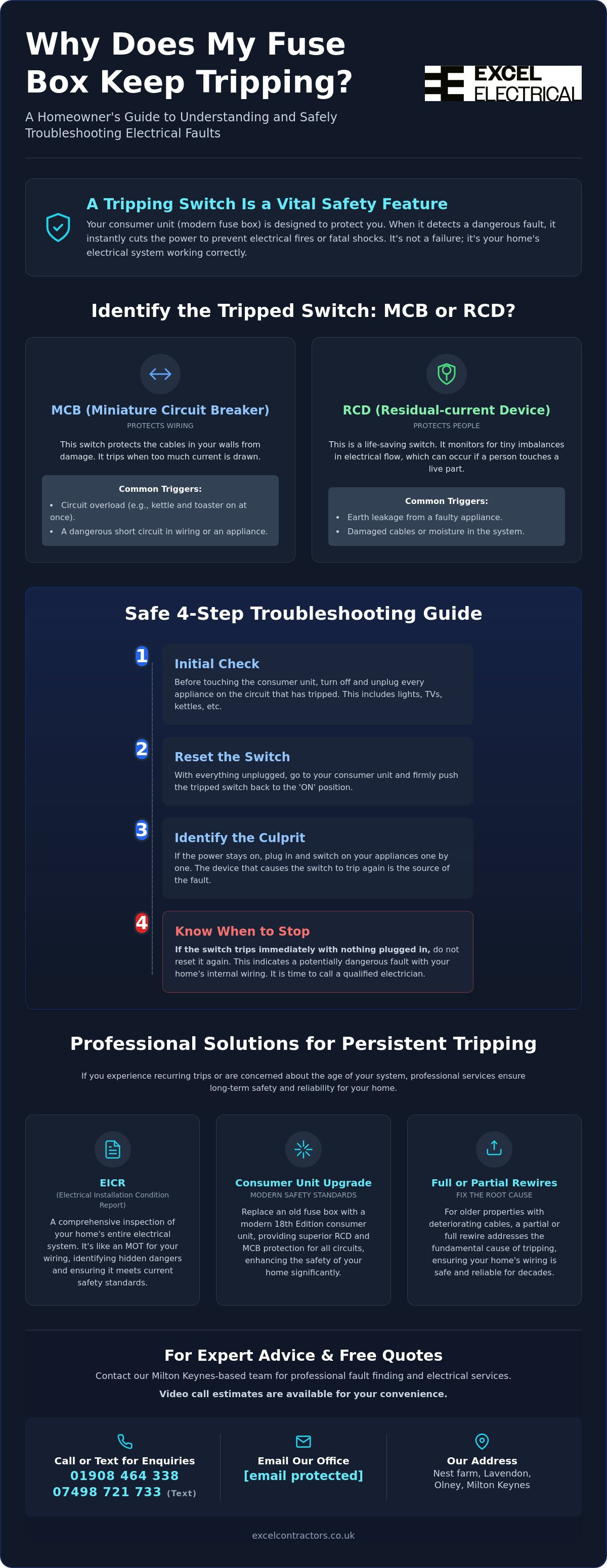
Safe Troubleshooting Guide: How to Identify the Faulty Circuit Yourself
Whilst you should never attempt to open the consumer unit or touch exposed wiring, there are safe steps you can take to determine why your power has cut out. Identifying the root cause of why does my fuse box keep tripping often requires a systematic approach known as the process of elimination. This method allows you to isolate whether the issue is a specific appliance or a fault within the fixed wiring of your home. If a switch refuses to stay in the "up" position after you've followed these steps, it indicates a permanent fault that requires professional intervention.
Before you begin, ensure your hands are dry and you have a torch to hand if the power cut has left you in the dark. Safety is the priority; if you see smoke, hear loud crackling, or smell burning, stop immediately and call for assistance. For residents in Milton Keynes and surrounding areas, you can contact Excel Contractors at 01908 464338 for expert advice.
The Step-by-Step Isolation Test
This procedure is designed to find which circuit is causing the RCD to trip. Follow these steps in order:
- Step 1: Switch off all individual circuit breakers (the smaller switches known as MCBs) by moving them to the "down" position.
- Step 2: Reset the main RCD or master switch by pushing it back to the "up" position. If it stays up, you have successfully reset the safety mechanism.
- Step 3: Switch the MCBs back on one by one. When you flip a switch and the RCD immediately trips again, you've found the faulty circuit.
- Step 4: Leave that specific faulty MCB in the "off" position and reset the RCD. You can now restore power to the rest of the house. Unplug every appliance on the faulty circuit and then try to turn that MCB back on.
If the circuit stays on once everything is unplugged, you can plug items back in one at a time to find the culprit. If the breaker trips even with everything unplugged, the fault is likely in the wiring itself.
Recording Your Findings for the Electrician
Your observations are incredibly valuable for a professional. Note down exactly which switch tripped and what appliances were running at the time. Check for external factors, such as heavy rain or recent building work, that might have affected your outdoor sockets or hidden cables. Providing these detailed notes can significantly reduce the time required for professional electrical fault finding, which ultimately helps keep your costs down.
If you cannot resolve the issue safely, it is time to call a qualified expert. Excel Contractors is based at Nest farm, Lavendon, Olney, Milton Keynes. You can book a professional fault finding service by calling 01908 464 338 or texting 07498721733. We offer free quotes and video call estimates to make the process as straightforward as possible for you.
Professional Solutions for Persistent Tripping: Consumer Unit Upgrades and EICRs
Persistent tripping is more than a minor inconvenience; it is often a symptom of an ageing or overloaded electrical system. If you have followed the isolation steps and still find yourself asking why does my fuse box keep tripping, the issue likely resides within your fixed wiring or an outdated consumer unit. For homeowners in Olney and Newport Pagnell, a consumer unit upgrade offers the most effective way to modernise your home's safety infrastructure. These newer boards are designed to handle the high electrical demands of modern life whilst providing superior protection against fire and electric shock.
At Excel Electrical, we specialise in domestic electrical maintenance and are fully NICEIC approved. Our team consists of 18th Edition qualified electricians who ensure every installation complies with the latest national safety standards, specifically BS 7671:2018+A4:2026. Choosing a qualified professional is not just about restoring power; it's about ensuring the long-term safety of your property and family.
Why an EICR is the Ultimate Fault-Finding Tool
An Electrical Installation Condition Report (EICR) is a comprehensive "health check" that goes far beyond a simple visual inspection. During this process, our electricians perform a series of rigorous tests, including insulation resistance, earth continuity, and polarity checks. These tests allow us to identify hidden dangers, such as degraded cable insulation or loose connections behind walls, that don't always cause a trip immediately but pose a significant fire risk. If you live in a period property, you should consult our electrical safety checks for older homes to understand the specific risks associated with ageing installations.
Upgrading to an AFDD and Surge Protected Board
Modern consumer units offer features that were unavailable just a few years ago. Surge Protection Devices (SPDs) are now a standard requirement to protect your sensitive electronics, such as computers and smart home systems, from external power surges. Additionally, we highly recommend upgrading to an Arc Fault Detection Device (AFDD). This technology is capable of detecting "micro-sparking" at loose terminals or damaged cables, cutting the power before an electrical arc can start a fire. This level of protection is a significant leap forward in domestic safety.
If your power continues to fail, don't leave your safety to chance. Contact Excel Electrical at Nest farm, Lavendon, Olney, Milton Keynes. You can call our office on 01908 464338, text 07498721733, or email [email protected]. We are proud to offer free quotes and video call estimates to help you resolve your electrical issues with precision and peace of mind.
Restoring Electrical Stability and Peace of Mind
Understanding the mechanics behind a circuit disconnect is the first step in maintaining a safe household. Whether the cause is a faulty kitchen appliance or a more complex earth leakage issue, your system is performing its primary duty by cutting power. Finding the definitive answer to why does my fuse box keep tripping requires a methodical approach, moving from basic appliance isolation to professional diagnostic testing.
For long-term safety, a professional EICR or a modern consumer unit upgrade ensures your property meets current 18th Edition regulations. As an NICEIC Approved and TrustMark registered contractor based at Nest farm, Lavendon, Olney, Excel Contractors provides the technical expertise needed to resolve persistent faults throughout Milton Keynes and Newport Pagnell. We prioritise your safety through systematic processes and transparent communication.
For expert electrical fault finding or a free quote, call Excel Electrical on 01908 464338 or text 07498721733 today. We also offer the convenience of video call estimates to streamline your enquiry. Our team is ready to help you ensure your home remains a safe and secure environment for your family.
Frequently Asked Questions
Is it dangerous if my fuse box keeps tripping?
It is potentially dangerous because the system is reacting to a fault that could cause a fire or electric shock. Whilst the tripping action is a safety measure, the underlying reason why does my fuse box keep tripping must be addressed to ensure the integrity of your installation. Ignoring a recurring fault can lead to significant heat damage within your wiring or the consumer unit itself. Always seek a professional inspection if the cause is not a clearly identified faulty appliance.
Why does the RCD trip but not the individual circuit breaker?
The RCD trips when it detects a current imbalance, often called earth leakage, which is a significant safety risk. Individual circuit breakers (MCBs) only react to overloads or short circuits. If you have a small amount of moisture in an outdoor socket or a heating element is starting to fail, it will trigger the RCD to prevent electrocution before the MCB even senses a problem. This is a common occurrence in modern, sensitive systems.
Can a faulty light bulb cause the whole house to lose power?
Yes, a failing light bulb can certainly cut power to a large part of your home. When a bulb's filament breaks, it can create a momentary surge or "arc" that the sensitive RCD detects as a fault. On older consumer units where multiple circuits share one RCD, a single bulb blowing in a bedroom could result in all the lights and sockets on that entire section of the house turning off instantly.
How much does it cost to fix a tripping fuse box in Milton Keynes?
The cost to resolve a tripping issue depends entirely on the complexity of the fault. A simple appliance isolation might only incur a standard call-out fee, whereas identifying a hidden wiring fault requires systematic testing. For homeowners in Milton Keynes, Olney, or Newport Pagnell, we recommend booking a professional fault finding session. This allows our electricians to provide an accurate assessment and a free quote for any necessary repairs or upgrades.
My fuse box trips at the same time every day—why is this happening?
Tripping at a consistent time usually points to an automated device or a specific household habit. Check appliances with timers, such as immersion heaters, dishwashers, or garden lighting. It can also be caused by an EV charger starting its cycle or even external factors like street lighting turning on. Tracking the exact timing of these events helps our electricians narrow down the culprit quickly during a professional inspection.
Can I replace a circuit breaker myself if it keeps tripping?
No, you should never attempt to replace a circuit breaker yourself. Working inside a consumer unit is hazardous and must be performed by an NICEIC approved contractor to ensure compliance with national safety regulations. A breaker that keeps tripping is usually doing its job correctly; replacing it without fixing the underlying circuit fault will not solve the problem and could leave your home at risk of an electrical fire.
What is the difference between a fuse box and a consumer unit?
A traditional fuse box uses physical wire that melts to break a circuit, whereas a modern consumer unit uses mechanical switches. Consumer units are far more advanced, providing essential protection through RCDs and often AFDDs. If you are still using an old-style board with rewirable fuses, you are missing out on life-saving technology that reacts much faster to why does my fuse box keep tripping than outdated fuse wire ever could.
Does a tripping fuse box mean I need a full house rewire?
A tripping board does not necessarily mean you need a full house rewire, as many issues can be resolved with targeted repairs. Whilst frequent tripping is a sign of stress on the system, it often points to a specific faulty circuit or the need for a consumer unit upgrade. An EICR is the most effective way to determine the health of your installation and decide whether a full rewire or a simpler fix is required.


