

What if your home's primary safety system is currently the most vulnerable part of your property? Many British homeowners still rely on outdated fuse boxes that weren't designed to handle the modern demands of EV chargers, solar panels, or sensitive home office electronics. We understand that researching the consumer unit upgrade cost often leads to a confusing maze of technical jargon like RCBOs, SPDs, and the latest 18th Edition Amendment 3 regulations. It's natural to feel anxious about being overcharged or worried that your older property's wiring might not be up to standard.
At Excel Electrical, based at Nest farm, Lavendon, Olney, Milton Keynes, we believe in complete transparency. This guide clarifies exactly what influences the price of a modern installation, from surge protection to fire-rated enclosures. You'll learn how to choose a solution that ensures long-term safety whilst meeting all legal Building Regulations. We'll also explain how our team simplifies the process through free video call quotes, ensuring you get an accurate estimate without the guesswork. For any enquiries, please call 01908 464338, text 07498721733, or email [email protected] to discuss your domestic electrical needs.
Key Takeaways
- Understand why upgrading to an 18th Edition consumer unit is essential for modern home safety and meeting current UK electrical regulations.
- Compare the benefits of RCBO protection over Dual RCD boards to eliminate nuisance tripping and improve circuit reliability across your property.
- Discover how the number of circuits and the inclusion of surge protection devices (SPDs) directly impact the total consumer unit upgrade cost.
- Learn why professional certification from an NICEIC Approved contractor is vital for maintaining your home insurance and ensuring legal compliance.
- Find out how free video call quotes can provide a rapid and accurate estimate for your fuseboard change, streamlining the entire installation process.
Why Upgrade Your Fuse Box? Safety, Compliance, and 18th Edition Regulations
Think of your consumer unit as the central safety hub for your home. It's the primary "brain" that manages every electrical circuit, from your kitchen appliances to your lighting. Its most vital role isn't just distributing power; it's the constant monitoring of your system to prevent electrical fires and fatal shocks. In modern British homes, an outdated fuse box is often the weakest link in property safety, especially as our demand for power increases with higher-load appliances and modern home technologies.
The technical shift from old-fashioned rewireable fuses to modern circuit breakers has fundamentally changed home safety. Traditional fuse boxes rely on a thin piece of wire that melts during an overload. These are slow to react and offer no protection against earth leakage. Modern units, designed under the latest UK electrical wiring standards, use sophisticated breakers that disconnect power in milliseconds. When you evaluate the consumer unit upgrade cost, you're investing in this precision technology that keeps your family and property secure.
Compliance with the 18th Edition (BS 7671) regulations is now a critical factor for home insurance and property sales. Most insurers require your electrical installation to be safe and well-maintained. If a fire occurs and your fuse box is found to be non-compliant, it could jeopardise your claim. Similarly, savvy buyers and surveyors in Milton Keynes will often flag an obsolete wooden-backed board as a major defect, potentially devaluing your home or stalling a sale.
Signs Your Current Fuse Box is Obsolete
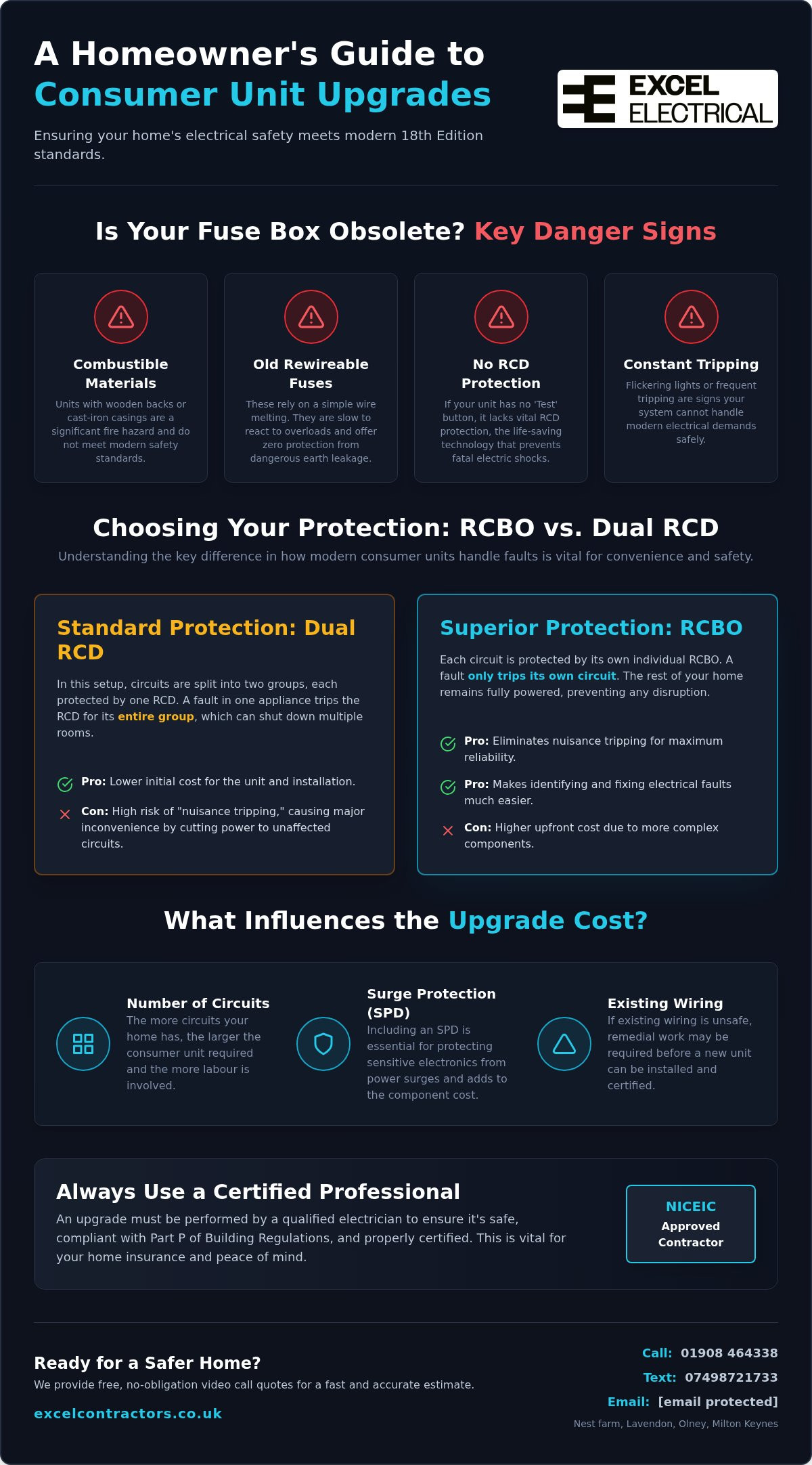
Identifying an aged system is usually straightforward. If your unit has a wooden back, a cast-iron casing, or a chaotic mix of different fuse types, it's likely over thirty years old. These materials are combustible and don't meet modern fire-safety standards. You might also notice flickering lights or frequent tripping amongst your circuits. The most dangerous sign is a lack of RCD protection; if you don't see a "Test" button on your board, your home lacks the vital life-saving technology required by law today.
The Role of Surge Protection Devices (SPD)
Modern homes are packed with sensitive electronics like smart TVs, computers, and solar inverters. These are easily damaged by transient overvoltages, commonly known as power surges. Surge Protection Devices (SPDs) are now a standard requirement in the 18th Edition to divert these spikes safely to the ground. Including an SPD within your initial consumer unit upgrade cost is a proactive step that protects thousands of pounds worth of technology from being fried by a single grid fluctuation or lightning strike.
Excel Electrical, located at Nest farm, Lavendon, Olney, Milton Keynes, provides expert guidance on these essential safety upgrades. As an NICEIC Approved contractor, we ensure every installation is fully certified and compliant with Part P of the Building Regulations. To simplify your project, we offer free video call quotes for rapid estimations. Please contact us on 01908 464338, text 07498721733, or email [email protected] to discuss your requirements. You can also learn more about our domestic electrical services online.
RCBO vs Dual RCD: Choosing the Right Unit for Your Home
Selecting the internal components of your new fuse box is a critical decision that affects both your daily convenience and the total consumer unit upgrade cost. The two primary configurations available in 2026 are Dual RCD (Residual Current Device) boards and RCBO (Residual Current Breaker with Over-Current) units. While both meet current safety regulations, they manage electrical faults in very different ways. Understanding these differences is essential, particularly for those planning high-end electrical installations where reliability is paramount.
Nuisance tripping is the most common frustration with older Dual RCD setups. In these boards, circuits are grouped together under a single RCD. If a faulty toaster causes a minor leak in the kitchen, the RCD will disconnect every circuit in its group. This could leave your entire ground floor, including your fridge and home office, in total darkness. RCBOs eliminate this issue by providing dedicated protection to every individual circuit. If a fault occurs on one, only that specific circuit trips, leaving the rest of your home powered and safe.
Dual RCD Boards: The Budget-Conscious Option
Dual RCD boards are often viewed as a cost-effective entry point. They provide high-level protection by splitting the house into two banks of circuits. Whilst this is a significant improvement over old fuse boxes, the grouped nature means fault-finding is more complex and disruptive. This configuration might still be appropriate for very small, simple properties with few circuits and low power demands, but it lacks the precision required for modern living.
RCBO Units: The Gold Standard for 2026
RCBO units represent the pinnacle of domestic safety and reliability. Because each circuit is independent, they are the superior choice for homes with complex needs, such as those with kitchen island installations or detached outbuildings. They also future-proof your home for EV chargers and heat pumps, which often require their own dedicated protection. From a technical perspective, RCBOs significantly simplify ongoing electrical maintenance services because the source of a fault is immediately obvious.
Excel Electrical specialises in installing these high-performance systems across Olney and Milton Keynes. When calculating your consumer unit upgrade cost, we recommend considering the long-term reliability and peace of mind that an RCBO setup provides. We offer free video call quotes to help you decide which unit fits your property best. For expert advice, call us on 01908 464338, text 07498721733, or visit our office at Nest farm, Lavendon, Olney, Milton Keynes. You can also email [email protected] to book a consultation for our domestic electrical services.
The Cost Equation: Factors Influencing Your Investment
Determining the final consumer unit upgrade cost involves more than just selecting a plastic or metal box. It's an investment in a bespoke safety system tailored to your property's specific electrical architecture. The total figure is a combination of high-quality components, such as those discussed in previous sections, and the professional labour required to install, test, and certify the work. Whilst initial quotes from various contractors might fluctuate, the priority must always remain on technical precision and long-term safety rather than the lowest possible price.
The primary driver of hardware costs is the number of circuits within your home. A small flat might only require a 6-way board, whereas a large detached property in Olney could need a 20-way unit to accommodate modern kitchen appliances, outdoor lighting, and home offices. Each circuit requires its own protective device, so a higher circuit count naturally increases the component cost. Additionally, the complexity of your existing wiring plays a significant role. If a registered electrician discovers "hidden" faults during the mandatory pre-installation testing, these must be rectified to ensure the new board functions correctly and safely.
Essential Add-ons: Earthing and Bonding
During a board change, we often find that older properties lack adequate earthing or bonding. UK safety regulations mandate that your gas and water pipes are correctly bonded to the main earth terminal. If these are missing or undersized, they must be upgraded by law before a new consumer unit can be certified. In some cases, particularly in rural properties around Milton Keynes, a new earth electrode may need to be installed in the ground. These requirements are essential "hidden" safety measures that protect you from electric shocks if a fault occurs elsewhere in the service network.
Future-Proofing for EV Chargers and Solar
Planning for future power demands can save you significant sums in the long run. With the rise of renewable technology, many homeowners are now requesting bidirectional protective devices, which are essential for solar panels and battery storage systems. Allocating space for an EV charger now, even if you don't yet own an electric vehicle, prevents the need for another costly upgrade in a few years. We always recommend choosing a larger board than currently required. This "spare capacity" allows for future home improvements without the need to replace the entire distribution hub again.
At Excel Electrical, we pride ourselves on providing transparent advice to help you understand every factor affecting your consumer unit upgrade cost. As NICEIC Approved and TrustMark registered professionals, we ensure every installation meets the highest industry standards. To streamline the process, we offer free video call quotes for residents in Olney, Milton Keynes, and the surrounding areas. Please contact our team at Nest farm, Lavendon, Olney, Milton Keynes, or reach us directly on 01908 464338. You can also text 07498721733 or email [email protected] to discuss your project and receive a Building Regulations Compliance Certificate upon completion.
The Installation Process: What to Expect from a Professional Upgrade
A professional fuseboard change is a methodical, multi-stage process that prioritises the integrity of your entire electrical system. It isn't merely a hardware swap; it's a comprehensive safety overhaul. Before any physical work begins, the most critical phase is the initial electrical testing. This diagnostic stage ensures your existing wiring can handle a modern, sensitive 18th Edition unit. Without this, you risk a situation where your new board trips immediately upon installation due to pre-existing faults. This thoroughness is a key factor in the overall consumer unit upgrade cost, as it guarantees a safe and functional result.
Once testing is complete, our electricians perform a safe isolation of your power supply. The old unit is removed, and the new fire-rated enclosure is mounted. Every circuit is then systematically reconnected to its dedicated protective device, such as an RCBO or SPD. After the physical installation, we conduct a second round of rigorous testing. We verify every circuit to ensure it disconnects within the required milliseconds during a fault. Finally, we provide you with an Electrical Installation Certificate (EIC) and notify your local authority to trigger the delivery of your Building Regulations Compliance Certificate (Part P).
Why an EICR is the First Step
We believe an Electrical Installation Condition Report (EICR) is the only responsible way to begin an upgrade. Modern consumer units are designed to be incredibly sensitive to protect your life. If your property has damaged insulation or "borrowed neutrals" from a DIY project decades ago, a new board will detect these as faults. By identifying these issues early, we prevent unexpected complications on the day of the swap. This is why Excel Electrical recommends a pre-work inspection; it allows us to provide a fixed-price guarantee for your project.
Managing Power Outages During the Day
Disruption is a common concern for homeowners, particularly those working from home in Olney or Milton Keynes. You should typically expect your power to be off for 4 to 8 hours depending on the number of circuits. We organise our workflow to minimise this downtime, often prioritising specific areas if you have critical requirements. We'll always communicate the schedule clearly so you can plan your day accordingly. A professional upgrade always concludes with a comprehensive safety demonstration to ensure you're comfortable with the new system.
If you are ready to secure your home, book your consumer unit upgrade with our NICEIC Approved team today. Our experts at Nest farm, Lavendon, Olney, Milton Keynes, are ready to help. You can call us on 01908 464338, text 07498721733, or email [email protected] to arrange a free video call quote. We specialise in domestic electrical services and ensure every consumer unit upgrade cost delivers maximum value and safety for your property.
Hiring a Reliable Electrician in Milton Keynes and Olney
Selecting a qualified professional is the final and most vital step in managing your consumer unit upgrade cost effectively. Whilst it might be tempting to rely on informal recommendations or unverified tradespeople, only a registered professional can provide the legal certification required in the UK. Hiring an NICEIC Approved Contractor ensures that the work is assessed regularly for safety and technical accuracy. This accreditation isn't just a badge; it's a guarantee that your installation meets the stringent 18th Edition standards, protecting both your family and your home insurance policy.
TrustMark registration provides an additional layer of security for homeowners. It signifies that a business has been thoroughly vetted for its domestic electrical services and commitment to quality workmanship. Local expertise is equally invaluable when navigating the diverse property types in our region. Properties in Olney and Newport Pagnell often feature traditional stone construction and older wiring systems that require a different approach than the modern housing stock found in central Milton Keynes or newer developments in Bedford. A local specialist understands these nuances and can anticipate technical challenges before they impact your project timeline.
The Part P Guarantee
Part P of the Building Regulations is a legal requirement for any domestic electrical work that involves a consumer unit change. This law ensures that all work is notified to the local authority building control to maintain a national standard of safety. You can verify an electrician's credentials on the Registered Competent Person Electrical website to ensure they are authorised to self-certify their work. Keeping these certificates is vital for future property valuations; solicitors will always require proof of compliance for all major electrical modifications before a sale can proceed.
Contact Excel Electrical for Your Free Estimate
Excel Electrical Installations Ltd is committed to delivering 18th Edition safety across Milton Keynes and the surrounding counties. We understand that your time is valuable, which is why we offer free video call quotes to provide rapid, accurate estimates. This modern approach allows us to assess your current fuseboard and discuss your requirements without needing an initial site visit. Whether you need a full EICR, a fuseboard change, or a complete rewire, our team provides a methodical and disciplined service.
For all enquiries, please call 01908 464338 or text 07498721733. You can also email [email protected] or visit us at Nest farm, Lavendon, Olney, Milton Keynes. We provide transparent advice on the consumer unit upgrade cost and ensure your home remains a safe environment for years to come. Visit our website to explore our full range of domestic electrical services.
Securing Your Home with Modern Electrical Standards
Upgrading your fuse box is a fundamental step in protecting your property from evolving electrical risks. By choosing an 18th Edition compliant unit with RCBO and surge protection, you ensure that your home office, EV charger, and sensitive electronics remain safe from faults and grid spikes. Understanding the consumer unit upgrade cost allows you to plan for a system that isn't just a legal requirement; it's a long-term investment in your property's safety hub.
Our team at Excel Contractors is ready to assist you from our base at Nest farm, Lavendon, Olney, Milton Keynes. As NICEIC Approved and TrustMarked specialists, we provide the technical expertise and official certification required for total peace of mind. To begin your project, you can request your free consumer unit upgrade quote from Excel Electrical today. We offer video call estimates to make the process as straightforward as possible. For immediate enquiries, please call 01908 464338, text 07498721733, or email [email protected]. Investing in professional domestic electrical services today ensures a reliable and compliant home for the future.
Frequently Asked Questions
How much does it cost to replace a consumer unit in 2026?
The total consumer unit upgrade cost is determined by several variables, including the number of circuits in your property and the type of protection required, such as RCBOs or SPDs. Every home in Milton Keynes or Olney is unique, so we provide bespoke estimates rather than generic pricing. This ensures your investment covers high-quality components and the professional labour needed for a fully certified, 18th Edition compliant installation.
Is it a legal requirement to upgrade my old fuse box?
There is no law stating you must upgrade a fuse box simply because of its age, provided it is safe for continued use. However, any major electrical alterations or new circuit installations must meet current 18th Edition standards. If your existing board cannot support these safety requirements, an upgrade becomes necessary to ensure the entire installation is legally compliant and safe for your family.
Do I need an EICR before I can have a new consumer unit installed?
Yes, we strongly recommend an Electrical Installation Condition Report (EICR) before proceeding with a board change. This diagnostic survey identifies "hidden" faults in your existing wiring that would cause a modern, sensitive consumer unit to trip immediately. Identifying these issues early prevents unexpected complications and ensures the new safety hub functions perfectly from the moment it is switched on.
What is the difference between a fuse box and a consumer unit?
A traditional fuse box uses rewireable fuses that melt to disconnect power during a fault, whereas a modern consumer unit uses advanced circuit breakers. Consumer units are significantly more sophisticated, offering life-saving RCD protection that detects tiny earth leakages. They provide much faster disconnection times and are designed to handle the high power demands of modern British households.
How long does it take to install a new consumer unit?
A professional installation typically takes between 4 and 8 hours to complete. This timeframe allows our electricians to safely isolate the power, remove the obsolete unit, and install the new fire-rated enclosure. A significant portion of this time is dedicated to the mandatory post-installation testing required to verify that every circuit meets national safety standards before we certify the work.
Will my power be off during the consumer unit upgrade?
Yes, your electricity supply will be switched off for the majority of the day whilst the work is being carried out. This is a critical safety requirement for the safe isolation of the system. We understand this can be disruptive, particularly for those working from home in Olney, so we always coordinate with you to minimise the impact on your daily routine.
What is an SPD and do I really need one in my new board?
An SPD is a Surge Protection Device that safeguards your home's sensitive electronics from transient overvoltages, often called power surges. Under the latest 18th Edition wiring regulations, SPDs are now a standard requirement. They protect expensive technology, such as smart TVs, computers, and solar inverters, from being damaged by grid fluctuations or lightning strikes.
Can I change my own consumer unit to save on labour costs?
No, replacing a consumer unit is classified as "notifiable work" under Part P of the Building Regulations. This means the work must be legally certified and registered with your local authority. This can only be done by a registered competent person, such as an NICEIC Approved contractor. Attempting this work yourself is illegal and could invalidate your home insurance. For a safe and legal installation, contact Excel Contractors at Nest farm, Lavendon, Olney, Milton Keynes, or call 01908 464338.


