

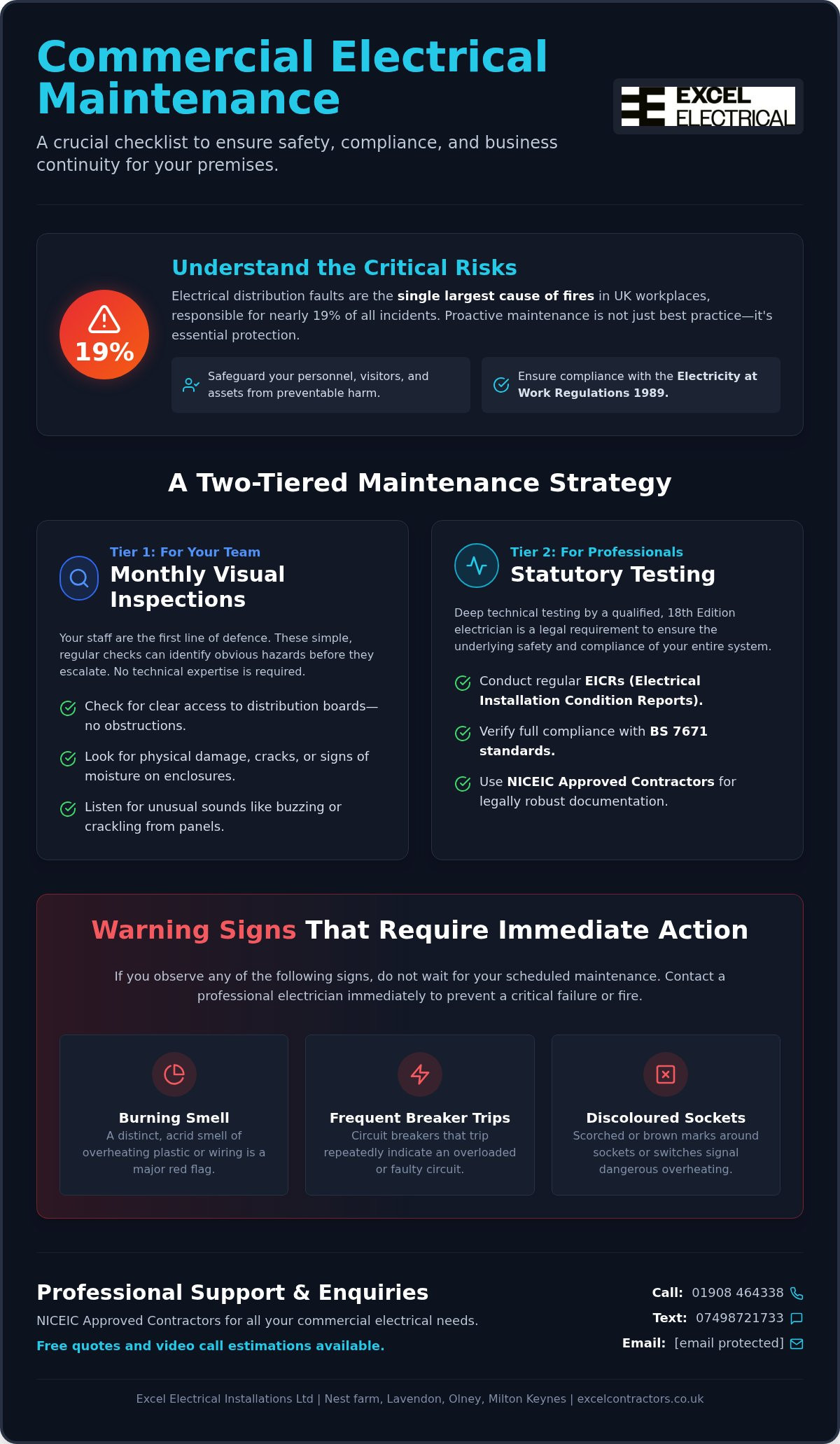
Did you know that electrical distribution faults are the single largest cause of fires in UK workplaces, accounting for nearly 19% of all incidents? For many business owners, the weight of the Electricity at Work Regulations 1989 feels like a constant source of anxiety. You likely worry about the catastrophic cost of an unexpected power failure or the legal fallout of a compliance gap. It's often difficult to discern which tasks your team can handle safely and which require a professional, 18th Edition qualified electrician.
This commercial electrical maintenance checklist is designed to remove that uncertainty and put you back in control of your building's safety. By following this structured framework, you can significantly reduce the risk of electrical fires whilst ensuring full compliance with legal and insurance requirements. We will guide you through the essential routine checks for 2026, including the critical updates from Amendment 4 of BS 7671. From identifying early warning signs to understanding EICR frequency, this guide provides the technical precision needed to maintain a safe environment. For professional support, Excel Electrical Installations Ltd is based at Nest farm, Lavendon, Olney, Milton Keynes. You can reach our team at 01908 464338 or [email protected].
Key Takeaways
- Understand your legal obligations under the Electricity at Work Regulations 1989 and how to remain compliant with the latest 18th Edition safety standards.
- Learn how to implement a tiered commercial electrical maintenance checklist that separates simple staff visual checks from essential professional testing.
- Identify critical warning signs, such as the distinct smell of electrical overheating or frequent breaker trips, that require immediate expert attention to prevent fires.
- Discover the vital role of regular Electrical Installation Condition Reports (EICR) in safeguarding your business and maintaining the validity of your commercial insurance.
- Access professional support from NICEIC Approved Contractors in Milton Keynes, including the option for efficient video call quotes to streamline your maintenance planning.
The Importance of a Commercial Electrical Maintenance Checklist
A robust commercial electrical maintenance checklist is far more than a simple to-do list; it is a strategic shield for your business operations. Preventive maintenance ensures that potential hazards are identified before they escalate into dangerous faults or costly outages. By shifting from a reactive "fix it when it breaks" mindset to a proactive strategy, you protect both your physical assets and your personnel. Excel Electrical Installations Ltd, based in Olney, supports businesses across Milton Keynes, Bedford, and Northampton in establishing these vital safety routines.
The legal landscape for UK businesses is rigorous. The Electricity at Work Regulations 1989 require that all electrical systems remain safe to use at all times. Following the publication of Amendment 4 (BS 7671:2018+A4:2026) in April 2026, the technical requirements for safety have evolved once again. A documented commercial electrical maintenance checklist provides the evidence needed to prove you've met these statutory obligations. Without this paper trail, you risk facing unlimited fines or criminal prosecution if an accident happens on your premises. Furthermore, many commercial insurance policies are rendered void if the claimant cannot prove that regular maintenance was performed by qualified professionals.
The financial argument for proactive care is undeniable. Emergency repairs often cost three times more than scheduled maintenance. When a consumer unit fails during a busy shift, the price of downtime often dwarfs the electrician's bill. Regular inspections allow you to identify aging components before they fail completely. This approach extends the lifespan of your infrastructure and prevents the chaos of sudden closures. It's a simple calculation: a small investment in regular checks saves thousands in lost revenue and emergency call-out fees.
Legal Compliance and Duty of Care
While deep technical testing requires a qualified professional, your staff can provide a vital first line of defence. Establishing a routine for non-qualified personnel to perform visual checks is a core component of any effective commercial electrical maintenance checklist. These inspections don't replace statutory testing, but they identify obvious hazards before they cause injury or fire. Adopting a structured approach similar to the NFPA 70B Standard helps create a formal preventive culture that prioritises reliability.
Distribution Boards and Control Gear
The distribution board is the heart of your building's electrical system. During a monthly walk-around, staff should ensure all boards are easily accessible and not obstructed by storage or debris. Look for physical damage to the enclosure, signs of moisture ingress, or any unusual buzzing or crackling noises. Up-to-date circuit labelling is essential for safety; if a circuit trips, staff must know exactly which area is affected. Monitoring for discolouration or scorch marks on the exterior of the board is critical, as these often indicate overheating components inside.
Sockets, Switches, and Visible Cabling
High-traffic areas like reception desks and breakrooms often suffer from wear and tear. Inspect for cracked faceplates or loose fittings that could expose live parts. A common risk in modern offices is "daisy-chaining" extension leads, which can easily overload a single circuit. In warehouse or industrial environments, check for frayed cables or damaged containment where forklifts or machinery might have made contact. If you identify multiple damaged outlets, it may be time to consider professional electrical maintenance to ensure your infrastructure can handle the load.
Lighting and Emergency Systems
Lighting impacts both safety and productivity. Failing ballasts or flickering bulbs can cause headaches and eye strain, affecting staff well-being. More importantly, emergency lighting must be tested monthly. This involves a short functional test to ensure the lamps illuminate when the power fails. All results must be recorded in the site logbook to maintain compliance. For more detail on technical inspections, see The Comprehensive Guide to Professional Electrical Maintenance Services.
Don't forget external areas. Car park lighting and illuminated signage are often overlooked but are essential for visitor safety and security. Check for water damage in external fittings and ensure timers or sensors are functioning correctly to avoid wasted energy. If you notice any defects during these walks, we suggest you call 01908 464 338 or text 07498721733 for enquiries.
Professional Testing and Statutory Compliance Requirements
While visual inspections catch obvious surface damage, they cannot detect internal faults like insulation degradation or poor earthing. Professional intervention is a mandatory part of any commercial electrical maintenance checklist. Fixed wire testing goes beyond the surface to examine the integrity of the hidden infrastructure within walls and ceilings. This ensures your systems remain compliant with the latest standards, specifically the 18th Edition Amendment 4 (BS 7671:2018+A4:2026), which became the mandatory standard for all new work from October 2026.
The EICR Process for Commercial Units
An Electrical Installation Condition Report (EICR) is the most comprehensive tool for assessing workplace safety. During an inspection, an NICEIC approved contractor like Excel Electrical Installations Ltd will issue a report using a standardised grading system. C1 observations indicate immediate danger and require urgent action. C2 observations are potentially dangerous, whilst C3 notes suggest improvements. For standard offices and retail units, these reports are usually required every five years. However, industrial units or environments with heavy public footfall often require testing every one to three years to account for increased wear and tear.
Emergency Lighting and Fire Alarm Interoperability
Your maintenance strategy must align with fire safety audits. Annual discharge tests are necessary to ensure emergency battery packs provide the required duration of light during a power failure. Under current regulations, safety system wiring must meet strict fire resistance standards. This ensures that fire alarms and emergency lighting remain operational long enough to facilitate a safe evacuation. Neglecting these battery discharge tests is a common compliance failing that can lead to significant liability during a fire service audit.
Portable Appliance Testing (PAT)
PAT testing focuses on equipment that plugs into the mains, from office kettles to industrial drills. While not a strict legal requirement for every single device, it is the industry recognised method for meeting the Electricity at Work Regulations 1989. For a deeper look at these requirements, see The Essential Guide to Electrical Testing. Keeping detailed records creates a "deemed safe" status that is often essential for maintaining the validity of your commercial insurance policy.
Our team provides these specialist services from our base at Nest farm, Lavendon, Olney, Milton Keynes. For professional testing or to book a video call quote, call 01908 464338 or email [email protected]. You can also text 07498721733 for enquiries regarding free quotes for your business premises.
Warning Signs and Immediate Action Protocols
A comprehensive commercial electrical maintenance checklist should empower your staff to recognise the early warning signs of system failure. Electrical faults often announce themselves through sensory cues before they result in a fire or total power loss. Ignoring these signals is a significant risk to business continuity and personnel safety. When your team identifies a red flag, they must follow a strict protocol: isolate the affected area if safe to do so and contact an 18th Edition qualified professional immediately.
Thermal Indicators and Unusual Odours
One of the most distinctive signs of a failing electrical component is the "smell of fish". This pungent odour is actually the scent of urea-formaldehyde or phenolic resins found in older plastic fittings as they begin to overheat and decompose. It is a critical warning that a fire may be imminent. Similarly, the smell of ozone or burning plastic indicates active arcing or melting insulation. These scents are never normal and always require investigation.
You should also pay close attention to the temperature of your fittings. Sockets or switches that feel warm to the touch suggest high resistance, often caused by loose connections or overloaded internal components. In modern commercial maintenance, we use thermal imaging cameras to detect these heat signatures behind walls and inside distribution boards before they become visible to the naked eye. If your staff report warm fittings, it is vital to seek professional electrical maintenance to prevent a localised fire.
Audible and Visual Faults
Whilst most electrical equipment generates a low-level operational hum, you must be able to distinguish this from dangerous arcing. Arcing sounds like a sharp crackling or buzzing; it occurs when electricity jumps across a gap in a damaged wire or loose terminal. This creates intense heat and is a leading cause of electrical fires. If you hear these sounds coming from a wall or a consumer unit, you should isolate the power to that circuit immediately.
Visual cues are equally important. Persistent flickering in your lighting systems often suggests a loose neutral connection, which can cause unpredictable voltage spikes and damage sensitive IT equipment. If your circuit breakers trip repeatedly, do not simply reset them. Frequent tripping is a symptom of an underlying fault, such as a short circuit or a ground fault. In many cases, especially in older commercial buildings, a fuseboard change or consumer unit upgrade is the only way to restore safety and ensure compliance with modern standards.
If you encounter any of these red flags, call 01908 464 338 or text 07498721733 for enquiries. Our team at Excel Electrical Installations Ltd provides free quotes and video call estimations to assess your site’s safety. We are located at Nest farm, Lavendon, Olney, Milton Keynes, and our office can be reached via [email protected].
Implementing Your Maintenance Strategy with Excel Electrical
Moving from a theoretical commercial electrical maintenance checklist to a live safety strategy requires a partner who understands both the technical standards and the local business environment. Excel Electrical Installations Ltd provides the professional framework needed to turn these safety requirements into a manageable routine. Based at Nest farm, Lavendon, Olney, Milton Keynes, our team is perfectly positioned to support businesses across the Home Counties. We prioritise clear communication and systematic processes, ensuring your premises remain compliant with the latest 18th Edition standards.
We specialise in creating bespoke Planned Preventative Maintenance (PPM) schedules tailored to your specific industry. A retail unit in Central Milton Keynes has different load requirements and wear patterns compared to an industrial facility in Bedford. Our NICEIC Approved contractors assess these variables to build a strategy that minimises risk whilst maximising the lifespan of your electrical infrastructure. This methodical approach ensures that statutory obligations are met without disrupting your daily operations.
Local Expertise for the Milton Keynes Region
Our deep roots in Olney allow us to offer responsive support to commercial clients in Newport Pagnell, Bedford, and Luton. We've built a reputation for unwavering reliability amongst local business owners and luxury home developers like Abbey Mill Homes. This experience across both high-end domestic and complex commercial projects ensures we bring a high level of finish and technical accuracy to every site. Whether you manage a single office in Buckinghamshire or a portfolio of properties across Bedfordshire, our stable and dependable approach puts your mind at ease.
Getting Started: Quotes and Consultations
We understand that business owners need efficiency and clear timelines. To streamline the estimation process, we offer innovative video call quotes alongside traditional on-site consultations. This allows for a faster turnaround and helps you integrate essential repairs or upgrades into your budget without delay. Our 18th Edition qualified team is dedicated to transparency, providing detailed breakdowns of all necessary work, from EICR remedial actions to consumer unit upgrades and full rewires.
Our commitment to TrustMark quality and NICEIC standards ensures that your maintenance strategy is in the most capable hands. We focus on domestic and light commercial needs with the same level of discipline, ensuring every connection is secure and every circuit is safe. By choosing a registered contractor, you protect your business from the risks of non-compliance and maintain the full validity of your commercial insurance.
To begin securing your premises, call 01908 464 338 or text 07498721733 for enquiries regarding our free quotes. You can also reach our office via email at [email protected] or visit us at Nest farm, Lavendon, Olney, Milton Keynes.
Securing Your Business with Proactive Electrical Safety
Maintaining a safe workplace is a continuous responsibility that demands both staff vigilance and professional expertise. By implementing a structured commercial electrical maintenance checklist, you move beyond mere compliance with the Electricity at Work Regulations 1989. You actively protect your business from the catastrophic costs of fire, equipment failure, and operational downtime. Remember that whilst monthly visual checks are essential, they must be supported by statutory testing like the EICR to ensure total system integrity.
Excel Electrical Installations Ltd has provided unwavering reliability across Milton Keynes since 2015. As an NICEIC Approved and TrustMark registered contractor, we deliver the technical precision required for modern 18th Edition standards. Request a free commercial maintenance quote from Excel Electrical today by calling 01908 464338 or texting 07498721733. You can also reach us at [email protected] or visit us at Nest farm, Lavendon, Olney, Milton Keynes. We offer free video call quotes to help you secure your premises with confidence and professional excellence.
Frequently Asked Questions
How often should a commercial electrical maintenance checklist be completed?
You should utilise a two-tiered approach for your safety schedule. Visual inspections by staff should occur monthly to identify obvious damage or hazards. Formal technical testing, such as an EICR, is typically required every five years for standard offices but every one to three years for high-risk industrial environments. This tiered commercial electrical maintenance checklist ensures you remain compliant with the Electricity at Work Regulations 1989 whilst protecting your building's safety.
Is a commercial electrical maintenance checklist a legal requirement?
Yes, maintaining electrical systems is a legal requirement under the Electricity at Work Regulations 1989. While the law doesn't specify a "checklist" by name, it mandates that systems must be maintained to prevent danger. Using a structured commercial electrical maintenance checklist is the industry-recognised method for demonstrating that you've met your statutory duty of care to employees and visitors, which is essential for insurance validity.
What is the difference between a visual check and an EICR?
A visual check is a surface-level inspection to spot broken sockets, frayed cables, or scorch marks. An EICR is a deep technical assessment performed by a qualified electrician using specialist equipment. The EICR tests hidden wiring, earthing, and insulation integrity that a visual check cannot detect. Both are essential components of a robust safety strategy to ensure your premises meet the latest 18th Edition safety standards.
Can my own staff perform the electrical maintenance checklist?
Your own staff can perform routine visual inspections if they've been given basic safety guidance. However, any technical testing, fuseboard changes, or remedial work must be carried out by a qualified electrician. Attempting complex repairs without professional accreditation is dangerous and will likely void your commercial insurance. Excel Electrical Installations Ltd provides the expert oversight needed for these critical technical tasks from our base in Olney, Milton Keynes.
What happens if our business fails an electrical safety inspection?
Failing an inspection means your electrical system is potentially dangerous. You'll receive a report with C1 or C2 observations that require urgent action. If you don't address these issues, you risk business closure, unlimited fines, and the invalidation of your insurance policy. Our team specialises in remedial works and consumer unit upgrades to bring failing systems back to safe, compliant standards quickly to minimise your operational downtime.
Do I need to maintain records of our electrical maintenance checks?
You must maintain accurate records of all electrical checks and maintenance performed. This documentation serves as vital evidence for health and safety audits, fire service inspections, and insurance claims. Keeping a site logbook with dates, findings, and signatures proves that you've exercised due diligence. It also helps our team at Excel Electrical track the history of your installation during future visits to Nest farm, Lavendon, Olney.
How much does professional commercial electrical maintenance cost?
The cost of professional maintenance depends on the size of your premises and the complexity of the installation. We don't provide fixed prices without an assessment because every commercial site is unique. To get an accurate figure, we suggest you call 01908 464 338 or text 07498721733 for enquiries. We offer free quotes and video call estimations to make the process as efficient as possible for your business.
Why should I choose an NICEIC approved contractor for my business?
Choosing an NICEIC approved contractor ensures that your electrical work meets the highest national safety standards. NICEIC contractors are regularly assessed for technical competence and adherence to regulations like BS 7671. This accreditation, combined with our TrustMark registration, gives you peace of mind that your business is being protected by a reliable partner. We serve Milton Keynes, Bedford, and Northampton with a commitment to professional excellence and transparency.


