

Did you know that as of May 2026, the maximum penalty for failing to comply with electrical safety regulations has risen to £40,000 per breach? For many property owners, receiving a technical report filled with cryptic abbreviations feels like a source of unnecessary anxiety rather than a helpful safety check. We understand that you want to protect your tenants and your investment without getting lost in industry jargon. This guide provides EICR codes explained for landlords to help you differentiate between a minor recommendation and a mandatory legal fix.
Mastering these requirements is essential for maintaining your 18th Edition compliance and ensuring your insurance remains valid. We'll decode the specific classification codes, from C1 danger to FI investigations, whilst outlining the strict 28-day deadline for remedial works. This article provides a clear, methodical path to achieving total electrical safety in your rental properties, backed by the expertise of Excel Electrical. Based at Nest farm, Lavendon, Olney, Milton Keynes, our team is available at 01908 464338, via email at [email protected], or via text at 07498721733 to help you manage these updates with professional confidence.
Key Takeaways
- This guide provides EICR codes explained for landlords to help you distinguish between immediate electrical hazards and non-urgent safety recommendations.
- Understand the mandatory 28-day deadline for completing remedial works on C1 and C2 faults to ensure your property remains legally compliant.
- Discover how to prepare your property and tenants for a thorough inspection by an 18th Edition qualified electrician to avoid unnecessary delays.
- Learn about the extension of safety regulations to the social housing sector and the critical compliance deadlines arriving in November 2026.
- Recognise the value of hiring NICEIC Approved and TrustMark registered contractors to protect your insurance and ensure technical accuracy.
What is a Landlord Electrical Safety Certificate?
A Landlord Electrical Safety Certificate is the formal technical document produced following a comprehensive Electrical Installation Condition Report (EICR). It serves as the definitive legal evidence that the fixed electrical systems in a rental property are safe for continued use. This assessment covers the consumer unit, fixed wiring, and all integrated circuits, though it specifically excludes portable appliances like kettles or heaters. Having EICR codes explained for landlords allows property owners to understand the technical nuances of their report, ensuring they can differentiate between a minor suggestion and a mandatory safety fix.
The regulatory landscape has evolved from the initial 2020 standards to the mandatory extensions seen in 2026. Whilst private landlords have been required to provide these reports for several years, the social housing sector is now entering a critical phase. By November 2026, all existing social tenancies must have undergone professional testing to meet national safety benchmarks. Choosing an NICEIC Approved contractor like Excel Electrical ensures that these reports are conducted with technical precision, providing peace of mind for both the property owner and the tenant whilst protecting the long-term value of the asset. To ensure your property assets are correctly assessed alongside these safety measures, you can learn more about Winfields Chartered Surveyors & Valuers for expert RICS valuation reports.
EICR vs Landlord Certificate: Clearing the Confusion
Whilst many letting agents use the term "certificate" colloquially, the actual document is a multi-page technical report. An EICR results in either a "Satisfactory" or "Unsatisfactory" outcome rather than a simple pass or fail. A property only achieves a satisfactory status if the inspector identifies no C1 or C2 codes. If these codes appear, the report is deemed unsatisfactory. This means the landlord must arrange remedial work within the strict legal timeframe to secure the safety of the installation and maintain their insurance validity.
The Legal Framework for Landlords in 2026
The Electrical Safety Standards in the Private Rented Sector (England) Regulations require inspections at least every five years. These assessments ensure that installations comply with the latest UK electrical wiring standards, currently defined by the 18th Edition of the IET Wiring Regulations. Excel Electrical provides the authoritative expertise needed to navigate these safety duties across Milton Keynes and the surrounding counties.
For enquiries regarding domestic electrical services, including EICRs, fuseboard changes, or rewires, please contact Excel Electrical. You can reach our office at 01908 464338, text 07498721733, or email [email protected]. Our team is based at Nest farm, Lavendon, Olney, Milton Keynes, and we offer free quotes and video call estimates to help streamline your compliance process.
The EICR Inspection Process: What Landlords Should Expect
Hiring an electrician who is 18th Edition qualified isn't just a recommendation; it's a necessity for legal compliance. These professionals possess the technical expertise to navigate complex government guidance on electrical safety, ensuring every circuit is scrutinised against current standards. For a standard two to three-bedroom domestic property, an inspection typically takes between two and four hours. During this window, the electrical supply must be disconnected periodically. It's helpful to notify your tenants in advance so they can power down sensitive electronic equipment and prepare for the temporary loss of lighting and power.
Excel Electrical prioritises a methodical rhythm to minimise disruption to your tenants' daily routines. By following a structured testing process, our team ensures that having EICR codes explained for landlords becomes a transparent experience rather than a technical burden. We focus on delivering a clear, evidence-based report that protects your investment and your residents. If you are preparing for an upcoming tenancy renewal or a new purchase, you can request a free quote to schedule your professional inspection today.
Step 1: Visual Inspection and Risk Assessment
The process begins with a comprehensive visual check of the entire installation. Our engineers look for obvious signs of thermal damage, such as scorched sockets, cracked switches, or brittle cable insulation. We frequently encounter unsafe DIY electrical work or outdated components that fail to meet modern safety standards. A critical part of this phase is verifying the presence of modern Residual Current Devices (RCDs) in the consumer unit. These components are essential for preventing electric shocks and reducing the risk of domestic fires caused by electrical faults. To further safeguard your property against all hazards, you can learn more about UK Fire Risk Assessments and ensure your building complies with the latest fire safety standards.
Step 2: Dead and Live Testing Procedures
Once visual checks are complete, we move into technical testing. Dead testing involves checking continuity and insulation resistance whilst the power is safely isolated from the mains. This helps identify hidden faults within the walls or under floorboards that aren't visible to the naked eye. Live testing follows, where we measure polarity and earth fault loop impedance. This confirms that the protective devices will trip correctly during a fault. This systematic approach ensures total accuracy in your final report, giving you the peace of mind that the property is safe.
For any enquiries regarding our domestic electrical services, please call 01908 464338 or text 07498721733. Our team at Excel Electrical is based at Nest farm, Lavendon, Olney, Milton Keynes, and we are happy to provide video call quotes to streamline your estimation process. You can also reach us via email at [email protected] for detailed compliance advice.
Understanding Classification Codes: C1, C2, C3, and FI
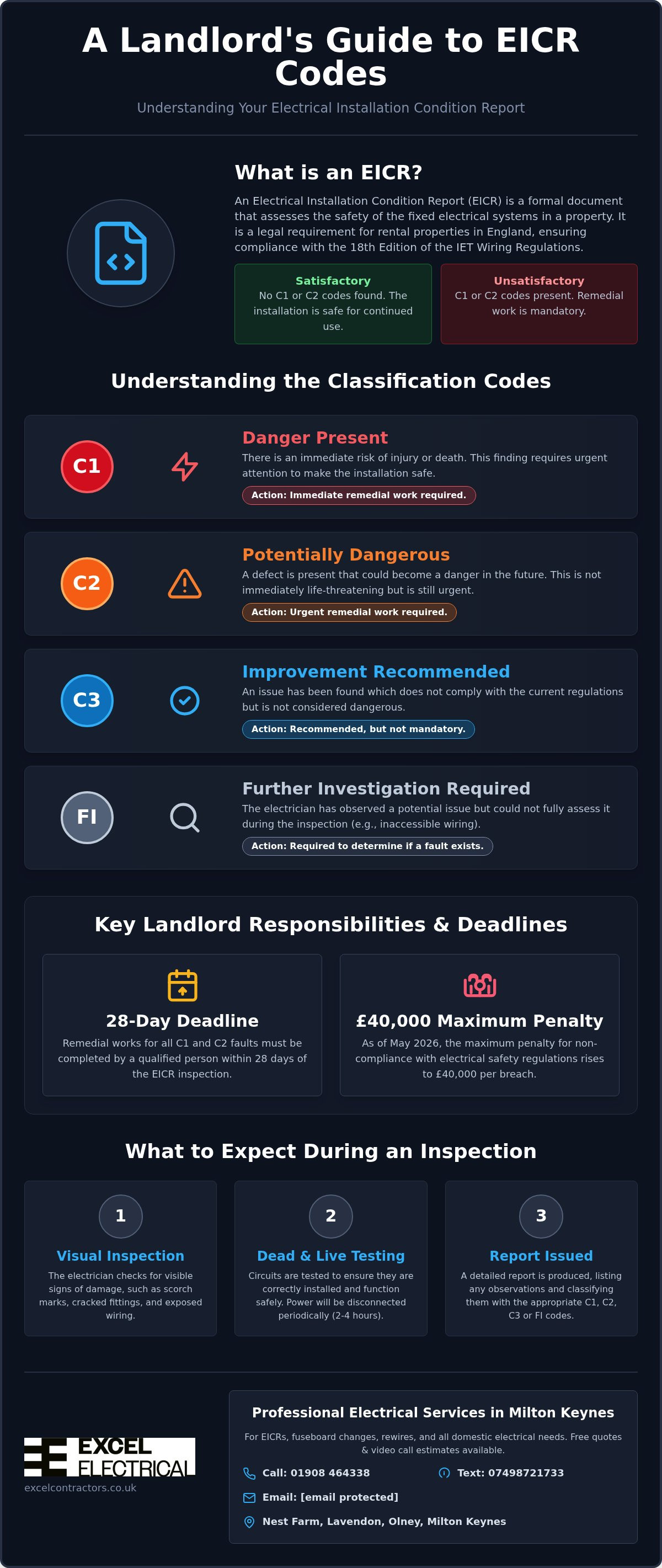
Deciphering the technical shorthand in an electrical report is a critical skill for property owners. The coding system allows an inspector to categorise risks based on their severity, moving from immediate life-threatening hazards to simple safety recommendations. Having these EICR codes explained for landlords ensures you can prioritise repairs effectively and maintain your legal standing. Any report containing a C1 or C2 fault is automatically classified as Unsatisfactory, meaning the property doesn't meet the required safety standards for habitation in 2026.
The classification system is designed to remove ambiguity from the safety assessment. Whilst a single C3 code won't lead to a legal failure, it highlights areas where your property falls behind modern safety benchmarks. Our methodical approach at Excel Electrical ensures that every fault is accurately recorded, giving you a clear roadmap for any necessary maintenance. Based at Nest farm, Lavendon, Olney, Milton Keynes, we provide the technical clarity you need to protect your tenants and your insurance validity.
C1 and C2: The Mandatory Remedial Fixes
A C1 code indicates an immediate danger to life or property. In these instances, our electricians may need to make the installation safe on the spot by isolating the faulty circuit or component. This is the most serious classification and requires an instant response. C2 codes represent a potential danger that could become life-threatening under certain conditions, such as a lack of effective earthing. Under current UK regulations, you have exactly 28 days to complete mandatory remedial works for any C1 or C2 issues. Excel Electrical simplifies this process by providing clear, fixed-price quotes for all required repairs, ensuring you can restore compliance without delay.
C3 and FI: Recommendations and Deep Dives
Not every code requires an immediate financial outlay. A C3 classification signifies that an improvement is recommended. Whilst the installation is safe for continued use, it may not align with the latest 18th Edition standards. Addressing C3 recommendations is safety best practice and can prevent these items from deteriorating into C2 faults over time. Conversely, an FI code means Further Investigation is required. This occurs when an inspector identifies an anomaly that can't be fully assessed during a standard test, such as hidden wiring issues. You must investigate these items before a satisfactory certificate can be issued. For a deeper look at the methodology behind these checks, read The Essential Guide to Electrical Testing.
For professional guidance on your report or to book an inspection, call our team on 01908 464338 or text 07498721733. We offer free quotes and video call quotes to streamline your compliance journey. You can also contact us at [email protected] to discuss your specific domestic electrical needs.
Landlord Responsibilities and Fines in 2026
Compliance is a continuous obligation rather than a one-off task. By 2026, the legal landscape for electrical safety has tightened significantly. Local authorities now possess greater enforcement powers to ensure every rental property meets the 18th Edition standards. Beyond the immediate safety of your tenants, maintaining a valid report is a fundamental requirement for your landlord insurance policy. If a fire occurs and you cannot produce a satisfactory EICR, your insurer may refuse to settle the claim, leaving you personally liable for damages. Having EICR codes explained for landlords helps you understand that some faults are not just suggestions; they are legal triggers for mandatory action.
The financial risks of negligence have never been higher. As of May 2026, the maximum fine for each breach of the electrical safety rules has increased to £40,000. This represents a substantial rise from previous years, reflecting the government's commitment to eliminating substandard housing. These penalties can be applied per breach, meaning a single property with multiple unresolved C1 or C2 faults could lead to devastating financial consequences. Regular maintenance is the most effective way to avoid these costs and prevent the need for expensive emergency rewires. For professional support with your portfolio, you can book an EICR inspection today.
Deadline and Documentation Requirements
Once your inspection is complete, you must follow strict distribution timelines. You are legally required to provide a copy of the EICR to each existing tenant within 28 days of the inspection. For new tenancies, a copy must be supplied before the tenant moves into the property. If a local authority requests a copy of your records, you have only seven days to provide it. Failing to meet these documentation deadlines is considered a breach of the regulations, even if the electrical installation itself is safe.
Fines and Enforcement Actions
Local authorities are now actively auditing property records to ensure compliance across both private and social housing sectors. If an inspection identifies C1 or C2 faults, you must complete the remedial work within 28 days or any shorter period specified in the report. Following the repairs, you must obtain written confirmation from a qualified electrician that the work has been completed. This documentation must be kept alongside the original EICR. To help stay organised, you can follow The Ultimate Home Electrical Maintenance Checklist to catch minor issues before they escalate.
Excel Electrical provides the methodical testing and clear documentation you need to stay on the right side of the law. Based at Nest farm, Lavendon, Olney, Milton Keynes, our team is ready to assist with your domestic electrical needs. Call us on 01908 464338, text 07498721733, or email [email protected] for a free quote or to arrange a video call estimate.
Professional Electrical Safety Testing in Milton Keynes
Choosing the right contractor is as vital as understanding the regulations themselves. Excel Electrical has built a reputation for unwavering reliability amongst property owners in Olney and Milton Keynes. Our NICEIC Approved Contractor status and TrustMark registration aren't just badges; they're your guarantee of technical competence and accountability. Having EICR codes explained for landlords by a qualified professional ensures that your safety report is both accurate and actionable. We strictly adhere to 18th Edition regulations, providing a methodical approach that prioritises the stability and safety of your domestic electrical systems.
We understand that managing a property portfolio is time-consuming. To streamline your compliance journey, we offer an innovative video call quote service. This allows us to assess your consumer unit and general installation remotely, providing a precise estimate without the need for an initial site visit. It's a modern solution designed for busy landlords who value efficiency alongside high-end domestic standards. This helps ensure that the process of getting EICR codes explained for landlords is followed by a clear, transparent path to any necessary remedial work.
Bespoke Services for Local Landlords
Our expertise extends beyond Milton Keynes to Newport Pagnell, Bedford, Northampton, and the surrounding counties. Whether your property requires a simple fuseboard change to meet modern safety standards or a full rewire, our team manages the project with precision. If an inspection reveals C1 or C2 faults, we provide the technical expertise necessary to restore your property's satisfactory status quickly. Understanding why hiring an NICEIC Approved Contractor is vital helps you appreciate the rigorous standards we maintain for every client project.
Get Started with a Free Quote
Securing your 2026 compliance shouldn't be a stressful process. Our office at Nest farm, Lavendon, Olney, Milton Keynes, serves as a hub for local trust and accountability. We invite you to reach out for a free quote or to arrange a video call estimate for your entire portfolio. Our clear communication and systematic processes ensure you remain fully protected against the risks of non-compliance whilst keeping your tenants safe. We take pride in our workmanship and our commitment to long-term client relationships.
For all your domestic electrical services, contact Excel Electrical today. Call our office on 01908 464338, text us at 07498721733, or email [email protected]. We look forward to helping you maintain a safe and legal environment for your tenants through professional testing and inspection.
Securing Your Property Portfolio for 2026
Managing the electrical safety of a rental property is a core responsibility for any professional owner. Having EICR codes explained for landlords ensures you can distinguish between immediate hazards and long-term maintenance recommendations. By adhering to the mandatory 28-day remedial window and maintaining accurate records, you protect your tenants and your insurance validity. The 2026 landscape involves higher financial penalties for non-compliance, making a methodical approach to testing more critical than ever before.
Excel Electrical provides the expertise needed to manage these updates with confidence. We're a NICEIC Approved Contractor and TrustMark Registered business based at Nest farm, Lavendon, Olney, Milton Keynes. For expert EICR testing and free quotes, call us on 01908 464338, text 07498721733, or email [email protected] today. We also offer free video call quotes to help you manage your portfolio efficiently. You can book your professional safety inspection online to ensure your properties remain safe and compliant for years to come.
Frequently Asked Questions
How often do I need a Landlord Electrical Safety Certificate in 2026?
Landlords must ensure their properties undergo a professional electrical inspection at least every five years. Many private tenancies are due for renewal in 2021, as this marks the five-year anniversary of the regulations becoming mandatory for all existing tenancies. Keeping your reports up to date is essential for maintaining your legal compliance and protecting your asset. Our team can help you track these deadlines to ensure your portfolio remains safe and fully insured.
How much does an EICR cost for a standard domestic property in Milton Keynes?
The cost of an EICR for a domestic property in Milton Keynes varies based on the number of circuits and the age of the installation. Whilst a standard two-bedroom house typically falls within a predictable range, more complex properties require deeper investigation. Excel Electrical provides free quotes and the option for a video call estimate to give you an accurate price without an initial site visit. This methodical approach ensures your compliance budget is managed effectively.
What happens if my property fails the electrical safety inspection?
If your property receives an "Unsatisfactory" result, it indicates that the inspector found C1 or C2 faults that pose a risk to tenants. You must arrange for a qualified electrician to carry out remedial work to resolve these specific issues. Once the repairs are finished, you'll receive written confirmation that the installation is safe. This documentation, combined with the original report, serves as your proof of compliance for local authorities and insurance providers.
Is PAT testing a legal requirement for landlords alongside the EICR?
Portable Appliance Testing (PAT) is not a strict legal requirement under the current EICR regulations, which focus on the fixed wiring of the property. However, landlords have a general legal duty to ensure that any electrical equipment they provide is safe for use. We recommend annual PAT testing for appliances like fridges or washing machines as a safety best practice. This proactive approach helps prevent accidents and demonstrates a high standard of care for your tenants.
Can any electrician issue a Landlord Electrical Safety Certificate?
No, only a "qualified and competent person" is permitted to carry out these inspections. This means the electrician must have the technical knowledge and experience to test installations against the 18th Edition of the IET Wiring Regulations. Choosing an NICEIC Approved Contractor like Excel Electrical ensures that your report is technically accurate and legally valid. We undergo regular audits to maintain these high standards, providing you with a reliable partner for your property maintenance.
What is the 28-day remedial work rule for landlords?
The 28-day rule requires landlords to complete all mandatory remedial works within four weeks of the inspection date. If your report identifies C1 or C2 faults, having EICR codes explained for landlords ensures you understand exactly what needs fixing to reach a satisfactory status. Once the work is finished, you must obtain written confirmation of the repairs and supply this, along with the original report, to your tenants and the local council within 28 days.
Do the 2026 regulations apply to social housing and HMOs?
Yes, the 2026 updates have extended these mandatory safety requirements to the social housing sector. Social landlords must ensure their first round of electrical safety checks are completed by 1 November 2026. HMOs also fall under these regulations and may have additional licensing requirements depending on the local authority. Our engineers are experienced in managing the specific challenges of multi-occupancy buildings, ensuring every circuit is tested thoroughly to protect your residents and your legal standing.
Will I need to upgrade my fuseboard to pass the EICR?
You won't necessarily need to replace your fuseboard if it's in good condition and operates safely. However, older consumer units that lack modern RCD protection or fire-rated enclosures often receive a C2 code, which requires an upgrade for a satisfactory report. If the board is safe but doesn't meet the absolute latest 18th Edition standards, it might receive a C3 recommendation. We provide clear, fixed-price quotes for fuseboard changes if they're required to bring your property up to code.
For all domestic electrical enquiries, please contact Excel Electrical at Nest farm, Lavendon, Olney, Milton Keynes. You can call our office on 01908 464338, text 07498721733, or email [email protected]. We offer free quotes and video call estimates to streamline the process for landlords in Milton Keynes and the surrounding counties.


