

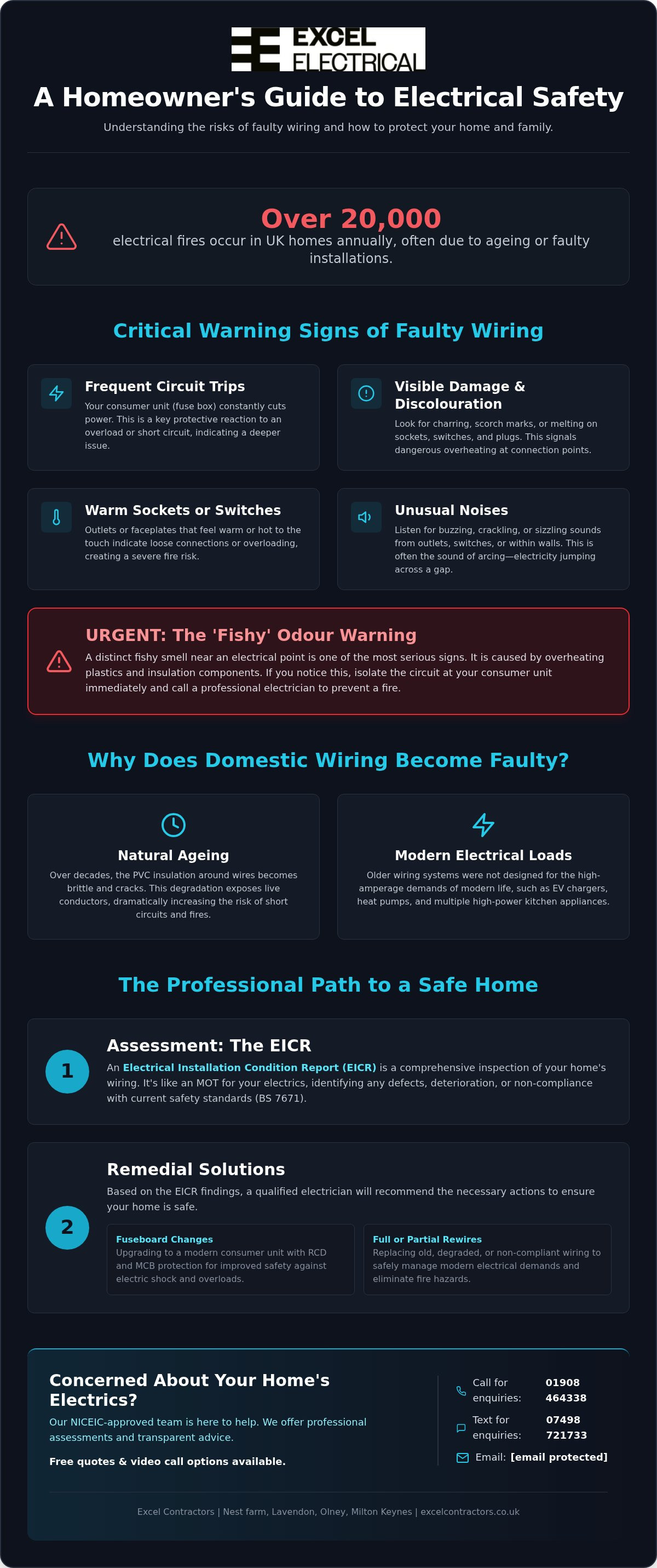
Did you know that over 20,000 electrical fires occur in UK homes every year? Most of these incidents stem from faulty products or ageing installations that haven't been properly maintained. It's easy to overlook the silent systems behind your walls, but spotting the early signs of faulty wiring in house uk properties is essential for your family's safety. Whether you've noticed a persistent burning smell or flickering lights, these symptoms are often the first warning that your electrical system requires professional attention.
We understand that the thought of a full rewire or complex terminology like Consumer Units can feel overwhelming. You want to ensure your home is safe without facing unnecessary costs. This guide will help you identify dangerous warning signs and explain the professional steps required to keep your property compliant with the latest BS 7671:2018+A4:2026 regulations. We'll cover everything from visual checks to the importance of an Electrical Installation Condition Report (EICR).
At Excel Contractors, based at Nest farm, Lavendon, Olney, Milton Keynes, we prioritise your peace of mind. If you are concerned about your wiring, you can call 01908 464338 or text 07498721733 for enquiries. Alternatively, email us at [email protected] for expert guidance. Our NICEIC approved team helps you navigate these safety requirements with transparency and professional care.
Key Takeaways
- Identify the most critical signs of faulty wiring in house uk properties, including persistent circuit tripping and discoloured sockets, to mitigate fire risks.
- Learn the immediate safety protocols to follow when you suspect an electrical fault, such as isolating the power at your main consumer unit.
- Understand how an Electrical Installation Condition Report (EICR) works and what the specific safety codes mean for your home's compliance.
- Evaluate whether your domestic installation requires a simple fuseboard upgrade or a full rewire to safely manage modern electrical loads.
- Discover how to secure a professional assessment for your Milton Keynes or Olney property through efficient options like free video call quotes.
Common Signs of Faulty Wiring in UK Properties
Identifying the signs of faulty wiring in house uk properties requires a vigilant approach to daily electrical performance. Your electrical system shouldn't be heard or smelled; it should operate silently in the background. If you notice a persistent tripping of the circuit breaker, your consumer unit is reacting to an overload or a short circuit. This is a protective measure designed to prevent damage, but regular occurrences suggest a deeper systemic issue that requires a professional assessment rather than simply flipping the switch back up.
There are several primary indicators that your domestic wiring is failing:
- Persistent tripping: The fuse box or consumer unit frequently cuts power to specific circuits.
- Visible damage: Discolouration, charring, or visible smoke around plug sockets and light switches.
- Heat: Sockets or switches that feel warm or hot to the touch during use.
- Unusual noises: Audible buzzing, sizzling, or crackling sounds coming from within walls or electrical points.
- Odours: A distinct burning smell or a "fishy" scent that persists in certain rooms.
Visible warnings are critical for home safety. Look for discolouration or charring around plug sockets. If a faceplate feels warm to the touch or shows signs of melting, the internal connections are likely loose or corroded. Heat builds up because the resistance in the wire increases at the point of failure. Audible buzzing or crackling sounds, often described as a sizzling noise, coming from behind sockets are a major red flag. This sound is the physical vibration caused by electricity jumping across a gap in a loose or damaged connection. This process, known as arcing, creates temperatures that can easily ignite surrounding building materials or cable insulation.
The "Fishy" Odour: A Critical Warning Sign
A distinct, fishy smell near an outlet or switch is one of the most urgent signs of faulty wiring in house uk homes. This specific odour is caused by the overheating of plastic components and older Bakelite insulation. When these materials reach high temperatures, they release chemicals that smell remarkably like fish. It indicates that a component is currently arcing or burning. You must isolate the circuit immediately at the consumer unit and contact a qualified electrician to prevent a fire; for instance, homeowners in the South East can learn more about Essex Home Electricians to access 24/7 emergency support. Ignoring this scent is dangerous, as it usually precedes a significant electrical fire.
Flickering Lights vs. Major Faults
Flickering lights don't always mean a catastrophe, but they shouldn't be ignored. A single flickering bulb is often just a loose fitting or a failing lamp. However, if multiple lights dim when you switch on a high-power appliance like a kettle or shower, your system is likely struggling with the load. Modern LED bulbs are particularly sensitive to these voltage drops and will pulse or flicker more noticeably than old incandescent versions. Understanding the evolution of your installation through UK electrical wiring standards helps identify if your home still uses outdated circuit types that weren't designed for today's high-demand appliances.
If you're concerned about the safety of your installation, Excel Contractors provides comprehensive testing to identify these hidden risks. You can reach our office at Nest farm, Lavendon, Olney, Milton Keynes, by calling 01908 464338, texting 07498721733, or emailing [email protected] to discuss your concerns. We offer free quotes and video call quotes to streamline your estimation process.
Understanding Why Domestic Wiring Becomes Faulty
Whilst identifying the signs of faulty wiring in house uk properties is the first step toward safety, understanding the root causes of these failures is vital for long-term maintenance. Electrical systems are often hidden behind plaster and floorboards, leading many homeowners to assume they're permanent. In reality, wiring is a degradable asset. Over several decades, the PVC insulation surrounding copper conductors becomes brittle and cracks. This natural ageing process exposes live wires, significantly increasing the risk of short circuits and electrical fires.
The demands we place on our homes have changed drastically. A property wired in 1990 wasn't designed to support the continuous, high-amperage draw of modern technology such as EV chargers, air source heat pumps, or powerful electric showers. When these heavy loads are added to an ageing circuit, the cables can overheat, hastening the degradation of insulation. This stress often leads to the systemic failures discussed previously, such as persistent tripping or charred sockets.
The Age Factor: Is Your Home Over 25 Years Old?
The standard lifespan for domestic wiring in the UK is generally considered to be around 25 to 30 years. If your property hasn't been rewired since the mid-1990s, the installation likely lacks modern safety features like RCD protection or Arc Fault Detection Devices (AFDDs). You can often identify dangerously old systems by looking for black rubber cabling or lead-sheathed wires at the consumer unit. These materials have long surpassed their safe working life and represent a significant hazard in 2026.
Environmental and External Damage
External factors frequently compromise circuit integrity. Moisture ingress from a leaking pipe or damp walls can cause "tracking," where electricity finds an unintended path, leading to nuisance tripping. Mechanical damage is also common; a single misplaced drill bit during a DIY project can nick a cable, creating a high-resistance fault. Compliance with the latest 18th Edition regulations ensures that cables are installed within "safe zones" or protected by metal conduit to prevent such accidents. All work in UK dwellings must adhere to the legal requirements outlined in Approved Document P to ensure occupant safety.
Rodent damage remains a persistent issue in rural and suburban UK homes. Squirrels and mice are attracted to the chemical compounds in cable insulation and can chew through entire sections of wiring in a loft space. Additionally, the "cowboy builder" effect remains a threat; non-compliant DIY work often bypasses critical safety protocols. If you suspect your home has been subjected to substandard modifications, we recommend a professional domestic electrical assessment to verify the safety of your installation. For a rapid estimation, Excel Contractors offers free video call quotes. Contact our team at Nest farm, Lavendon, Olney, Milton Keynes, by calling 01908 464338, texting 07498721733, or emailing [email protected] to organise an inspection.
Assessing the Risk: Minor Repair or Full House Rewire?
Distinguishing between a minor electrical annoyance and a fundamental safety hazard is essential for every homeowner. If you have identified isolated signs of faulty wiring in house uk properties, such as a single damaged socket or a loose light fitting, a targeted repair may be all that's required. However, when symptoms like flickering lights or tripping circuits occur across multiple rooms, the issue is likely systemic. We must determine if the fault is a simple component failure or a sign that the entire installation has reached the end of its safe working life.
A partial rewire is often a viable middle ground. This involves replacing specific circuits, such as the kitchen or bathroom wiring, whilst leaving others intact if they remain compliant with BS 7671 standards. To make this decision, we look for indicators of non-compliance. These include a lack of proper earthing, the presence of old-fashioned green goo (plasticiser) leaching from cables, or wiring that cannot support modern electrical demands. If your property still uses a wooden-backed fuse box or has no RCD protection, it no longer meets current UK safety standards.
When a Consumer Unit Upgrade is Enough
A full rewire becomes necessary when the signs of faulty wiring in house uk dwellings suggest a total failure of the insulation or a lack of circuit capacity. If you frequently experience faults across different circuits, or if your home still uses old-style fuse boxes with replaceable wire, a complete overhaul is the safest path forward. Planning for a rewire also allows you to future-proof your home. You can integrate smart home technology, dedicated circuits for EV chargers, and renewable energy connections during the process. This systematic approach ensures long-term reliability and significantly increases the property's value by providing a clean bill of health.
If you're unsure which category your home falls into, Excel Contractors offers professional assessments and free video call quotes to streamline the process. You can contact our NICEIC approved team at Nest farm, Lavendon, Olney, Milton Keynes, by calling 01908 464338 or texting 07498721733. We specialise in domestic electrical services and can provide a clear roadmap for your safety requirements.
Once you've identified the signs of faulty wiring in house uk properties, your priority must shift from observation to immediate risk mitigation. Electrical faults are not self-correcting; they are active hazards that can escalate into house fires or serious injury if ignored. If you observe visible sparks, smoke, or a persistent burning smell, the first step is to isolate the power at the source. You shouldn't wait for a circuit to trip on its own if you can see a physical danger developing.
There are several critical actions you should take whilst waiting for a professional assessment:
- Isolate the power: Turn off the main switch on your consumer unit immediately if you suspect a fire risk.
- Remove the load: Unplug any appliances that were in use when the fault occurred, especially those that appear to be causing the circuit to trip.
- Maintain distance: Never touch discoloured, charred, or hot sockets with your bare hands. The internal temperature can be high enough to cause severe burns or deliver a shock through damaged casing.
- Document the fault: If it's safe to do so, take clear photos or a short video of the symptoms. This provides your electrician with vital diagnostic evidence.
Safe Isolation and Power Management
Operating the main switch on your consumer unit is the most effective way to ensure safety during an emergency. This switch is usually a large red or double-pole toggle that cuts power to the entire property. If a specific circuit breaker has tripped, you should never attempt to force it back into the "on" position if it resists. A breaker that immediately trips again indicates a permanent fault or a short circuit. Forcing it can cause internal damage to the consumer unit or lead to a fire. Additionally, avoid using extension leads as a permanent workaround for a faulty socket. Overloading extension leads creates a secondary fire risk that compounds existing wiring issues.
The Value of a Video Call Quote
In a high-stakes situation, speed is essential. At Excel Electrical, we use video call quotes to provide rapid safety advice and preliminary assessments. This allows our NICEIC Approved contractors to see the fault in real-time, helping us determine the urgency of the repair without the delay of a physical site visit. This service reduces the time between fault detection and professional resolution, providing you with immediate peace of mind. We offer these as free quotes to ensure that financial concerns don't stand in the way of your home's safety.
If you suspect an issue, don't delay your professional assessment. You can contact our team at Nest farm, Lavendon, Olney, Milton Keynes, by calling 01908 464338 or texting 07498721733. For non-urgent enquiries, email us at [email protected]. Our experts specialise in domestic electrical safety and rewiring, ensuring your home remains compliant and secure.
Professional EICR Testing and Remedial Solutions
Once you have observed the physical signs of faulty wiring in house uk properties, the next logical step is a formal diagnostic assessment. An Electrical Installation Condition Report (EICR) is the industry-standard method for verifying the safety of your home's electrical systems. Unlike a simple visual check, an EICR involves a deep technical audit of the circuits hidden within your walls. This report provides a legal record of your installation's health, which is often required for insurance purposes or when selling a property.
The results of your inspection are categorised using a standard coding system that prioritises your safety. A C1 code indicates that danger is present and immediate action is required to prevent injury or fire. A C2 code signifies a potentially dangerous fault that needs urgent attention. Finally, a C3 code suggests that whilst the system is currently safe, improvements are recommended to meet modern standards. Understanding these codes allows you to make informed decisions about remedial work, moving your home from a state of uncertainty to a certified, safe environment.
The EICR Process: What to Expect
A professional EICR is a methodical inspection of all circuits, sockets, and the consumer unit. Our engineers test the continuity of cables and the effectiveness of earthing systems to ensure that protective devices will trip correctly during a fault. For a standard three-bedroom UK home, the process typically takes between two and four hours to complete thoroughly. You can read The Essential Guide to Electrical Testing for a detailed breakdown of how we ensure your property remains compliant with the latest safety regulations.
Why Milton Keynes Homeowners Trust Excel Electrical
Choosing an NICEIC Approved contractor is the gold standard for domestic safety. This accreditation guarantees that our work is regularly assessed for technical competence and strict adherence to the 18th Edition wiring regulations. As a TrustMark registered business based at Nest farm, Lavendon, Olney, Milton Keynes, we provide local expertise across Milton Keynes, Olney, and Newport Pagnell. We pride ourselves on transparent communication and methodical workmanship, ensuring that every remedial solution we provide prioritises your peace of mind.
If you are concerned about the signs of faulty wiring in house uk installations, don't leave your safety to chance. We offer free quotes and the option for video call quotes to streamline your estimation process and provide rapid advice. Contact Excel Contractors today to organise your professional assessment. You can reach our office at 01908 464338, text us on 07498721733, or email [email protected] for reliable, expert advice. Our team is committed to ensuring your property remains safe, compliant, and efficient for years to come.
Securing Your Home's Electrical Future
Proactive maintenance is the most effective way to ensure your property remains safe and compliant with modern standards. By recognising the signs of faulty wiring in house uk properties, such as persistent tripping or unusual odours, you can address minor issues before they escalate into dangerous faults. It's essential to remember that a professional EICR is the only certain method to verify the integrity of your hidden cabling and protective devices.
At Excel Contractors, our NICEIC Approved and TrustMark registered team is dedicated to providing peace of mind through expert domestic services. Our 18th Edition qualified electricians specialise in fuseboard upgrades and full rewires across Milton Keynes and Olney. We offer free video call quotes to provide rapid safety advice and accurate estimations without delay. To take the next step toward a safer home, you can book your free electrical safety quote with Excel Electrical by calling 01908 464338 or texting 07498721733. You can also reach us at [email protected] or visit our office at Nest farm, Lavendon, Olney, Milton Keynes. Protecting your family starts with a reliable, professional assessment.
Frequently Asked Questions
How much does it cost to fix faulty wiring in a UK house?
Costs vary significantly based on the extent of the damage and your property size. A minor repair, such as replacing a single charred socket, is a relatively small task compared to a full or partial rewire. Factors affecting the final figure include the age of your installation and the accessibility of existing cables. For an accurate estimation, we provide free video call quotes to assess your specific domestic needs without delay.
Can I check for faulty wiring myself?
You can perform basic visual inspections, but you should never attempt technical testing. Homeowners should look for physical signs of faulty wiring in house uk properties, such as discoloured sockets, flickering lights, or scorched faceplates. However, verifying the integrity of hidden cables requires specialist equipment and NICEIC qualification. If you notice any physical damage, isolate the circuit and call a professional for a formal safety assessment immediately.
How often should a house be rewired in the UK?
A domestic electrical installation typically requires a full rewire every 25 to 30 years. Over this period, cable insulation naturally degrades and becomes brittle, which increases the risk of short circuits. If your home has not been updated since the 1990s, it likely lacks modern safety features like RCDs or AFDDs. We recommend a professional inspection every 10 years for homeowners to monitor the system's condition and identify necessary upgrades.
Does home insurance cover faulty electrical wiring?
Most standard home insurance policies do not cover the cost of repairing or replacing faulty wiring caused by general wear and tear. However, they may cover damage caused by a resulting fire. Insurers often expect homeowners to maintain their property to a safe, compliant standard. Having a valid EICR can be essential when making a claim, as it proves you have taken reasonable steps to ensure your electrical safety.
What is an EICR and do I need one if I suspect a fault?
An Electrical Installation Condition Report (EICR) is a formal document produced after a thorough inspection of your home's electrical systems. You should certainly commission one if you suspect a fault. The report uses a coding system to identify specific dangers, ranging from immediate risks to recommended improvements. It is the most reliable way to confirm if your wiring is compliant with current BS 7671 regulations and ensures your peace of mind.
Why does my fuse box keep tripping even after I unplug everything?
If your consumer unit trips with no appliances connected, the fault likely lies within the permanent wiring of the building. This can be caused by moisture ingress, rodent damage, or a breakdown in cable insulation. These issues are serious signs of faulty wiring in house uk dwellings and require immediate professional investigation. You should not attempt to force the breaker back up, as this can cause further damage or a fire.
Is a burning smell always a sign of faulty wiring?
A persistent burning smell, especially one resembling fish or melting plastic near an outlet, is almost always an indicator of an electrical fault. It suggests that a component is arcing or overheating, which represents a significant fire risk. Whilst some new appliances may emit a faint odour during their first use, a smell coming from sockets or the fuse box is an emergency that requires you to isolate the power immediately.
What should I do if I see sparks from a light switch?
You must stop using the switch immediately and isolate the circuit at your main consumer unit. Visible sparking, or arcing, indicates a loose connection or a damaged component that could ignite surrounding materials. Once the power is safely isolated, contact an NICEIC Approved contractor for an emergency inspection. You can reach the Excel Contractors team at 01908 464338 for rapid assistance at your Milton Keynes or Olney property.


