

Could a single misplaced socket invalidate your entire home insurance policy during your next renovation? It's a daunting prospect, particularly when you're more focused on worktop materials than the complex kitchen electrical regulations UK homeowners must follow. Most people naturally worry about the devastating risk of house fires or the legal confusion surrounding which specific tasks are 'notifiable' to local authorities. You deserve to feel certain that your investment is protected and your household is safe from harm.
This guide ensures your project remains fully compliant by mastering 2026 safety standards, strictly aligned with 18th Edition requirements. We'll provide a clear understanding of socket 'zones', explain exactly when you must request an EICR or minor works certificate, and help you find a reliable NICEIC contractor. For those in Milton Keynes needing professional support, Excel Contractors at Nest farm, Lavendon, Olney, provide expert domestic services. You can reach the team on 01908 464338 or via email at [email protected] to ensure your kitchen rewire or fuseboard upgrade meets every safety benchmark. Getting these technical details right today prevents a costly and dangerous situation tomorrow.
Key Takeaways
- Learn how to navigate kitchen electrical regulations UK to ensure all work complies with the latest 18th Edition safety standards and Part P building codes.
- Identify the critical safety zones for socket placement to maintain the required distance from water sources and prevent electrical hazards.
- Understand the difference between notifiable major works and minor repairs to ensure you receive the correct EICR or certification for your records.
- Determine the circuit requirements for high-power modern appliances to avoid overloading your system and risking electrical fires.
- Recognise the value of NICEIC approved certification for protecting your home insurance and simplifying any future property sale.
Kitchen Electrical Regulations UK: Why Compliance Matters in 2026
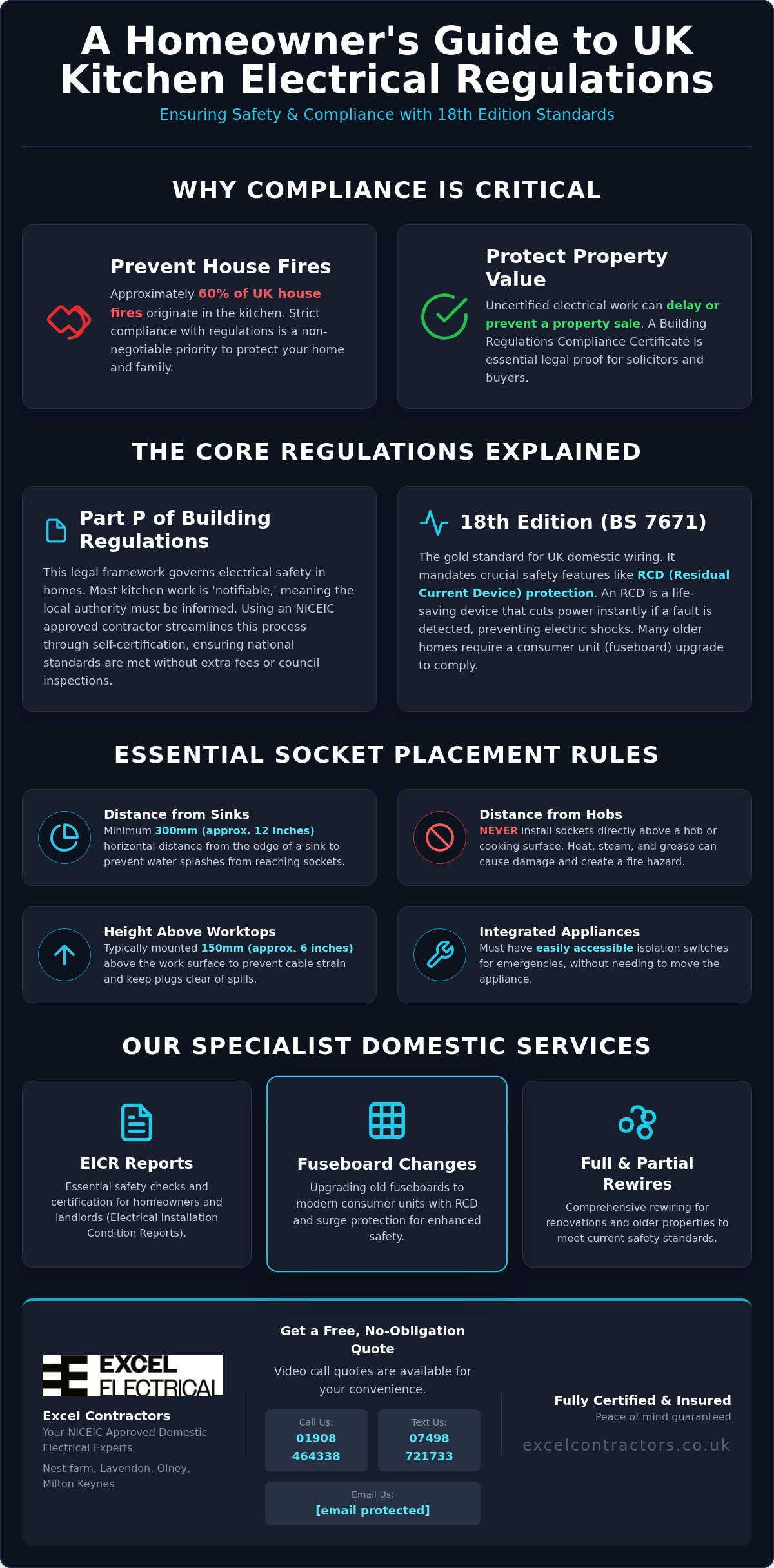
Kitchens represent the most technically demanding area of any British home. They combine high-power appliances with water sources and heat, creating a unique environment where electrical faults can quickly become life-threatening. Adhering to kitchen electrical regulations UK is not merely a box-ticking exercise for builders; it's a critical safety requirement designed to prevent house fires and electric shocks. Data from NICEIC indicates that roughly 60% of UK house fires originate in the kitchen, making strict compliance a non-negotiable priority for any 2026 renovation project.
The legal landscape is equally unforgiving. If you complete electrical work without the proper certification, you'll likely struggle to sell your property in the future. Solicitors now routinely request evidence of compliance for any major electrical alterations. Without a Building Regulations Compliance Certificate, you might face significant delays or be forced to pay for costly remedial work to satisfy a buyer's surveyor. Professional installers like Excel Electrical Installations Ltd ensure every project is fully documented and legally sound, protecting both your safety and your property value.
The Importance of Part P Compliance
Part P of the Building Regulations is the statutory framework that governs electrical safety in dwellings. It ensures that any electrical installation is designed and installed to protect residents from fire or injury. Under these rules, most kitchen electrical work is classified as "notifiable." This means the local authority building control must be informed of the work before it begins. By using an NICEIC approved contractor, you benefit from a streamlined process where the electrician self-certifies the work. This provides peace of mind that the installation meets national standards without the need for independent council inspections or additional fees.
18Th Edition Standards for Modern Homes
The 18th Edition of the IET Wiring Regulations (BS 7671) is the current gold standard for domestic wiring in the UK. For a modern kitchen, this standard mandates specific safety features that older homes often lack. One of the most vital requirements is RCD (Residual Current Device) protection. An RCD is a life-saving device that breaks the circuit instantly if it detects a leakage of current, such as when a wire is accidentally cut or water enters a socket. Many older properties require a consumer unit upgrade before any kitchen renovation can begin. This ensures the new circuits are protected by modern circuit breakers and surge protection devices, keeping your household safe from unexpected electrical surges whilst supporting high-wattage modern living.
Essential Socket Placement and Zoning Requirements
Sockets are the most visible part of your electrical system, but their placement is strictly governed by kitchen electrical regulations UK. It's not just about aesthetics; it's about physical safety. Water and electricity are a lethal combination. Steam from a kettle or splashes from a sink can bridge the gap in a socket, causing a short circuit or a fire. Precise positioning ensures that your kitchen remains a safe environment for your family.
Safe Distances from Sinks and Hobs
The general industry standard, often referred to as the "300mm rule," dictates that sockets should be at least 300mm away from the edge of a sink horizontally. This distance significantly reduces the risk of water splashing directly into the electrical points. For hobs and ovens, the rules are even stricter. You must never install a socket directly above a cooking surface. Heat and steam from pans can melt the plastic faceplates or damage the internal wiring. In high-end bespoke kitchens, managing these splash zones requires careful planning to ensure the layout remains functional without compromising safety.
Height and Accessibility Standards
Sockets should typically be mounted 150mm above the work surface. This height prevents cables from being strained or pinched by heavy appliances. It also keeps the plugs clear of any liquids that might spill onto the counter. For integrated appliances like dishwashers or wine coolers, you must provide accessible isolation switches. These should be positioned so they can be reached easily in an emergency without having to pull the appliance out. If you're planning a kitchen island, consider pop-up sockets or side-mounted points that maintain these safety clearances. Proper planning at the start of your project avoids the need for expensive corrections later.
In very small kitchens where these distances cannot be physically met, you might be prohibited from installing traditional 13A sockets in certain areas. This is where professional expertise becomes vital. If you're unsure about your layout, the team at Excel Electrical Installations Ltd can help you design a compliant and safe kitchen environment. Our NICEIC approved electricians specialise in domestic layouts that balance modern convenience with strict safety adherence.
Understanding Notifiable vs Non-Notifiable Work
Differentiating between notifiable and non-notifiable work is a critical step in any renovation project. Notifiable work involves significant changes that must be reported to the local authority Building Control department. This includes the installation of entirely new circuits, such as those required for a kitchen island or a high-power induction hob. It also covers consumer unit upgrades and any major alterations to existing wiring. Conversely, non-notifiable work typically refers to minor repairs or like-for-like replacements. Changing a cracked socket cover or swapping an old light fitting for a modern equivalent generally doesn't require formal notification, provided the underlying circuit remains unchanged.
Managing the administrative side of kitchen electrical regulations UK is straightforward when you work with the right professionals. A registered electrician handles the notification on your behalf, ensuring the local council records are updated correctly. Once the work is complete, you'll receive a Building Regulations Compliance Certificate. This document is a vital piece of your property's history. It proves that your project adheres to kitchen electrical regulations UK and protects you during future house surveys or sales.
When You Must Hire a Registered Electrician
While DIY projects are popular for decorating, electrical work in a kitchen is a different matter entirely. The law requires a qualified professional for any notifiable work to ensure the installation is safe and legal. Attempting to rewire a kitchen yourself often leads to insurance complications. If a fire occurs and the work wasn't certified, your provider may refuse to pay out. Choosing NICEIC approved contractors ensures your project meets the highest safety standards. These professionals are regularly assessed to confirm their technical competence, providing you with a layer of protection that DIY work simply cannot match.
The Certification Process Explained
Documentation is the final, essential stage of any electrical job. For major works, you'll receive an Electrical Installation Certificate (EIC). This detailed report confirms that the new installation is safe for use. For smaller additions, a Minor Works Certificate is issued instead. You should expect to receive these compliance documents within 30 days of the project's completion. Store them safely alongside your property deeds. When the time comes to sell your home, these certificates act as definitive proof that your kitchen electrics are modern and safe. For enquiries regarding certification or to book a project, call 01908 464 338 or text 07498721733. Excel Contractors, based at Nest farm, Lavendon, Olney, Milton Keynes, provides free quotes and video call estimates for your convenience. You can also reach us via email at [email protected].
Modern Circuit Demands for High-End Kitchens
Modern kitchens are no longer just places to cook; they are high-tech hubs requiring significant power. A luxury renovation often includes high-wattage appliances such as induction hobs, steam ovens, and boiling water taps. These devices place an immense strain on your home’s electrical infrastructure. Consequently, a consumer unit upgrade is frequently the essential first step in a renovation. Adhering to kitchen electrical regulations UK ensures that your system can handle this cumulative load without overheating or causing circuit failure. Planning for these demands early prevents the frustration of tripped breakers once your new kitchen is operational.
Dedicated Circuits for Heavy Appliances
Induction hobs require heavy-duty cabling and their own dedicated isolation switches to function safely. It's a common mistake to lump too many high-power appliances onto a single circuit. To prevent nuisance tripping, professional designers separate refrigeration units from cooking appliances. This ensures that a minor fault in an oven doesn't spoil the contents of your fridge. Electricians apply "diversity factors" from the 18th Edition standards during the design phase. This calculation accounts for the fact that you rarely run every appliance at maximum power simultaneously, allowing for a safe and efficient circuit layout that respects the capacity of your consumer unit.
Lighting Circuits and Bespoke Solutions
Lighting is a key component of high-end design, but it must be installed with safety in mind. Task lighting under cabinets and ambient ceiling lights should ideally be on separate circuits. This provides better control and ensures that a failure in one area doesn't leave the whole room in darkness. LED drivers must be placed in accessible locations, such as behind removable plinths or in ventilated cupboards, to allow for future maintenance. All lighting circuit installations must also maintain the fire-rating of your ceiling. Using fire-rated downlights or hoods ensures that the integrity of the ceiling is not compromised, protecting your home and family.
Planning a high-end kitchen requires technical precision to balance aesthetics with safety. For expert advice on your renovation, contact Excel Electrical Installations Ltd. You can call 01908 464 338 or text 07498721733 to arrange a free video call quote. Our specialists are based at Nest farm, Lavendon, Olney, Milton Keynes, and are ready to ensure your project meets every requirement of the kitchen electrical regulations UK.
Professional Kitchen Rewires in Milton Keynes and Olney
Local expertise is vital when navigating the specific requirements of kitchen electrical regulations UK. Excel Electrical Installations Ltd operates from Olney, providing a responsive service that national firms often struggle to match. We understand that a kitchen is the heart of the home, which is why we manage every rewire with a focus on minimal disruption. Our team works systematically to ensure your power is restored as quickly as possible, allowing your renovation to proceed without unnecessary delays. By choosing a local contractor, you benefit from a partner who is familiar with the property styles in Buckinghamshire and the specific challenges they present.
Our Domestic Electrical Expertise
We specialise in both full and partial kitchen rewires throughout the Milton Keynes area. Before any major work begins, we often conduct EICR testing to evaluate the condition of your existing circuits. This assessment identifies hidden faults that could compromise the safety of your new installation. As an NICEIC Approved Contractor and TrustMark registered business, we ensure every project adheres to 18th Edition standards. Our qualified electricians have the expertise to handle complex domestic requirements, from upgrading consumer units to installing bespoke lighting systems, all whilst maintaining strict compliance with national safety codes.
Get Started with a Free Quote
Planning a kitchen renovation is a significant undertaking, and we aim to make the electrical phase as seamless as possible. We offer free quotes and innovative video call estimates, which allow you to show us your project requirements via your smartphone. This saves time and provides a clear, transparent scope of work before any physical site visit. Whether you need a simple socket relocation or a complete kitchen rewire, our pricing is detailed and fixed. We prioritise clear communication so you know exactly what is required to meet kitchen electrical regulations UK.
Our office is located at Nest farm, Lavendon, Olney, Milton Keynes, where we serve homeowners across the region. To discuss your project or to book an estimate, call our office on 01908 464338 or text 07498721733 for a prompt response. You can also contact us via email at [email protected]. By choosing a local specialist, you ensure your kitchen renovation is safe, legal, and fully compliant with the latest safety standards.
Securing Your Kitchen Investment for the Future
Navigating kitchen electrical regulations UK doesn't have to be a source of stress during your home improvement journey. By understanding the critical importance of socket zoning, the legal necessity of Part P compliance, and the power demands of modern luxury appliances, you've taken the first step toward a safer home. These standards exist to protect your family from fire risks and ensure your property remains a valuable, compliant asset.
For those looking to go beyond electrical updates and undertake a full property refurbishment, CFS group Limited provides professional maintenance services to help ensure your entire renovation meets the highest standards of quality and safety.
As an NICEIC Approved Contractor and TrustMark registered business, Excel Electrical Installations Ltd provides the technical authority you need for a successful renovation. For a free quote on your kitchen electrical project, call 01908 464338, text 07498721733, or enquire online with Excel Electrical. You can also reach us via email at [email protected] or visit us at Nest farm, Lavendon, Olney, Milton Keynes. We offer free video call quotes to streamline your planning process. Your dream kitchen deserves the peace of mind that only professional, certified workmanship can provide.
Frequently Asked Questions
Do I need a Part P certificate for a new kitchen installation?
Yes, you require a Part P certificate for any notifiable work during a new kitchen installation. This includes adding new circuits or changing a consumer unit. A registered electrician will issue this document to prove the work meets the building regulations. It's a legal requirement that protects you from substandard installations and ensures your home remains safe and insurable. Without it, you may face difficulties when selling your property in the future.
How far should a socket be from a kitchen sink in the UK?
You must place electrical sockets at least 300mm horizontally from the edge of a kitchen sink. This specific distance is designed to prevent water splashes from entering the socket and causing a short circuit or fire. Whilst there is no specific vertical regulation, keeping sockets 150mm above the worktop prevents cable strain. Adhering to these kitchen electrical regulations UK measurements ensures a safe environment for using small appliances near water sources.
Can I rewire my own kitchen if I am confident with DIY?
Rewiring a kitchen yourself is not recommended and is legally complex due to Part P requirements. Most kitchen electrical work is notifiable to local authority building control. If you carry out the work yourself, you must inform the council before starting and pay for an inspection. Non-compliant DIY work often voids home insurance and can lead to dangerous faults. It's safer and more efficient to hire a qualified NICEIC contractor to manage the certification.
What is the difference between an NICEIC Approved Contractor and a handyman?
An NICEIC Approved Contractor is a qualified professional who undergoes regular technical assessments to ensure they meet national safety standards. Unlike a handyman, an approved contractor can self-certify their work to building control, providing you with a legal compliance certificate. They also carry professional indemnity insurance and adhere to the 18th Edition wiring regulations. This formal accreditation offers a level of accountability and safety that a non-qualified individual cannot provide.
How many sockets should a modern UK kitchen have?
There is no specific legal minimum for the number of sockets, but modern kitchens typically require at least four to six double outlets. You should plan your layout based on your appliance list, including dedicated points for kettles, toasters, and coffee machines. It's better to install more sockets during the renovation phase than to rely on dangerous extension leads later. Proper planning ensures your kitchen remains functional whilst supporting modern high-load electrical demands.
Do I need a separate fuse for my electric oven and hob?
High-power appliances like electric ovens and induction hobs usually require their own dedicated circuits and fuses. Connecting multiple heavy-load appliances to a single circuit can cause frequent tripping or overheating of the cables. A qualified electrician will calculate the total load and determine if separate circuits are necessary based on the manufacturer's instructions. This ensures that your cooking equipment operates safely without overloading your home's main consumer unit.
What happens if I don’t have a certificate for my kitchen electrical work?
If you don't have a compliance certificate for your kitchen electrical work, you may struggle to sell your home. Solicitors frequently request these documents during the conveyancing process to prove the property is safe. Your home insurance could be invalidated if a fire is traced back to uncertified electrical work. You might be forced to pay for a retrospective EICR or remedial work to satisfy a buyer's surveyor or local building control.
Is it mandatory to upgrade my consumer unit when renovating a kitchen?
Whilst not strictly mandatory in every case, a consumer unit upgrade is often necessary to satisfy modern kitchen electrical regulations UK. Current standards require RCD protection for all kitchen circuits to prevent electric shocks. If your existing fuseboard lacks these modern safety features, it cannot legally support new electrical installations. A qualified electrician will assess your current system to ensure it provides the required protection for your high-power appliances and modern lighting.


