

Would you notice if the wiring hidden behind your walls began to deteriorate today? For many property owners, electrical systems are out of sight and out of mind until a fault occurs. It's understandable to feel confused by the different rules for homeowners versus landlords, especially with the strict penalties for non-compliance. Understanding exactly how often should you have your electrics checked uk wide is the only way to ensure your property remains safe and legally compliant in 2026.
We recognise that you want peace of mind without the stress of unexpected costs or major disruptions. This guide clarifies the legal requirements and safety recommendations for electrical inspections, helping you protect your family or tenants from hidden fire risks. You'll learn about the mandatory five-year EICR cycle for rentals, the ten-year recommendation for homeowners, and the latest 2026 updates for social housing. Excel Electrical is based at Nest farm, Lavendon, Olney, Milton Keynes. You can contact our expert team at [email protected] or call 01908 464338. By the end of this article, you'll have a clear roadmap for maintaining a safe, compliant electrical installation.
Key Takeaways
- Understand the distinct testing frequencies for different property types, including the 10-year recommendation for homeowners and the strict 5-year legal mandate for landlords.
- Learn exactly how often should you have your electrics checked uk wide to ensure your property remains compliant with the latest 2026 safety regulations.
- Identify the physical warning signs, such as scorching or frequent fuseboard tripping, that indicate your electrical system requires urgent professional attention.
- Demystify the EICR process by understanding the difference between visual inspections and technical dead testing carried out by qualified electricians.
- Discover how to streamline your safety certification with free video call quotes from NICEIC-approved contractors serving the Milton Keynes and Olney areas.
Understanding Electrical Safety: What is an EICR?
An Electrical Installation Condition Report (EICR) is the primary safety standard for electrical systems throughout the United Kingdom. It's a formal document, produced only by a qualified and competent electrician, that assesses the safety of the fixed wiring in a property. Its purpose is to identify wear and tear, physical damage, and potential fire hazards that could put occupants at risk. When considering how often should you have your electrics checked uk residents must understand that an EICR is more than a simple maintenance log; it's a vital safety certification.
Hiring an NICEIC approved contractor is essential for this process. A "DIY" check or a cursory glance from an unaccredited tradesperson cannot provide the legal protection or technical accuracy required. A professional report categorises issues into specific codes, such as C1 (danger present) or C2 (potentially dangerous). This ensures that urgent remedial work is prioritised to keep your home or business compliant with national safety standards.
The Role of the 18th Edition Standards
BS 7671, frequently referred to as the 18th Edition of the Wiring Regulations, serves as the national standard for electrical installations. These regulations are updated regularly to reflect changes in technology and safety research. Modern standards now incorporate specific requirements for EV charger installations and surge protection devices that weren't present in older iterations of the code.
Many older properties in Milton Keynes and the surrounding Home Counties often fall short of these current safety benchmarks. Wiring that was considered safe thirty years ago might not handle the electrical load of contemporary appliances and smart home systems. An EICR evaluates your installation against these modern 18th Edition standards to identify where upgrades, such as a fuseboard change, are necessary for continued safety.
Why Visual Checks Aren't Enough
It's a common mistake to assume that if a light switch works, the system is safe. Surface-level aesthetics are often misleading. Most of your electrical system remains hidden behind walls, under floorboards, and within the ceiling. Professional testing goes beyond what the eye can see to monitor the behaviour of circuits under load.
Technicians use specialised equipment to perform "dead testing" and "live testing" to ensure the system reacts correctly during a fault. Insulation resistance testing is a core part of a professional check that identifies whether the protective coating on your wires has degraded over time. Without these technical tests, hidden faults can quietly develop into significant fire risks or electrocution hazards. Knowing how often should you have your electrics checked uk wide starts with acknowledging that only professional diagnostic tools can reveal the true health of your wiring.
How Often Should You Have Your Electrics Checked in the UK?
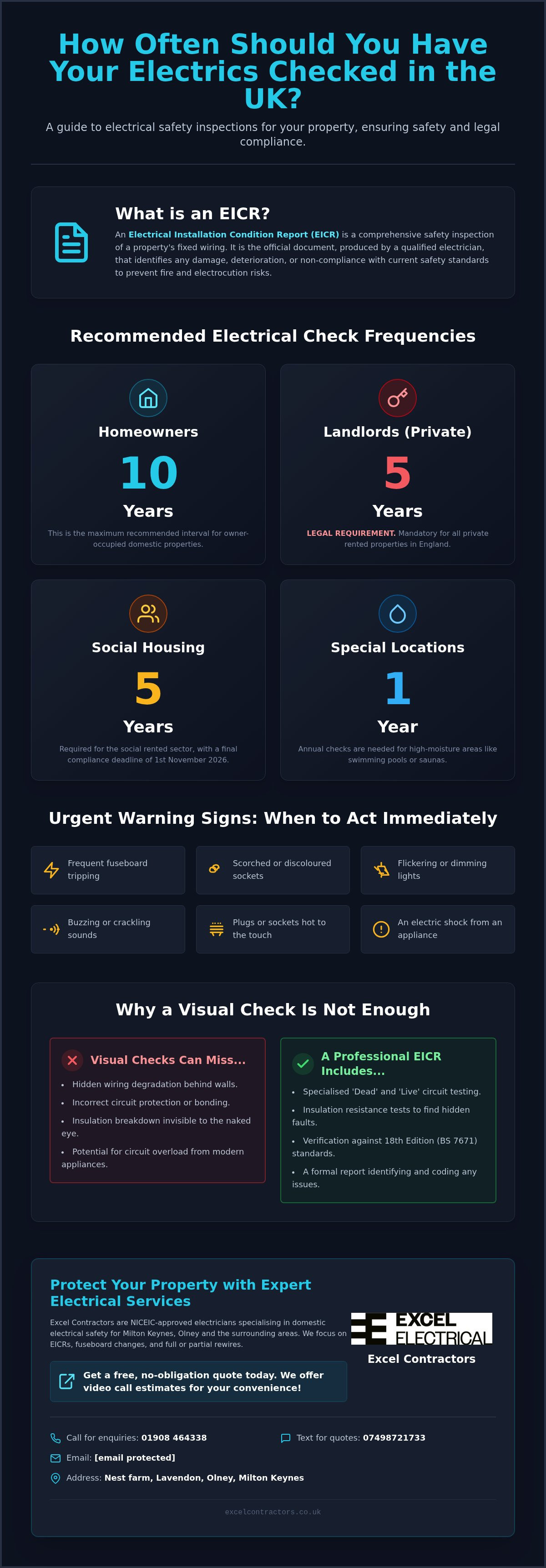
Determining how often should you have your electrics checked uk wide depends heavily on the property's use and environmental factors. For owner-occupied domestic homes, the industry standard recommendation is an inspection every 10 years. This timeframe assumes the installation was performed to a high standard and hasn't undergone significant modifications. However, this is a maximum interval; many homeowners choose to align their testing with major life events, such as moving into a new property or following a significant renovation, to ensure total peace of mind.
Certain environments demand much more frequent attention. Special locations where moisture is present, such as swimming pools, saunas, or commercial laundries, typically require annual inspections. Water and electricity are a lethal combination; even minor degradation in these areas can lead to immediate danger. Similarly, if your property is more than 40 years old, a bespoke maintenance programme is advisable. Older wiring insulation, such as rubber or early PVC, can become brittle and fail, necessitating more regular monitoring than a modern installation would require.
Landlord Legal Obligations in 2026
Landlords face much stricter requirements than homeowners. Under the Electrical Safety Standards in the Private Rented Sector (England) Regulations 2020, rental properties must undergo an EICR at least every five years. This 5-year rule is a legal maximum. You must also provide a copy of the report to your tenants within 28 days of the inspection. For the social rented sector in England, the transition period concludes on 1 November 2026, by which point all existing tenancies must have a valid report. Failing to meet these deadlines can result in financial penalties of up to £40,000 and the invalidation of landlord insurance. To ensure your portfolio remains compliant, you should call 01908 464 338 or text 07498721733 to arrange professional testing services with our qualified team.
Commercial and Business Premises
Most commercial buildings, including offices and retail units, follow a 5-year testing cycle to comply with the Health and Safety at Work Act. Understanding how often should you have your electrics checked uk wide in a business context is essential for maintaining your statutory health and safety records. Industrial sites, petrol stations, or high-occupancy buildings like cinemas often require 3-yearly checks due to the higher wear and tear on the electrical infrastructure. You can find more detail in the comprehensive guide to professional electrical maintenance services. Regular testing ensures that your business remains operational and that your employees remain safe from avoidable electrical accidents. Excel Electrical provides free quotes and the option for video call quotes to streamline the estimation process for your premises.
Red Flags: When to Organise an Electrical Check Early
While the 10-year guideline provides a general timeframe for homeowners, your property’s electrical system may communicate its distress much sooner. Physical symptoms of failure should never be ignored. If you notice any of the following signs, the question of how often should you have your electrics checked uk wide becomes secondary to the immediate need for a professional diagnostic inspection.
- Persistent tripping: A fuseboard that regularly cuts power is not just an inconvenience; it is a safety mechanism working overtime to prevent a fire or shock.
- Burning smells or discolouration: Acrid, fishy smells often indicate melting plastic. Brown or black "scorching" marks on socket faces suggest internal arcing or excessive heat.
- Flickering lights: Whilst often blamed on a faulty bulb, persistent flickering can signal loose terminal connections deep within the circuit.
- Buzzing or crackling: These sounds are the audible warning of electricity jumping across a gap. This "arcing" creates intense heat and requires immediate professional attention.
Ignoring these symptoms can lead to catastrophic failure. If you are experiencing any of these issues in the Milton Keynes or Olney area, you can call 01908 464 338 or text 07498721733 for an urgent enquiry. We provide free quotes to help you address these risks before they escalate.
The Dangers of Outdated Consumer Units
Identifying an old "fusebox" is relatively simple; look for a wooden back or ceramic pull-out fuses. These units were designed for an era with much lower electrical demands and lack vital Residual Current Device (RCD) protection. An RCD is a life-saving component that disconnects the power in milliseconds if it detects a leak to earth. Without this, the risk of fatal electric shock is significantly higher. We frequently suggest a consumer unit upgrade to ensure your home benefits from modern 18th Edition safety standards.
Buying or Renovating a Property
An EICR is an essential part of any pre-purchase survey for a home in the Home Counties. Most standard homebuyer reports only include a cursory visual check, which cannot identify hidden wiring integrity issues behind walls. Similarly, major renovations often put existing circuits under new types of stress. When planning a kitchen rewire or a bathroom upgrade, understanding how often should you have your electrics checked uk residents find that an early inspection ensures new installations don't overload older, existing infrastructure.
The Inspection Process: What to Expect During an EICR
An EICR is a systematic assessment of your property’s electrical health. Knowing how often should you have your electrics checked uk is the first step, but understanding what happens during the visit helps you prepare for the temporary disruption. The process is divided into several technical stages designed to uncover faults that a standard visual check would miss.
The inspection begins with a visual assessment. Your electrician examines the consumer unit, visible cables, and accessories like sockets and switches for signs of thermal damage or physical deterioration. Following this, "dead testing" is carried out whilst the power is disconnected. This includes insulation resistance testing to ensure current isn't leaking between conductors and continuity testing to verify that all grounding paths are intact. These tests are essential for identifying faults that could lead to electric shocks or fires.
Once the dead tests are complete, the power is restored for "live testing". This stage evaluates the behaviour of your circuit breakers and Residual Current Devices (RCDs). We measure the exact time it takes for these safety components to trip under fault conditions, ensuring they meet the strict requirements of BS 7671. This data confirms that your system will respond correctly during a surge or short circuit.
Understanding the Result Codes
Every finding in an EICR is categorised using standardised UK codes. These determine the urgency of any required remedial work and influence how often should you have your electrics checked uk residents find that the severity of these codes dictates their next steps:
- C1 (Danger present): This indicates a high risk of injury. Immediate action is required to make the installation safe.
- C2 (Potentially dangerous): This code signifies a fault that could become dangerous under certain conditions. Urgent remedial work is necessary.
- C3 (Improvement recommended): Your system is safe, but it doesn't meet the latest 18th Edition standards. Improvements are advised but not mandatory.
- FI (Further Investigation): This is used when a potential fault is identified that requires more in-depth testing to locate the source.
Preparing for Your Visit
A thorough inspection requires the power to be turned off for a significant portion of the testing phase. You should plan for this downtime by shutting down computers and sensitive electronic equipment. To ensure a smooth process, please provide clear access to the consumer unit and ensure that sockets aren't obstructed by heavy furniture.
At Excel Electrical, we aim to make the process as transparent as possible. We offer a video call quote option to provide an initial assessment without needing an immediate site visit. If you are ready to secure your property, you can book a domestic EICR with our NICEIC approved team today. For enquiries, please call 01908 464 338 or text 07498721733 to speak with our qualified experts.
Securing Your Property with Excel Electrical’s Expert Testing
Choosing the right professional is as vital as knowing how often should you have your electrics checked uk wide. Excel Electrical provides an unwavering commitment to safety through our status as an NICEIC approved contractor. This accreditation ensures that our work is assessed regularly against national standards, giving you the confidence that your domestic or commercial installation is in expert hands. Based in Olney, we serve Milton Keynes and the surrounding Home Counties with a focus on technical precision and strict industry compliance.
Our team consists of 18th Edition qualified electricians who understand the complexities of modern electrical demands and the latest BS 7671 regulations. We are also TrustMark registered, a government-endorsed quality scheme that provides an extra layer of consumer protection and peace of mind. Whether you require a routine periodic inspection or a complex fuseboard upgrade, we prioritise transparent communication and systematic processes. We offer free quotes and the convenience of video call estimations to streamline the initial assessment of your property without delay.
Domestic Specialists in EICRs and Rewires
We specialise in domestic electrical services, ranging from minor maintenance to full or partial rewires. Our process is designed to be as non-intrusive as possible, moving logically from your initial enquiry to the final delivery of your safety certification. If you're concerned about the age of your wiring or need to meet landlord legal obligations, our methodical approach ensures no detail is overlooked. For residential management companies or freehold owners, Winfields Block Management offers comprehensive services to ensure large-scale compliance across entire developments. We take pride in our workmanship and aim to put every client at ease by maintaining high standards. You can contact our office on 01908 464338 to book your inspection or discuss your specific requirements with a member of our team.
Contact Our Olney-Based Team
Excel Electrical operates with a steady, professional cadence that respects your time and intelligence. We believe in building long-term relationships through accountability and a quiet confidence in our technical capabilities. Our office is located at Nest farm, Lavendon, Olney, Milton Keynes. For direct enquiries or to arrange a video call quote, please email us at [email protected]. You can also text 07498721733 for quick enquiries or call 01908 464338 to speak with us directly. We remain committed to maintaining the highest safety standards across every project we undertake, ensuring your home or business remains fully compliant with 2026 regulations. Furthermore, we value the work of local community hubs like eavcentre.co.uk that provide essential support services to residents in the region.
Securing Your Property’s Electrical Future
Maintaining electrical safety is a continuous commitment rather than a one-off task. By now, you should have a clear understanding of how often should you have your electrics checked uk wide, whether you are a landlord adhering to the mandatory five-year cycle or a homeowner following the ten-year safety recommendation. Recognising the physical red flags, such as scorching or persistent tripping, ensures you can act before a minor fault becomes a major hazard.
Working with a professional, NICEIC Approved Contractor provides the technical accuracy needed to comply with 18th Edition standards. As a TrustMark Registered business based in Olney, we prioritise your peace of mind through systematic testing and transparent reporting. Don't leave your property's safety to chance. You can book your professional EICR or request a free video quote from Excel Electrical today to ensure your home or business remains fully compliant and safe for years to come. For immediate enquiries, call our team on 01908 464338 or text 07498721733. We look forward to helping you secure your installation with the professional care it deserves.
Frequently Asked Questions
Is an EICR a legal requirement for UK homeowners?
An EICR isn't currently a legal requirement for owner-occupied homes, but it's a mandatory obligation for landlords. For homeowners, the 10-year recommendation is a safety benchmark designed to identify hidden degradation before it becomes dangerous. Landlords must have an inspection every five years to remain compliant with the law. Regardless of legal status, an up-to-date report is often required by insurers to maintain valid building cover.
How much does a professional electrical check cost in Milton Keynes?
Costs for an EICR depend on the size of your property and the total number of circuits. A one-bedroom flat is generally less expensive to test than a large detached house. Rather than providing a generic estimate, we offer free video call quotes to give you a precise figure for your specific property in Milton Keynes or the surrounding Home Counties. This ensures you only pay for the work your home actually requires.
Can I fail an electrical inspection, and what happens next?
You can receive an "unsatisfactory" result if the inspector identifies C1 or C2 codes. A C1 code indicates immediate danger, whilst a C2 suggests a potentially dangerous fault. If your property fails, you must organise remedial work to rectify these specific issues within 28 days. Once the repairs are finished, your electrician will issue a certificate to confirm that the installation now meets the required safety standards for continued use.
How long does a domestic electrical safety test take to complete?
A domestic electrical safety test usually takes between two and four hours to complete. The time required varies based on the property's size and the complexity of the consumer unit. Larger homes or properties with older, more intricate wiring systems may take longer to inspect thoroughly. Our electricians work methodically to ensure every circuit is tested without unnecessary delay, providing you with a comprehensive report on the same day.
Do I need an EICR to sell my house in the UK?
Providing an EICR isn't a legal necessity for selling a property, but it's standard practice during the conveyancing process. Buyers and their lenders often request a recent report to ensure there are no hidden electrical liabilities. A "satisfactory" EICR can prevent delays in the sale and stop buyers from asking for price reductions to cover the cost of potential rewiring or fuseboard upgrades. It provides transparency for all parties.
What is the difference between a PAT test and an EICR?
The primary difference is the scope of the inspection. PAT testing focuses on portable appliances that plug into a socket, such as toasters or power tools. An EICR assesses the fixed wiring, consumer unit, and permanent circuits hidden within the walls. When asking how often should you have your electrics checked uk, it's the fixed installation covered by the EICR that's the most critical for long-term fire safety.
Will the electrician need to turn off my power during the check?
The electrician will need to disconnect the power for a significant part of the inspection. This is essential for performing "dead tests" that measure insulation resistance and circuit continuity safely. You should prepare for several hours without electricity by turning off sensitive appliances and computers in advance. We always aim to minimise disruption and will inform you exactly when the power needs to be isolated during the visit.
How do I check if my electrician is NICEIC registered?
You can check a contractor's status by using the "Find a Contractor" tool on the official NICEIC website. This allows you to verify that the business is currently registered and assessed for technical excellence. Choosing an NICEIC approved contractor ensures that the firm assessing how often should you have your electrics checked uk in your property is fully qualified, insured, and working to the highest national safety standards.


