

A single electrical fault can bankrupt a business through uninsured losses and criminal fines long before a fire ever starts. It's understandable why many directors feel confused about the transition from domestic rules to complex commercial EICR requirements. The fear of unknowingly invalidating your insurance or causing significant business disruption during a site visit is a legitimate concern for any property manager or business owner. At Excel Electrical, based at Nest farm, Lavendon, Olney, Milton Keynes, we provide the technical authority and professional competence needed to protect your assets and your people.
This guide provides the technical clarity you need to maintain a safe environment whilst ensuring total compliance with national safety standards and the latest wiring regulations. We'll examine mandatory inspection frequencies, the nuances of landlord versus tenant responsibilities, and the methodical process our engineers follow during a professional assessment. By the end of this article, you'll have a clear roadmap for maintaining electrical safety and protecting your business from the risks of non-compliance. For expert guidance, you can reach our office at 01908 464338, text 07498721733, or email [email protected] to discuss your needs or arrange a free video call quote.
Key Takeaways
- Identify the specific legal frameworks and current wiring regulations that dictate your mandatory commercial EICR requirements.
- Recognise the distinct inspection frequencies required for different business environments, from standard retail units to high-risk industrial sites.
- Clarify the division of electrical safety responsibilities between landlords and tenants within common commercial lease structures.
- Gain a step-by-step understanding of the technical inspection process and how remedial codes impact your compliance status.
- Contact Excel Electrical at Nest farm, Lavendon, Olney, Milton Keynes, on 01908 464338 or text 07498721733 to secure a professional assessment.
Understanding Commercial EICR Requirements and Legal Obligations
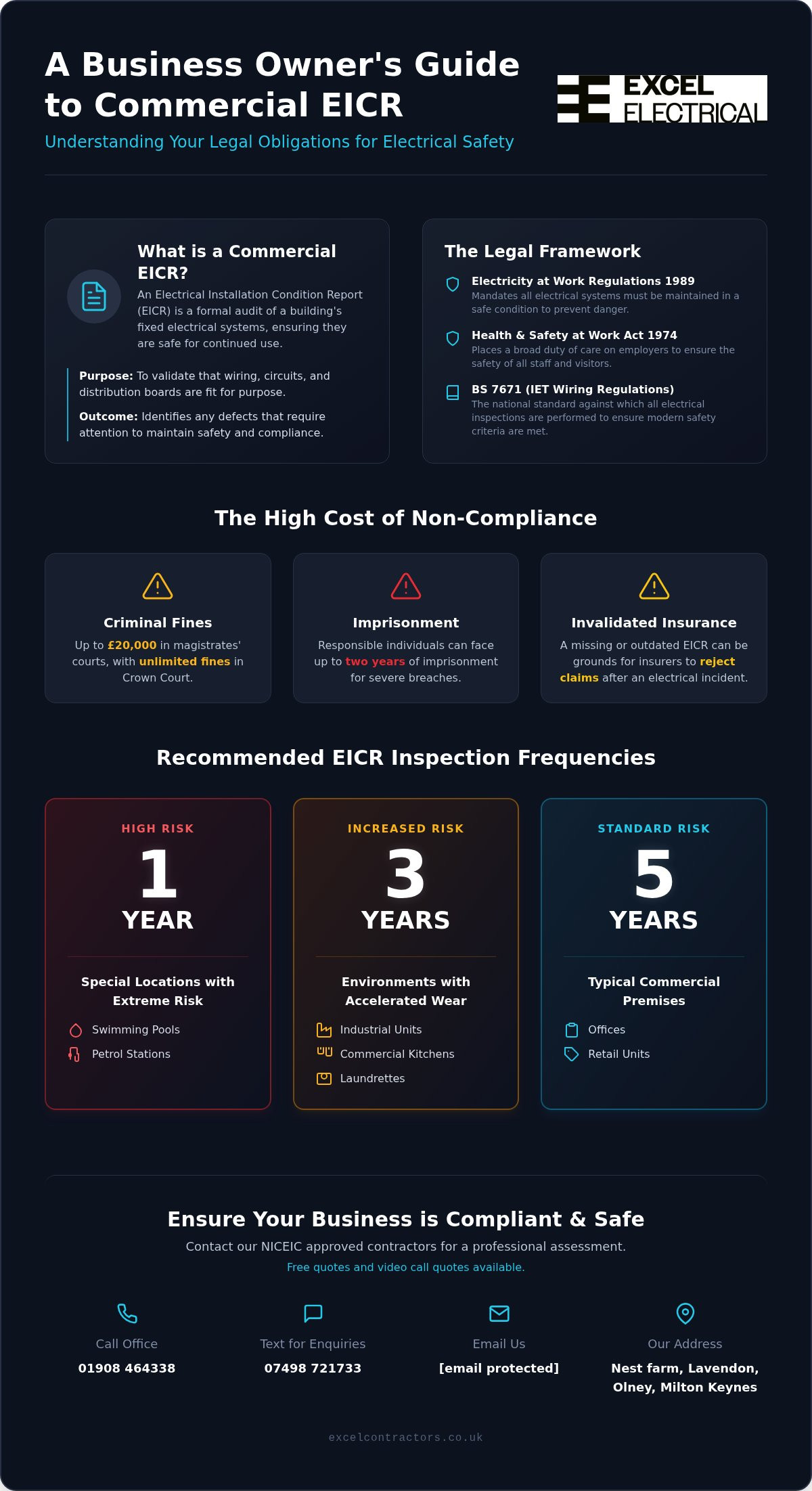
An Electrical Installation Condition Report (EICR) is a formal document produced following a comprehensive technical audit of a building's fixed electrical systems. In a commercial context, this report serves as a professional validation that your distribution boards, circuits, and wiring are safe for continued use. Unlike domestic settings, where rules are often perceived as less stringent, commercial EICR requirements are underpinned by statutory duties designed to prevent fire and injury in the workplace. A satisfactory report confirms that your infrastructure is fit for purpose, whilst an unsatisfactory one identifies specific defects that require urgent attention to maintain safety.
The primary legal framework governing these inspections is the Electricity at Work Regulations 1989. These regulations mandate that all electrical systems in a place of work must be maintained in a safe condition at all times to prevent danger. Whilst the law doesn't explicitly name the "EICR" as the only compliance document, it is the universally recognised method for demonstrating that you've met your legal duties. Furthermore, the Health and Safety at Work etc. Act 1974 places a broad duty of care on employers and property managers to ensure the safety of employees and visitors. Insurance providers also play a critical role; they frequently mandate a current EICR as a condition of coverage, meaning a missing report could lead to the rejection of a claim following an electrical incident.
Duty of Care for Employers and Property Managers
Regular testing is a vital safeguard that protects your staff from hidden dangers like circuit degradation or overheating. The legal consequences of neglecting these duties are severe. Breaches of the Electricity at Work Regulations 1989 are criminal offences. The Health and Safety Executive (HSE) can pursue fines of up to £20,000 in a magistrates' court, whilst Crown Court cases can result in unlimited fines and up to two years of imprisonment for responsible individuals. An EICR is the definitive legal mechanism required to prove that a business owner has taken all reasonable steps to ensure the electrical safety of their commercial premises.
The Role of BS 7671 (IET Wiring Regulations)
All inspections are carried out against the BS 7671 Wiring Regulations, which serves as the national standard for electrical installations. As of 15 April 2026, Amendment 4 (A4:2026) is the mandatory benchmark for all new assessments. This ensures your property is evaluated against modern safety criteria, rather than outdated standards from when the building was first wired. To ensure your documentation is legally robust and technically accurate, you must instruct an NICEIC approved contractor who is fully qualified to these current benchmarks.
At Excel Electrical, we specialise in these systematic audits from our base at Nest farm, Lavendon, Olney, Milton Keynes. If you're unsure about your current compliance status, call 01908 464338 or text 07498721733 to speak with our qualified team. We offer free quotes and video call quotes to help local firms manage their safety obligations with precision and transparency.
How Often Does a Commercial Property Require an EICR?
Establishing the correct testing interval is a core part of meeting your commercial EICR requirements. Whilst many business owners assume a standard five-year cycle applies to all buildings, the reality is more nuanced. The frequency of inspection is determined by the type of business you operate, the age of the installation, and the environmental conditions the wiring must endure. For typical office environments and retail units, a five-year interval is the standard recommendation to ensure the fixed wiring remains safe for continued use.
High-risk premises require more frequent oversight to manage the accelerated wear and tear on electrical systems. Industrial units, commercial kitchens, and laundrettes often require inspections every three years. These environments subject electrical components to heat, moisture, and mechanical vibration, all of which can compromise safety faster than in a quiet office. Furthermore, special locations like swimming pools or petrol stations demand annual inspections due to the extreme risks posed by water or flammable materials. You can find further details on equipment safety and broader duties in the official government guidance regarding electrical regulations.
Certain events can trigger the need for an EICR before your scheduled date. If you've recently changed the use of your building, or if the property has suffered environmental damage such as flooding, an immediate inspection is necessary. This ensures that any new loads placed on the system are supported and that the integrity of the wiring hasn't been compromised by external factors.
Determining the Frequency for Your Business Type
In sectors such as hospitality, healthcare, and education, the density of staff and visitors necessitates a rigorous approach to safety. Whilst the standard may be five years, a qualified engineer might recommend a shorter interval if the installation shows signs of significant age or previous poor maintenance. You must always check the "Date of Next Inspection" on your current certificate. This date is not merely a suggestion; it is the technical benchmark set by the inspector to ensure your business remains compliant with the Electricity at Work Regulations 1989.
Interim Inspections and Routine Maintenance
A full EICR shouldn't be the only time you consider your electrical safety. Annual routine visual checks are a vital part of a robust safety strategy. These inspections allow for the early detection of damaged sockets, loose cables, or signs of overheating before they lead to a system failure. Consistent electrical maintenance services help prevent the costly business disruption that often follows an "Unsatisfactory" EICR result.
If you're unsure when your last report was completed or need to book a professional survey, our team at Nest farm, Lavendon, Olney, Milton Keynes, is ready to assist. Call 01908 464338 or text 07498721733 to speak with a specialist. We offer free quotes and video call quotes to help you manage your compliance with precision and ease.
Landlord vs Tenant: Who is Responsible for Commercial Electrical Safety?
Determining who is responsible for meeting commercial EICR requirements often leads to confusion between landlords and tenants. Whilst residential settings have clear-cut rules for landlords, commercial arrangements are primarily dictated by the specific terms of the lease agreement. In many instances, the legal duty to ensure a safe working environment falls on the party in control of the premises, which is typically the tenant. This ensures that the person using the power is the one responsible for its safety.
Most commercial agreements are "Fully Repairing and Insuring" (FRI) leases. Under these terms, the tenant is responsible for the maintenance and repair of the entire building, including the fixed electrical installation. This means that arranging and paying for an EICR becomes the tenant's obligation. This duty is anchored in The Electricity at Work Regulations 1989, which requires that electrical systems are maintained to prevent danger to anyone working on the site. If the lease is silent on the matter, the duty usually remains with the employer using the space.
Landlords typically retain responsibility for communal areas, such as shared lobbies, stairwells, and external car park lighting. They also manage the main distribution boards that feed individual units. To avoid disputes or gaps in safety coverage, it's vital that the lease explicitly states which party is responsible for testing specific parts of the installation. Clear stipulations at the start of a tenancy prevent the fear of insurance being invalidated later due to missing documentation.
Navigating Repairing and Insuring Leases
Tenants who neglect their commercial EICR requirements under an FRI lease face significant risks. Beyond the potential for criminal prosecution, a lack of a valid certificate can lead to a breach of the lease contract, potentially resulting in eviction or significant financial claims at the end of the tenancy. Landlords should request copies of these reports annually. This proactive approach ensures their property assets remain compliant and satisfies their own building insurance conditions.
Local Considerations for Milton Keynes Business Parks
In business centres across Milton Keynes and Olney, lease structures can vary significantly between older industrial units and modern office blocks. Excel Contractors works closely with property managers and local firms to streamline the process of electrical testing, ensuring that all parties understand their specific obligations. Whether you are a tenant in a shared hub or a landlord managing a large estate, we provide the technical clarity needed for full compliance.
Based at Nest farm, Lavendon, Olney, Milton Keynes, our team is perfectly positioned to support businesses throughout the region. For expert advice on your lease obligations or to book an inspection, call 01908 464338 or text 07498721733. We offer free quotes and video call quotes to make your compliance journey as straightforward as possible. You can also reach us via email at [email protected].
The Commercial EICR Process: What to Expect During Testing
Adhering to commercial EICR requirements involves a methodical five-step technical investigation. This process is designed to uncover hidden defects that could lead to fire or electric shock. Our engineers follow a disciplined routine that prioritises accuracy and safety, ensuring your premises are assessed against the current BS 7671 standards. Understanding this process helps you prepare your team and manage any necessary circuit isolations with minimal fuss.
The inspection begins with a visual assessment. We examine cables, fixtures, and distribution boards for signs of thermal damage, wear, or poor installation. Once the visual check is complete, we move to dead testing. This requires us to isolate circuits to check continuity, insulation resistance, and polarity. Following this, live testing is conducted to verify that residual current devices (RCDs) trip within safe time limits and that earth fault loop impedance levels are correct. Finally, we classify any findings and issue a detailed report that outlines necessary remedial work to achieve a "Satisfactory" status.
Understanding Remedial Codes (C1, C2, C3)
If our engineers identify a fault, it is categorised using industry-standard codes. A C1 code indicates immediate danger, such as exposed live parts; we are duty-bound to make these safe before leaving the site. C2 codes represent potentially dangerous defects that require urgent attention. For commercial compliance, these must typically be rectified within 28 days to maintain your legal standing. C3 codes are recommendations for improvement. Whilst they do not result in an "Unsatisfactory" report, they highlight areas where your infrastructure could be upgraded to meet modern safety benchmarks.
Minimising Disruption to Your Daily Operations
We understand that closing your business for testing is not always feasible. Our team works with you to organise testing programmes that align with your operational needs, often scheduling work during quieter periods to avoid downtime. We also offer video call quotes to streamline the estimation process, providing a rapid and non-intrusive way to assess your requirements before we arrive on-site. This service is particularly beneficial for commercial clients in Bedford and Luton who need a steady hand to manage their compliance needs efficiently.
If you are ready to ensure your premises are safe, you can book your commercial inspection with our NICEIC approved team. For all enquiries, call 01908 464338 or text 07498721733. You can also visit us at Nest farm, Lavendon, Olney, Milton Keynes, or email [email protected]. We provide free quotes for all commercial electrical services and are committed to helping you maintain a safe environment for your employees and customers.
Ensuring Compliance with NICEIC Approved Contractors in Milton Keynes
Choosing the right partner to manage your commercial EICR requirements is as vital as the testing itself. In a regulatory landscape where non-compliance leads to criminal prosecution and invalidated insurance, you need a contractor with verifiable credentials. NICEIC Approved Contractor status is the gold standard for commercial electrical work in the UK. It provides business owners with the technical assurance that their electrical systems are being assessed by professionals who undergo regular, rigorous audits of their safety standards and workmanship.
TrustMark registration adds another layer of protection for business owners. This government-endorsed scheme ensures that contractors are committed to high standards of service and professional accountability. For firms in Milton Keynes and Northampton, selecting a TrustMark registered provider means your project is backed by a code of practice that prioritises safety over marketing fluff. Our team is fully qualified to the latest 18th Edition regulations, ensuring every report we issue is legally robust and meets the mandatory benchmarks required for modern commercial compliance.
Professional Standards and Peace of Mind
The auditing process for NICEIC contractors is incredibly thorough, covering everything from technical equipment calibration to the accuracy of completed certificates. Excel Contractors is the preferred choice for local developers like Abbey Mill Homes and numerous regional business centres because we maintain these high standards without compromise. Our office at Nest farm, Lavendon, Olney, Milton Keynes, serves as a dedicated hub for electrical safety across the region. We focus on building long-term client relationships through transparency and clear communication, providing the steady hand you need in a high-stakes industry.
Next Steps: Securing Your Commercial EICR
Securing your commercial EICR requirements shouldn't be a source of business anxiety. Contacting Brady Lewis and our team of specialists is the first step toward ensuring your premises are safe and your legal duties are fulfilled. We simplify the process by offering flexible scheduling that aligns with your operational needs. To discuss your specific requirements or to book your next inspection, call 01908 464338 or text 07498721733 to organise your free quote.
We actively promote the availability of free quotes and the option for video call quotes to streamline the estimation process. This approach allows us to provide an accurate cost assessment whilst reducing the need for initial site visits. For expert advice or to start your compliance journey, reach out to us at [email protected]. Our commitment to the Milton Keynes, Olney, and Northampton areas ensures that your business remains a safe environment for your employees and customers alike.
Securing Your Business with Professional Electrical Compliance
Maintaining your electrical infrastructure is a continuous commitment to safety and professional accountability. By understanding your specific commercial EICR requirements, you ensure that your premises remain compliant with the Electricity at Work Regulations 1989 and the latest BS 7671 standards. Whether you're a tenant managing a high-risk industrial unit or a landlord overseeing office blocks in Milton Keynes, systematic testing is the only definitive way to protect your staff and preserve your insurance coverage.
Our NICEIC Approved and TrustMark registered engineers provide the technical authority you need for total peace of mind. Based at Nest farm, Lavendon, Olney, Milton Keynes, our 18th Edition qualified team serves the entire surrounding region with precision and care. You can call 01908 464338 or text 07498721733 for enquiries. We provide free quotes and offer video call quotes to save you time and streamline the estimation process. Contact Excel Electrical for a free commercial EICR quote or email [email protected] today. Taking proactive steps now ensures your business remains a safe and stable environment for years to come.
Frequently Asked Questions
Is an EICR a legal requirement for a commercial property in the UK?
An EICR is the primary method for demonstrating compliance with the Electricity at Work Regulations 1989. Whilst the law doesn't explicitly name the report, it mandates that all electrical systems are maintained in a safe condition. Failing to produce a valid certificate during a Health and Safety Executive (HSE) inspection can lead to criminal prosecution. It is also a standard requirement for most commercial insurance policies to remain valid following an incident.
How much does a commercial EICR cost for a small office?
The cost of an inspection depends on the number of circuits and the technical complexity of your installation. We don't provide flat rates as every property has unique commercial EICR requirements based on its usage. For an accurate estimate, contact our office at Nest farm, Lavendon, Olney, Milton Keynes. You can call 01908 464338, text 07498721733, or email [email protected]. We offer free quotes and video call quotes for your convenience.
How long does a commercial electrical inspection take to complete?
Duration varies significantly based on the size and complexity of your premises. A small retail unit or office might take between four to six hours, whilst larger industrial facilities can require several days of systematic testing. Our engineers work methodically to minimise disruption to your daily operations. We can provide a specific timeline during your initial enquiry or once we have reviewed your previous reports and distribution board layouts during a consultation.
What happens if my business fails its EICR?
If your report is marked as "Unsatisfactory", it means our engineers identified C1 or C2 defects that pose an immediate or potential risk. You are legally required to address these issues to ensure the safety of your staff and visitors. Most insurers require remedial work to be completed within 28 days. Once the faults are rectified, we issue a separate certificate for the repairs, which proves your full compliance with national safety standards.
Does a commercial EICR cover PAT testing for appliances?
No, an EICR focuses solely on the fixed electrical installation, including cables, sockets, and distribution boards. Portable Appliance Testing (PAT) is a separate process that checks individual items like computers, kettles, and power tools. Whilst both are essential for workplace safety, they are distinct requirements. We recommend scheduling PAT testing alongside your fixed wire inspection to ensure every aspect of your electrical system is fully documented and safe for your employees to use.
Can I carry out commercial EICR testing myself if I am a maintenance manager?
You should only perform this testing if you are a "competent person" with the specific qualifications, calibrated equipment, and professional indemnity insurance required for commercial work. Most insurers and regulatory bodies specifically demand reports from NICEIC Approved Contractors to ensure the assessment is unbiased and technically accurate. Using a third party like Excel Contractors provides a level of professional accountability that internal staff often cannot match, ensuring your report is legally robust.
Will my electricity be turned off during the EICR testing?
Yes, brief power outages are necessary during the dead testing phase of the inspection. We must isolate circuits to safely check continuity and insulation resistance. Our engineers are experienced in managing these outages circuit by circuit to minimise impact on your business operations. We can also schedule testing during quieter periods or out of hours. Call 01908 464338 or text 07498721733 to discuss how we can tailor the testing schedule to your needs.
What is the difference between a domestic and commercial EICR?
The primary differences lie in the complexity of the installation and the frequency of testing. Commercial systems often involve three-phase power and more extensive distribution networks than domestic homes. Whilst domestic properties generally require testing every five years, commercial EICR requirements can vary between one and five years depending on the environment. Commercial reports also face higher scrutiny from insurers and the HSE, making technical precision and accredited contractor status even more critical for business owners.


