

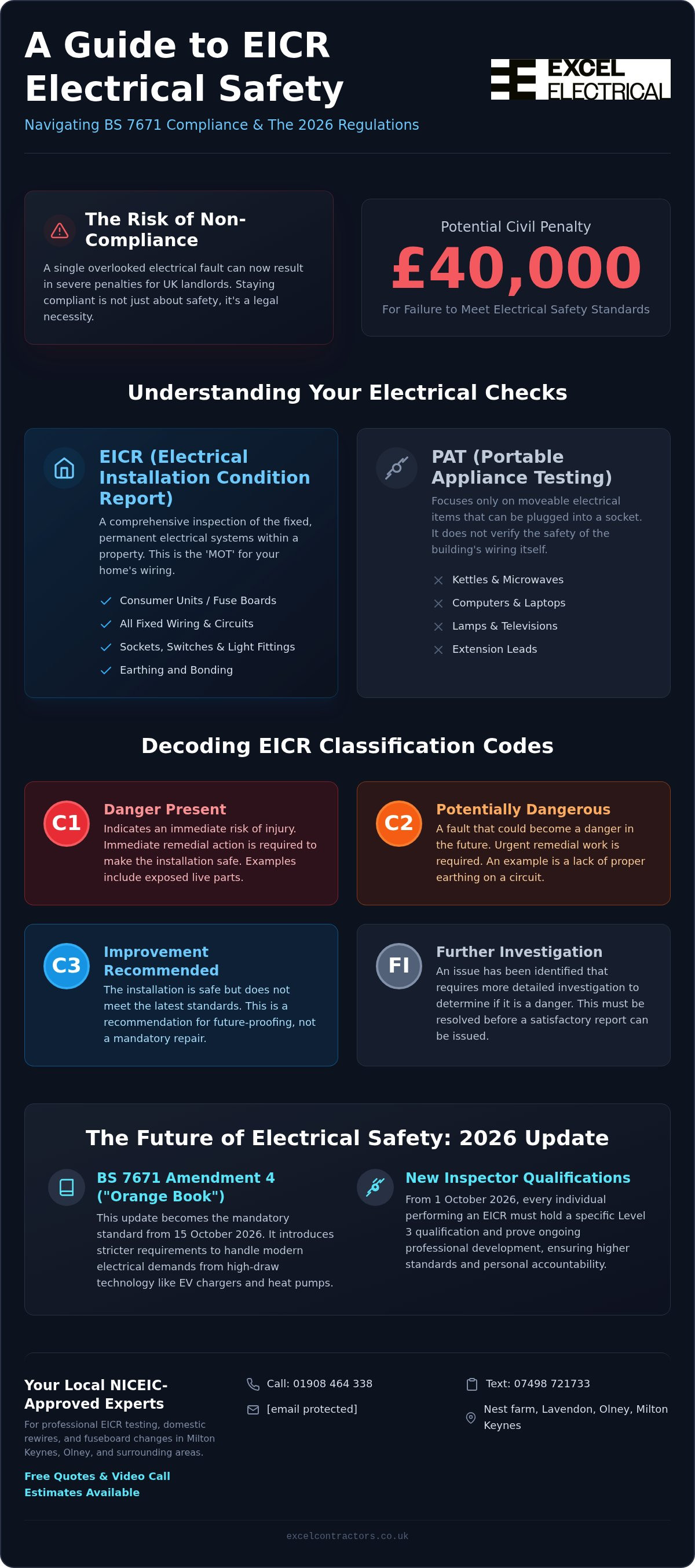
A single overlooked electrical fault could now result in a civil penalty of up to £40,000 for UK landlords. With the introduction of BS 7671 Amendment 4 and stricter individual qualification requirements starting in October 2026, staying compliant with EICR testing has never been more critical. It's understandable if you feel overwhelmed by technical jargon or anxious about the potential cost of remedial works. Most property owners simply want the peace of mind that comes with a 'Satisfactory' safety certificate without the fear of a contractor inventing unnecessary repairs.
We agree that keeping your property safe shouldn't be a source of constant stress or confusion. This guide provides a clear roadmap to help you navigate the latest safety standards and legal mandates. You'll discover exactly what the C1, C2, and C3 classification codes mean for your budget and how to identify a reliable NICEIC-approved professional in Milton Keynes. We'll also preview the transition to the new "Orange Book" regulations to ensure your property remains fully insured and legally protected throughout 2026 and beyond.
Key Takeaways
- Learn how a formalised assessment identifies hidden fire hazards and ensures your property meets the latest safety standards.
- Understand the critical difference between C1, C2, and C3 classification codes to prioritise necessary repairs effectively.
- Stay compliant with legal mandates by understanding the required frequency for EICR testing for both rental properties and private homes.
- Use our preparation checklist to streamline the inspection process and ensure the contractor has the access needed for a thorough report.
- Discover the benefits of partnering with a TrustMark-registered expert in Milton Keynes to achieve a 'Satisfactory' safety rating.
Understanding EICR Testing: The Gold Standard for Electrical Safety in 2026
An Electrical Installation Condition Report (EICR) is a formalised assessment of your property's fixed electrical infrastructure. In 2026, The Gold Standard for Electrical Safety is defined by strict adherence to the BS 7671 Amendment 4 regulations. This update, known as the "Orange Book", became the mandatory standard on 15 October 2026. Excel Electrical provides these specialised reports across Olney, Milton Keynes, and Newport Pagnell, ensuring local homes remain compliant and safe.
The safety landscape changed significantly on 1 October 2026. Every individual carrying out an EICR must now hold a specific Level 3 qualification and provide evidence of ongoing professional development. This shift ensures that the person testing your home is personally accountable for the report's accuracy. EICR testing is more vital than ever because modern domestic power demands have reached record levels. High-draw technologies like EV chargers and air-source heat pumps place immense strain on circuits that were often designed decades ago. A professional report identifies critical risks such as overloaded circuits and lack of earthing before they become dangerous.
What Exactly is an 'Electrical Installation'?
The 'electrical installation' refers to the permanent components of your property's system. This includes the consumer unit or fuse board, all fixed wiring, and socket-outlets. It also encompasses lighting circuits and permanent fixtures such as electric showers. In many older Milton Keynes properties, hidden wiring within wall cavities or under floorboards requires meticulous inspection. These ageing systems often lack modern safety features, which can lead to fire hazards if left unchecked. Our team at Excel Electrical focuses on these hidden elements to ensure your property's "bones" are structurally sound and capable of handling modern electrical loads.
The Difference Between EICR and PAT Testing
Confusion often arises between EICR testing and Portable Appliance Testing (PAT). An EICR focuses on the building's fixed wiring. It examines the components that stay with the property. Conversely, PAT testing is strictly for portable items like kettles, laptops, and lamps. Relying on PAT testing alone leaves your property's core infrastructure unverified. This is a dangerous oversight. A safe toaster won't prevent an electrical fire if the socket it's plugged into is connected to faulty, overloaded fixed wiring. Understanding this distinction is the first step toward achieving a truly safe living environment and avoiding the risks associated with unverified electrical systems.
Decoding the EICR Report: Understanding Classification Codes and Safety Risks
Receiving the final document after EICR testing is only the first step in ensuring your property's safety. The true value of the report lies in the classification codes assigned to each observation. These codes determine whether your electrical installation is legally compliant or if it poses a risk to life and property. At Excel Electrical, we believe in transparency; we provide a clear, jargon-free summary with every report to ensure property owners in Olney and Milton Keynes understand exactly what's required to maintain a safe environment.
The Four Critical EICR Codes Explained
The inspector uses four specific codes to categorise the severity of any faults found during the assessment. Understanding these is essential for prioritising repairs and managing your maintenance budget effectively.
- C1 (Danger Present): This is the most severe classification. It indicates an immediate risk of injury or fire, such as exposed live parts. Immediate action is required to make the installation safe.
- C2 (Potentially Dangerous): While not an immediate threat, these faults could become dangerous if a further fault were to occur. An example would be a lack of earthing on a circuit. These require urgent remedial work.
- C3 (Improvement Recommended): This code often causes confusion. It means the installation is safe for continued use but doesn't meet the latest standards, such as the BS 7671 Amendment 4 requirements. It's a suggestion for future-proofing rather than a mandate for immediate repair.
- FI (Further Investigation): This is used when an inspector identifies an issue that cannot be confirmed as safe without more intrusive testing. It must be resolved before a final result can be determined.
What Makes a Report 'Satisfactory'?
A report is deemed 'Satisfactory' only if there are no C1, C2, or FI codes present. If any of these appear, the report is automatically 'Unsatisfactory', and the property is not compliant with safety regulations. For landlords, this is a critical distinction; you must provide a copy of the report to your tenants within 28 days, and any 'Unsatisfactory' results must be addressed promptly to avoid heavy penalties. For those managing rental properties, following an Inspection Prep: A Guide can help you understand these requirements from a regulatory perspective.
It's important to note that a C3 code does not prevent a 'Satisfactory' result. Many older homes in Buckinghamshire receive C3 recommendations because they were built to previous standards. Whilst these don't require immediate action, they highlight areas where safety could be enhanced. If your report highlights urgent faults, our team can provide a free quote for remedial works to bring your installation back to a safe standard efficiently and professionally.
Legal Requirements and Frequency: How Often Do You Need EICR Testing?
Electrical safety is a legal obligation for many and a vital safety precaution for all. The frequency of EICR testing depends largely on the property's use and its tenancy status. Whilst the primary goal is occupant safety, a valid report is also a critical document for insurance compliance across Bedford, Luton, and the wider Buckinghamshire area. Many insurance providers now stipulate that a 'Satisfactory' certificate must be in place to maintain coverage, particularly in the event of fire-related claims.
EICR for Landlords: The 2026 Compliance Landscape
Landlords in England are legally mandated to conduct an inspection at least every five years. The regulatory environment has tightened significantly for 2026. For social housing tenancies granted before 1 December 2025, the regulations came into full force on 1 May 2026. Landlords must ensure all electrical installations are tested before the 1 November 2026 deadline. Failure to comply is no longer a minor oversight; the maximum civil penalty for breaches has risen to £40,000 per instance. To help you stay ahead of these requirements, we have compiled a resource on Common EICR Failures in Rental Properties: A 2026 Landlord Guide. Providing a copy of the report to tenants within 28 days is a strict requirement that Excel Electrical helps you manage through our methodical reporting system.
Homeowners and the 'Change of Occupancy' Rule
If you own and live in your home, the general recommendation is to arrange EICR testing every ten years. However, this interval should be shortened if your property is older or if you notice signs of electrical wear. We strongly advise requesting a fresh report before purchasing a new home in Milton Keynes. Relying on an outdated certificate can lead to expensive surprises, such as the need for a full rewire or a consumer unit upgrade shortly after moving in. A recent report facilitates a smoother property sale by proving to buyers and solicitors that the installation meets modern 18th Edition standards. This transparency builds trust and protects your investment.
Commercial premises face even more varied requirements. Depending on the nature of the business and the level of public access, testing may be required every one to five years. If you are unsure about the specific mandates for your property type, our team at Nest farm, Lavendon, Olney, Milton Keynes can provide expert guidance. We offer free quotes and can even conduct video call quotes to streamline the estimation process for busy property managers. For enquiries, call 01908 464 338 or text 07498721733 to speak with a qualified professional. You can also reach us via email at [email protected].
Inspection Prep: A Guide for Homeowners and Landlords
Preparing for your property's EICR testing doesn't need to be a source of stress. A few simple steps can significantly reduce the time our engineers spend on-site and minimise disruption to your daily routine. We understand that residents in Northampton and Milton Keynes value efficiency and transparency. That's why Excel Electrical offers video call quotes to help you prepare. This initial digital walkthrough allows us to identify potential access issues before we arrive at your door, ensuring a smoother site visit for everyone involved.
The Day of the Inspection: What Happens?
The process begins with a thorough visual inspection of all visible electrical components, including the consumer unit, switches, and sockets. We look for signs of wear, overheating, or damage. Following this, we perform 'dead testing'. This involves disconnecting the power to check the integrity of the insulation and the continuity of the earthing. Finally, 'live testing' ensures that safety devices like RCDs trip within the required timeframes. Whilst your power will be off for certain periods, we aim to work methodically to keep these outages as brief as possible. Our goal is to provide a comprehensive safety assessment with minimal impact on your day.
Checklist for a Smooth EICR Visit
Access is the most critical factor for a successful report. If an engineer cannot reach a socket or the consumer unit, they cannot verify its safety. Ensuring the following steps are taken before we arrive will help guarantee the EICR testing is thorough and accurate:
- Clear all items from around the consumer unit (fuse board) to allow full access for the engineer.
- Ensure all rooms are accessible and that sockets aren't blocked by heavy furniture or stored boxes.
- Unplug sensitive electronic equipment, such as desktop computers, servers, or high-end audio gear, to protect them from testing surges.
- Identify and inform the engineer of any known 'quirks' or previous electrical issues you've experienced in the property.
If you're ready to book your assessment or have questions about the preparation process, request a free quote today. Our team at Nest farm, Lavendon, Olney, Milton Keynes is here to ensure your property meets the highest safety standards. For enquiries, call 01908 464 338 or text 07498721733. You can also reach us at 01908 464338 or via email at [email protected].
Why Professional EICR Testing from Excel Electrical is the Right Choice
Choosing the right contractor for your EICR testing is as important as the assessment itself. Many property owners worry about finding a professional who is technically competent and locally accountable. Excel Electrical is an Olney-based business built on a foundation of integrity and professional excellence. As an NICEIC Approved Contractor and TrustMark registered business, we adhere to the highest national safety standards. Our electricians are fully qualified to the latest 18th Edition regulations, specialising in domestic safety and compliance across Milton Keynes and the surrounding areas.
Beyond the Report: Our Remedial and Maintenance Services
A common frustration with electrical assessments is the gap between receiving an 'Unsatisfactory' report and finding a reliable professional to fix the faults. We close that gap by providing a seamless transition from the initial inspection to any necessary remedial works. Whether your property requires a fuseboard change or a full rewire to meet modern safety mandates, our team handles the process with precision. We don't just point out problems; we provide the solutions that lead to a 'Satisfactory' result. For a deeper look at our systematic approach, you can read The Essential Guide to Electrical Testing: Ensuring Safety and Compliance.
The Excel Electrical Brand Promise
Our brand persona is that of a reliable partner. We take a serious, methodical approach to every project, ensuring that safety is never compromised for the sake of speed. We serve homeowners and landlords in Milton Keynes, Olney, Newport Pagnell, and throughout Buckinghamshire. Transparency is at the core of our operations. We provide free, detailed quotes with no hidden financial surprises, allowing you to plan your property maintenance with confidence. We also offer video call quotes to streamline the estimation process, saving you time whilst maintaining our high standards of accuracy.
If you require professional EICR testing or any domestic electrical services, we invite you to contact us directly. You can find us at Nest farm, Lavendon, Olney, Milton Keynes. For enquiries or to arrange a free quote, call 01908 464 338 or text 07498721733. Our office team is also available at 01908 464338 or via email at [email protected]. Let us help you secure the peace of mind that comes with a professionally verified electrical installation.
Securing Your Property's Electrical Future in 2026
Maintaining electrical safety is a continuous responsibility that demands technical precision and strict adherence to the latest regulations. By understanding the severity of classification codes and the specific requirements of the BS 7671 Amendment 4, you can protect both your occupants and your property's value. Whether you are a landlord managing a rental portfolio or a homeowner in Milton Keynes, staying ahead of EICR testing ensures you remain compliant with insurance mandates and legal safety standards.
Excel Electrical provides the expert oversight needed to navigate these high-stakes requirements. As NICEIC Approved and TrustMark Registered contractors, our 18th Edition qualified electricians deliver meticulous inspections and reliable remedial works. For a professional EICR testing quote in Milton Keynes, call us on 01908 464338 or text 07498721733 today. We actively promote the availability of free quotes and video call estimations to streamline your safety assessment. You can also reach our team at [email protected] or visit us at Nest farm, Lavendon, Olney, Milton Keynes. Taking proactive steps today guarantees a safer living environment for the future.
Frequently Asked Questions
Is EICR testing a legal requirement for homeowners in 2026?
No, EICR testing is not a legal mandate for private homeowners in 2026, but it remains a critical safety recommendation. Most industry experts advise an inspection every ten years to identify hidden wear and tear. You may also find that a valid certificate is required by your insurance provider to maintain cover or by a mortgage lender during a property sale.
Can I fail an EICR and what happens if I do?
Yes, a property is considered to have "failed" if the report is deemed 'Unsatisfactory' due to the presence of C1 or C2 classification codes. If this occurs, you must arrange for urgent remedial works to address the identified hazards. Once these repairs are completed, a new certificate or an Electrical Installation Certificate (EIC) is issued to confirm the installation is safe.
How much does EICR testing cost for a standard 3-bedroom house?
The cost of an inspection is determined by the size of your property and the complexity of its electrical system. Factors such as the number of circuits, the age of the installation, and the ease of access to the consumer unit all influence the final estimation. We provide free, transparent quotes and offer video call estimations to ensure you receive an accurate price for your specific needs.
What happens if a landlord does not have a valid EICR certificate?
Landlords who fail to comply with safety regulations face severe legal consequences, including civil penalties of up to £40,000 per breach. You cannot legally move new tenants into a property without a 'Satisfactory' report, and failing to provide one to existing tenants within 28 days is a violation of the law. It also leaves you personally liable for any electrical injuries on the premises.
How long does a typical EICR inspection take to complete?
A standard domestic inspection usually takes between two and four hours to complete. This timeframe depends on the size of the property and how many circuits need to be tested and verified. We work methodically to minimise disruption to your home, but ensuring clear access to all sockets and the consumer unit beforehand will help the engineer complete the work more efficiently.
What is the difference between an EICR and a Landlord Electrical Safety Certificate?
There is no difference between the two; they are the same document. An Electrical Installation Condition Report (EICR) is the formal technical name for the assessment, whilst "Landlord Electrical Safety Certificate" is a common term used in the rental industry. Both refer to the official report that verifies the safety and compliance of a property's fixed wiring and electrical infrastructure.
Can I carry out my own EICR if I am competent at DIY?
No, you cannot perform your own inspection. From 1 October 2026, every individual carrying out EICR testing must hold a specific Level 3 qualification and have documented experience. Only a registered, NICEIC-approved professional has the technical expertise and calibrated testing equipment required to issue a legally recognised safety certificate that complies with national regulations.
What are the most common reasons for a property failing an EICR?
Properties often fail due to a lack of RCD protection on circuits or inadequate earthing. Other frequent causes include damaged wiring, overloaded circuits, and DIY electrical work that doesn't meet safety standards. Identifying these risks through EICR testing is essential for preventing electrical fires and ensuring your home remains compliant with the latest 18th Edition regulations.


