

With the maximum penalty for non-compliance now reaching £40,000, the margin for error in electrical safety has effectively vanished. Many landlords find that a property previously deemed safe may now fall short due to the rigorous standards of the 18th Edition Amendment 4. Identifying the common EICR failures in rental properties is the first step in moving from regulatory confusion to total legal protection.
It's understandable to feel concerned about the potential costs of remedial works or the complexity of the November 2026 regulatory updates. You need a professional perspective to cut through the jargon and provide clear, actionable advice. This guide will help you master the most frequent electrical safety failures to ensure your rental property remains compliant, safe, and legally protected. We'll examine the most critical areas of concern, from outdated consumer units to inadequate RCD protection, giving you a clear understanding of how to achieve a "Satisfactory" report whilst managing your maintenance budget effectively.
Key Takeaways
- Understand why a "Satisfactory" result is the only legal standard for the mandatory five-year inspection cycle under 2026 regulations.
- Identify common EICR failures in rental properties, such as missing RCD protection or outdated fuseboards, to address issues before they lead to heavy fines.
- Learn to decode EICR failure codes, specifically why a C1 or C2 result immediately triggers an "Unsatisfactory" report and requires urgent action.
- Discover how recent updates to the 18th Edition can turn previously acceptable electrical installations into modern safety risks.
- Streamline your compliance process by using video call quotes for rapid, cost-effective remedial work estimates from qualified professionals.
The Landlord Electrical Safety Certificate: Legal Requirements in 2026
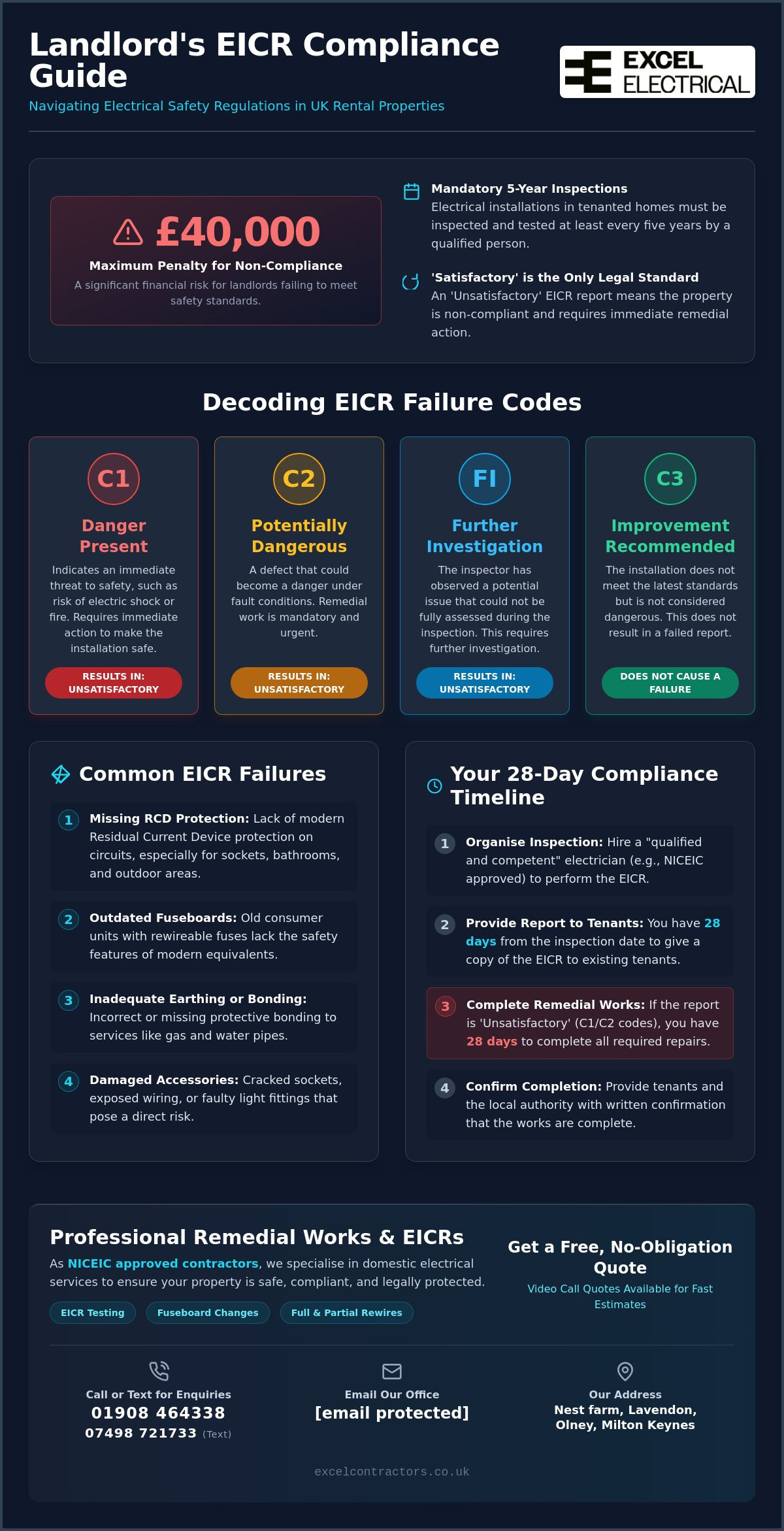
The Electrical Safety Standards in the Private Rented Sector (England) Regulations 2020 govern the safety of all tenanted homes. These regulations mandate that electrical installations are inspected and tested at least every five years. By 2026, the enforcement landscape has become considerably more stringent. The maximum penalty for non-compliance was increased to £40,000 on 1 November 2025, leaving no room for administrative oversight or safety lapses.
Securing a "Satisfactory" outcome is the only way to fulfil your legal obligations. A report marked as "Unsatisfactory" means the installation is unsafe for continued use. Identifying common EICR failures in rental properties early allows you to address risks before they escalate into legal or financial liabilities. The standards used for these inspections are based on the UK electrical wiring standards, specifically BS 7671. With the transition to Amendment 4 (BS 7671:2018+A4:2026) concluding in October 2026, staying ahead of these technical changes is vital for property safety. The introduction of the 2026 amendment regulations, expected to take full effect on 30 November 2026, further clarifies the benchmarks required for re-letting properties.
Who Can Legally Carry Out an EICR?
The law states that a "qualified and competent" person must perform the inspection. This is a specific legal definition that requires more than basic electrical knowledge. It demands a thorough understanding of the latest wiring regulations and the testing procedures required to verify them. Choosing an NICEIC approved contractor is the most reliable way to ensure your inspector meets these criteria. At Excel Electrical, based at Nest farm, Lavendon, Olney, Milton Keynes, we provide the technical expertise needed to produce a legally robust report. This accreditation is often essential for maintaining the validity of your landlord insurance policy. Without it, your report might be challenged by local authorities or insurers in the event of a claim.
Your Responsibilities as a Landlord
Your duties don't end once the electrician leaves the site. You must provide a copy of the EICR to your existing tenants within 28 days of the inspection date. For new tenancies, the report must be handed over before the tenant moves in. If common EICR failures in rental properties are found, you have exactly 28 days to complete the mandatory remedial works. Failure to meet these deadlines can trigger local authority intervention and the aforementioned fines. For clear advice or a free quote, you can call 01908 464338 or text 07498721733. We also offer video call quotes to help you understand any required repairs without delay. You can also reach our team at [email protected] to organise your next inspection and ensure your records are kept up to date for the duration of every tenancy.
Decoding EICR Failure Codes: C1, C2, and FI Explained
When you receive your EICR, the overall assessment will be either 'Satisfactory' or 'Unsatisfactory'. This result is determined by the observation codes assigned to various parts of your electrical system. Understanding these codes is essential for any landlord, as they dictate the urgency of repairs and your legal standing. The official The Landlord Electrical Safety Certificate: Legal Requirements guidance makes it clear that any report containing C1 or C2 codes is automatically unsatisfactory.
A C1 code indicates immediate danger; it signifies that a risk of electric shock or fire is present now. This is the most severe classification. The inspector is required to take immediate action to make the area safe, which often involves isolating the dangerous circuit. A C2 code is defined as 'potentially dangerous'. Whilst it may not pose an instant threat, it could become dangerous under fault conditions. Both classifications are common EICR failures in rental properties that require mandatory remedial action. Conversely, a C3 code means 'Improvement Recommended'. It doesn't cause a failure, but it identifies areas where the installation doesn't meet the latest 18th Edition standards.
The Consequences of a C1 or C2 Classification
Receiving a C1 or C2 code triggers a strict 28-day window for remedial works. Ignoring these codes is a direct breach of your statutory duty as a landlord. Beyond the risk of local authority fines, an 'Unsatisfactory' report can invalidate your property insurance. If an electrical fire occurs and you haven't addressed a known C2 fault, your insurer is likely to reject the claim. If you've received a report with these codes, our team can help you prioritise the necessary remedial works to restore compliance and peace of mind.
Understanding the FI (Further Investigation) Code
The FI code is often a source of frustration for landlords. It's issued when an inspector cannot complete a full assessment of a circuit, perhaps due to a locked basement or a hidden junction box. An FI code prevents a 'Satisfactory' result because the inspector cannot guarantee the installation's safety. To avoid this, ensure your electrician has access to every room and all consumer units. It's worth noting that for inspections completed after 30 November 2026, draft regulations suggest the FI code will be removed to ensure reports are more definitive. Until then, any FI items must be investigated and resolved before a final certificate can be issued. Preparation is key; clearing cupboards that house fuseboards and providing all keys will prevent these avoidable delays.
The Most Common EICR Failures in Rental Properties
Many landlords are surprised when a property that has "never had an issue" fails its inspection. However, safety standards evolve to address modern electrical loads and the increased use of sensitive electronic equipment. According to industry data on common EICR failures, the majority of "Unsatisfactory" results stem from a handful of recurring technical issues. Identifying these common EICR failures in rental properties early can save significant time and money during the remedial phase. Our team at Excel Electrical, based in Olney, Milton Keynes, regularly encounters these issues across domestic properties, and most can be resolved with systematic maintenance.
Consumer Unit and RCD Deficiencies
Old-style rewireable fuses, often found in older "Wylex" boards, are frequently flagged as C2 failures in 2026 if they lack adequate RCD protection. Under the 18th Edition, almost all domestic circuits require Residual Current Device (RCD) protection to prevent fatal electric shocks. If your consumer unit has a wooden back or is made of plastic and situated in a high-risk area, such as a primary escape route, it may no longer meet safety requirements. A consumer unit upgrade is often the most cost-effective way to bring an entire property up to modern standards. This ensures that every circuit is protected by a modern circuit breaker, providing peace of mind for both you and your tenants.
Earthing and Bonding Issues
Earthing and main protective bonding form the backbone of your property's safety system. Earthing ensures that a fault current has a safe path to the ground, whilst bonding connects your electrical system to incoming metal gas and water pipes. A very frequent C2 failure is the absence of 10mm bonding cables. You can often identify these by looking for a green and yellow wire clamped to the pipes near your boiler or water meter. If these cables are missing or undersized, the property is at a higher risk of metalwork becoming "live" during an electrical fault. This is one of the common EICR failures in rental properties that must be addressed to secure a "Satisfactory" report.
Bathroom Electrical Safety
Bathrooms are high-risk zones due to the presence of water, which significantly increases the risk of electric shock. Inspectors check for correct Ingress Protection (IP) ratings on all light fittings and extractor fans within specific zones. Standard pendant lights or non-IP-rated downlights in these areas will result in an automatic failure. We also pay close attention to electric showers, as these high-load devices often show signs of scorched terminals or undersized wiring. Ceiling-mounted pull-cords remain the safest and most compliant choice for switching lights in these environments. If you are unsure about your property's status, our team at Nest farm, Lavendon, can provide a clear assessment through a video call quote to streamline the estimation process.
Why Properties Fail Renewals and How to Prepare
It's a common misconception amongst landlords that a property passed in 2021 will automatically pass again in 2026. Electrical safety standards are not static. As technology and our understanding of electrical risks evolve, so do the regulations that govern them. This shift often means that an item previously marked as a C3 (Improvement Recommended) might now be reclassified as a C2 (Potentially Dangerous) under the latest 18th Edition standards. Understanding these common EICR failures in rental properties helps you anticipate these shifts before the inspector arrives.
Beyond regulation changes, the physical condition of a rental property changes over time. High tenant turnover often accelerates the degradation of electrical accessories. Loose socket outlets, cracked light switches, and even unauthorised DIY work by tenants can all lead to an "Unsatisfactory" result. Tenants may sometimes attempt to add extra sockets or change light fittings themselves, often without the necessary technical knowledge, creating hidden hazards that only a professional inspection will uncover.
The Impact of the 18th Edition Amendment 3 and 4
The transition to the latest wiring regulations has introduced a stronger focus on modern safety components. Surge Protection Devices (SPDs) are now a major discussion point. Whilst they were once optional, they're now frequently required to protect the installation and sensitive electronic equipment from overvoltages. Professional electrical testing is the only way to determine if your property's current configuration meets these updated safety benchmarks. If your property hasn't been upgraded since the previous inspection cycle, it's highly likely that some remedial work will be necessary to achieve compliance.
A Landlord’s Pre-EICR Checklist
You can reduce the likelihood of avoidable failures by performing a simple visual check before your scheduled inspection. Ensure that all light fittings have their covers in place and that no bare bulbs or exposed wires are visible. Check every socket and switch for signs of cracking or thermal damage, such as brown scorch marks. It's also vital to ensure the consumer unit is easily accessible. If it's buried behind tenant belongings in a cupboard, the inspector may be forced to issue an FI code, delaying your certification.
If you're concerned about your upcoming renewal, you can book a domestic electrical assessment with our expert team. Excel Electrical is based at Nest farm, Lavendon, Olney, Milton Keynes, and we specialise in helping landlords maintain safe, compliant homes. For enquiries or to arrange a free video call quote, call 01908 464338 or text 07498721733. You can also reach us via email at [email protected] to discuss your specific property needs.
Professional Remedial Works: Ensuring Your Property is Compliant
Receiving an "Unsatisfactory" report is a challenge, but it is a manageable one. At Excel Electrical, we specialise in transforming these reports into a clear, transparent plan of action. We focus on the high-priority items first, ensuring that any C1 or C2 codes are resolved within the mandatory 28-day window. This systematic approach allows you to address common EICR failures in rental properties without unnecessary delays or escalating costs. Once the remedial work is complete, we provide the essential Electrical Installation Certificate (EIC) or Minor Electrical Installation Works Certificate. This documentation is your legal proof that the property has been brought up to the required safety standards and is safe for continued use.
One of the biggest hurdles for landlords is the time taken to get a repair estimate. We have removed this barrier by offering video call quotes. Instead of waiting for an extra site visit, you can show us the issues via a video call, and we can provide an accurate estimate for the repairs. This streamlined process is particularly effective for addressing the common EICR failures in rental properties identified in your initial report, such as fuseboard upgrades or bathroom lighting corrections. It allows you to move quickly from a failure to a "Satisfactory" status, ensuring your tenants remain safe and your legal obligations are met.
Why Choose Excel Electrical in Milton Keynes and Olney?
Our status as an NICEIC Approved Contractor and TrustMark registered firm provides the assurance that all work meets the highest industry standards. Based at Nest farm, Lavendon, Olney, Milton Keynes, we have deep local expertise across Newport Pagnell, Bedford, and Northampton. We understand the specific needs of domestic landlords and are fully qualified to the latest 18th Edition standards. Our focus is on providing a high-end, reliable service that prioritises long-term safety over quick, temporary fixes. You can trust our team to handle everything from minor socket repairs to full property rewires with the same level of professional competence.
Booking Your Remedial Work and Next Steps
To begin the process, simply send us a copy of your "Unsatisfactory" report. We will review the findings and arrange a video call to discuss the remedial priorities. Our team is available to provide free quotes and guide you through every step of the compliance journey. Once the work is finished, we will issue your final Landlord Electrical Safety Certificate, which you must then provide to your tenants and, if requested, the local authority. For enquiries, call 01908 464338 or text 07498721733. You can also reach us at [email protected] to organise your remedial works and ensure your rental property remains a safe and legally protected investment.
Securing Your Property's Electrical Compliance
Ensuring your rental property meets the latest safety standards is a legal necessity that requires professional oversight. By understanding the common EICR failures in rental properties, such as missing RCD protection and outdated consumer units, you can proactively manage your maintenance schedule. The transition to the 18th Edition Amendment 4 means that previous "Satisfactory" results may no longer hold up under current scrutiny. Addressing C1 and C2 faults within the mandatory 28-day window is the only way to avoid the increased £40,000 penalties and keep your insurance valid.
As an NICEIC Approved Contractor and TrustMark registered firm, Excel Electrical provides the technical authority you need for total peace of mind. We offer free quotes and convenient video call estimates to help you plan your remedial works efficiently. Don't leave your compliance to chance. Book your EICR or request a free video quote today to ensure your property remains safe for 2026 and beyond. For enquiries, please call 01908 464 338 or text 07498721733. You can also contact us at [email protected] or visit our office at Nest farm, Lavendon, Olney, Milton Keynes.
Frequently Asked Questions
How long does a landlord electrical safety certificate last?
A landlord electrical safety certificate, or EICR, is valid for a maximum of five years from the date of the inspection. However, your inspector may recommend a shorter interval if the installation is particularly old or shows signs of rapid deterioration. You must ensure a new inspection is carried out before the current certificate expires to remain compliant with the 2020 regulations.
What happens if my rental property fails its EICR?
If your property fails its EICR, you will receive an "Unsatisfactory" report detailing the necessary remedial works. You are legally required to address any C1 (Danger Present) or C2 (Potentially Dangerous) issues within 28 days of the inspection. Once the work is completed by a qualified person, you must provide written confirmation of the repairs to your tenants and the local authority if they request it.
Can I carry out the remedial works myself to save money?
No, remedial works must be carried out by a qualified and competent person to ensure they meet BS 7671 standards. Attempting DIY repairs can lead to common EICR failures in rental properties during the next inspection and may invalidate your landlord insurance. For your safety and legal protection, always use an NICEIC approved contractor to perform repairs and issue the required certification.
How much does an EICR cost for a typical 3-bedroom rental property?
The cost of an EICR depends on the size of your property and the complexity of its electrical system. Rather than relying on generic industry averages, we recommend contacting our team at Nest farm, Lavendon, Olney, Milton Keynes. You can call 01908 464338 or email [email protected] for a free quote. We also offer video call quotes to provide a fast and accurate estimate for your specific 3-bedroom rental.
Do I need an EICR if my property is a new build?
You do not typically need a separate EICR for the first five years of a new build property. The Electrical Installation Certificate (EIC) issued upon completion of the build serves as your proof of compliance for this initial period. You must keep a copy of this certificate and provide it to your tenants. You should then arrange for your first EICR once that five-year window has closed.
What is the difference between a PAT test and an EICR?
A PAT test covers portable appliances like kettles or toasters, whereas an EICR assesses the fixed electrical installation of the building. The EICR checks the "skeleton" of the property, including the consumer unit, wiring, and socket outlets. Whilst PAT testing is highly recommended for furnished rentals, the EICR is a mandatory legal requirement under the Private Rented Sector regulations.
Will the electrician turn off the power during the inspection?
Yes, the power will need to be turned off for several short periods during the inspection and testing process. This is necessary to perform "dead testing," which ensures the integrity of the wiring and the effectiveness of safety components. Most inspections take between two to four hours. It's helpful to notify your tenants in advance to minimise disruption to their daily routine.
Is an RCD required on every circuit for a pass in 2026?
Under the current 18th Edition Amendment 4, RCD protection is generally required on all domestic circuits to ensure a "Satisfactory" result. A missing RCD is one of the most common EICR failures in rental properties because it is a vital safeguard against electric shock. If your property lacks this modern protection, you can text 07498721733 to discuss a consumer unit upgrade with our qualified team at Excel Electrical.


