

Imagine standing on a fresh plot of land in Milton Keynes, holding plans for a home that must meet the most stringent energy and safety standards the UK has ever seen. The transition to the mandatory BS 7671:2018+A4:2026 "Orange Book" standards, combined with new requirements for integrated EV charging, has made the planning of an electrical installation for new builds more complex than ever before. It's natural to feel concerned about strict compliance or the risk of choosing an uncertified contractor for such a high-stakes infrastructure project.
We understand that true peace of mind comes from knowing your property is in the hands of a disciplined, methodical professional. This guide provides a definitive roadmap for 2026, detailing the regulations and project stages required for a safe, future-proof system. We'll examine the critical path from initial design to the final certification that protects your investment. For technical enquiries, reach out to Excel Electrical at Nest farm, Lavendon, Olney, Milton Keynes. You can call 01908 464338, text 07498721733, or email [email protected]. We offer free quotes and video call estimations to ensure your project begins with professional clarity and technical accuracy.
Key Takeaways
- Understand the full project timeline of an electrical installation for new builds, ensuring seamless coordination between your contractor and the District Network Operator (DNO).
- Recognise the legal necessity of Part P compliance and the Electrical Installation Certificate (EIC) to guarantee your new home meets 2026 safety standards.
- Plan for future-proof infrastructure by integrating smart home hubs and mandatory EV charging points during the initial design phase.
- Learn how to verify essential credentials, including NICEIC approval and 18th Edition qualifications, to ensure long-term reliability and peace of mind.
- Discover how to simplify your estimation process through free video call quotes offered by our expert team in Milton Keynes and Olney.
What is Electrical Installation for New Builds?
A comprehensive electrical installation for new builds is the fundamental infrastructure that powers every aspect of a modern property. Unlike minor works or maintenance, this process involves designing a complete system from the ground up. It encompasses the primary connection from the District Network Operator (DNO), the installation of the consumer unit, and the deployment of final circuits for lighting, power, and fixed appliances. Every component must be installed to the highest technical standards to ensure long-term safety and performance.
Modern UK construction is strictly governed by the 18th Edition Wiring Regulations, specifically BS 7671:2018+A4:2026. This technical standard, often referred to as the "Orange Book", dictates the methods and materials used in Electrical wiring to prevent fire and electric shock. Professional design is a mandatory requirement before any physical work begins. This planning stage ensures the system can handle the rigorous energy demands of 2026 technology whilst adhering to Part P of the Building Regulations. At Excel Electrical, we prioritise this methodical design phase to ensure every project is built on a foundation of technical excellence.
New Build vs. Property Rewiring
Designing for a new build offers a "blank canvas" that is fundamentally different from a full or partial rewire of an existing home. In a new project, we have the freedom to route cables along the most efficient paths without the constraints of legacy wiring or hidden structural issues found in older properties. This allows for seamless integration with other trades, such as plumbing and HVAC, during the early construction phases. By coordinating these services before the walls are closed, we eliminate the need for invasive and costly retrofitting that often complicates renovation projects.
The Importance of Electrical Design and Load Calculation
Modern homes in Milton Keynes and Olney now require significantly higher power capacities due to the shift toward total electrification. We perform precise load calculations to accommodate high-demand equipment like air-source heat pumps, induction hobs, and home server racks. Without these calculations, a system risks instability or overheating. In the context of 2026 energy demands, load diversity is defined as the calculated probability that not all high-powered appliances will be operating at their maximum capacity simultaneously, allowing for a more efficient and safe system design.
Excel Electrical provides expert guidance for developers and self-builders from our office at Nest farm, Lavendon, Olney, Milton Keynes. For professional enquiries regarding your electrical installation for new builds, call 01908 464338 or text 07498721733. You can also reach us at [email protected] to arrange a free quote or a video call estimation to streamline your project planning.
The Stages of a New Build Electrical Project
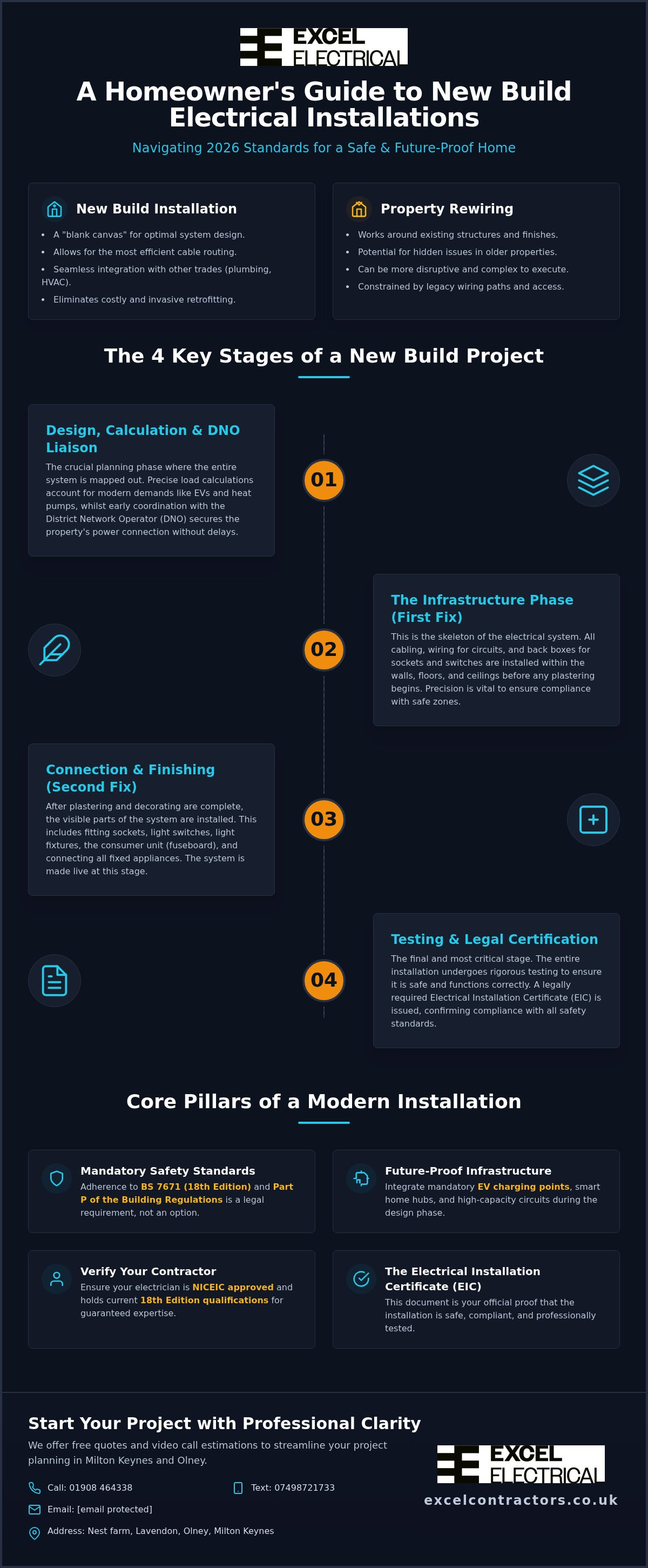
The timeline for a successful electrical installation for new builds is a multi-phase process that requires meticulous coordination with other trades. It begins long before the first wire is pulled. We initiate contact with the District Network Operator (DNO) to manage the new connection, ensuring the site has adequate power capacity. In areas like Buckinghamshire, managing DNO lead times is critical to avoiding delays during the early groundworks phase. This systematic approach ensures that the infrastructure is ready the moment the building becomes weather-tight.
Modern construction methods, such as timber-frame or Structural Insulated Panels (SIPs), demand a specialised "chase-free" installation technique. Unlike traditional masonry, these builds rely on dedicated service voids. Our electricians ensure that no structural or thermal barriers are compromised whilst adhering to the National Electric Installation Standards (NEIS) for safety and precision. The transition between construction phases must be managed with a steady hand to maintain the integrity of the building's envelope and ensure a seamless handover between trades.
First Fix: The Infrastructure Phase
First fix is the skeleton of your electrical system. This phase involves installing all cabling, back boxes, and basic circuit routing before the walls are plastered. Precision is vital here. We coordinate closely with your builder to ensure all cable runs follow designated safe zones and regulatory depths. This prevents future accidents and ensures that the house remains compliant with all safety standards. It's the point where we lay the groundwork for your future-proofed tech, including network cabling and dedicated circuits for high-load appliances. If you're at this stage, our domestic electrical services team at Excel Electrical can provide a technical review of your plans.
Second Fix: Finishing and Functionality
Once the plastering is complete and the building is decorated, we move to the second fix. This is where we fit the sockets, switches, and light fittings that define the aesthetic of your home. We also install the consumer unit, which serves as the control centre for the entire property. For modern homes, we often specify consumer unit upgrades that include Surge Protection Devices (SPD) and Arc Fault Detection Devices (AFDD) as standard. This phase also includes connecting specialist systems like underfloor heating and smart thermostats, ensuring everything is fully operational before final testing.
Excel Electrical is located at Nest farm, Lavendon, Olney, Milton Keynes. For detailed enquiries or to discuss your build timeline, call 01908 464338 or text 07498721733. You can also reach us via email at [email protected]. We provide free quotes and video call estimations to help you plan your project with confidence and technical accuracy.
Compliance, Safety Standards, and Certification
For every electrical installation for new builds, compliance with Part P of the Building Regulations is a statutory requirement that cannot be overlooked. Part P ensures that all electrical work in a dwelling is designed and installed to protect residents from fire or electric shock. Upon completion of the project, we provide an Electrical Installation Certificate (EIC). This document is the primary evidence that the system was constructed and tested to the BS 7671 standards. It's a critical asset for your property's legal records, essential for securing insurance and facilitating any future sale of the home.
Choosing an NICEIC Approved Contractor provides an unwavering layer of security for your investment. This accreditation involves annual assessments of our technical competence and site workmanship, ensuring we stay at the forefront of industry safety. Our TrustMark registration further reinforces our commitment to consumer protection and high-end service. These rigorous UK credentials align with the core principles of safety found in international benchmarks like the OSHA electrical standards, which prioritise systematic risk management and technical accuracy in every installation.
Mandatory Electrical Testing and Inspection
Before a new build can be handed over, it must undergo a series of rigorous tests. We perform "dead testing" to check circuit continuity and insulation resistance whilst the power is off, followed by "live testing" to verify polarity and earth fault loop impedance. It's vital to understand that an EIC is for brand-new installations, whereas an EICR (Electrical Installation Condition Report) is used to assess the safety of existing systems. We manage the entire notification process to Local Authority Building Control (LABC), ensuring your project is fully registered and compliant without administrative burden on your part.
Fire Safety and Smoke Alarms
Current UK regulations mandate the installation of mains-powered, interlinked smoke and heat detectors throughout the property. These must be strategically placed in hallways, landings, and high-risk areas like kitchens to ensure an early warning system is audible in every room. In 2026, residential fire detection standards require that all new dwellings utilise Grade D1 or D2 systems with tamper-proof lithium battery backups to guarantee protection during power interruptions. This methodical approach to fire safety is a cornerstone of our domestic electrical services.
Excel Contractors is located at Nest farm, Lavendon, Olney, Milton Keynes. If you have enquiries about compliance for your upcoming project, call 01908 464 338 or text 07498721733. You can also email us at [email protected]. We provide free quotes and video call estimations to ensure your new build project begins with a clear, compliant, and professional plan.
Future-Proofing: Smart Homes and EV Charging
Designing an electrical installation for new builds in 2026 requires looking far beyond the immediate needs of a moving-in day. A modern property must serve as a high-performance energy hub. With the introduction of Part S of the Building Regulations, every new home with associated parking in England is now legally required to have an EV charging point installed. Integrating this infrastructure at the design stage, rather than as an afterthought, ensures that the main supply and distribution board are correctly rated for high-load equipment. We ensure your home is "EV Ready" from the ground up, avoiding the need for invasive surface-mounted conduit later.
Smart home features are no longer luxury add-ons; they are standard expectations for 2026 construction. We prioritise the installation of structured data cabling, such as Cat6 or Cat7, alongside traditional power circuits. Whilst wireless technology has improved, a hardwired network remains the only way to guarantee the stability required for 4K streaming, home offices, and automation hubs. We also plan for the seamless integration of solar PV and battery storage. By ensuring the distribution board is configured for bi-directional energy flow, we make it simple to add renewable technology without requiring a complete system overhaul.
EV Charger Installation for New Properties
Calculating the impact of an electric vehicle charger is a critical part of the initial load assessment. A standard 7kW smart charger adds a significant constant load to the main fuse capacity. If you require a 22kW rapid charger, the property may even require a three-phase supply. We determine the optimal placement for external charging points during the first fix, ensuring that cabling is neatly concealed within the building fabric. Using OZEV-compliant smart chargers allows you to manage energy consumption effectively, taking advantage of off-peak tariffs to reduce long-term running costs. For expert advice on your green energy needs, you can explore our ev charger installations services.
Modern Consumer Units and Surge Protection
The consumer unit is the brain of the home, and its specification has changed significantly under the latest regulations. Surge Protection Devices (SPDs) are now a mandatory requirement to protect sensitive electronic equipment from voltage spikes. We always design systems with "spare ways" in the consumer unit. This allows for future expansion, such as adding a loft conversion or an air-source heat pump, without needing to replace the entire board. When planning your budget, it's helpful to understand the cost considerations for high-end fuse boxes to ensure you are investing in a system that offers both safety and longevity.
Excel Contractors operates from Nest farm, Lavendon, Olney, Milton Keynes. To discuss how we can future-proof your new build, call 01908 464 338 or text 07498721733 for enquiries. Our team provides free quotes and the option for video call estimations to streamline your project planning. You can also reach us via email at [email protected].
Choosing the Right Contractor for Your New Build
Selecting a partner for an electrical installation for new builds requires more than just a review of basic estimates. You need a contractor who understands the regional infrastructure of Milton Keynes, Olney, and Newport Pagnell. Local expertise is invaluable when coordinating with District Network Operators (DNOs) like UK Power Networks. We understand the specific response times and connection requirements across Buckinghamshire, which prevents unnecessary delays during the groundworks phase. A contractor with deep roots in the community provides a level of accountability and accessibility that national firms often lack.
Credentials should be your first point of verification. It's essential to hire an 18th Edition qualified electrician who is fully conversant with the 2026 "Orange Book" updates. Beyond basic qualifications, look for experience in luxury domestic electrical services. High-end builds often involve complex lighting controls, integrated audio-visual systems, and sophisticated automation that standard contractors might find overwhelming. A transparent, itemised quote is the hallmark of a professional service. It should clearly outline the scope of work, from the initial mains connection to the final testing and certification, without hidden fees.
The Excel Electrical Approach to New Builds
We pride ourselves on methodical project management and formal communication. Our office is located at Nest farm, Lavendon, Olney, Milton Keynes, which allows us to provide face-to-face consultations for local developers and self-builders. We understand the pressures of a modern construction schedule. To make the estimation process as efficient as possible, we offer free quotes and the option for video call estimations. This allows us to review your site progress or architectural plans remotely and provide technical advice whilst keeping your project on track. Our disciplined approach ensures that every electrical installation for new builds we undertake is delivered with precision and technical accuracy.
Next Steps for Your Electrical Project
To begin your project, we recommend gathering your architectural floor plans and any preliminary lighting designs. This documentation allows us to conduct a thorough initial review and identify potential infrastructure needs, such as high-capacity circuits for heat pumps or EV chargers, before the first fix begins. We can then schedule a site visit or a detailed video call to discuss your specific requirements. Whether you are building a single bespoke home or a larger development, we provide the steady hand and professional expertise needed for a compliant, future-proof system.
For professional enquiries, call 01908 464 338 or text 07498721733 for a free, no-obligation quote. You can also email your plans to [email protected] or visit us at Nest farm, Lavendon, Olney, Milton Keynes to discuss your infrastructure needs in detail. Our domestic electrical services team is ready to ensure your new build project is safe, certified, and built to the highest industry standards.
Secure the Future of Your New Build Project
Designing a compliant electrical installation for new builds in 2026 requires a disciplined approach to safety and infrastructure. By prioritising 18th Edition compliance and integrating smart technology from the earliest design stages, you ensure your property remains functional and valuable for decades. We have examined how meticulous planning, rigorous testing, and the right certification provide the essential foundation for any modern home. These steps are vital for long-term reliability and peace of mind.
Excel Contractors is your reliable partner for high-end domestic installations. As an NICEIC Approved Contractor and TrustMark registered business, we specialise in 18th Edition compliance and future-proofed systems. We operate from Nest farm, Lavendon, Olney, Milton Keynes, and serve clients across the surrounding counties with unwavering professional competence. Our team prioritises technical accuracy and clear communication throughout every phase of the build.
To begin your journey toward a safe and certified home, request a free quote for your new build electrical project today. You can call 01908 464 338, text 07498721733, or email [email protected] for enquiries. We also offer video call estimations to streamline your planning process. We look forward to helping you build a home that is both safe and technically advanced.
Frequently Asked Questions
Do I need a specific electrician for a new build property?
Yes, you must employ an electrician who is registered with a competent person scheme, such as an NICEIC Approved Contractor. This ensures the individual is qualified to the 18th Edition (BS 7671:2018+A4:2026) standards and can self-certify that the work complies with Part P of the Building Regulations. Using an uncertified contractor often leads to additional costs and delays, as the local authority must then inspect the work manually.
How long does a full electrical installation take for a new four-bedroom house?
A standard electrical installation for new builds typically requires 10 to 15 working days to complete. This timeline is divided into two distinct phases: the first fix usually takes 5 to 7 days, while the second fix and final certification require another 5 to 8 days. Factors such as the complexity of smart home automation and the efficiency of site coordination with other trades can influence these durations.
What is the difference between First Fix and Second Fix in electrical work?
First fix refers to the installation of the internal infrastructure, including routing cables and fitting back boxes before the walls are plastered. Second fix occurs after the internal surfaces are finished, involving the installation of all visible components like sockets, switches, and light fittings. The consumer unit is also connected during this stage, followed by rigorous live and dead testing to ensure the system is safe for use.
Is an EV charger mandatory for all new build homes in 2026?
Yes, under Part S of the Building Regulations, every new-build home with associated parking in England must have a smart EV charging point installed. This requirement has been in force since June 2022 to support the transition to electric vehicles. We integrate these chargers into the initial design of the electrical installation for new builds to ensure the main supply can accommodate the additional 7kW or 22kW demand.
What certificates should I receive after my new build is wired?
Upon completion, you should receive an Electrical Installation Certificate (EIC) and a Building Regulations Compliance Certificate. The EIC is a technical document proving the installation meets BS 7671 safety standards, whilst the compliance certificate confirms the work was officially notified to the local authority. These documents are essential for your property's legal records and will be required by insurers and future buyers.
Can I change my lighting design after the First Fix is completed?
Changes can be made after the first fix, but they are often invasive and costly. Since cables are already secured behind plastered walls, moving a light fitting or switch usually requires cutting into the finished surfaces and rerouting the wiring. We strongly advise finalising your lighting and socket layout during the initial design phase to ensure the project remains on schedule and within budget.
Do new build electrical installations require a surge protection device (SPD)?
Yes, Surge Protection Devices are now a mandatory requirement under the current 18th Edition Wiring Regulations for all new domestic installations. These devices are installed within the consumer unit to protect sensitive electronics, such as smart hubs and home appliances, from transient overvoltages. We include SPDs as a standard feature in our new build projects to provide maximum protection for your investment.
How do I get a quote for a new build electrical project in Milton Keynes?
You can obtain a detailed, transparent quote by contacting Excel Contractors at our office at Nest farm, Lavendon, Olney, Milton Keynes. Call 01908 464 338 or text 07498721733 to discuss your project requirements. We provide free quotes and the option for video call estimations, allowing us to review your architectural plans and provide a technical assessment without needing an immediate site visit.


